Posts Tagged: shamanic healing


Autumn Equinox: A Shamanic Journey into the Dark
To listen to this article on YouTube go here: https://youtu.be/wxg658c81Rw
On 23 September, we reach the Autumn Equinox: a turning point in the year when day and night come close to balance and the long, expansive days of summer begin to give way to the darker months.
There is something unmistakable about this time of year. The quality of the light changes, mornings become cooler, fruits ripen, and leaves begin to change colour and fall from the trees. The natural world starts withdrawing its energy from outward growth.
To modern eyes, autumn can sometimes appear to be a season of decline. Yet nature does not treat autumn as a failure. It is simply another part of the cycle.
In the shamanic tradition in which I work, the Medicine Wheel offers a way of understanding these cycles, not only in nature but within our own lives. The wheel teaches us that there is a time for birth, a time for growth, a time for harvest and release, and a time for rest and renewal.
The Autumn Equinox brings us particularly into the medicine of the West: the place of harvest, sunset, pruning, release and preparation for winter.
But there is another aspect of the Medicine Wheel that I find especially helpful. We are not necessarily in the same season in every part of our lives.
The Medicine Wheel and the Seasons of Life
The Medicine Wheel is a symbolic representation of the cycles through which life continually moves. In the tradition I was taught, the East corresponds with spring, sunrise, birth, planting seeds, setting intentions and new beginnings. It is the place of potential, when something new is brought into being and needs our care and attention.
The South corresponds with summer and growth towards maturity. The seed has germinated, and the plant is growing, flowering and producing buds and unripe fruit. This is the expansive part of the cycle, but discernment is still needed. Just as we weed a garden, we decide what deserves our continued energy and what needs to be removed so that something else can flourish.
The West corresponds with autumn and sunset. Here we reap what we have sown, gather what is valuable, store our reserves and begin pruning back what is no longer required. It is simultaneously a time of harvest and celebration and a time of preparing ourselves for winter.
Finally, the North corresponds with winter. This is the place of hibernation, healing, rest, rejuvenation and going within. Although there may appear to be stillness externally, internally another kind of growth is taking place. The ground is being prepared for the next spring.
We can see this wheel turning continuously in nature, but the same pattern also appears in our relationships, careers, creative work, personal healing and spiritual development.
What Season Are You In?
One of the most useful things about the Medicine Wheel is that it allows us to ask a different question about our lives. Instead of immediately asking, What is wrong?, we can ask, What season am I in?
We can then go further and ask what season we are experiencing within each particular aspect of our lives, because our lives rarely move around the Medicine Wheel as a single unit.
We might be experiencing spring in our work because we have just begun a new project. At the same time, a relationship may be in summer: flourishing, deepening and asking to be nurtured. Another aspect of our lives might already have entered autumn, where we are beginning to recognise that something has given us everything it can and we need to decide what we wish to take from the experience before releasing it.
Somewhere else we might be in winter, requiring solitude, healing and rest. We can therefore be standing in several different places on the Medicine Wheel at the same time.
Recognising the season can change how we respond to what is happening. Many difficulties arise because we try to force something to remain in a season that has already passed. We try to keep harvesting from soil that needs to rest, attempt to make something flower before its roots are established, cling to autumn leaves when they are ready to fall, or immediately plant something new because we are frightened of the stillness of winter.
Nature does not make these mistakes. The tree does not demand that January resemble June.
The Medicine of the West
Autumn belongs to the West on the Medicine Wheel, and its medicine is not simply about endings. It begins with harvest.
Before we decide what needs to leave our lives, the West invites us to recognise what has already been created. What have we grown this year? What has reached maturity? What have we learnt? Which relationships have nourished us? What challenges have revealed something important about ourselves? What have we achieved that we have barely paused to acknowledge?
In our culture, we can become so focused upon the next goal that we forget to harvest the one we have already reached. Autumn reminds us to stop and gather.
Autumn is both a time of celebration and feast and a time of preparation for the winter ahead. We take what nourishes us forward, and then we begin to prune.
Look at a tree in autumn. It does not attempt to save every leaf. The leaves have performed their purpose. Their work is complete. As the tree withdraws its energy, they change colour and eventually return to the earth. The tree remains.
There are times when healing asks us to do something similar. We may need to release an old agreement about ourselves, recognise that a pattern of behaviour which once protected us is now restricting us, or accept that a relationship has completed its cycle. An identity we once needed may no longer fit the person we are becoming. Sometimes we are simply carrying too much.
There is an important difference between rejecting the past and releasing it. The Medicine Wheel suggests that we first take the harvest. We gather the wisdom from an experience before deciding what we no longer need to carry.
Then we let the leaves fall.
Autumn, Healing and Letting Go
In shamanic healing, I work with the deeper energetic and spiritual patterns underlying our experiences. This can include restoring lost life-force energy, clearing blockages and working with agreements and belief patterns that may continue to influence our behaviour long after the circumstances in which they developed have passed.
The Medicine Wheel can therefore offer a useful way of understanding healing itself. Sometimes healing requires the medicine of the East because something new needs to be born. At other times it requires the South because something new needs to be nurtured and strengthened. Sometimes we need the West because something must be harvested, understood and released. And sometimes we need the North because there is nothing more to do. We need to rest, integrate and allow healing to take place.
This can be particularly revealing when we consider our relationships. Some relationships are in spring: new, tentative and full of possibility. Others have reached summer and are growing into something deeper. But sometimes a relationship enters autumn.
That does not necessarily mean it must end. Autumn may simply mean that something within the relationship needs to be harvested, reassessed or pruned. Old ways of relating may need to change, agreements may need to be reconsidered, and boundaries may need to become clearer. Sometimes, however, the relationship itself has completed its natural cycle.
After a relationship has ended, there can be value in allowing ourselves to consider what worked, what did not and what our own behaviour contributed before planting the seeds of another relationship.
There is wisdom in not rushing straight back to spring.
A Journey into the Dark
The Autumn Equinox does not yet bring us fully into winter. It points towards it. Autumn is preparation.
The nights become longer, activity in the natural world begins to contract and energy moves away from outward growth. We begin travelling towards the medicine of the North.
Winter, in the Medicine Wheel, is associated with rest, healing, rejuvenation and going within. I particularly like to think of this as stillness on the outside with movement on the inside.
This is why I do not see our journey into the darker months as something inherently negative. Darkness has its own medicine. Seeds germinate beneath the soil, roots deepen underground, animals hibernate, and human beings dream. Things happen in darkness that cannot happen in full sunlight.
Stillness also has an important place within the Medicine Wheel. Stillness and balance work together. Through stillness we can find our centre, while greater balance allows us to become still.
The journey into darkness can therefore also be a journey towards ourselves.
One of my favourite images within the Medicine Wheel is what happens to the things we release. The fallen leaves eventually become compost, returning their nutrients to the earth and helping to create the fertile ground from which new life will emerge.
The ending becomes nourishment. Nothing needs to be wasted.
Even difficult periods of our lives can eventually become part of the soil from which something new emerges. The relationship that ended may teach us what we truly need from love. The career that collapsed may lead us towards work that is more aligned with who we have become. The boundary we finally learnt to establish may transform every relationship that follows.
The person we once were does not have to be erased. That person becomes part of the soil.
An Autumn Equinox Medicine Wheel Practice
Around the Autumn Equinox, find somewhere quiet where you can sit undisturbed. If possible, go outside and spend some time with the land. You might light a candle, smudge your space, drum or simply sit quietly.
Draw a circle and divide it into four sections representing the four directions of the Medicine Wheel. In the East, consider what is beginning in your life and the seeds you are planting. In the South, consider what is already growing and deserves your continued care and energy.
When you reach the West, spend some time considering your harvest. What has this year given you? What wisdom can you take from your experiences? What has reached maturity? What needs pruning, and what are you ready to release?
Finally, turn to the North. Ask yourself what needs to rest. Where do you need healing, quietness or contemplation? Is there anything you are trying to solve immediately that might instead need time?
Then look at the whole wheel. You may discover that different areas of your life sit in completely different places. Allow that to be so.
Ask yourself one final question: Where am I trying to force something into a season that it is no longer in?
Do not rush to answer. Sometimes the most valuable part of the practice is simply becoming still enough to hear what we already know.
Moving with the Wheel
The Autumn Equinox reminds us that balance does not mean remaining unchanged. Nature’s balance is found through movement. Light becomes darkness and darkness eventually becomes light again. Spring becomes summer, summer becomes autumn, autumn becomes winter, and winter eventually returns us to spring.
Shamanism teaches us to recognise these natural rhythms and to bring ourselves back into right relationship with them. There will be times to plant and times to grow. There will be times to celebrate what we have created and times to prune and release. There will also be times when the wisest thing we can do is become quiet.
The tree does not mourn every falling leaf or mistake its bare branches for failure. It withdraws, rests and trusts the cycle.
Perhaps the invitation of the Autumn Equinox is to do the same: to recognise where we are on our own Medicine Wheel, honour the medicine of the season we have entered, and trust that the darkness is not the end of the journey.
It is part of the wheel.
Shamanic Healing
If you are presently experiencing an ending, or feel that something in your life is ready to fall away, Shamanic Healing can support you through this period of transition.
Sometimes we know that an old relationship, behaviour, belief, agreement or way of being no longer serves us, yet we find it difficult to release the energetic patterns that keep us connected to it.
Through Shamanic Healing, we can work with what is ready to be cleared or released, restore lost life-force energy and create space for the next part of your cycle to emerge. Like the autumn tree, we do not need to know exactly what the next spring will bring before we allow the old leaves to fall.
If you feel that you have reached such a turning point in your own life, you can find out more about how I work and the Shamanic Healing sessions I offer here: https://www.roseautumn.com/shamanic-healing/
Shamanic Healing: Ancient Traditions & Modern Practice
To listen to the audio recording of this article, go here: https://youtu.be/56VWfE9qMco
Shamanic practices are among the oldest known forms of spiritual practice and healing.[1] Long before the development of modern medicine or organised systems of psychotherapy, people sought healing through their relationships with nature, ceremony, altered states of consciousness, ancestors, and the spirit realm.
Shamanic traditions have developed among peoples in widely separated parts of Mother Earth, while the practices themselves have been transmitted through generations in many different cultural forms. Rather than representing a single religion or uniform system of belief, shamanic practice encompasses diverse traditions connected by recurring relationships between healing, the natural environment, altered states of consciousness, and the spirit realm.
Shamanic Healing as it is practised today has nevertheless changed considerably. Understanding where these practices came from, and how they have developed, is important not only for practitioners, but also for anyone considering Shamanic Healing.
Where Did Shamanic Healing Originate?
Shamanic Healing did not begin with a single historical moment, nor was there originally one universal system called shamanism.
The word “shaman” most probably derives from the Tungus-speaking Evenki people of northern Siberia. The Evenki term saman referred to a particular spiritual practitioner within the community.[2] The much broader application of the terms “shaman” and “shamanism” to comparable spiritual practitioners and practices in cultures across Mother Earth developed subsequently.
Practices that scholars have described as shamanic have been identified within numerous cultures. These traditions have taken different forms, reflecting the beliefs, environment, ancestors, and spiritual understanding of individual peoples.
Despite these differences, certain practices and characteristics recur across a number of traditions. These can include altered states of consciousness, communication with spirits, healing, divination, ceremony, and relationships with the natural and spiritual realms.[2]
It is therefore important not to treat the many indigenous traditions now described collectively as “shamanism” as though they constituted a single historical religion or spiritual system.
The Traditional Role of the Shaman
Traditionally, shamanic practitioners were usually embedded within their communities. Their responsibilities could extend considerably beyond anything we would now recognise as the role of a therapist.
Depending upon the particular culture, the practitioner might undertake healing, divination, ceremony, communication with ancestors or spirits, guidance for the community, and the identification of spiritual causes of illness or misfortune.[2]
Shamanic practice was therefore not simply a collection of healing techniques. It formed part of a wider relationship between the individual, the community, the natural environment, and the spirit realm.
This distinction becomes particularly important when considering how Shamanic Healing has developed in the modern Western world.
The Development of Modern Shamanic Practice
During the twentieth century, the work of anthropologists, researchers, and writers brought greater awareness of indigenous shamanic traditions to Western audiences.
One particularly influential writer was the historian of religions Mircea Eliade. His Shamanism: Archaic Techniques of Ecstasy, first published in French in 1951 and translated into English in 1964, had a major influence upon both academic and popular understandings of shamanism. Eliade placed particular emphasis upon ecstatic states and the spiritual journeys undertaken by shamans.[3]
Another particularly influential figure was the American anthropologist Michael Harner. Harner began studying indigenous cultures during the 1950s and subsequently undertook fieldwork among the Shuar of Ecuador and the Conibo of the Peruvian Amazon. He began teaching shamanic methods to small groups in the United States during the early 1970s.[4]
Harner eventually developed what became known as Core Shamanism. Rather than attempting to reproduce one particular indigenous tradition, he sought to identify what he regarded as universal, near-universal, or commonly occurring elements within shamanic traditions. These included the shamanic journey and the use of repetitive drumming to facilitate an altered state of consciousness.[5]
In 1979, Harner established the Centre for Shamanic Studies. His influential book The Way of the Shaman appeared in 1980, and the Foundation for Shamanic Studies subsequently developed from his work.[4][6][7]
This approach had an enormous influence upon the development of contemporary Western shamanic practice.
Shamanic techniques consequently became accessible to people who had not inherited them through membership of a traditional shamanic culture. Contemporary Shamanic Healing may now be encountered through individual healing sessions, workshops, training courses, retreats, shamanic circles, and other forms of spiritual practice.
Shamanic Healing in the Twenty-First Century
The development of contemporary Shamanic Healing has also created important questions about how these practices should be approached.
There is an important distinction between indigenous shamanic traditions and contemporary Western shamanic practice. A traditional practitioner exists within the particular spiritual, cultural, and social context of a community. A contemporary Western practitioner may learn and work with shamanic techniques without possessing that inherited cultural role. For this reason, I describe myself as a Shamanic Practitioner rather than claiming the traditional cultural role of a Shaman.
Understanding the history of these practices encourages me to approach Shamanic Healing with respect, humility, and an awareness that the techniques I practise have a much longer history than the contemporary therapeutic environment in which I offer them.
It also raises important questions about cultural appropriation. Contemporary practitioners need to consider where particular teachings, ceremonies, terminology, and objects originate, and whether adopting culturally specific practices without their original context is appropriate.
Core Shamanism represents one response to this problem. Harner deliberately sought to distinguish what he considered the underlying methods of shamanism from ceremonies and cultural practices specific to individual indigenous peoples.[5]
Whatever approach a practitioner follows, understanding the provenance of a practice is an important part of practising responsibly.
Ancient Principles in a Modern Practice
Respecting the origins of shamanic traditions does not mean that Shamanic Healing must remain unchanged.
Spiritual traditions have always existed within particular communities and environments. As circumstances change, how people encounter and practise spiritual healing can change as well.
In my own practice, I work with principles and techniques including shamanic journeying, drumming, spiritual connection, intention, ceremony, energy healing, and relationship with Mother Earth. My Shamanic Healing work may also include Power Animal Retrieval, Soul Retrieval, Cord Cutting, Shamanic Extraction, Changing Agreements, Psychopomp, and Spiritual Parasite or Entity Removal.
At the same time, I believe it is important to distinguish between working with shamanic principles and simply reproducing ceremonies belonging to cultures other than my own.
This allows contemporary Shamanic Healing to develop while maintaining respect for the traditions from which much of our knowledge has emerged.
Continuing to Learn
Training as a Shamanic Practitioner is not the end of the learning process.
My practice continues to develop through research, personal spiritual practice, experience of working with clients, reflection upon the provenance of particular practices and terminology, and continued exploration of different shamanic traditions.
For me, understanding the history of Shamanic Healing is therefore not simply an academic exercise: it influences how I practise.
The further we explore the history and cultural context of shamanic practices, the better equipped we are to distinguish between ancient traditions, modern interpretations, and our own direct spiritual experience.
Shamanic Healing continues to evolve. My intention is to allow my own practice to evolve with it, while maintaining respect for its history, its cultural significance, and the relationship between human beings, the spirit realm, and Mother Earth.
About Rose
Rose is a Shamanic Practitioner offering in-person and distance Shamanic Healing Sessions and Shamanic Life Coaching, specialising in narcissistic abuse.
Rose works without hallucinogenic or psychedelic plant medicines. Instead, she uses an ancient drumming method to access this altered state of consciousness. A session may include a tailored combination of Power Animal Retrieval, Divination, Soul Retrieval, Energy Body Healing, Psychopomp, and Extraction to remove negative energy and blockages.
Each session with me includes Shamanic Subconscious Repatterning. A powerful system that changes the subconscious programmes that drive unwanted behaviour. This method heals trauma at its source, removes the self-limiting programme, and then rewrites a new way of being.
Shamanic Healing can be accessed face-to-face in the Rose Healing Room, Petersfield, East Hampshire or remotely through Distance Healing Sessions. Because the work is carried out in the Spirit Realm with the support of Rose’s Spirit Guides, the client does not need to be physically present in the same room. Distance sessions are narrated in real time, and clients receive an audio recording by email afterwards.
For further information about Shamanic Healing, go to: https://www.roseautumn.com/shamanic-healing/
References
[1] Pollock, Donald, “Shamanism”, Oxford Bibliographies in Anthropology, Oxford University Press, first published 26 October 2015, revised 19 February 2019. Pollock describes shamanism as having been regarded as one of the world’s oldest religions and records evidence associated with shamanic practice in Palaeolithic cave art. See also Manvir Singh, “The Cultural Evolution of Shamanism”, Behavioral and Brain Sciences, vol. 41, 2018, e66, which describes shamanism as an ancient human institution, records its presence among nearly all documented hunter-gatherer societies, and concludes that it probably characterised the religious lives of many ancestral human populations. https://academic.oup.com/reference/62334/reference-article-abstract/554065193 https://pubmed.ncbi.nlm.nih.gov/28679454/
[2] Cox, James L., “Shamanism”, in Adam Possamai and Anthony J. Blasi (eds.), The SAGE Encyclopedia of the Sociology of Religion, SAGE Publications, 2020, pp. 747–748. Cox discusses the probable derivation of the term shaman from the Tungus-speaking Evenki people of northern Siberia, the traditional role of the practitioner, and the subsequent development of the broader concept of shamanism. https://researchers.westernsydney.edu.au/en/publications/shamanism/
[3] Eliade, Mircea, Shamanism: Archaic Techniques of Ecstasy, translated from the French by Willard R. Trask, Bollingen Series LXXVI, Princeton University Press, Princeton, 1964. Originally published in French as Le Chamanisme et les techniques archaïques de l’extase, Payot, Paris, 1951. Eliade’s comparative study placed particular emphasis upon ecstasy and the spiritual journey and became one of the most influential twentieth-century studies of shamanism. https://press.princeton.edu/books/paperback/9780691210667/shamanism
[4] Foundation for Shamanic Studies, “Michael Harner, PhD”. Harner studied with the Shuar in Ecuador and the Conibo of the Peruvian Amazon, began teaching shamanic methods during the early 1970s, founded the Center for Shamanic Studies in 1979, and subsequently established the Foundation for Shamanic Studies. https://www.shamanism.org/michael-harner/
[5] Foundation for Shamanic Studies, “About the Foundation for Shamanic Studies”. The Foundation describes Core Shamanism as Harner’s system based upon what he identified as universal, near-universal, and common features of shamanism, distinguished from the culturally specific ceremonies of individual indigenous peoples. https://www.shamanism.org/about/
[6] Harner, Michael, “The History and Work of the Foundation for Shamanic Studies”, Shamanism, Journal of the Foundation for Shamanic Studies, originally published 1991; revised and republished 2005. Harner describes the development of his practice, his teaching workshops from the early 1970s, the development of Core Shamanism, the establishment of the Center for Shamanic Studies, and the publication of The Way of the Shaman in 1980. https://www.shamanism.org/articles/the-history-and-work-of-the-fss/
[7] Harner, Michael, The Way of the Shaman: A Guide to Power and Healing, Harper & Row, New York, 1980; revised edition, HarperSanFrancisco, 1990.

What is Shamanic Healing?
Shamanic healing is one of the oldest healing practices on Earth, yet many people are still unfamiliar with what it involves or how it works.
In my new video, What Is Shamanic Healing?, I explain how shamanic healing works with the deeper energetic and spiritual causes of imbalance and how it may support people who feel stuck, disconnected or caught in repeating patterns.
Rather than focusing only on physical, mental or emotional symptoms, shamanic healing considers what may be happening at the level of the spirit.
Repeated experiences of anxiety, fear, depression, illness or unwanted behaviour may sometimes have an energetic or spiritual aspect. There may be blockages within the energy body, lost life-force energy, limiting beliefs or subconscious programmes that continue to shape our lives long after the original experience has passed.
Shamanic healing works with these deeper layers.
Go here to view the video: https://youtu.be/gFccc958T48
Journeying into Non-Ordinary Reality
One of the things that distinguishes shamanic healing from practices such as Reiki or sound healing is that the practitioner enters an altered state of consciousness and journeys into what is often called non-ordinary reality.
Using rhythmic drumming, the practitioner enters a focused and intentional trance state and connects with compassionate spiritual guides, power animals, helpers and teachers.
The practitioner acts as a bridge between ordinary reality and the spirit realm. In traditional shamanic language, this is sometimes described as becoming a hollow bone.
This means that the practitioner is not attempting to direct the healing through personal will, ego or their own energy. The healing is undertaken with the support and guidance of compassionate spirits.
Restoring Balance and Wholeness
A shamanic healing session may involve clearing heavy or negative energy, removing energetic blockages, returning lost power or life-force, restoring spiritual protection or helping someone reconnect with their own inner wisdom and strength.
The aim is always to restore balance, clear what no longer serves and support a deeper return to wholeness.
In my own practice, I work without hallucinogenic or psychedelic plant medicines. I use the ancient method of rhythmic drumming to enter the shamanic state of consciousness safely and intentionally.
Depending upon the needs and intentions of the client, a session may include:
- Power Animal Retrieval
- Divination
- Soul Retrieval
- Energy Body Healing
- Psychopomp work
- Shamanic Extraction
Every session also includes Shamanic Subconscious Repatterning.
This method works with the subconscious programmes that can drive unwanted behaviours, emotional reactions and self-limiting beliefs. It helps to identify the old programme, address the trauma or wound beneath it and repattern a new way of being.
For many people, this is where profound and lasting change can begin.
In-Person and Distance Shamanic Healing
Shamanic healing sessions are available face-to-face in the Rose Healing Room in East Hampshire or remotely through a Distance Healing Session.
Because the healing takes place within the spirit realm, the client does not need to be physically present in the same room.
During a distance session, I undertake the healing remotely and narrate the shamanic journey into an audio recorder in real time. The recording is then sent to the client by email so that they can listen to the journey and understand the healing work that took place.
Whether the session is undertaken in person or at a distance, the work is always carried out with the client’s permission, intentions and highest good at the centre.
The Path of the Wounded Healer
My own approach to shamanic healing is grounded in my personal healing journey.
Like many people who are drawn to this work, my path began through my own experience of deep healing. This is sometimes known as the path of the wounded healer.
Over the past six years, I have completed extensive training, including a 120-hour Shamanic Apprenticeship and further advanced shamanic training. I am also a member of the Federation of Holistic Therapists and fully insured for Shamanic Healing and Shamanic Life Coaching.
Shamanic Healing with Rose
Shamanic healing may be helpful if you feel:
- Stuck in a repeating pattern
- Disconnected from yourself
- Weighed down by old energy
- Unable to change an unwanted behaviour
- Ready for deeper healing and transformation
You can book an in-person Shamanic Healing Session or a Distance Healing Session through my website.
I look forward to co-creating your new way of being with you.
A suitable next step would be to add a brief booking button immediately beneath the embedded video.
About Rose
Rose is a Shamanic Practitioner offering in-person and distance Shamanic Healing Sessions and Shamanic Life Coaching, specialising in narcissistic abuse.
Rose works without hallucinogenic or psychedelic plant medicines. Instead, she uses an ancient drumming method to access this altered state of consciousness. A session may include a tailored combination of Power Animal Retrieval, Divination, Soul Retrieval, Energy Body Healing, Psychopomp, and Extraction to remove negative energy and blockages.
Each session with me includes Shamanic Subconscious Repatterning. A powerful system that changes the subconscious programmes that drive unwanted behaviour. This method heals trauma at its source, removes the self-limiting programme, and then rewrites a new way of being.
Shamanic Healing can be accessed face-to-face in the Rose Healing Room, Petersfield, East Hampshire or remotely through Distance Healing Sessions. Because the work is carried out in the Spirit Realm with the support of Rose’s Spirit Guides, the client does not need to be physically present in the same room. Distance sessions are narrated in real time, and clients receive an audio recording by email afterwards.
For further information about Shamanic Healing, go to: https://www.roseautumn.com/shamanic-healing/
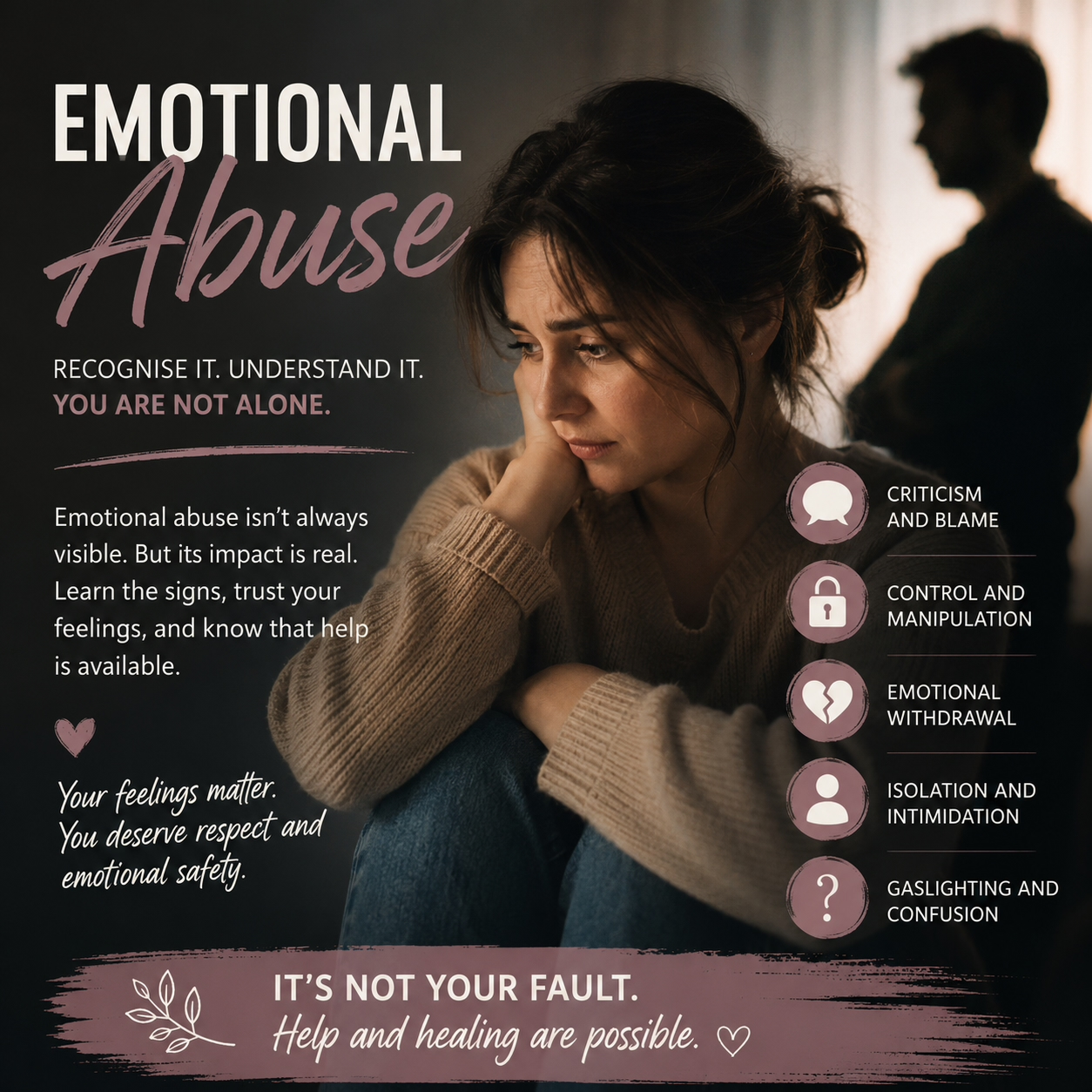
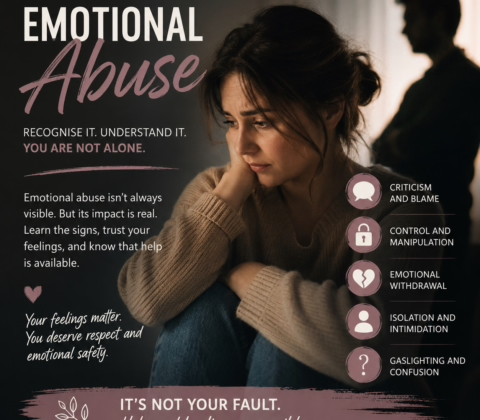
Emotional Abuse
In this article, we will look at what emotional abuse is, how it can show up in everyday relationships, and why it can be so difficult to recognise while it is happening. We will explore common patterns such as criticism, control, gaslighting, blame-shifting, emotional withdrawal, and intimidation, as well as the effect these behaviours can have on a person’s confidence, well-being, and sense of self. The aim is to help readers identify unhealthy dynamics more clearly, trust their own perceptions, and begin thinking about what support, boundaries, or next steps may be needed.
What is Emotional Abuse?
Emotional abuse is a pattern of behaviour to undermine another person’s confidence, independence, and sense of reality. Unlike a normal conflict, emotional abuse is not simply about hurt feelings or disagreement; it is about power and control. Because emotional abuse often happens privately and may be subtle or denied by the person causing harm, it can be difficult to recognise, but its impact can be deeply damaging.
Emotional abuse is best understood as a repeated pattern of behaviour rather than a single isolated incident. The key elements often include power and control, manipulation, criticism, blame, intimidation, emotional withdrawal, humiliation, isolation, and the distortion of reality through gaslighting or denial.
These behaviours may be subtle at first, but over time they can create a relationship dynamic in which the person on the receiving end feels increasingly anxious, confused, ashamed, overly responsible, isolated, diminished, unable to trust their own judgment, or afraid to express their own needs. What makes the behaviour abusive is the way it is used repeatedly to destabilise the other person, reduce their confidence, and keep them emotionally dependent, compliant, or unsure of themselves.
Identifying Emotional Abuse
We can begin to identify emotional abuse by looking less at isolated incidents and more at the repeated emotional pattern of the relationship. Ordinary conflict may involve disagreement, frustration, or hurt feelings, which are quickly resolved through apologies and discussion.
In contrast, emotional abuse tends to leave one person feeling consistently smaller, confused, anxious, guilty, afraid, or responsible for keeping the other person calm.
We may recognise that we are in an emotionally abusive relationship if we notice a repeated pattern in which our confidence, freedom, judgement, or emotional well-being is being worn down. We may feel as though they are constantly walking on eggshells, apologising to keep the peace, doubting our own memory or perception, or changing our behaviour to avoid criticism, anger, sulking, ridicule, or withdrawal.
Signs can include being belittled, blamed, mocked, isolated from friends or family, controlled financially or socially, threatened, intimidated, ignored as punishment, or made to feel “too sensitive” when they try to raise concerns.
A key warning sign is that the relationship no longer feels emotionally safe: instead of feeling respected and able to speak freely, the person feels confused, diminished, anxious, trapped, or afraid of the consequences of being themselves.
The most useful question for the reader is: “Do I feel more like myself in this relationship, or less?” Emotional abuse often creates self-doubt and dependence; coercive control can include isolation, monitoring, threats, financial control, and intimidation, and it is recognised in UK domestic abuse guidance as a serious pattern of harm.
Why is Emotional Abuse Happening?
If we are someone who is naturally happy and who enjoys making friends and spending time with people, we may begin to wonder why emotional abuse can occur. What purpose does it serve in any relationship?
People may become emotionally abusive for different reasons, but the behaviour often has one central function: it gives them power, control, or emotional relief at another person’s expense. Some people have learned these patterns in childhood, some feel deeply insecure or threatened by another person’s independence, and some use blame, criticism, intimidation, withdrawal, or manipulation because they cannot manage their own shame, anger, jealousy, fear, or vulnerability in a healthy way.
Others may have a strong sense of entitlement, a need to dominate, or narcissistic traits that make it difficult for them to take responsibility for the impact of their behaviour.
Whatever the cause, emotional abuse is not caused by the victim, and it should not be excused as stress, love, trauma, or passion. The responsibility remains with the person using abusive behaviour to recognise it, stop it, and seek help if they are unable to change.
Understanding Is Not Excusing
Understanding why someone behaves abusively is not the same as excusing the behaviour. A person may have experienced trauma, insecurity, abandonment, shame, or unhealthy relationship patterns in their own past, but these experiences do not give them the right to control, intimidate, belittle, manipulate, or emotionally harm another person.
Explanations can help us recognise where abusive patterns may come from, but responsibility still belongs to the person choosing those behaviours. This distinction is important because victims of emotional abuse are often encouraged to feel sorry for the abuser, understand their pain, or make endless allowances for their wounds. Compassion may explain someone’s suffering, but it should never be used to minimise the damage they cause or to pressure another person into staying in an unsafe relationship.
What to Do If You Think You Are Being Emotionally Abused
If something does not feel right in a relationship, that concern is worth expressing to a trusted friend or therapist, especially where hurtful behaviour is repeatedly excused or minimised.
If you think you may be in an emotionally abusive relationship, try to take your concerns seriously, even if the other person denies the behaviour or tells you that you are overreacting. Emotional abuse often creates confusion and self-doubt, so it can help to step back and look at the pattern: how often it happens, how it makes you feel, and whether you feel free, safe, respected, and able to be yourself.
You may want to keep a private record of incidents, speak to someone you trust, contact a therapist, GP, or specialist domestic abuse service, and begin thinking carefully about your emotional and practical safety. It is usually safer not to confront an abusive person impulsively, especially if there is intimidation, coercive control, threats, stalking, financial control, or fear of escalation.
Support can help you make sense of what is happening, rebuild trust in your own judgement, and consider your next steps at a pace that feels safe.
Shamanic Healing for Emotional Support
Shamanic healing may assist someone recovering from emotional abuse by helping them reconnect with their own inner strength, intuition, and sense of self after a relationship that has left them feeling diminished, confused, or disconnected. Emotional abuse can affect a person not only psychologically, but also spiritually and energetically, leaving them feeling drained, fragmented, fearful, or unable to trust their own judgement. Within a safe and supportive healing space, shamanic work may help the person release emotional heaviness, restore personal boundaries, recover lost confidence, and begin to feel more grounded in their own body and truth. It offers healing for those seeking to rebuild their energy, reclaim their voice, and move towards a deeper sense of wholeness through Extraction, to remove any darkness, Soul Retrieval, to get your soul parts (life force energy) back from an abuser, and Shamanic Subconscious Repatterning to reprogramme the subconscious from trauma response to a new way of being.
Further Reading
This blog post is part of a recent series exploring my experience of abusive behaviour in daily life:
Read about my experience of one-sided communication here: https://www.roseautumn.com/2026/06/when-someone-talks-at-you/
Read about my experience of emotional dumping here: https://www.roseautumn.com/2026/06/emotional-dumping
Read about my experience of setting boundaries here: https://www.roseautumn.com/2026/06/boundary-setting-reactions/
Read about my experience of gaslighting here: https://www.roseautumn.com/2026/06/gaslighting/
For further information about Shamanic Healing, go to: https://www.roseautumn.com/shamanic-healing/
About Rose
Rose is a Shamanic Practitioner trained in traditional shamanism. She is a member of the Federation of Holistic Therapists and is fully insured for in-person and distance Shamanic Healing sessions, as well as Shamanic Life Coaching. She specialises in supporting people recovering from narcissistic abuse.
Rose works without hallucinogenic or psychedelic plant medicines. Instead, she uses an ancient drumming method to access this altered state of consciousness. A session may include a tailored combination of Power Animal Retrieval, Divination, Soul Retrieval, Energy Body Healing, Psychopomp, and Extraction to remove negative energy and blockages.
Each session with me includes Shamanic Subconscious Repatterning. A powerful system that changes the subconscious programmes that drive unwanted behaviour. This method heals trauma at its source, removes the self-limiting programme, and then rewrites a new way of being.
Shamanic Healing can be accessed face-to-face in the Rose Healing Room, Petersfield, East Hampshire or remotely through Distance Healing Sessions. Because the work is carried out in the Spirit Realm with the support of Rose’s Spirit Guides, the client does not need to be physically present in the same room. Distance sessions are narrated in real time, and clients receive an audio recording by email afterwards.
For further information about Shamanic Healing, go to: https://www.roseautumn.com/shamanic-healing/
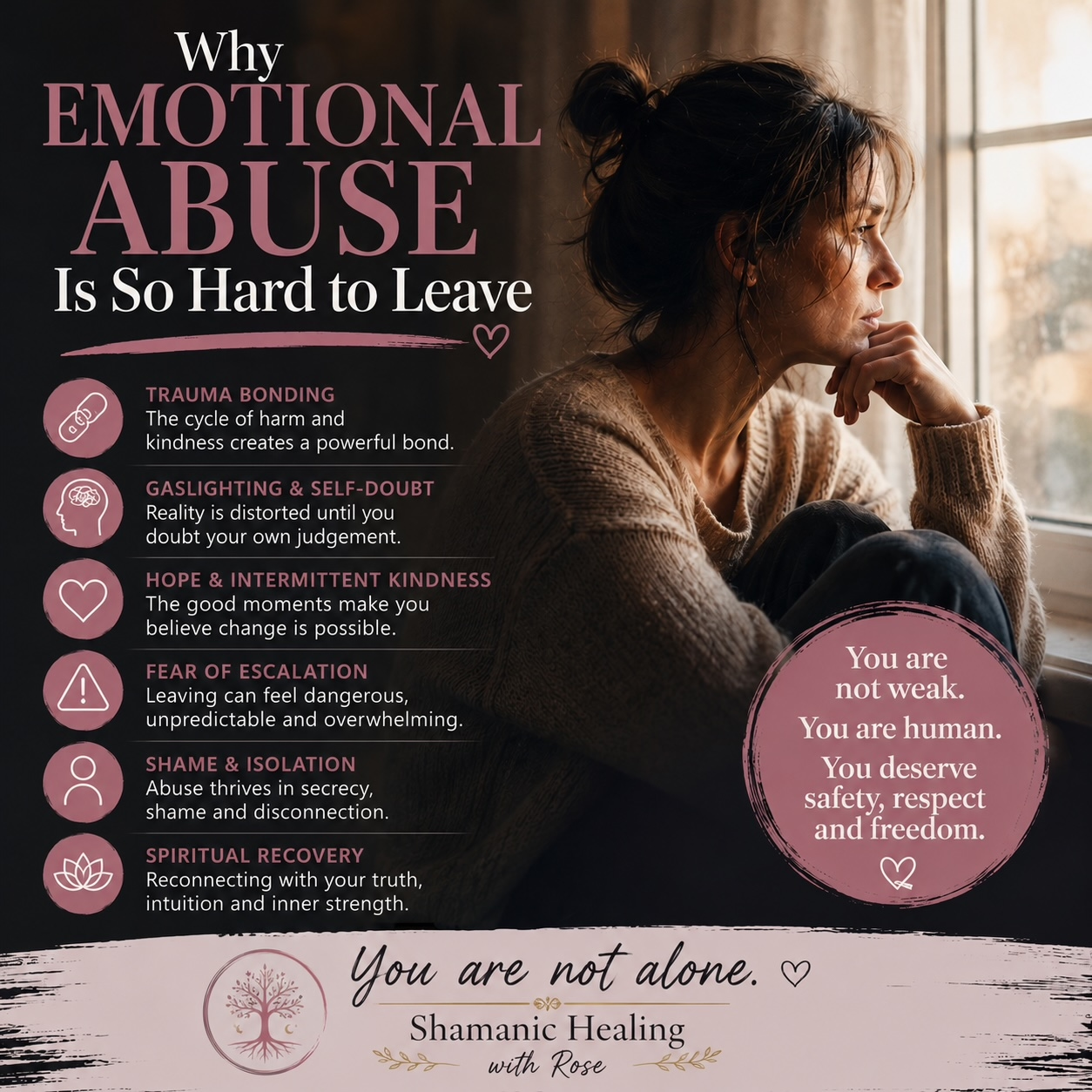
Why Emotional Abuse Is So Hard to Leave
One of the most misunderstood aspects of emotional abuse is why someone stays. From the outside, it may seem obvious that a person should simply leave, but emotional abuse often works by gradually weakening a person’s confidence, clarity, independence, and trust in themselves. By the time they recognise the pattern, they may feel confused, ashamed, frightened, financially trapped, emotionally attached, or responsible for the other person’s well-being. This article explores why emotional abuse can be so difficult to leave, and why compassion, support, and understanding are far more helpful than judgment.
Trauma Bonding
One reason emotional abuse can be so difficult to leave is trauma bonding. This happens when periods of criticism, control, cruelty, withdrawal, or intimidation are mixed with moments of affection, apology, kindness, or apparent remorse. The relationship becomes emotionally unpredictable. One day, the person may feel rejected, blamed, or afraid; another day, they may feel loved, needed, or reassured that things will change.
This cycle can create a powerful attachment. The victim may begin to focus on the good moments and minimise the harm, hoping that the loving version of the person will return permanently. They may believe that if they can just explain themselves better, behave differently, avoid certain topics, or become more understanding, the relationship will improve. Over time, the nervous system becomes caught in a cycle of fear, relief, hope, and disappointment.
Trauma bonding is not a weakness. It is a survival response to an unstable emotional environment. The person may not be choosing the abuse; they may be trying to hold on to the moments of connection that make the relationship feel meaningful. This is why it can be so hard to leave, even when part of them knows that the relationship is damaging them.
Gaslighting and Self-Doubt
Emotional abuse often involves gaslighting, denial, blame-shifting, or the repeated distortion of reality. The person causing harm may insist that the abuse did not happen, that it was not serious, that the victim is too sensitive, too dramatic, unstable, selfish, or imagining things. They may twist conversations, deny what was said, or turn every attempt to raise a concern into an accusation against the victim.
Over time, this can seriously damage a person’s trust in their own judgement. They may start asking themselves: “Am I overreacting?” “Was it really that bad?” “Maybe it is my fault.” “Maybe I am the problem.” This self-doubt can make leaving feel almost impossible, because the person may no longer feel clear enough to trust their own perception of what is happening.
Gaslighting is especially harmful because it attacks the victim’s inner compass. When someone has been repeatedly told that their feelings, memories, and reactions are wrong, they may need time and support to reconnect with their own reality. Leaving an emotionally abusive relationship often begins with the quiet but powerful recognition: “I am allowed to trust what I know. I am allowed to believe my own experience.”
Hope and Intermittent Kindness
Another reason people stay is hope. Emotional abuse is rarely abusive every moment of every day. There may be times when the relationship feels loving, exciting, intimate, or normal. The abusive person may apologise, cry, promise to change, become affectionate, give gifts, or speak about the future in a way that feels convincing. These moments can be very confusing.
Intermittent kindness can make the relationship harder to leave because it gives the victim something to hold on to. They may remember who the person was at the beginning, or who they still seem to be in their better moments. They may believe the abuse is caused by stress, trauma, insecurity, alcohol, work pressure, family problems, or past wounds. They may keep waiting for the “real” person to come back.
This hope is understandable, but it can also keep someone trapped in a painful cycle. A relationship should not require someone to endure repeated harm in exchange for occasional kindness. Genuine change requires responsibility, consistency, accountability, and respect over time. Promises alone are not enough if the same damaging pattern continues.
Fear of Escalation
For some people, leaving does not feel emotionally difficult; it may feel unsafe. Emotional abuse can include intimidation, threats, stalking, financial control, social isolation, coercive control, or the fear that the other person will punish them for trying to leave. Even if there has been no physical violence, the victim may sense that the situation could escalate if they challenge the relationship or try to end it.
This is why it is not always helpful to tell someone to “just leave.” Leaving may involve practical risks around housing, money, children, pets, work, reputation, family pressure, or safety. The person may need to plan carefully, gather support, speak to a trusted friend or professional, and contact a specialist domestic abuse service before making decisions.
If there is any risk of danger, threats, coercive control, or escalation, safety should come first. The priority is not to prove a point to the abusive person or force them to understand. The priority is to protect the victim’s well-being and help them take the next safest step.
Shame and Isolation
Emotional abuse often creates shame. The victim may feel embarrassed that they stayed, ashamed that they tolerated certain behaviour, or afraid that others will judge them. They may worry that people will say, “Why didn’t you leave sooner?” or “Why did you put up with that?” These reactions can make it even harder to ask for help.
Abusive relationships can also become isolating. The person may have been criticised for seeing friends, discouraged from speaking openly, made to feel guilty for having outside support, or slowly cut off from the people who might have helped them see the situation more clearly. Even when friends and family are still present, the victim may hide what is happening because they feel confused, protective of the relationship, or afraid of not being believed.
Shame keeps abuse hidden. Compassion helps bring it into the light. If someone has stayed in an emotionally abusive relationship, it does not mean they are foolish, weak, or responsible for the abuse. It means they have been living inside a dynamic that may have slowly worn down their confidence, clarity, and sense of self. What they need is not judgment, but support, patience, and a safe space to tell the truth.
Spiritual Recovery
Emotional abuse can affect more than the mind. Many people describe feeling as though they have lost themselves. They may feel disconnected from their intuition, their body, their voice, their creativity, their confidence, or their spiritual centre. After living in a relationship where they have been criticised, controlled, blamed, or made to doubt themselves, they may need time to remember who they are outside the abusive dynamic.
Spiritual recovery can involve reconnecting with the self at a deeper level. This may include rebuilding boundaries, listening again to inner guidance, restoring a sense of personal power, and releasing the emotional weight of fear, shame, guilt, or confusion. For some people, therapy, journaling, time in nature, meditation, prayer, creative practice, bodywork, or shamanic healing may help them begin to feel grounded and whole again.
Shamanic healing, in particular, may support someone who feels emotionally fragmented, energetically drained, or disconnected from their own truth. For those who are ready to rebuild their inner strength and reclaim their voice, soul retrieval and Shamanic Subconscious Repatterning will assist, along with extraction.
By extracting any negative residues, one can clear the body and reset the energy body. Soul retrieval will bring back the soul parts (life force energy) stolen by the abuser, reinstalling empowerment and confidence. Shamanic Subconscious Repatterning will rewrite the subconscious programmes so that you can create new, supportive relationships.
Conclusion
Leaving emotional abuse is rarely simple. It can involve trauma bonding, self-doubt, fear, hope, shame, isolation, practical barriers, and a deep emotional attachment to the person causing harm. This is why victims need understanding rather than judgment. From the outside, the answer may seem obvious, but from the inside, emotional abuse can feel confusing, frightening, and painfully difficult to untangle.
If you recognise yourself in this article, try to take your feelings seriously. You do not have to make every decision at once. Begin by noticing the pattern, trusting your own experience, and reaching out for safe, confidential support. Healing starts when you are able to say, even quietly to yourself, “What happened to me matters. My feelings matter. I deserve to feel safe, respected, and free to be myself.”
About Rose
Rose is a Shamanic Practitioner offering in-person and distance Shamanic Healing Sessions and Shamanic Life Coaching, specialising in narcissistic abuse.
Rose works without hallucinogenic or psychedelic plant medicines. Instead, she uses an ancient drumming method to access this altered state of consciousness. A session may include a tailored combination of Power Animal Retrieval, Divination, Soul Retrieval, Energy Body Healing, Psychopomp, and Extraction to remove negative energy and blockages.
Each session with me includes Shamanic Subconscious Repatterning. A powerful system that changes the subconscious programmes that drive unwanted behaviour. This method heals trauma at its source, removes the self-limiting programme, and then rewrites a new way of being.
Shamanic Healing can be accessed face-to-face in the Rose Healing Room, Petersfield, East Hampshire or remotely through Distance Healing Sessions. Because the work is carried out in the Spirit Realm with the support of Rose’s Spirit Guides, the client does not need to be physically present in the same room. Distance sessions are narrated in real time, and clients receive an audio recording by email afterwards.
For further information about Shamanic Healing, go to: https://www.roseautumn.com/shamanic-healing/


How to Avoid Crossing Emotional Boundaries in Conversation
There are times when life becomes painful, confusing, frightening, or overwhelming, and we naturally turn to other people for comfort and perspective. Healthy relationships depend on this kind of sharing. But there is a difference between mutual support and crossing emotional boundaries.
Emotional dumping happens when one person offloads intense feelings, problems, complaints, or distress onto another person without checking whether they have the time, energy, or willingness to receive it. It can also happen when someone dominates a conversation, talks at length without noticing the other person’s responses, or repeatedly uses casual social encounters as an opportunity to process their own emotions.
Most people who do this are not deliberately trying to be unkind. Often, they are lonely, anxious, overwhelmed, or unaware of how much space they are taking up. But even when there is no bad intention, the impact can still be draining for the person on the receiving end.
Learning to respect other people’s conversational and emotional boundaries is an important part of emotional maturity. It allows relationships to feel safer, more balanced, and more genuinely connected.
Ask Before You Offload
One of the simplest ways to avoid crossing a boundary is to ask permission before sharing something heavy.
Instead of launching straight into a painful story or stressful situation, you might say:
“Do you have the headspace for something a bit heavy?”
“Is now a good time to talk about something I’m struggling with?”
“I’d really value your perspective, but I don’t want to overwhelm you.”
“Can I share something, or would another time be better?”
This gives the other person a choice. It shows that you recognise they have their own inner world, their own responsibilities, and their own limits.
If they say they are not available, try not to take it as rejection. A person can care about you and still not be able to hold a difficult conversation at that moment.
Notice the Difference Between Sharing and Dumping
Sharing is relational. It leaves room for the other person.
Dumping is one-sided. It pours everything out without checking what is happening for the listener.
A useful question to ask yourself is:
“Am I having a conversation, or am I using this person as a container for my distress?”
In a healthy conversation, both people have space to speak. There are pauses, questions, responses, and a sense of mutual presence. In emotional dumping, one person may talk for a long time while the other becomes quiet, tired, trapped, or overwhelmed.
If you notice that you have been speaking continuously for several minutes, pause and say:
“I’ve been talking for a while. How are you doing with all this?”
“I don’t want to dominate the conversation.”
“I realise I’ve gone into a lot of detail. Shall I pause there?”
These small moments of self-awareness can make a significant difference.
Watch the Other Person’s Signals
People often communicate discomfort before they say it directly.
They may start giving shorter answers. They may look away, check the time, step backwards, become physically still, or stop asking questions. Their tone may become flat. They may say things like “Oh dear,” “That sounds difficult,” or “I’m sorry to hear that,” without adding much else.
These can be signs that the person is listening politely but no longer has the capacity to engage.
If you notice this, do not push harder. Pause. Give them an exit.
You could say:
“I realise this is a lot. I’ll leave it there.”
“You look as though you may need to get on.”
“Thank you for listening. I don’t want to keep you.”
This is not awkward. It is considerate.
Be Careful With Casual Encounters
Not every meeting is an invitation for a deep emotional conversation.
If you bump into someone in the street, at the shops, while they are walking their dog, or when they are clearly on their way somewhere, it is usually best to keep the conversation light unless you have checked first.
Someone may be polite, but that does not mean they are available. They may be tired, busy, recovering from their own difficult day, or simply wanting a quiet moment.
A good rule is: do not assume access to someone’s time simply because they are physically present.
You can say:
“It’s lovely to see you. I won’t keep you.”
“I’d love to catch up properly another time.”
“Are you in a rush, or do you have five minutes?”
This gives the other person space to answer honestly.
Keep an Eye on Time
When we are emotionally activated, we often lose track of time. What feels like a quick update to us may feel like a long monologue to someone else.
If you know you tend to talk a lot, practise setting internal limits. For example, aim to explain the main issue in two or three minutes, then pause.
You might say:
“The short version is…”
“I’ll try not to give you the whole saga.”
“There’s a lot to this, but the main thing is…”
This helps you become clearer and less overwhelming. It also respects the listener’s attention.
Ask Yourself Why You Are Telling This Person
Before sharing something intense, it can help to ask:
“What am I hoping for from this conversation?”
Do I want comfort? Advice? Validation? A witness? Practical help? Or am I simply trying to discharge anxiety?
There is nothing wrong with needing support. But if you are repeatedly turning to the same person, without their clear agreement, it may be time to widen your support system.
Some things are better taken to a therapist, counsellor, support group, journal, helpline, or trusted friend who has explicitly agreed to be part of that conversation.
Friends and acquaintances can offer kindness, but they cannot be expected to function as an unlimited emotional processing service.
Practise Reciprocal Conversation
A good conversation has movement in both directions.
If you have shared something about yourself, make space for the other person. Ask:
“How are things with you?”
“What has your week been like?”
“I’ve talked a lot. I’d like to hear how you are.”
Then listen to the answer. Do not immediately turn the conversation back to yourself.
Reciprocity is not about keeping a perfect score. It is about being genuinely interested in the other person’s experience, not just their usefulness as a listener.
Learn to Tolerate a Boundary
One of the clearest signs of emotional maturity is how we respond when someone sets a limit.
If someone says they cannot talk, need to go, or do not have the capacity, try to receive that boundary respectfully.
You might say:
“Of course. Thanks for letting me know.”
“I understand. We can speak another time.”
“Thank you for being honest.”
Avoid sulking, guilt-tripping, pushing, or making the other person responsible for your feelings. A boundary is not necessarily a rejection. It is often an attempt to keep the relationship healthy.
Develop Self-Awareness
If you are worried that you may sometimes talk too much or emotionally dump, that concern itself is a good sign. It means part of you is already becoming more aware.
You can build on that by reflecting after conversations:
Did I ask whether it was a good time?
Did the other person have space to speak?
Did I notice their body language?
Did I repeat the same points several times?
Did I leave the conversation feeling relieved, while they seemed drained?
Did I ask how they were?
This is not about shaming yourself. Shame rarely helps people change. It is about becoming more conscious, more considerate, and more able to regulate your own emotional needs.
Find Healthier Ways to Process Emotions
Sometimes people emotionally dump because they do not yet have enough ways to process distress internally.
Useful alternatives include journaling, walking, therapy, voice notes to yourself, meditation, creative practice, breathwork, or writing down the key points before speaking to someone else. These practices can help you calm your nervous system before you reach for another person.
Then, when you do speak, you are more likely to communicate clearly rather than flood the conversation.
Final Thoughts
We all need care, compassion, and human connection. But other people also have limits. Respecting those limits does not make relationships colder; it makes them safer.
Before sharing something intense, pause. Ask permission. Notice the other person. Leave room for them. Be willing to stop.
The aim is not to become guarded or emotionally silent. The aim is to become relationally aware.
When we learn to share with consent, listen with curiosity, and respect the emotional capacity of others, our conversations become less draining and more genuinely connected.
Further Reading
Read about my experience of one-sided communication here: https://www.roseautumn.com/2026/06/when-someone-talks-at-you/
Read about my experience of emotional dumping here: https://www.roseautumn.com/2026/06/emotional-dumping
Read about my experience of setting boundaries here: https://www.roseautumn.com/2026/06/boundary-setting-reactions/
Read about my experience of gaslighting here: https://www.roseautumn.com/2026/06/gaslighting/
For further information about Shamanic Healing, go to: https://www.roseautumn.com/shamanic-healing/
About Rose
Rose is a Shamanic Practitioner trained in traditional shamanism. She is a member of the Federation of Holistic Therapists and is fully insured for in-person and distance Shamanic Healing sessions, as well as Shamanic Life Coaching. She specialises in supporting people recovering from narcissistic abuse.
Rose works without hallucinogenic or psychedelic plant medicines. Instead, she uses an ancient drumming method to access this altered state of consciousness. A session may include a tailored combination of Power Animal Retrieval, Divination, Soul Retrieval, Energy Body Healing, Psychopomp, and Extraction to remove negative energy and blockages.
Each session with me includes Shamanic Subconscious Repatterning. A powerful system that changes the subconscious programmes that drive unwanted behaviour. This method heals trauma at its source, removes the self-limiting programme, and then rewrites a new way of being.
Shamanic Healing can be accessed face-to-face in the Rose Healing Room, Petersfield, East Hampshire or remotely through Distance Healing Sessions. Because the work is carried out in the Spirit Realm with the support of Rose’s Spirit Guides, the client does not need to be physically present in the same room. Distance sessions are narrated in real time, and clients receive an audio recording by email afterwards.
For further information about Shamanic Healing, go to: https://www.roseautumn.com/shamanic-healing/


Earth Day Grounding Practice
In England, Tuesday, 21st April 2026, is Earth Day, giving us an opportunity to celebrate and connect with our Mother Earth through a Grounding Practice.
It is often still too cold to stand barefoot on the Earth in England during spring, yet it is essential that we remain grounded for the optimal functioning of body, mind, and Spirit.
Modern life pulls us away from the natural world. We spend our days in shoes, on hard floors, surrounded by buildings, screens, and electrical devices. Over time, this can leave us feeling scattered, tired, anxious, emotionally overloaded, and disconnected from ourselves.
Grounding offers a simple and powerful way to return.
Why grounding matters
Grounding, also known as earthing, is the practice of reconnecting with the Earth. In warmer weather, this can be done by standing or walking barefoot on grass, soil, or sand. Even a short time in direct contact with the Earth can help restore a sense of calm, steadiness, and wellbeing.
Grounding supports the body by helping to calm the nervous system and reduce stress. It can improve mood, support better sleep, and create a greater sense of balance. But grounding is not only physical. It is also emotional, energetic, and spiritual.
When we are ungrounded, we may feel mentally overactive, emotionally reactive, or unable to settle. We may struggle to stay present. We may feel disconnected from our bodies, from the Earth, and from our own inner knowing.
To be grounded is to be here. To be in the body. To be connected to the present moment. It is to feel supported by the Earth beneath us and able to meet life from a place of greater stability and clarity.
For those on a spiritual path, grounding is especially important. It helps us embody spiritual insight rather than drifting into fantasy, overwhelm, or dissociation. It allows intuition to become rooted in real life. Spirit moves more clearly through us when we are fully present in the body.
Grounding indoors in spring
During the English spring, the ground can still feel too cold for bare feet. But we do not have to wait for summer to reconnect.
We can maintain our connection with the Earth through a simple daily indoor practice. The body responds to attention, breath, intention, and physical contact with the floor beneath us. By bringing awareness into the feet and legs, we begin to restore a felt sense of support and connection.
Even indoors, we are not separate from the Earth. Beneath the floor, beneath the foundations of the building, beneath the roads and pavements, the Earth is still there, holding us.
Grounding Indoor Exercise
- Sit comfortably on a chair and place your feet on the ground. If a chair is unavailable, you can also do this standing up.
- Close your eyes, or keep them open, whatever makes you feel most comfortable.
- Notice how your feet feel where they meet the floor. Begin to press each toe into the ground, one at a time, for several seconds.
- As you do this, feel the resistance beneath you. Become aware of the floor, the foundation of the building, the soil below it, and the pull of the Earth’s gravity.
- Once you have finished with your toes, repeat the same process with the heels of your feet.
- For even more grounding, bring your awareness to your ankles and legs. Notice how your muscles shift and engage as you press down into the ground beneath you.
- Breathe slowly and deeply. As you breathe out, imagine stress, excess thoughts, or energetic heaviness draining down into the Earth.
- As you breathe in, imagine steadiness, calm, and support rising up from the Earth into your body.
- Feel roots extend down from the souls of your feet into the centre of the Earth.
- Pull up the energy and send away any negativity.
- Be aware of the flow of energy.
- Stay with the practice for a few moments and notice how you feel.
A simple return
This is a small practice, but it can have a powerful effect. It helps bring us back into the body, back into the moment, and back into relationship with the living Earth.
Grounding does not need to be complicated. It is a return to something ancient, natural, and freely available to us. In a world that constantly pulls us upwards into thought, activity, and overstimulation, grounding brings us back down into presence, truth, and belonging.
And when warmer days arrive, we can deepen this connection further by stepping outside barefoot onto the grass, the soil, or the sand.
Need support to feel more grounded?
If you are feeling overwhelmed, disconnected, or energetically scattered, spiritual healing can help bring you back into alignment. My Shamanic Healing Sessions support grounding, nervous system regulation, and deeper reconnection with body, soul, and Spirit. I offer Shamanic Healing In-Person in Petersfield, Hampshire, England and online via Zoom.


Mind, Soul, and Consciousness in Shamanism
One of the questions people ask is whether shamanic traditions make a distinction between the mind and the soul, and if they do, how that distinction is actually understood.
In my experience, there is a strong distinction between the mind and the soul. The mind is part of our human experience, but the soul belongs to a deeper level of being.
The Soul
The Soul is the primary aspect and the essence of our being. It is eternal. It can cross dimensions, experience different levels of consciousness, and reincarnate into different beings. It can be fragmented by trauma, causing soul loss. This is why soul retrieval is such an important part of Shamanic Healing.
The Mind
The mind, by contrast, is not a clear reflection of who we really are. It is a secondary aspect forming the functional or cognitive apparatus that processes our experience of the world. It can be conditioned by trauma, fear, social programming, and ego. It can also be influenced, distorted, and destabilised by negative forces. For that reason, I do not see the mind as identical with the soul.
This is not a simple topic. Language changes across cultures, and translation is imperfect. Different lineages use different words. Some teachings speak poetically rather than analytically. Yet in the teachings I have received, and through my own healing and practice, a meaningful distinction does appear to exist. It is not always presented as a rigid philosophical diagram, but more often as a practical map for healing and direct spiritual experience.
The logic mind and the spirit mind
North American shamanism makes this distinction very clearly through the understanding of the practitioner as a hollow bone. Once the logic mind is silenced, the spirits can speak and work through the practitioner. Practitioners are taught a methodology for accessing the spirit mind directly. This suggests that ordinary thinking function is not the same as the deeper faculty through which spiritual knowledge is received.
So, within this understanding, the thinking mind is not rejected, but it is not considered the highest or most reliable instrument for spiritual perception. The logic mind is useful in ordinary life, but it can also generate noise, analysis, projection, and internal chatter. The spirit mind, by contrast, is the faculty through which one enters non-ordinary reality and receives guidance, healing, and truth from spirit.
This means that a person can be perfectly functional in ordinary mental terms and still be disconnected from deeper spiritual knowing. It also means that someone may be intellectually clear while still carrying wounds, blockages, or losses on a deeper level that the rational mind alone cannot resolve.
My own experience of mind and healing
In my own life, I have found that the mind can be trained, steadied, and brought into greater peace.
Daily meditation over the past fifteen years has enabled me to gain much greater control over my mind, so that I have moved from depression and anxiety towards peace and contentment. That inner work has shown me that the mind is changeable. It can be disciplined. It can be healed. It can become quieter and less reactive.
Meditation has been essential, yet I have also found that some deeper wounds do not fully resolve through mental discipline alone. Through plant medicine work, Shamanic Healing, and training as a Shamanic Practitioner, I have experienced another level of healing that goes beyond thought. Soul retrieval, in particular, has brought fragmented life-force energy back to me, giving me a stronger and more powerful base from which to operate.
It also creates a stronger connection with the soul, removing some of the veils that get in the way and shroud who we really are.
Shamanic Consciousness
Another important distinction in the teachings I have received is between different states of consciousness.
Ordinary reality is normal waking consciousness in the physical world.
Non-ordinary reality refers to realities that are not bound by the usual constraints of the physical world.
The shamanic state of consciousness is the state through which non-ordinary reality can be entered intentionally and with purpose.
This matters because the division is not simply between “mind” and “soul.” Consciousness itself is understood to have layers or states. Ordinary waking awareness is one level. Dreaming is another. The shamanic state is another. So when people ask how many layers there are, the answer is not always a neat numbered ladder. Rather, what is offered is a practical distinction between different modes of awareness and different ways of knowing.
The subconscious is another layer
There is another distinction in the teachings I have received that matters just as much: the distinction between conscious thought and subconscious patterning.
Shamanic healing often works beneath trauma and beneath ordinary cognition, at the level of old agreements, inherited patterns, and behavioural imprints. This suggests that a person may be mentally articulate, emotionally composed, and outwardly functional, while still being governed by hidden agreements formed through trauma, fear, repetition, or conditioning.
These agreements are not the soul, but they are also not simply surface thought. They belong to a deeper layer of conditioning that shapes behaviour until it is brought into awareness and changed.
So yes, a person can be healthy and functional in the mind and still have deeper layers beneath ordinary awareness. These may include the internal dialogue, subconscious agreements, and the spirit mind.
Soul as life-force, not just identity
The idea of soul retrieval, as I have come to understand it through the teachings I have received and through my own healing, introduces another crucial distinction.
Here, the soul is not merely the personality, nor simply the seat of beliefs. It is a living spiritual essence or life-force. Following trauma, shock, or injury, part of that essence may withdraw or dissociate. Healing occurs when this missing part is retrieved and restored.
This is very different from modern psychological language. Thought may continue. A person may remain outwardly functional. But vitality, presence, wholeness, and deep coherence may be reduced when soul parts are missing.
In my own experience, soul retrieval has restored fragmented life-force energy and strengthened my connection to my deeper essence. It has not simply changed how I think. It has changed the energetic basis from which I live.
Healing trauma and building a strong container
Healing trauma is also essential because it creates a stronger container to hold spiritual energy.
As more life-force returns, we need the strength, grounding, and integrity to hold it well. Otherwise, what comes in can feel overwhelming or unstable. Healing is not only about receiving power or light. It is also about being able to embody that energy safely and clearly.
For me, this has reinforced the importance of humility, service, and boundaries. Spiritual energy should never be approached through ego inflation or self-importance. It must be held with humility and a sincere wish to be in service, while also maintaining clear boundaries.
That balance matters. A person can grow spiritually without becoming grandiose. They can become more powerful without becoming less human. In fact, the deeper the work, the more important groundedness becomes.
So is there a division between self and soul?
Yes, I believe there is, though not always in the rigid way that Western philosophy might define it.
The self that thinks, analyses, worries, narrates, and maintains ordinary functioning is not identical to the deeper spiritual essence. The ordinary self includes the logic mind and conscious personality. Beneath and beyond that are subconscious agreements, spirit perception, life-force energy, and soul parts.
The self can carry stories; the soul carries vitality. The self can be mentally organised; the soul can still be wounded, fragmented, or partially absent.
At the same time, these are not completely separate substances. They interact. A spiritual wound can affect mental and emotional life. A changed agreement can strengthen the person and allow more life-force to return. Healing involves restoring the physical, mental, emotional, and spiritual aspects together rather than isolating one from the others.
Are there exact names and numbers for the layers?
In the teachings I have received, there is not always a final, precise taxonomy of exactly how many layers the mind has. What is offered instead is a set of distinctions that are experiential and functional.
These include:
• the logic mind or internal dialogue
• the ordinary waking mind
• the subconscious agreements that pattern behaviour
• the spirit mind
• the soul as life-force
• soul parts that may dissociate and later return
• different states of consciousness, such as ordinary waking awareness, dreaming, and the shamanic state
That may not amount to a universal doctrine of all shamanic cultures everywhere, but it does form a coherent healing model.
A Kaleidoscope
The image of a kaleidoscope is a beautiful metaphor for all of this.
At any moment, what we call “mind” may be a shifting pattern made of thought, memory, emotion, habit, imagination, perception, and spiritual sensitivity. The pattern changes as the pieces move. Some arrangements are harmonious. Some are distorted. Some are beautiful but incomplete.
Healing is not only about calming the mind. It is also about restoring lost light, changing the deeper agreements that distort perception, and bringing more of the soul back into the present.
So the answer, as I understand it through the teachings I have received and through my own direct experience, is that there is a distinction between mind and soul. The soul is pure and eternal. The thinking mind is one layer. The subconscious is another. The spirit mind is another. The soul is deeper still, as living essence and life-force.
Healing happens when these layers are brought back into right relationship with one another, which is the core essence of Shamanic Healing.

Shamanic Healing for Borderline Personality Disorder
Borderline Personality Disorder (BPD) is often misunderstood, stigmatised, and spoken about in ways that miss its deeper truth. Rather than being a “personality flaw,” BPD is increasingly understood as a nervous-system and attachment response shaped by early relational trauma. Behind the intense emotions, fear of abandonment, and relationship difficulties is a highly sensitive system that learned to stay in survival mode to cope. This article explores BPD through a trauma-informed, compassionate lens — focusing on what’s really happening beneath the behaviours, and how healing becomes possible when safety and regulation are restored.
Core Features
-
Emotional instability – intense, rapidly shifting emotions (anger, sadness, anxiety) often triggered by relationships
-
Fear of abandonment – extreme sensitivity to real or perceived rejection; frantic efforts to avoid being left
-
Unstable relationships – idealising someone one moment, then devaluing them the next (“all good / all bad” thinking)
-
Unstable self-image – shifting sense of identity, values, goals, or sense of self
-
Impulsivity – risky behaviours (spending, sex, substances, binge eating, reckless driving)
-
Self-harm or suicidal behaviour – cutting, burning, threats or attempts (not always present, but common)
-
Chronic emptiness – persistent feelings of inner void or boredom
-
Intense anger – difficulty controlling anger; outbursts or simmering resentment
-
Stress-related paranoia or dissociation – feeling unreal, disconnected, or suspicious under stress
Key Patterns
-
Emotion-driven reactions rather than reasoned responses
-
Black-and-white thinking (splitting)
-
High sensitivity to tone, silence, or small changes in others
-
Symptoms often ease with age, especially with therapy
Important Notes
-
BPD is not a character flaw — it’s a trauma-linked nervous system pattern
-
Many people with BPD are highly empathetic, intuitive, and creative
-
Effective treatments exist, especially Dialectical Behaviour Therapy (DBT)
Cause of BPD
In my experience, those with BPD are empaths who grew up with Narcissistic Abuse from Narcissistic Mothers. A caregiver with Narcissistic Personality Disorder will cause many emotional problems in children. Those children who are very sensitive will be the worst affected and may end up with extreme damage in the form of BPD. Children will be further affected by harsh and unfair treatment by teachers, resulting from the institutional narcissism within schools.
How Shamanic Healing Can Support Recovery from BPD
Shamanic Healing approaches recovery from Borderline Personality Disorder by working at the level where many BPD patterns originate: the subconscious, energetic, and nervous-system imprint of early trauma. Rather than focusing on symptoms alone, shamanic work seeks to restore wholeness, safety, and inner sovereignty.
Shamanic Subconscious Repatterning
Shamanic Subconscious Repatterning, as offered by Rose, supports recovery from BPD by addressing the deep-rooted subconscious programmes and emotional imprints that drive automatic responses and survival patterns. This approach uses shamanic journeying to access and shift dysfunctional, self-limiting beliefs held in the subconscious mind, replacing them with more empowering patterns that reduce reactivity, fear-based behaviours, and emotional overwhelm — essentially rewiring how the limbic (emotional) brain responds to triggers. By releasing old trauma imprints, removing energetic blockages, and reinstating lost life-force energy, Shamanic Subconscious Repatterning can help people with BPD feel more grounded, regulated, and in control of their emotional responses, creating space for new, healthier ways of being.
Restoration
From a shamanic perspective, chronic emotional instability, fear of abandonment, and identity disturbance can be understood as forms of power loss — where parts of the self disconnect during overwhelming experiences. Practices such as soul retrieval and energy-body clearing are designed to gently restore these lost aspects, allowing the individual to feel more grounded, present, and internally anchored.
Drumming
Shamanic healing also emphasises regulation through the rhythm of the drumming to calm the nervous system, bringing it out of survival mode and into a state of connection and safety. This mirrors modern somatic trauma approaches, helping emotions become less overwhelming and more manageable over time.
Indirect Healing
Another key element is working with spiritual allies and symbolic imagery rather than cognitive analysis alone. For many people with BPD, direct talking can re-trigger emotional flooding. Shamanic work allows healing to occur indirectly, through imagery, sensation, and felt experience, bypassing the analytical mind while still creating profound shifts in behaviour and emotional response.
Nervous System Regulation
Importantly, shamanic healing can support nervous-system regulation, repair attachment wounds, and strengthen a sense of inner stability. Over time, this combination can help individuals move from survival-driven reactions toward greater self-trust, emotional balance, and a felt sense of belonging within themselves.
Restoration
At its core, shamanic healing reframes recovery from BPD not as “fixing what is broken,” but as remembering what was lost — and restoring the individual’s innate capacity for balance, connection, and self-compassion.

Healing Ego with Shamanism in the Film Changing Lanes
The film ‘Changing Lanes’ demonstrates how a moment of distraction quickly spirals into a dangerous feud, and how ego, as an expression of unhealed trauma, can derail lives. It is a cautionary tale and a reminder of the importance of mindfulness and healing in creating a peaceful and loving New Earth.
Samuel L Jackson and Ben Affleck star in this tense and gripping drama that explores anger, greed, and the battle of wills. This film probes the limits of morality and human behaviour in modern society when people put themselves under extreme pressure.
A seemingly minor car accident on a busy New York City morning rapidly spirals out of control, setting off a chain of extreme conflict that ripples through both men’s lives. Preoccupied by the stress of their separate court appointments, neither of them is focusing on the road or the cars around them.
Affleck is a lawyer with an urgent legal filing, and Jackson is an insurance agent anxious about a custody hearing. Instead of being aware of the traffic, they are in their minds, overthinking and planning what they will say in their respective court cases. This lack of attention has far-reaching consequences for others around them.
Both men are living fast-paced lives, demonstrating how modern living has distorted our sense of well-being, creating triggered reactions to stressful events, resulting in destructive behaviour. Instead of working things out amicably, they embark upon a competitive battle, each determined to impose greater harm on the other.
Mindfulness
The film illustrates how a lack of mindfulness and empathy can escalate ordinary frustrations into destructive battles. Had they taken a mindful approach to their morning drive, the situation could have been avoided. Daily meditation enables us to approach life as a peaceful observer who is in full command of our thoughts, feelings, and actions. Acting from a place of peace enables us to have empathy for others, moderating our behaviour.
Healing Wounds
People who operate their lives through ego are often reacting from a place of unhealed trauma. The ego will always come up to defend an old wound. By becoming aware of our negative patterns of behaviour, we can start to peel the onion and get to the core of our wounds. Shamanic Healing Distance Sessions can quickly identify the root cause of the pattern and create a new, positive programme.
Greed
As well as exploring the consequences of anger, two subplots also touch on the ego of greed, demonstrating how unchecked power leads to cheating and theft. The two other partners at Afleck’s law firm are implicated in the theft of money from a charity for which they were acting. These characters were acting from unrestrained greed and lack of moral standards, likely caused by an unhealed childhood trauma. Throughout the film, the main characters are acting without consideration for the feelings of others and without thought for the consequences of their actions.
Anger & Alcoholism
Jackson’s character could have healed his alcoholism if he had gone for a Shamanic Healing Session to heal the wound that was causing him to self-medicate his anger. There would likely have been a caregiver in his childhood with whom he was angry. By repressing his emotions, they were being released in triggered moments, causing chaos in his life. He sought to control this chaotic behaviour through alcohol.
Pride & Lust
Affleck’s character would have improved his marriage by addressing the reason he was having an affair with a work colleague and changing his behavioural pattern to a new one of fidelity and consideration for his wife. He would also benefit from mindfulness so that he could act with consideration for others in all areas of his life. His pride caused him to rush around, triggering rash actions with grave repercussions. This arrogance was likely being fueled by an unresolved childhood wound, which could have been resolved through Shamanic Healing.
Forgiveness
The film entertainingly follows the two protagonists in a full day of sparring and concludes with them both stepping back to consider their actions. By pausing to reflect on the day, they are able to explore forgiveness and the cost of redemption.
Healing the Web of Life
Changing Lanes serves as a cautionary tale, highlighting how a single rash choice, driven by ego, can unleash a cascade of consequences far beyond our control, impacting our lives and those around us. It shows how urgently we need mindfulness and healing to navigate not just the roads we travel, but the shared journey of life itself. Shamanic Healing can address trauma and create new patterns of behaviour that cascade out into our everyday lives to benefit the web of life.
For further information about transmuting the ego, see my previous post:

The Role of Animism in Healing
I recently enjoyed watching The Last of the Mohicans and the insight it gave into the Native American spirit and way of life. The opening scene gave an informative view into the Shamanic tradition of animism demonstrating the reverence tribal people had for animals and the Web of Life. In this scene, three hunters chase a Stag through the woods and strike a final blow. As the animal emits its last breath they say a prayer over the dead body.
We do honour to your courage and speed, your strength.
We’re sorry to kill you, Brother.
By honouring and respecting the spirit of the Stag they are living in spiritual harmony with nature. They killed the animal to eat, not for sport, and expressed gratitude for the spirit of the animal leaving its host body to enable them to receive nourishment.
Animism is an ancient belief system that attributes spiritual essence or consciousness to all entities, including animals, plants, inanimate objects, and natural phenomena such as the wind and rain. It is the idea that everything in the natural world has a soul and is animated by a spirit, being alive and interconnected.
Animism is not a single, unified religion but rather a belief system found in various forms across the remaining indigenous cultures. This belief system was prevalent up to 5,000 years ago until urbanization caused humanity to progressively forget about nature and the Web of Life. Each culture may have its own unique practices and interpretations of animistic principles but there are some broad themes:
Spiritual Essence
Animism posits that all things, whether living or non-living, have a spirit or soul. This includes all the expressions of nature including humans, animals, plants, rocks, rivers, and mountains;
Interconnectedness
In animistic beliefs, all entities are interconnected through their spirits. This interconnectedness often leads to a worldview where humans are part of a larger, spiritually interconnected ecosystem. Tribal communities understood that they had a responsibility to be the custodians of nature as part of this web of life;
Respect for Nature
Animism promotes a deep respect for nature and the environment, seeing it as alive and deserving of reverence. This respect often translates into sustainable living practices and rituals to honour the spirits of the natural world. Indigenous shamanic culture also knew the importance of treating the spirits of plants and animals with respect by asking for their permission before using them for food or medicine; and
Communication
Many animistic traditions involve communication with the spirits of nature through rituals, offerings, and prayers. Shamans or spiritual leaders often act as intermediaries between the human community and the spirit world. This communication with the spirits of animals and plants assists with deep healing.
The advent of religion in the West resulted in the patriarchal attitude of dominion over nature which caused a decline of animism in our culture. This has disrupted our connection with nature, traditional healing methods, and the origins of our food. Shopping at supermarkets distances us from natural foods, leaving us unaware of how they were produced or whether animals suffered. While the Christian tradition of saying grace before meals offers a nod to the gratitude of our tribal ancestors, this practice has largely faded in contemporary society.
Contemporary shamanism is bringing shamanic practices back into our culture. Although often linked with ancient or indigenous traditions, animism still impacts contemporary spiritual practices and environmental movements. It encourages a deep connection to nature and advocates for environmental stewardship, highlighting an increasing recognition of the importance of sustainable and harmonious living with the natural world. We can travel on shamanic journeys to seek guidance and healing from spirit allies and to restore balance with Mother Earth and nature.
As a Shamanic Practitioner, I can utilise animism for medicinal purposes and to resolve addictions and dependencies. Some plants such as Cannabis are medicinal but can have a possessing spirit which can create a dependency or addiction. By travelling to meet with the plant spirit and communicating with it the dependency can be resolved, alongside healing the cause. However, the individual will also be required to make lifestyle changes to support the healing.
For further information about Shamanic Healing and the Shamanic Techniques that I use, please go to www.roseautumn.com


What is Clairaudience?
Clairaudient messages are communications received through clairaudience, a form of extrasensory perception (ESP) or psychic ability where an individual hears voices, sounds, or messages from the spiritual realm or higher planes of consciousness. Clairaudience means “clear hearing” and is one of the major psychic abilities.
For me, clairaudience developed with fragments of long-forgotten or unfamiliar songs popping into my head when I was washing up or in the shower. If I can remember it for long enough I research the lyrics online and look for the messages. I have enjoyed listening to songs that I either don’t recall hearing or have long forgotten and I have felt supported by the messages they contain.
Characteristics of Clairaudient Messages
The notion of repetition is a characteristic for me: if I’m in the kitchen cooking I might not have time to write the lyrics down, and then when I’m walking the dog I’ll realise that I’ve forgotten. Then a couple of days later it will come back to me and I make sure that I write it down and look it up immediately before it goes away again.
Internal Sound: These messages are often heard inside the mind, similar to thought but distinct in that they seem to come from an outside source.
External Sound: Less commonly, the messages may be heard externally, as if someone is speaking aloud to the person.
Variety of Sources: The messages can come from various sources, such as spirit guides, angels, deceased loved ones, or other spiritual entities.
Clarity and Repetition: Clairaudient messages are typically clear and distinct. Sometimes, they may be repeated to ensure the message is understood.
Guidance and Insight: These messages often provide guidance, insight, warnings, or information that can help the individual in their personal or spiritual journey.
How Clairaudience Can Manifest
We all have different experiences of clairaudience, so there is no set expectation. Music is the only form I receive, but there are others.
Random Words or Phrases
Hearing random words or phrases that seem to pop into the mind without any apparent source.
Music or Sounds
Hearing music, sounds, or tones that have no physical source.
Names and Numbers
Receiving specific names or numbers that hold significance.
Conversations
Hearing parts of conversations or dialogues, either within the mind or externally.
Developing Clairaudience
I didn’t set out to develop clairaudience; it came to me later in life after fifteen years of mediation and a plant medicine ceremony which really brought it through as a mode of communication from my spirit guides/higher self.
Meditation:
Regular meditation can help quiet the mind and make it easier to discern clairaudient messages.
Listening Exercises:
Practice active listening in daily life to enhance auditory perception.
Trust and Openness:
Trusting in the messages received and remaining open to the experience without scepticism.
Journaling:
Keeping a journal of any messages, sounds, or voices heard can help in recognizing patterns and understanding the messages more clearly.
Distinguishing Clairaudience from Mental Health Issues
Clairaudient messages are a form of spiritual communication received through the sense of hearing. They can provide valuable insights, guidance, and support. Developing this ability involves practice, openness, and discernment, ensuring that the messages received are for the highest good.
It is important to distinguish between clairaudient experiences and symptoms of mental health conditions, such as auditory hallucinations associated with disorders like schizophrenia. Clairaudient messages are typically positive, guiding, and constructive, whereas auditory hallucinations in mental health conditions can be distressing, negative, and disruptive.
Of course, addictions may be the source of the problem such as taking street drugs, drinking too much alcohol or taking too much plant medicine. Pharmaceutical drugs can also disrupt mental health but you must discuss this with your doctor rather than abruptly stopping the medication which may cause other problems.
Shamanic Healing
If you are experiencing distressing experiences that are in the realm of mental health issues, a Shamanic Healing Distact Session may help. It could be a Spiritual Parasite or Entity that is controlling an aspect of your behaviour. Such entities attach via tears in the energy body created by trauma allowing negative influences to come in and take over. Rose uses Shamanic Techniques to remove Spiritual Parasites and negative energy and change the agreements you made that have allowed them to resonate with you so that they cannot return.


The Narcissistic Abuse Cycle
The cycle of narcissistic abuse is a repetitive and destructive pattern of behaviour often experienced in relationships with narcissists. This cycle typically consists of three main phases: idealization, devaluation, and discard. In my experience, these phases are common to all narcissists including mothers, spouses, partners, friends, group leaders, and work colleagues.
Understanding this cycle can help you to recognize and break free from abusive relationships. Here is a detailed explanation of each phase:
Idealization Phase
During this phase, the narcissist appears charming, attentive, and loving, creating a “honeymoon” period in the relationship. This stage is also known as “love bombing” because the narcissist overwhelms you with affection, praise, and gifts. The narcissist may flatter, shower with compliments, and make grand gestures. If you have a history of feeling undervalued this makes you feel valued, special, and deeply connected to the narcissist, creating a strong emotional bond. It feels wonderful and is intoxicating.
Devaluation Phase
Once you are emotionally invested, the narcissist will gradually shift towards devaluation. The narcissist begins to criticize, belittle, and manipulate, eroding self-esteem and sense of self-worth. The narcissist may engage in verbal abuse, gaslighting, passive-aggressive behaviour, and blame-shifting. You may feel confused, anxious, and worthless, often questioning your reality and blaming yourself for the narcissist’s behaviour.
Discard Phase
In the discard phase, the narcissist abruptly ends the relationship or distances themselves emotionally, leaving you feeling abandoned and devastated. This phase can be temporary, with the narcissist returning to restart the cycle. The narcissist may ghost, withdraw affection, or abruptly end the relationship causing intense emotional pain, confusion, and a sense of betrayal.
Hoovering
After the discard phase, the narcissist may attempt to re-enter your life, a tactic known as “hoovering.” This is often done to regain control and restart the cycle of abuse. The narcissist may apologize, make promises to change, or employ manipulative tactics to draw you back causing hope for change so that you re-enter the relationship, only to repeat the cycle.
Breaking the Cycle
Recognizing the cycle of narcissistic abuse is crucial for breaking free. Here are some steps to consider:
- Education: Learn about narcissistic personality disorder and abuse patterns to understand what you are experiencing.
- Feelings: Tune into your feelings and if something feels wrong, pay attention.
- Boundaries: Set and enforce strong personal boundaries to protect yourself from further harm.
- Support: Seek support from trusted friends, family, or professional counsellors who can offer guidance and validation.
- Self-Care: Focus on self-care and rebuilding your self-esteem and sense of self-worth.
- No Contact: Consider implementing a “no contact” rule to fully detach from the narcissist and prevent further manipulation.
Shamanic Healing
Narcissistic abuse is often an entrenched pattern, evolving from early childhood experiences where we develop beliefs and agreements about ourselves and others. This could take the form of “I’m not good enough” which has far-reaching consequences for people in their lives, holding them back from experiencing their true potential. It may stop them from applying to college to do a course, sabotage them from attending an interview for their dream job, or put them in a state of depression where they don’t want to socialise. The pattern will repeat from early childhood caregivers through friendships, work colleagues, and partners/spouses.
Talking about our problem in psychotherapy can give us a cognitive understanding of the situation, but it cannot change our programmed behaviour on a subconscious level. Shamanic healing can break the trauma bonds with the abuser by changing the agreements that have caused them to seek a detrimental relationship. By shifting to “I am good enough” we can step into a new manifestation of life with a new job, home, and hobbies.
Soul Retrieval will enable you to get the life-force energy back that was stolen from you, which is a very empowering experience. This gives solid confidence which is not in ego. Energy Body Healing will seal up the holes in your energy body so that the soul parts cannot leave again. Spiritual Parasite / Entity Removal will remove any external negative forces that may be controlling you without you knowing, such as causing you to drink too much which leads to emotional outbursts that the entity feeds off leaving you drained. The removal of negative energy and blockages through Shamanic Extraction will help you to feel refreshed, and more energetic and give you a positive frame of mind.
For further information go to Shamanic Healing and Shamanic Techniques. To book a free 10-minute Zoom to discuss your needs, please go to the Contact and to make an online booking go to Bookings.


What is Narcissistic Abuse?
Narcissistic abuse refers to the psychological, emotional, and sometimes physical maltreatment inflicted by individuals with narcissistic traits or narcissistic personality disorder (NPD). This type of abuse often leaves deep, lasting impacts on victims. Here are some key aspects of narcissistic abuse:
Characteristics of Narcissistic Abuse
Manipulation
- Gaslighting: This is a form of manipulation where the abuser makes the victim doubt their reality, memory, or perceptions. It involves lying, denying facts, and twisting the truth to make the victim question their sanity.
- Triangulation: The narcissist might bring in a third party to reinforce their perspective or to create jealousy and rivalry, further destabilizing the victim.
- Devaluation: After initially idealizing the victim, the narcissist begins to criticize, belittle, and demean them, stripping away their self-esteem and self-worth.
- Silent Treatment: Ignoring or refusing to communicate with the victim as a form of punishment or control.
Control and Domination
- Isolation: Narcissistic abusers often isolate their victims from friends, family, and support systems to maintain control and dependency.
- Financial Control: They may control the victim’s finances, making it difficult for them to gain independence.
Psychological Manipulation
- Love Bombing: Initially overwhelming the victim with affection, flattery, and attention to quickly gain their trust and affection.
- Projection: Accusing the victim of the very behaviours and faults the narcissists exhibit themselves.
Physical and Sexual Abuse:
- Though less common, narcissistic abuse can also involve physical and sexual violence. This aspect of abuse serves to further dominate and control the victim.
Impacts on Victims
Psychological Effects
- Trauma and PTSD: Victims often experience symptoms of trauma and post-traumatic stress disorder (PTSD), including anxiety, flashbacks, and severe emotional distress.
- Low Self-Esteem: Continuous devaluation erodes the victim’s self-esteem and self-worth, making it difficult for them to trust their own judgment.
Emotional and Social Effects:
- Isolation: The victim may become isolated from their support network, feeling alone and misunderstood.
- Depression and Anxiety: Chronic exposure to narcissistic abuse can lead to severe depression and anxiety.
How You Can Heal:
Rose can assist you with recovering from narcissistic abuse with a Shamanic Healing Session using Shamanic Techniques that will:
- Remove negative intrusions and energy;
- Replace lost or stolen life-force energy;
- Discover the source of abuse;
- Heal the original trauma;
- Erase the programmed responses;
- Create new empowering behaviours;
- Seal the energy body to prevent further leakage of energy or intrusions.
Spirit may include additional information and guidance tailored to your experience and healing process. More than one session may be required.
Resources for Further Reading:
These sources provide comprehensive insights into the dynamics of narcissistic abuse, its characteristics, and its profound impact on victims.
Psychology Today: https://www.psychologytoday.com/us/blog/toxic-relationships/201707/narcissistic-abuse
Healthline: https://www.healthline.com/health/narcissistic-abuse
Verywell Mind: https://www.verywellmind.com/signs-of-narcissistic-abuse-syndrome-4155227
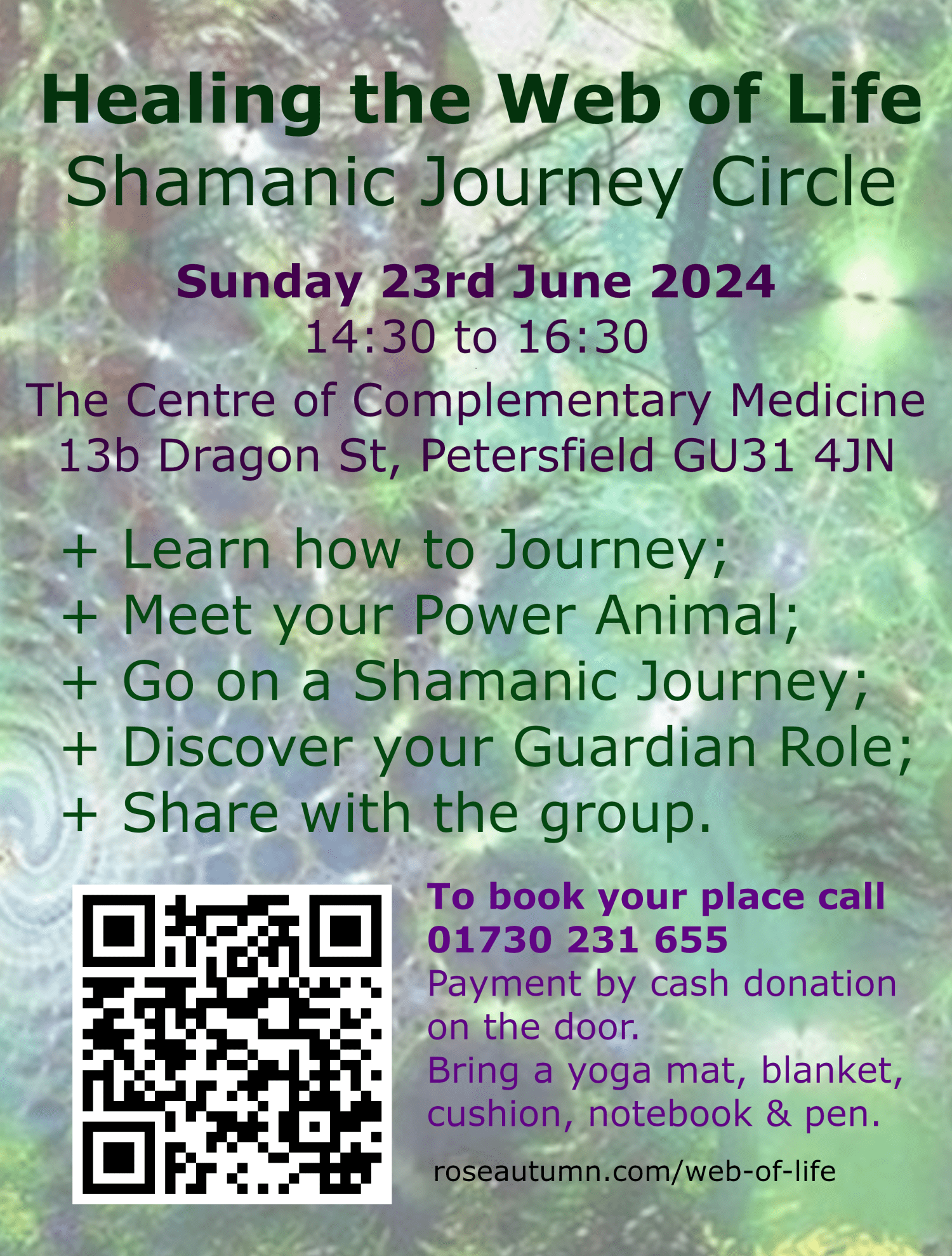

Healing the Web of Life Shamanic Journey Circle – June 2024
Healing the Web of Life Shamanic Journey Circle
Step into your shared responsibility as a Guardian of the Earth and Caretaker of the Web of Life at our next meeting on
Sunday 23rd June 2024
14:30 to 16:30
at
The Centre of Complementary Medicine
13b Dragon Street, Petersfield, Hampshire GU31 4JN
The Centre is located behind Animal Crackers
and is accessible via the driveway between Animal Crackers and ATS Euromaster.
You can turn up on the day or book your place by calling The Centre on 01730 231 655.
Learn how to Journey and meet your Power Animal before going on a Shamanic Journey to discover your role as a Guardian of the Earth and ways you can be involved in healing the Web of Life. Participants will be invited to share their experiences with the group.
You can make a cash donation on the door and card payments can be taken at the time of booking.
The session will last for approximately two hours.
Bring your cash donation, a yoga mat, blanket, cushion, notebook, pen, eyemask, or something to cover your eyes – drums are not required.
To stay in touch with our events and to ask any questions please join us on social media:
https://www.facebook.com/groups/shamanicjourneycirclepetersfield
https://t.me/ShamanicJourneyCirclePetersfield
What is the Web of Life?
Shamanism is the oldest spiritual practice and was common to almost all pre-modern societies for around 50,000 years. All traditional tribal cultures lived in harmony with the earth and respected the sacred nature of the Web of Life, being in reverence for both the Feminine and Masculine Principles. They offered their gratitude for the blessings of Mother Earth as our Goddess and Creation, and Father Sky as our God and Creator.
Ancient cultures recognised that the Creator made every natural living thing on earth and gave them a Spirit. The Web of Life refers to the spiritual connection shared by all plants, animals, and minerals, together with the men and women, and the Earth herself. We can tap into this interconnectedness via Shamanic Journeys and ask Spirit what we can do to support the Earth and nature.
Why Do We Need to Participate?
The realm of spiritual ecology is a contemporary solution to the environmental crisis by providing reverence for and spiritual communication with Mother Earth. It is a two-way communication that returns our ancestors’ connection with Nature’s spiritual power.
The Roman Empire eradicated our connection to the Mother and Father by promoting the now dominant patriarchal system of control, which has held the masculine principle in supremacy, leading to the systematic abuse of both women and Mother Earth. Goddess worship and shamanic practices were either diluted or assimilated into the new hierarchy of Christianity. Labelled as heretical and discarded under the threat of punishment or death they were replaced with a mediated relationship with a vengeful god, colonialism, industrialisation, and technology.
In traditional tribal cultures localities had spirit guardians, families had protective ancestors, and individuals enjoyed a direct connection to Mother Earth through the spirits of plants and animals. They also enjoyed a direct relationship with Father Sky who was able to provide a constant source of loving guidance. These common themes run through the diverse shamanic cultural traditions that today bring us unified global truths and an important understanding of our relationship with the natural world.
The Land is alive and should be respected by humanity: by connecting with the energy of the Earth Goddess our role is to assist with re-establishing the right alignment with the Guardian Spirits of the Land and to heal our relationship with Mother Earth and the animals and plants who live in harmony with her.
At a time when the behaviour of humanity makes our future survival questionable, these principles can form the basis for a shift in consciousness to being more spiritually aware so that we can form a renewed relationship with Earth.
As an old Native American prophecy states:
“When the earth is ravaged and the animals are dying, a new tribe of people shall come unto the earth from many colours, classes, creeds, and who by their actions and deeds shall make the earth green again….”
Drumming Track
Listen to a drumming track on YouTube: https://www.youtube.com/watch?v=NsjrGznlEE4
Listen to a drumming tack online: https://shamanicspiritmedicine.com/drumming-for-shamanic-journeywork
Download the drumming track for free: https://shamanicspiritmedicine.com/shamanic-drumming-download/medicine-drum-drumming-for-shamanic-journeying
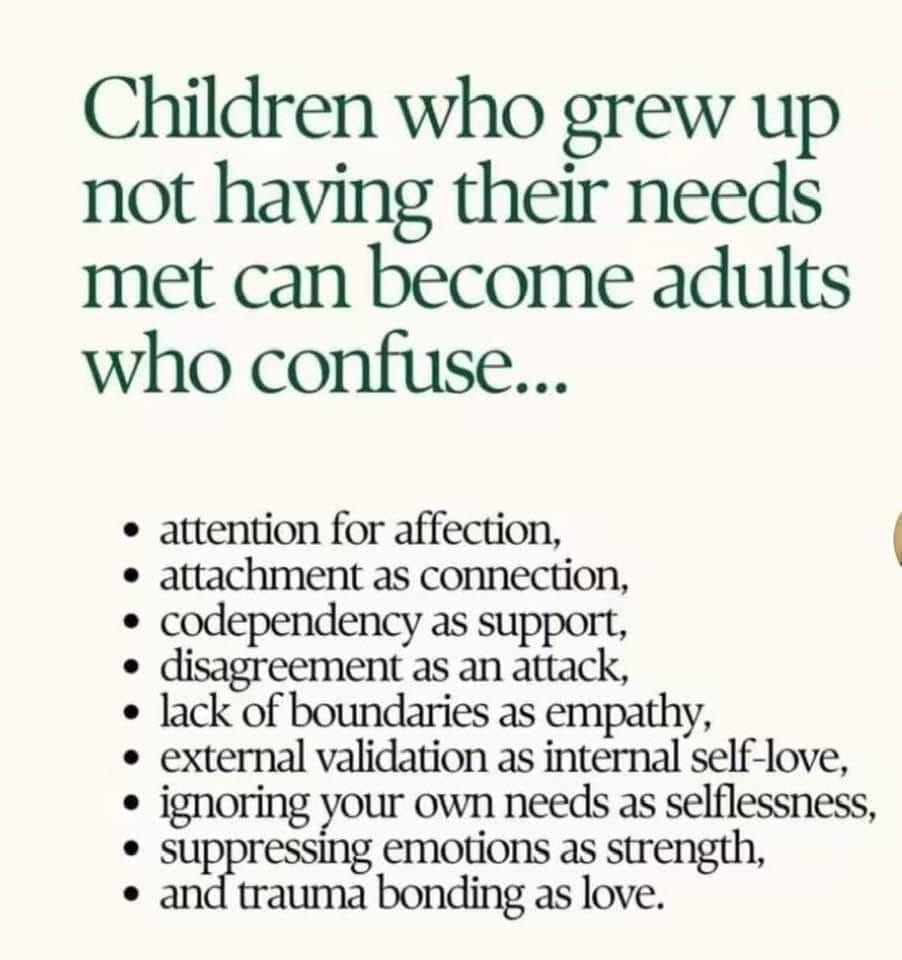

Unmet Needs & Behaviour
They are on an automatic pilot, repeatedly running an old programme that makes them unable to see things differently. These programmes are formed from experiences in childhood, with negative experiences from family members often being the strongest. So if a child has an over-critical mother they will be the most damaged, causing them to be frequently triggered throughout their lives.
The most common negative programme is “I’m not good enough”, which wreaks havoc because it takes away our confidence in all aspects of our lives. When this program is running the ego will play a trick on their mind, causing the belief that everyone they meet will see them as a failure. If they are in a leadership position, either running their own business or social group, the false idea that everyone holds a negative opinion about every action they take will create some bizarre situations.
Their inner critic will bombard them with negative self-talk, priming them to being over-sensitive. Then, if a co-worker or associate expresses an alternative idea or view it will be taken as a personal attack and instantly trigger a robust defence mechanism. The ego has to preserve its sense of self at all costs, even though it is a distortion. As such it will start aggressive outbursts coloured by black-and-white thinking where they are always right and the other is wrong. The wrong person will be ordered to shut up or asked to leave creating unnecessary upset for everyone involved. This is particularly damaging for those souls who have problems expressing themselves due to throat chakra blockage, which triggers them back into self-doubt.
Over time, people will learn to keep away, but there is a solution to break these destructive patterns.
The Shamanic Spirit Medicine Healing Method is very good at resolving behavioural issues because it is conducted in Shamanic Conciousness, outside the restrictions of time and space. The healer goes on a Shamanic Journey using the beat of the drum to put them into theta state where they can access the power for healing on behalf of the client.
This system differs from the offerings of most contemporary Shamanic Healers in that not only does it remove blockages and negative energy, heal the energy body, and return lost life-force energy, but it also includes a technique that gets to the root cause of the problem, preventing it from recurring by reprogramming the subconscious.
By accessing Spirit Mind we can go into the limbic part of the brain to erase disempowering beliefs and consciously select positive ones to make permanent changes to the automatic operating system. This process lays new foundations for more positive belief systems that will change instinctual response patterns and drive a behaviour change, assisting the achievement of better outcomes in all areas of life.
For further information please go to the Shamanic Healing page.
Rose can work with you face-to-face or remotely via distance sessions, which are just as effective. She provides Shamanic Healing at The Centre of Complementary Medicine 13b Dragon Street, Petersfield, Hampshire GU31 4JN. For an appointment please telephone 01730 231655.
She takes bookings for distance sessions directly. To make an appointment please go to the Bookings Page.


Healing the Web of Life Journey Circle – 26 May 2024
Healing the Web of Life Journey Circle
Step into your shared responsibility as a Guardian of the Earth and Caretaker of the Web of Life at our next meeting on
Sunday 26th May 2024
14:30 to 16:30
at
The Centre of Complementary Medicine
13b Dragon Street, Petersfield, Hampshire GU31 4JN
The Centre is located behind Animal Crackers
and is accessible via the driveway between Animal Crackers and ATS Euromaster.
Spaces are limited and booking is recommended by calling 01730 231 655.
Learn how to Journey and meet your Power Animal before going on a Shamanic Journey to discover your role as a Guardian of the Earth and ways you can be involved in healing the Web of Life. Participants will be invited to share their experiences with the group.
You can book a place, or just turn up on the day at 14:15, although priority will be given to participants with a booking. You can make a cash donation at the door or make a card payment when you book. The session will last for approximately 1.5 to 2 hours.
Bring your cash donation, a yoga mat, blanket, cushion, notebook, pen, eyemask, or something to cover your eyes – drums are not required.
To stay in touch with our events and to ask any questions please join our FaceBook group:
https://www.facebook.com/groups/shamanicjourneycirclepetersfield
2024 Dates
Sunday 26th May
Sunday 23rd June
What is the Web of Life?
Shamanism is the oldest spiritual practice and was common to almost all pre-modern societies for around 50,000 years. All traditional tribal cultures lived in harmony with the earth and respected the sacred nature of the Web of Life, being in reverence for both the Feminine and Masculine Principles. They offered their gratitude for the blessings of Mother Earth as our Goddess and Creation, and Father Sky as our God and Creator.
Ancient cultures recognised that every natural living thing on earth was made by the Creator and has a Spirit. The Web of Life refers to the spiritual connection shared by all plants, animals, and minerals, together with the men and women, and the Earth herself. We can tap into this interconnectedness via Shamanic Journeys and ask Spirit what we can do to support the Earth and nature.
Why Do We Need to Participate?
The realm of spiritual ecology is a contemporary solution to the environmental crisis by providing reverence for and spiritual communication with Mother Earth. It is a two-way communication that returns our ancestors’ connection with Nature’s spiritual power.
The Roman Empire eradicated our connection to the Mother and Father by promoting the now dominant patriarchal system of control, which has held the masculine principle in supremacy, leading to the systematic abuse of both women and Mother Earth. Goddess worship and shamanic practices were either diluted or assimilated into the new hierarchy of Christianity. Labelled as heretical and discarded under the threat of punishment or death they were replaced with a mediated relationship with a vengeful god, colonialism, industrialisation, and technology.
In traditional tribal cultures localities had spirit guardians, families had protective ancestors, and individuals enjoyed a direct connection to Mother Earth through the spirits of plants and animals. They also enjoyed a direct relationship with Father Sky who was able to provide a constant source of loving guidance. These common themes run through the diverse shamanic cultural traditions that today bring us unified global truths and an important understanding of our relationship with the natural world.
The Land is alive and should be respected by humanity: by connecting with the energy of the Earth Goddess our role is to assist with re-establishing the right alignment with the Guardian Spirits of the Land and to heal our relationship with Mother Earth and the animals and plants who live in harmony with her.
At a time when the behaviour of humanity makes our future survival questionable, these principles can form the basis for a shift in consciousness to being more spiritually aware so that we can form a renewed relationship with Earth.
As an old Native American prophecy states:
“When the earth is ravaged and the animals are dying, a new tribe of people shall come unto the earth from many colours, classes, creeds, and who by their actions and deeds shall make the earth green again….”
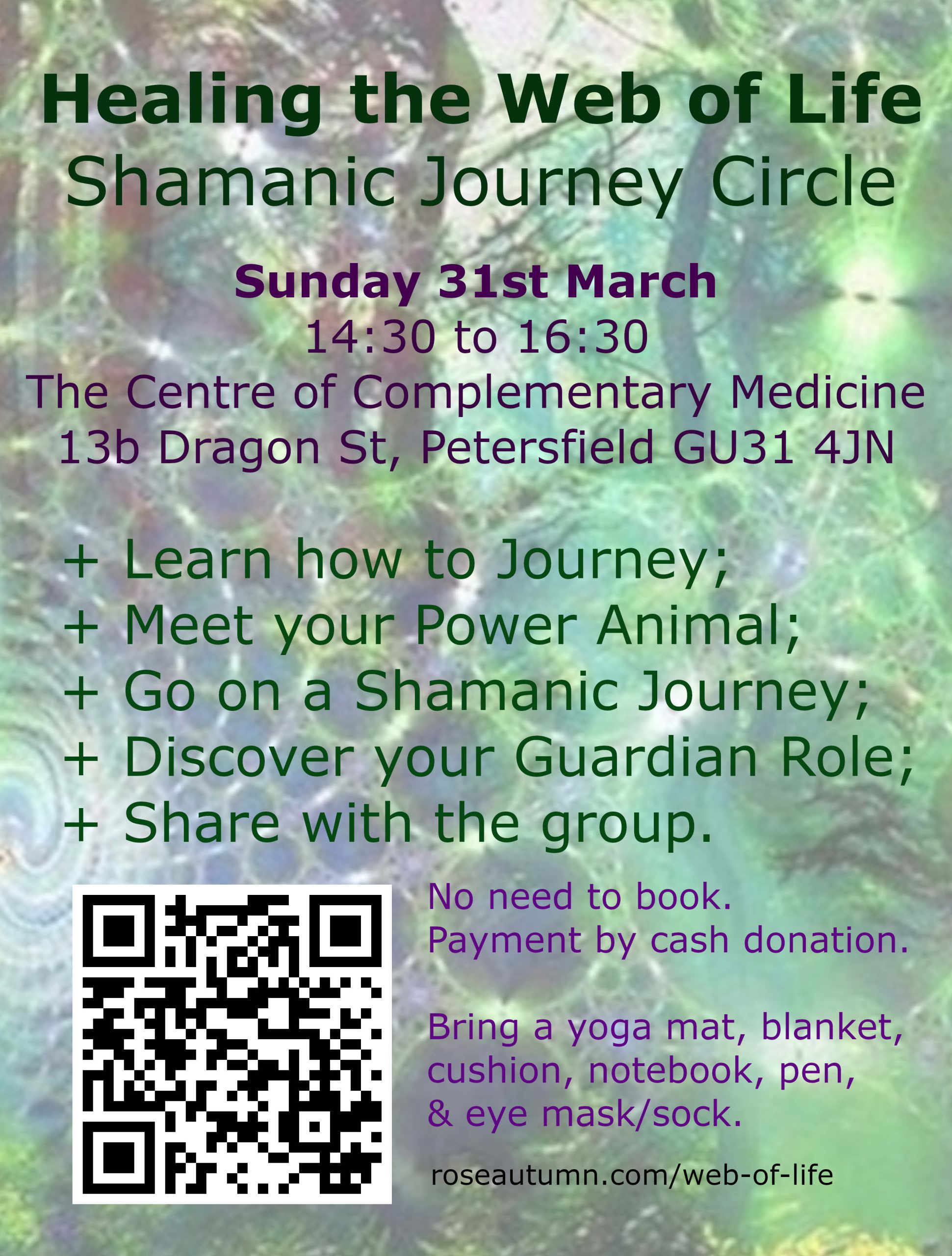

Healing the Web of Life Shamanic Journey Circle: March 2024
Step into your shared responsibility as a Guardian of the Earth and Caretaker of the Web of Life by Joining The Healing the Web of Life Journey Circle.
14:30 to 16:30
on Sunday 31st March 2024
at The Centre of Complementary Medicine, 13b Dragon Street, Petersfield, Hampshire GU31 4JN
Learn how to Journey and meet your Power Animal before going on a Shamanic Journey to discover your role as a Guardian of the Earth and ways that you can be involved in healing the Web of Life. Participants will be invited to share their experiences with the group. There will be a different theme each month.
There is no need to book, just turn up for a 14:30 start and pay a cash donation on the door. The session will last for approximately 1.5 to 2 hours.
Bring your cash donation, a yoga mat, blanket, cushion, notebook, pen, and eyemask or something to cover your eyes – drums are not required.
If you would like to book a place please telephone The Centre on 01730 231655.
For further information please go to: https://www.roseautumn.com/web-of-life/


Shamanic Case Study – Childhood Trauma
Weekend Dog Trauma at Petersfield Heath
On Friday afternoon I decided to enjoy total relaxation during my weekend alone; with a social media detox and no paperwork or other work-related activity. On Saturday morning I bought myself breakfast from the market on my way to The Heath for my favourite dog walk. As I sat on a bench overlooking the pond, I felt gratitude for the misty morning and the beauty of the still water. But my reverie was soon broken by three large dogs running towards me; they were off the lead and their owner was nowhere in sight. As they tried grabbing my food I shouted out for the owner to call them back, but to no avail.
Eventually, they left to hassle another dog off the lead and pandemonium soon broke out as the owner of the other dog went in to pull his out of the fray. I watched as one of the three dogs went and investigated each of the fishermen’s tents along the waterside, before running back over to the Plump Duck. A few minutes later they all came running back for another try at grabbing my food, which was very distressing. Eventually, the owner came sauntering along and I asked him why he wasn’t taking control of his dogs and he smirked as one of them continued to jump up for the remainder of my pork pie.
My stomach was churning, I felt upset and angry that my relaxing morning had been so brutally disturbed by such a man with a total lack of empathy or consideration for others. After finishing my tea I went for a walk in the woods and did some grounding and healing with an old tree and felt much better so that I was able to enjoy the rest of my day.
On Sunday morning I had managed to eat my breakfast from the Farmers Market in peace and was halfway around the wooded area of The Heath when the same three dogs came racing up; again off the lead with the owner out of sight. They were jumping at my much smaller dog who was on the lead and yelped in fright. This put me in fear again and I felt tension in my gut as I looked around for the owner with a sense of helplessness and distress. When he eventually appeared I asked him why he wasn’t calling the dogs back to him so they didn’t go out of sight, and again I got the same nonchalant response.
For the second time in two days, I was left very shaky and upset and I wondered why this traumatic experience was happening to me again. Why was the universe twice creating this situation to disrupt my relaxation?
Then my mind went silent and a picture came into my mind from childhood of a huge black dog with big teeth (just like the photo I used) running across the road and attacking me as I walked home alone from a friend’s house. Instead of helping me the owner just screamed at me to stand still while allowing the dog to continue to jump up at me; its muddy paws pressing against my chest and shoulders. I was terrified and there was nobody to help.
I soon realised that the incident at The Heath had triggered a deep trauma that had remained hidden away for over 40 years; the sense of fear, helplessness, and threat of being bitten all came back causing me to become tearful. I was in shock that this could happen on one of my favourite walks – what if a child had been with me? Another trauma would have been created from a lack of consideration by an irresponsible dog owner.
At home, I did a Shamanic Healing on myself; I went back to that point in place and time with the Doberman and did what was necessary to reassure and assist my young self as a child. I then conducted an extraction on myself to remove the negative energy from that first assault, and then performed a soul retrieval, returning the lost soul parts (otherwise known as life-force energy) which were suspended in that time and place. Finally, I changed the agreement that had been set around the first trauma to prevent it from being triggered again.
During the healing, I cried a lot and felt feelings of abandonment, which was really unpleasant. As an uncontrollable fit of terror was being released I was told that by allowing it all to come out I would be able to move forward with a greater sense of confidence and empowerment. It was exhausting.
I have realised that this is how the universe can send us the healing that we need; through unexpected incidents that use others as a tool for us to access the traumas that are deeply locked away. I write with gratitude to the man at The Health; without his lack of care or consideration, I would not have had the opportunity to access this wound. But I do hope that others are vigilant so that another child isn’t traumatised.
The Shamen who cared for our ancient ancestors would not have waited more than three days to deal with the effects of a traumatic experience such as this, as such the individual would not have to carry such a burden for a lifetime. But in recent times, our obsession with drugs to suppress symptoms and surgery to cut out problems has left us unable to deal with healing on a spiritual level. I had five years of psychotherapy and SSRIs but that did nothing to heal this deeply-held trauma.
You can read more about the benefits of Shamanic Healing by clicking on the ‘Shamanic Healing’ tab on the menu at the top of the page.


Interview about Shamanic Healing on Shine Radio
I was unexpectedly interviewed about Shamanic Healing by Jo Gray of Petersfield’s Shine Radio at the recent opening of The Centre of Complementary Medicine, in Petersfield.


Regenerate Yourself on Imbolc 1st February 2024
In Shamanic tribal cultures, the Medicine Wheel represents the changing seasons and natural cycles of the year. Our ancient Celtic ancestors were deeply connected to the land, the seasons, and the natural world and honoured these times with rituals and ceremonies. By following this cyclical way of life we too can be aligned with the rhythms and patterns of nature that can offer us their wisdom and support our well-being.
In England, as the great wheel turns we now find nature slowly re-emerging from the deep hibernation of Winter. The 1st of February marks the Ancient Celtic festival of Imbolc (pronounced Im-molk), the first of eight celebrations held throughout the year to herald the change of the seasons.
Imbolc is a cross-quarter or mid-season festival halfway between the Winter Solstice and the Spring Equinox. It marks the change in energy as the light starts to illuminate the end of the long, dark Winter to activate a new cycle of life, bringing the first stirrings of Spring.
Mother Earth is pregnant with the seeds of summer’s fruits, so Imbolc represents regeneration as the light returns to warm the land and nurture the new growth. As such it is linked with pregnancy and the Goddess Brigid in her role as a Maiden and fertility goddess. She rules the fire of the hearth as well as the fire of imagination through poetry and crafts. She also blessed other skills that required the use of fire, like blacksmithing.
Imbolc is symbolised by snowdrops and milk; the first plants and foods of early Spring. Ancient farmers used it to mark the start of Spring when the first baby lambs were born. They ensured lambs were born before the calves because they could survive better and provide much-needed milk after the long winter.
Over time, this day was absorbed by Christianity as the feast of St Brigid, Ireland’s Mother Saint, and one of Ireland’s three patron saints.
As nature starts to wake up, the new Spring energy invites us to celebrate a point of both seasonal and psychic transformation. We can use this phase to activate a new cycle on a personal level to bring in creative energy for new ideas and behaviours.
To clear the way for the new growth of our intentions we can start with purification, cleansing, and clearing away stagnation that built up over the winter months.
- Open all the windows and sound cleanse each room by clapping loudly in each corner, or ringing a bell to shift stagnant energies which have built up over the long winter.
- Burn sage with all of the windows open to remove unwanted energy and attract the new.
- Spring clean and de-clutter your home.
- Light a fire or candle in every room.
- Make a list of the old things you want to let go of and burn it.
- Collect snowdrops for the windowsill.
- Drum, dance, recite poetry, and sing songs.
- Brainstorm, create a vision board, and journal, to plan your new activities, ideas and ambitions for the coming year.
- Plant seeds for new skills and hobbies: join a choir, take a class, or learn to paint or draw.
If you would like assistance with clearing out old patterns of behaviour and limiting beliefs, book a Shamanic Healing Session with Rose: https://www.roseautumn.com/shamanic-healing/
Some altar items for inspiration:
- Incense. Myrrh, frankincense, and musk are good for creating a ritual space;
- Basil, rosemary, and cinnamon are good for uplifting energy;
- Red or orange candles;
- Sun symbols;
- Snowdrops (first flower of spring);
- Something woollen or a sheep figure;
- A triskele or other triple goddess symbol;
- Early greens like wild garlic;
- A blue cloth represents flowing water;
- Crystals with solar or passionate associations: citrine, garnet, amber, sunstone.
The other festivals are:
Spring Equinox, or Eostre, 21 March
Beltane, 1-2 May
Summer Solstice, or Litha, 21 June
Lughnasadh, or Lammas, 1-2 August
Autumn Equinox, or Mabon, 2 September
Samhain, 31 October-2 November
Winter Solstice, or Yule, 21 December
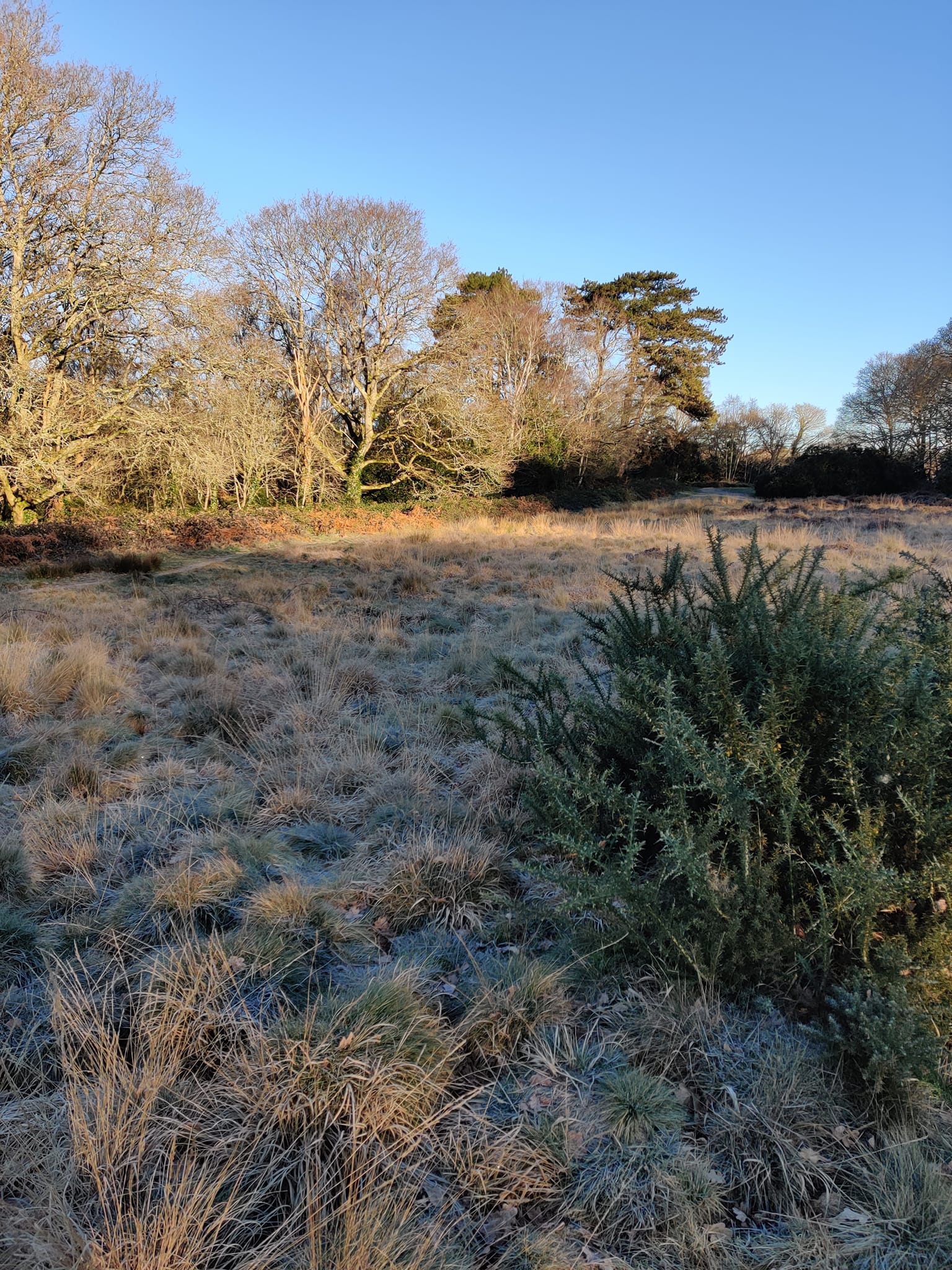

January: That Dreaded First Month of the Year
I was dismayed to read this negative phrase regarding the season of Winter: January – that dreaded first month of the year. It caused me to wonder: why do people dread this month? Is it because things have slowed down after all of the Christmas and New Year celebrations? Is January just not exciting enough? This post is a reminder for us all to go back to our Shamanic roots and welcome the Winter as a time of healing and self-care.
Contemporary life can present a tempting array of distractions and things to do which cause us to swing towards an expectation of constant stimulation and excitement. But it is important to recognise the principle of rhythm in natural law, which tells us that there is always an ebb and flow; the pendulum swing moves equally on both sides between two poles. When our pendulum swings to one extreme, it has to swing back to the same extent in the opposite direction.
Thus, extreme excitement will eventually cause an extreme depression, as the pendulum reaches its limit and falls back down again. So that someone who has gone to lots of Christmas parties may then find that they have done too much and their body responds by getting a bad cold to detox all of the alcohol and sugar, forcing the body to rest. This slow-down can be a form of irritation and that individual may fight it with cold remedies and caffeine, resisting rest and recuperation, possibly causing greater health issues in the future.
We can avoid these dramatic extremes by finding balance in our lives and operating from a place of acceptance that is in harmony with the seasons. In Shamanic practice, Winter is an important aspect of a seasonal calendar that is respected by all tribal cultures. They accept that the cycles of life affecting all plants and creatures on earth also apply to them, and they don’t resist this necessary change. By harmonising our lives with the gentle and gradual changes of the seasons we can avoid the extreme swings, and embrace nature’s requirement for rest and inner change that is necessary for our personal growth.
Our tribal ancestors recognised Winter as a time of hibernation because they saw nature naturally slowing down around them; they observed the trees losing their leaves and the animals disappearing into their warm nests. They knew that this gradual slowing down was a time of rest for nature so it could prepare for the new growth in the spring. By watching nature tribal people have an inner acceptance that just as all living things go into some form of hibernation during the winter, so should they.
Winter is recognised as being an important time of rest so that they can go within and evaluate the year, considering what could be changed so that they can clarify their intent to manifest something different for the next year. In doing so they would achieve spiritual growth and give themselves time to incubate their new ideas and plans for rejuvenation in the spring.
In contemporary cities, it is easy to ignore nature and turn up the heating to carry on with business as usual. But in doing so we miss out on an important time for personal growth work and self-care. So why not learn to honour this time for yourself by curling up on the sofa for some rest and journaling? Think about what didn’t work for you last year, the changes you want to make, and how you can improve your life. Consider areas such as relationships, well-being, creativity, exercise, work/career, hobbies, family, and your home and make a list for each heading.
If you identify some changes you would like to make in your behaviour and attitudes to life, book in for a Shamanic Healing Session which can assist you with making real changes for self-improvement and greater enjoyment of life. Rose can perform Shamanic Healing by distance sessions or face-to-face appointments. Please note that distance sessions are just as effective as in-person meetings. To book a session go here: https://www.roseautumn.com/bookings/.
Rose Autumn is a Shamanic Practitioner working at The Centre of Complementary Medicine in Petersfield, East Hampshire, in the South East of England. Rose is a member of the Federation of Holistic Therapists and is fully insured. She has completed over 120 hours of training during her Shamanic Apprenticeship with Scott Silverston, founder of the Shamanic Spirit Medicine Healing System.
Image taken by Rose on The Heath in Petersfield, Hampshire, England on 18th January 2024.
For further reading on natural law go to https://www.roseautumn.com/2022/01/the-principle-of-rhythm/
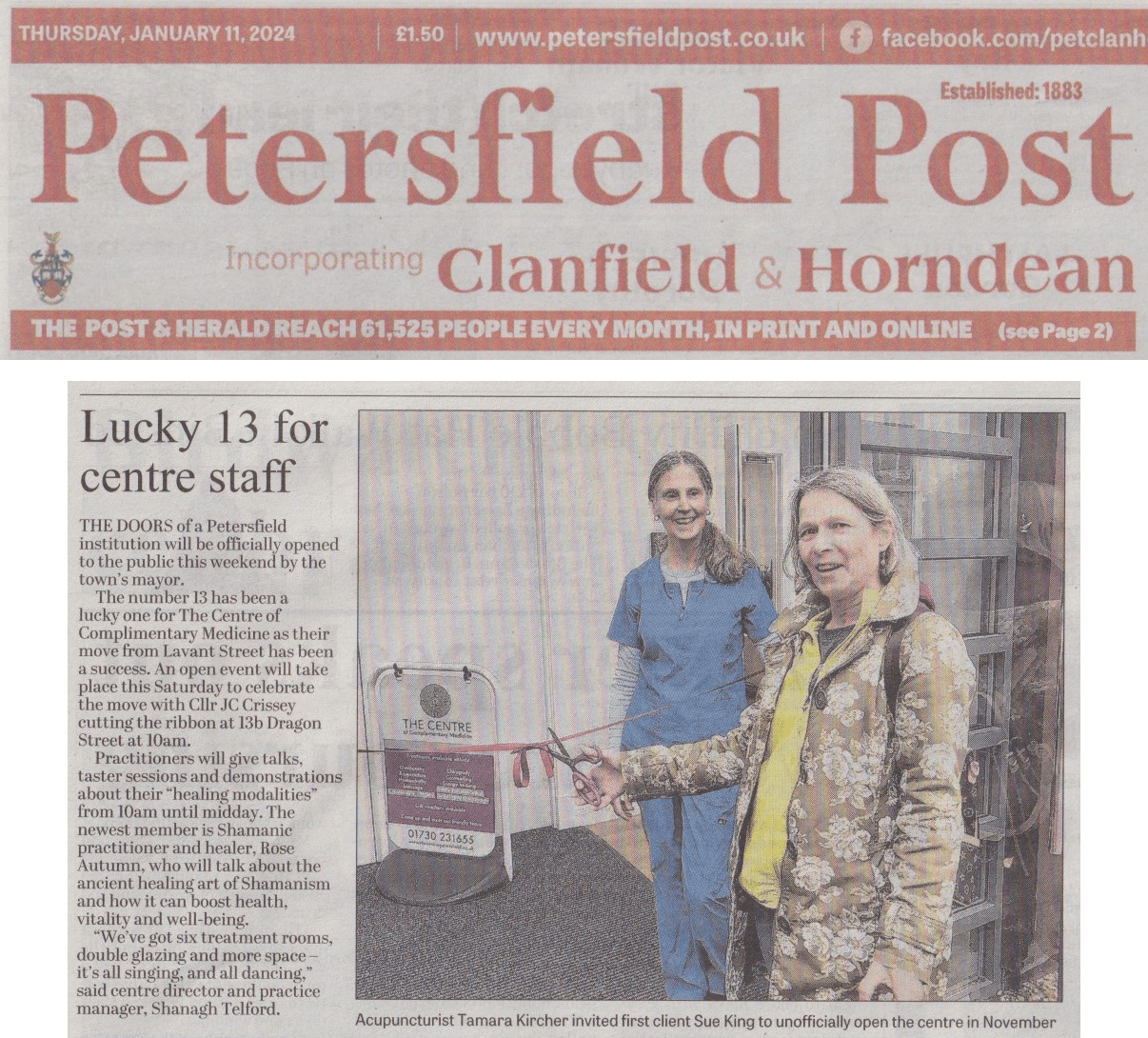

Petersfield Post 11 January 2024
The Petersfield Post has covered the opening of The Centre of Complementary Medicine at 13b Dragon Street, Petersfield, Hampshire GU31 4JN.
Rose provides Shamanic Healing on Saturdays, telephone 01730 231655 to book an appointment.
Like their Facebook Page.


Boundaries
Clients are usually given homework to complete after a Shamanic Healing Session. The setting of boundaries is one that often comes up after an extraction or soul retrieval to ensure the problem doesn’t return.
If we set an agreement around the event that created the Soul Loss and Intrusion, we can find that there are repeating patterns of behaviour that are difficult to change.
By changing the agreement to something positive, we can enable new ways of thinking and acting that align with our true selves and ultimately experience better outcomes in our relationships.
We will find it easier to confidently set boundaries with others so that soul loss doesn’t occur again through negative behaviour patterns.
My work is about changing behaviour to enable clients to move forward with their lives; not to create returning customers!
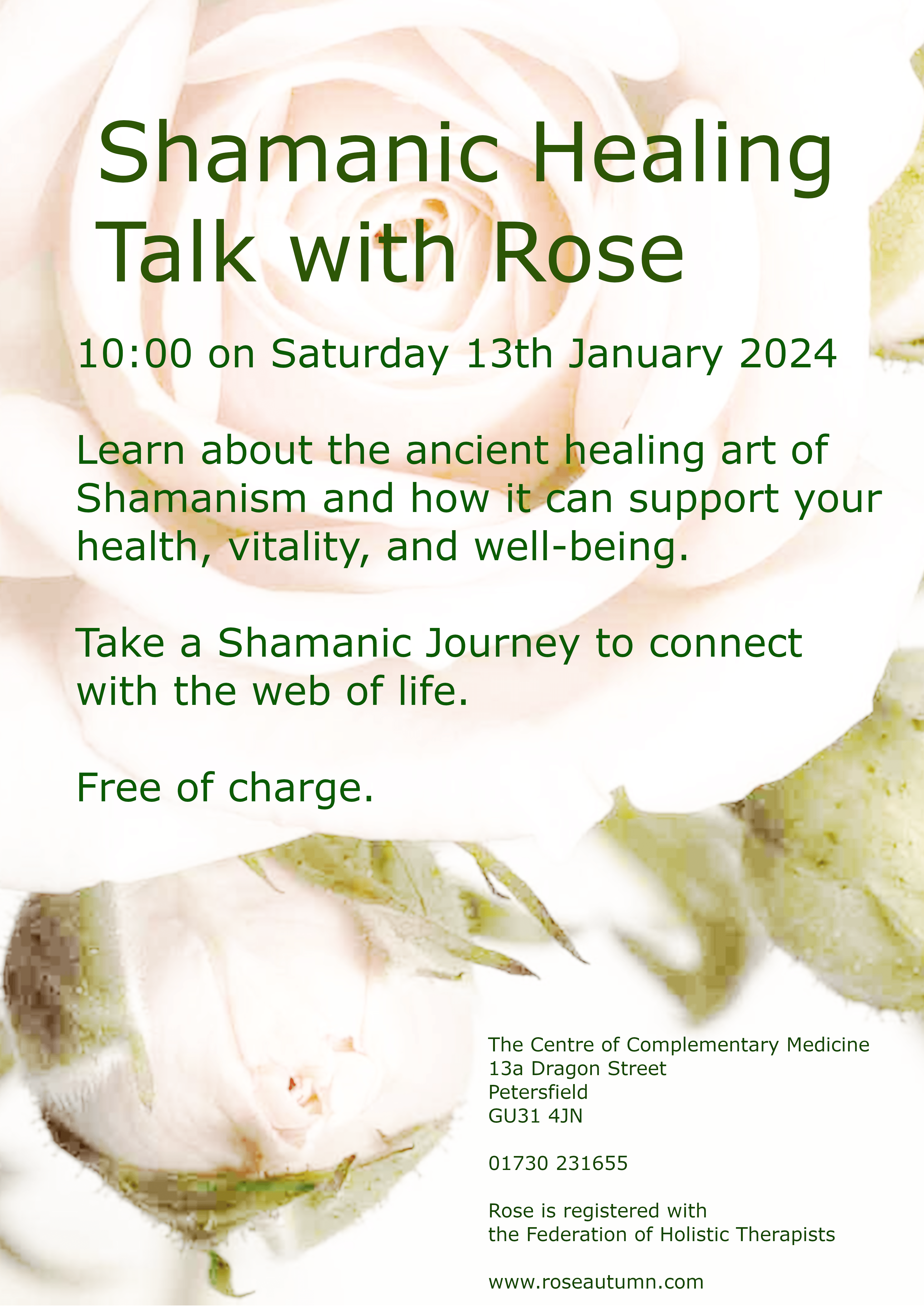

Shamanic Healing – Talk and Taster Journey
The Centre of Complementary Medicine has moved to a beautiful new building in Dragon Street, Petersfield. To celebrate the opening practitioners are hosting an open day giving talks, taster sessions, and demonstrations about their healing modalities.
on Saturday 13th January 2024
from 10:00 until 12:00
at The Centre of Complementary Medicine
13a Dragon Street, Petersfield GU31 4JN
https://www.thecentre-petersfield.co.uk/
I will be talking about the ancient healing art of Shamanism and how it can support your health, vitality, and well-being. Participants can also take part in a Shamanic Journey to connect with the web of life. No need to book – just turn up on the day. The opening ceremony will start at 10:00.
About Shamanic Healing
I conduct Shamanic Journey sessions with a traditional drumming method used by indigenous cultures for over 50,000 years to heal physical illnesses, clear trauma, and change unwanted patterns of behaviour. Through the repetitive beat of the drum, I access shamanic consciousness using it as a tool to shift the deep, subconscious agreements we hold about ourselves.
Healing occurs by restoring the physical, mental, emotional, and energetic body to balance and wholeness, which in turn heals the soul and spirit. This promotes personal transformation and empowerment, enabling clients to reach their full potential.
Each session includes a tailored combination of Power Animal Retrieval, Divination, Soul Retrieval, Energy Body Healing, Changing Agreements, Psychopomp, and removing negative energy and blockages through Shamanic Extraction. Shamanic Healing can be performed face-to-face or remotely via distance sessions, which are just as effective.
I am a member of the Federation of Holistic Therapists and fully insured. I have completed over 120 hours of training during my Shamanic Apprenticeship with Scott Silverston, founder of Shamanic Spirit Medicine.
Further Information
https://www.roseautumn.com/
Bookings
Shamanic Healing Sessions are available at
The Centre of Complementary Medicine, 13b Dragon Street, Petersfield, Hampshire GU31 4JN. To book an appointment please telephone 01730 231655. £155.00 per session.
Distance Healing Sessions can be booked via my website here: https://www.roseautumn.com/bookings/
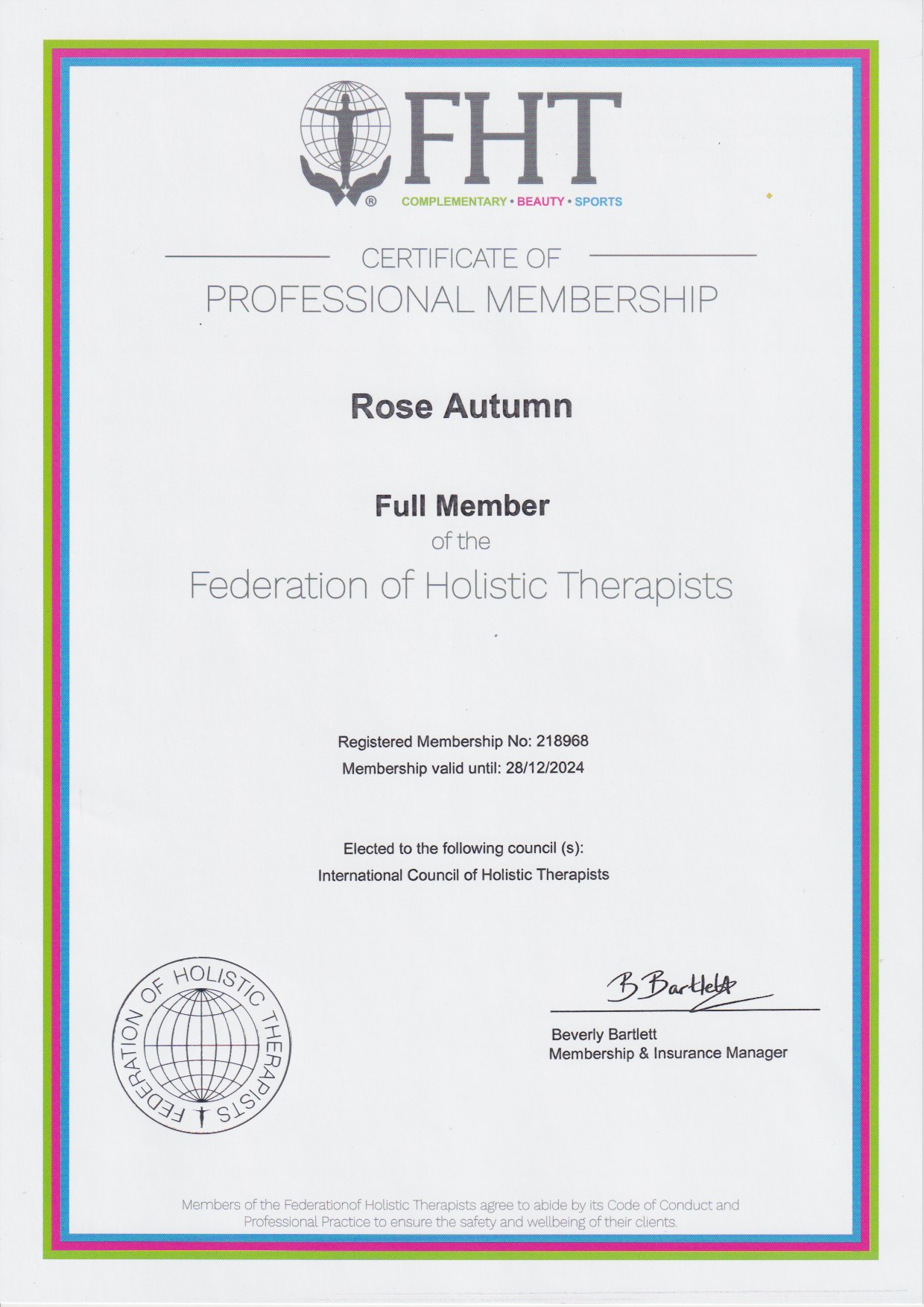

FHT Membership
Rose is delighted to be accepted as a Member of the Federation of Holistic Therapists (FHT), the largest organisation of Complementary Therapists in England, Ireland, and Internationally.
You can find her on the FHT Therapist Register. Clients will feel reassured knowing she is fully insured for Shamanic Healing, Energy Healing, Sound Therapy, Singing Bowls, Drumming, and Wellness Coaching.


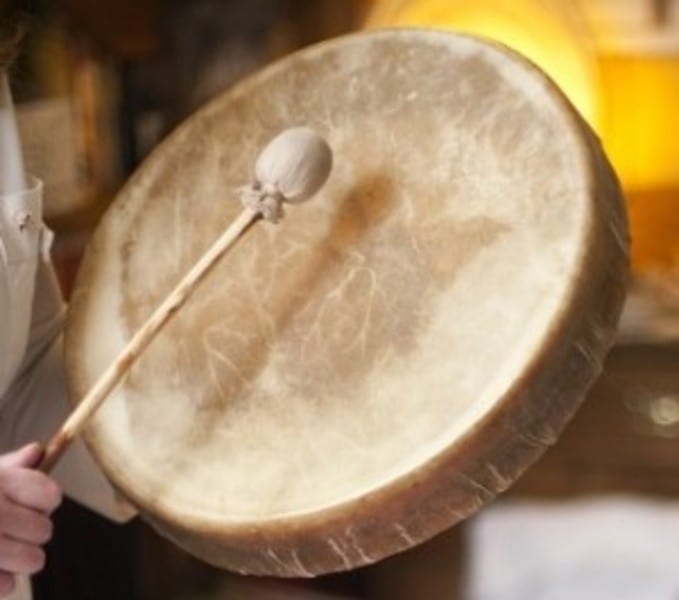

Shamanic Case Study: Pharmaceutical Drugs
Healing the Side Effects of Pharmaceutical Drugs
Having received two blood transfusions I was discharged from the hospital to wait for my surgery date to be booked.
To prevent further bleeding I was prescribed three prescription drugs to take daily during this waiting time.
For the previous two and a half years I hadn’t had so much as one paracetamol. As a result, I was feeling very tired, unable to concentrate, and feeling disconnected from my Shamanic practices.
This was compounded by having had seven days in the hospital without meditation, grounding, or Qi Gung and being in a busy environment surrounded by electromagnetic radiation so I was very much depleted.
I contacted Scott, my teacher from Shamanic Spirit Medicine, for advice and he recommended contacting the Possessing Spirits of the drugs I was taking and extracting them from my body along with a soul retrieval to return any soul parts that I had lost during the hospital stay.
Having repeated this exercise several times I suddenly got my energy back and felt well enough to go to a friend’s birthday dinner which I really enjoyed.
This experience has taught me that when prescription medication is required to save our lives, we can support ourselves with Shamanic techniques if we are negatively affected.
 0
0