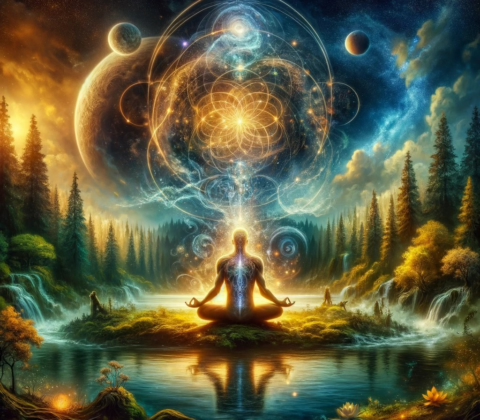
Mind, Soul, and Consciousness in Shamanism
One of the questions people ask is whether shamanic traditions make a distinction between the mind and the soul, and if they do, how that distinction is actually understood.
In my experience, there is a strong distinction between the mind and the soul. The mind is part of our human experience, but the soul belongs to a deeper level of being.
The Soul
The Soul is the primary aspect and the essence of our being. It is eternal. It can cross dimensions, experience different levels of consciousness, and reincarnate into different beings. It can be fragmented by trauma, causing soul loss. This is why soul retrieval is such an important part of Shamanic Healing.
The Mind
The mind, by contrast, is not a clear reflection of who we really are. It is a secondary aspect forming the functional or cognitive apparatus that processes our experience of the world. It can be conditioned by trauma, fear, social programming, and ego. It can also be influenced, distorted, and destabilised by negative forces. For that reason, I do not see the mind as identical with the soul.
This is not a simple topic. Language changes across cultures, and translation is imperfect. Different lineages use different words. Some teachings speak poetically rather than analytically. Yet in the teachings I have received, and through my own healing and practice, a meaningful distinction does appear to exist. It is not always presented as a rigid philosophical diagram, but more often as a practical map for healing and direct spiritual experience.
The logic mind and the spirit mind
North American shamanism makes this distinction very clearly through the understanding of the practitioner as a hollow bone. Once the logic mind is silenced, the spirits can speak and work through the practitioner. Practitioners are taught a methodology for accessing the spirit mind directly. This suggests that ordinary thinking function is not the same as the deeper faculty through which spiritual knowledge is received.
So, within this understanding, the thinking mind is not rejected, but it is not considered the highest or most reliable instrument for spiritual perception. The logic mind is useful in ordinary life, but it can also generate noise, analysis, projection, and internal chatter. The spirit mind, by contrast, is the faculty through which one enters non-ordinary reality and receives guidance, healing, and truth from spirit.
This means that a person can be perfectly functional in ordinary mental terms and still be disconnected from deeper spiritual knowing. It also means that someone may be intellectually clear while still carrying wounds, blockages, or losses on a deeper level that the rational mind alone cannot resolve.
My own experience of mind and healing
In my own life, I have found that the mind can be trained, steadied, and brought into greater peace.
Daily meditation over the past fifteen years has enabled me to gain much greater control over my mind, so that I have moved from depression and anxiety towards peace and contentment. That inner work has shown me that the mind is changeable. It can be disciplined. It can be healed. It can become quieter and less reactive.
Meditation has been essential, yet I have also found that some deeper wounds do not fully resolve through mental discipline alone. Through plant medicine work, Shamanic Healing, and training as a Shamanic Practitioner, I have experienced another level of healing that goes beyond thought. Soul retrieval, in particular, has brought fragmented life-force energy back to me, giving me a stronger and more powerful base from which to operate.
It also creates a stronger connection with the soul, removing some of the veils that get in the way and shroud who we really are.
Shamanic Consciousness
Another important distinction in the teachings I have received is between different states of consciousness.
Ordinary reality is normal waking consciousness in the physical world.
Non-ordinary reality refers to realities that are not bound by the usual constraints of the physical world.
The shamanic state of consciousness is the state through which non-ordinary reality can be entered intentionally and with purpose.
This matters because the division is not simply between “mind” and “soul.” Consciousness itself is understood to have layers or states. Ordinary waking awareness is one level. Dreaming is another. The shamanic state is another. So when people ask how many layers there are, the answer is not always a neat numbered ladder. Rather, what is offered is a practical distinction between different modes of awareness and different ways of knowing.
The subconscious is another layer
There is another distinction in the teachings I have received that matters just as much: the distinction between conscious thought and subconscious patterning.
Shamanic healing often works beneath trauma and beneath ordinary cognition, at the level of old agreements, inherited patterns, and behavioural imprints. This suggests that a person may be mentally articulate, emotionally composed, and outwardly functional, while still being governed by hidden agreements formed through trauma, fear, repetition, or conditioning.
These agreements are not the soul, but they are also not simply surface thought. They belong to a deeper layer of conditioning that shapes behaviour until it is brought into awareness and changed.
So yes, a person can be healthy and functional in the mind and still have deeper layers beneath ordinary awareness. These may include the internal dialogue, subconscious agreements, and the spirit mind.
Soul as life-force, not just identity
The idea of soul retrieval, as I have come to understand it through the teachings I have received and through my own healing, introduces another crucial distinction.
Here, the soul is not merely the personality, nor simply the seat of beliefs. It is a living spiritual essence or life-force. Following trauma, shock, or injury, part of that essence may withdraw or dissociate. Healing occurs when this missing part is retrieved and restored.
This is very different from modern psychological language. Thought may continue. A person may remain outwardly functional. But vitality, presence, wholeness, and deep coherence may be reduced when soul parts are missing.
In my own experience, soul retrieval has restored fragmented life-force energy and strengthened my connection to my deeper essence. It has not simply changed how I think. It has changed the energetic basis from which I live.
Healing trauma and building a strong container
Healing trauma is also essential because it creates a stronger container to hold spiritual energy.
As more life-force returns, we need the strength, grounding, and integrity to hold it well. Otherwise, what comes in can feel overwhelming or unstable. Healing is not only about receiving power or light. It is also about being able to embody that energy safely and clearly.
For me, this has reinforced the importance of humility, service, and boundaries. Spiritual energy should never be approached through ego inflation or self-importance. It must be held with humility and a sincere wish to be in service, while also maintaining clear boundaries.
That balance matters. A person can grow spiritually without becoming grandiose. They can become more powerful without becoming less human. In fact, the deeper the work, the more important groundedness becomes.
So is there a division between self and soul?
Yes, I believe there is, though not always in the rigid way that Western philosophy might define it.
The self that thinks, analyses, worries, narrates, and maintains ordinary functioning is not identical to the deeper spiritual essence. The ordinary self includes the logic mind and conscious personality. Beneath and beyond that are subconscious agreements, spirit perception, life-force energy, and soul parts.
The self can carry stories; the soul carries vitality. The self can be mentally organised; the soul can still be wounded, fragmented, or partially absent.
At the same time, these are not completely separate substances. They interact. A spiritual wound can affect mental and emotional life. A changed agreement can strengthen the person and allow more life-force to return. Healing involves restoring the physical, mental, emotional, and spiritual aspects together rather than isolating one from the others.
Are there exact names and numbers for the layers?
In the teachings I have received, there is not always a final, precise taxonomy of exactly how many layers the mind has. What is offered instead is a set of distinctions that are experiential and functional.
These include:
• the logic mind or internal dialogue
• the ordinary waking mind
• the subconscious agreements that pattern behaviour
• the spirit mind
• the soul as life-force
• soul parts that may dissociate and later return
• different states of consciousness, such as ordinary waking awareness, dreaming, and the shamanic state
That may not amount to a universal doctrine of all shamanic cultures everywhere, but it does form a coherent healing model.
A Kaleidoscope
The image of a kaleidoscope is a beautiful metaphor for all of this.
At any moment, what we call “mind” may be a shifting pattern made of thought, memory, emotion, habit, imagination, perception, and spiritual sensitivity. The pattern changes as the pieces move. Some arrangements are harmonious. Some are distorted. Some are beautiful but incomplete.
Healing is not only about calming the mind. It is also about restoring lost light, changing the deeper agreements that distort perception, and bringing more of the soul back into the present.
So the answer, as I understand it through the teachings I have received and through my own direct experience, is that there is a distinction between mind and soul. The soul is pure and eternal. The thinking mind is one layer. The subconscious is another. The spirit mind is another. The soul is deeper still, as living essence and life-force.
Healing happens when these layers are brought back into right relationship with one another, which is the core essence of Shamanic Healing.
 0
0 0
0
 20
20