Posts in Category: Shamanic Healing

Understanding Narcissistic & Emotional Abuse

The terms narcissistic abuse and emotional abuse are often used interchangeably, but they do not mean the same thing. Narcissistic abuse is not the same thing as emotional abuse, although narcissistic abuse is usually a form of emotional or psychological abuse.

Emotional abuse is the broader category. It refers to a persistent pattern of behaviour that seeks to control, manipulate, intimidate, humiliate, or undermine another person’s emotional wellbeing and sense of self.

Narcissistic abuse is a widely used descriptive term for a pattern of emotional and psychological abuse associated with someone who has pronounced narcissistic traits or narcissistic personality disorder (NPD). It describes a relationship in which one person seeks to maintain power, control, or admiration by undermining another person’s confidence, autonomy, or sense of reality.

In simple terms, narcissistic abuse is generally understood as a particular pattern of emotional and psychological abuse, whereas emotional abuse can occur in many different types of relationships and for many different reasons.

The relationship between the two is best understood like this:

  • Emotional abuse is the broad category. It refers to patterns of behaviour that control, intimidate, humiliate, manipulate, or undermine another person.
  • Narcissistic abuse is a term commonly used to describe a pattern of emotional and psychological abuse carried out by someone with strong narcissistic traits or someone diagnosed with narcissistic personality disorder (NPD).

In short:

  • All narcissistic abuse is a form of emotional abuse.
  • Not all emotional abuse is narcissistic abuse.
  • The harm experienced by the victim can be equally serious regardless of whether the abuser is narcissistic.

Narcissistic Abuse

Narcissistic abuse is a widely used descriptive term referring to a pattern of abusive behaviours associated with someone with pronounced narcissistic traits.

It is psychological manipulation in which a person with narcissistic personality disorder seeks to maintain power, control, or admiration by undermining another person’s confidence, autonomy, or sense of reality.

It commonly involves behaviours such as gaslighting, chronic criticism, blame-shifting, emotional invalidation, intermittent affection and rejection, manipulation, and a lack of empathy.

Over time, this pattern can leave the victim feeling confused, anxious, isolated, and with diminished self-esteem.

Narcissistic abuse often has distinctive patterns. Although every relationship is different, people describe narcissistic abuse as involving behaviours such as:

  • Idealisation (“love bombing”) followed by devaluation.
  • Gaslighting (making someone doubt their own perceptions or memories).
  • Chronic criticism and belittling.
  • Lack of empathy for the other person’s feelings.
  • Manipulation through guilt, shame or obligation.
  • Triangulation (bringing third parties into conflicts to create jealousy or division).
  • Silent treatment or withdrawal as punishment.
  • Blame shifting and refusal to accept responsibility.

Emotional Abuse

Emotional abuse is a persistent pattern of behaviour that seeks to control, manipulate, intimidate, or undermine another person’s emotional wellbeing and sense of self.

Unlike physical abuse, it often leaves no visible injuries, but can have profound and long-lasting psychological effects.

Emotional abuse may include intimidation, humiliation, excessive criticism, threats, isolation, gaslighting, coercive control, or deliberately withholding affection or communication to exert power over another person.

Over time, it can erode a person’s confidence, independence, and ability to trust their own thoughts and feelings, leading to anxiety, depression, low self-esteem, and emotional distress.

Emotional abuse can be carried out by many different people. Someone does not need to be narcissistic to be emotionally abusive. Emotional abuse can be committed by:

  • A controlling partner.
  • Someone with poor emotional regulation.
  • A person who learned abusive behaviours in childhood.
  • Someone with another personality disorder.
  • Someone seeking power or control without having any mental health condition.

Which term is more useful?

For someone recovering from an unhealthy relationship, focusing on the behaviour rather than the label is often more helpful.

Ask yourself questions like:

  • Were my boundaries respected?
  • Was I frequently manipulated or made to doubt myself?
  • Did I feel afraid to express my needs?
  • Was there a consistent pattern of control or humiliation?

Whether a relationship is described as emotionally abusive or narcissistically abusive, the effects can be equally damaging. Recognising unhealthy patterns is often the first step towards setting healthy boundaries, seeking appropriate support and beginning the process of recovery.

Healing

From a shamanic perspective, emotional and narcissistic abuse are not simply patterns of behaviour but signs of deeper spiritual and emotional imbalance. Those who have experienced abuse often carry the energetic imprint of fear, shame, grief, loss of confidence, or soul loss, while those who inflict harm may themselves be acting from unresolved wounds, disconnection, fear, or a loss of their true nature.

Shamanic healing seeks to address these deeper causes by working with the spiritual and energetic aspects of the individual.

For the victim, this may involve releasing energetic attachments, restoring lost personal power, strengthening healthy boundaries, and reconnecting with their authentic self.

For the perpetrator, meaningful healing is only possible where there is genuine accountability and a sincere desire to change, allowing old wounds and destructive patterns to be transformed.

While every person’s journey is unique, shamanic healing offers a compassionate path towards greater awareness, balance and wholeness, helping to break cycles of suffering so that healthier relationships can emerge.

About Rose

Rose is a Shamanic Practitioner offering in-person and distance Shamanic Healing Sessions and Shamanic Life Coaching, specialising in narcissistic abuse.

Rose works without hallucinogenic or psychedelic plant medicines. Instead, she uses an ancient drumming method to access this altered state of consciousness. A session may include a tailored combination of Power Animal Retrieval, Divination, Soul Retrieval, Energy Body Healing, Psychopomp, and Extraction to remove negative energy and blockages.

Each session with me includes Shamanic Subconscious Repatterning. A powerful system that changes the subconscious programmes that drive unwanted behaviour. This method heals trauma at its source, removes the self-limiting programme, and then rewrites a new way of being.

Shamanic Healing can be accessed face-to-face in the Rose Healing Room, Petersfield, East Hampshire or remotely through Distance Healing Sessions. Because the work is carried out in the Spirit Realm with the support of Rose’s Spirit Guides, the client does not need to be physically present in the same room. Distance sessions are narrated in real time, and clients receive an audio recording by email afterwards.

For further information about Shamanic Healing, go to: https://www.roseautumn.com/shamanic-healing/

What is Shamanic Healing?

Shamanic healing is one of the oldest healing practices on Earth, yet many people are still unfamiliar with what it involves or how it works.

In my new video, What Is Shamanic Healing?, I explain how shamanic healing works with the deeper energetic and spiritual causes of imbalance and how it may support people who feel stuck, disconnected or caught in repeating patterns.

Rather than focusing only on physical, mental or emotional symptoms, shamanic healing considers what may be happening at the level of the spirit.

Repeated experiences of anxiety, fear, depression, illness or unwanted behaviour may sometimes have an energetic or spiritual aspect. There may be blockages within the energy body, lost life-force energy, limiting beliefs or subconscious programmes that continue to shape our lives long after the original experience has passed.

Shamanic healing works with these deeper layers.

Go here to view the video: https://youtu.be/gFccc958T48

Journeying into Non-Ordinary Reality

One of the things that distinguishes shamanic healing from practices such as Reiki or sound healing is that the practitioner enters an altered state of consciousness and journeys into what is often called non-ordinary reality.

Using rhythmic drumming, the practitioner enters a focused and intentional trance state and connects with compassionate spiritual guides, power animals, helpers and teachers.

The practitioner acts as a bridge between ordinary reality and the spirit realm. In traditional shamanic language, this is sometimes described as becoming a hollow bone.

This means that the practitioner is not attempting to direct the healing through personal will, ego or their own energy. The healing is undertaken with the support and guidance of compassionate spirits.

Restoring Balance and Wholeness

A shamanic healing session may involve clearing heavy or negative energy, removing energetic blockages, returning lost power or life-force, restoring spiritual protection or helping someone reconnect with their own inner wisdom and strength.

The aim is always to restore balance, clear what no longer serves and support a deeper return to wholeness.

In my own practice, I work without hallucinogenic or psychedelic plant medicines. I use the ancient method of rhythmic drumming to enter the shamanic state of consciousness safely and intentionally.

Depending upon the needs and intentions of the client, a session may include:

  • Power Animal Retrieval
  • Divination
  • Soul Retrieval
  • Energy Body Healing
  • Psychopomp work
  • Shamanic Extraction

Every session also includes Shamanic Subconscious Repatterning.

This method works with the subconscious programmes that can drive unwanted behaviours, emotional reactions and self-limiting beliefs. It helps to identify the old programme, address the trauma or wound beneath it and repattern a new way of being.

For many people, this is where profound and lasting change can begin.

In-Person and Distance Shamanic Healing

Shamanic healing sessions are available face-to-face in the Rose Healing Room in East Hampshire or remotely through a Distance Healing Session.

Because the healing takes place within the spirit realm, the client does not need to be physically present in the same room.

During a distance session, I undertake the healing remotely and narrate the shamanic journey into an audio recorder in real time. The recording is then sent to the client by email so that they can listen to the journey and understand the healing work that took place.

Whether the session is undertaken in person or at a distance, the work is always carried out with the client’s permission, intentions and highest good at the centre.

The Path of the Wounded Healer

My own approach to shamanic healing is grounded in my personal healing journey.

Like many people who are drawn to this work, my path began through my own experience of deep healing. This is sometimes known as the path of the wounded healer.

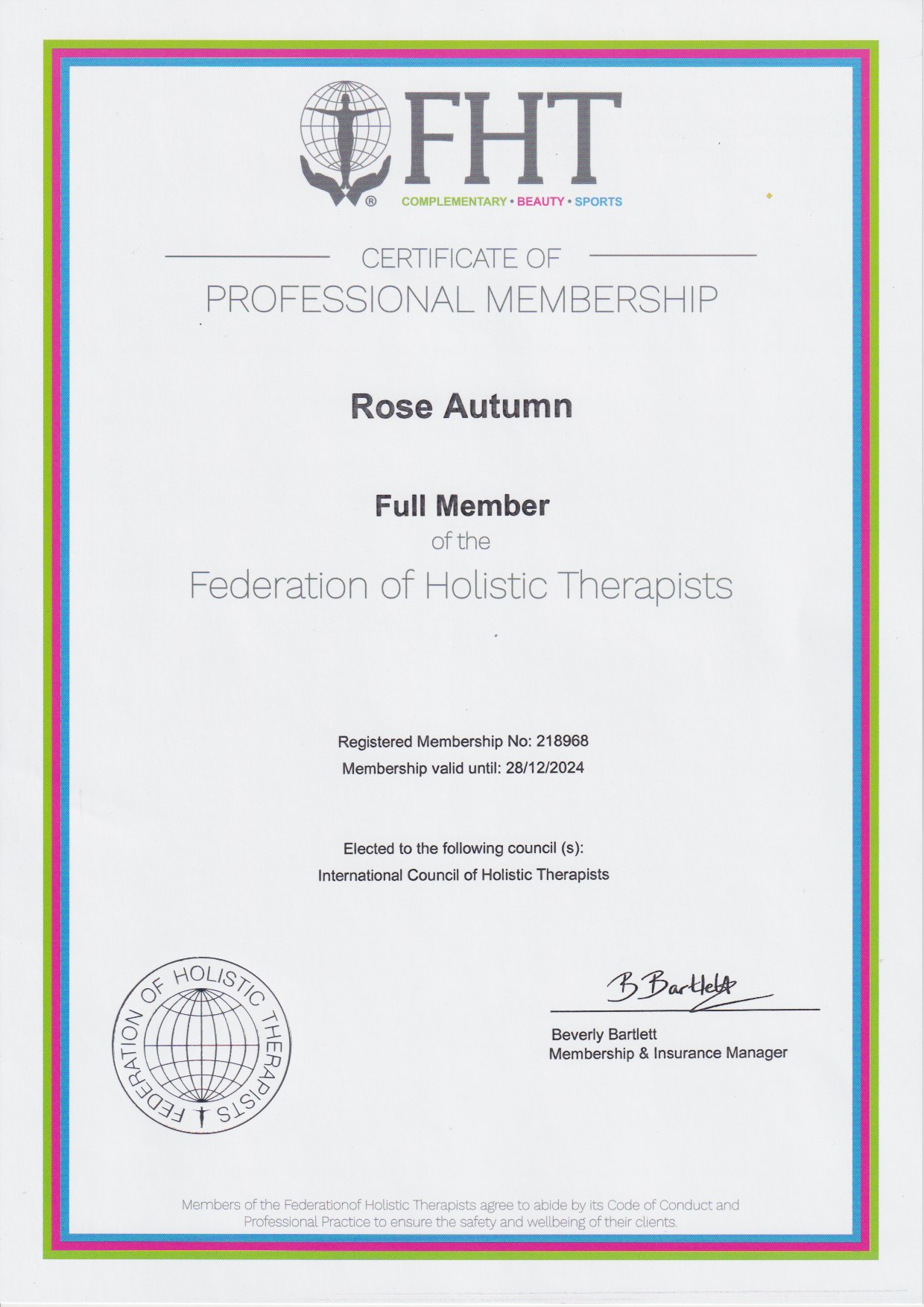
Over the past six years, I have completed extensive training, including a 120-hour Shamanic Apprenticeship and further advanced shamanic training. I am also a member of the Federation of Holistic Therapists and fully insured for Shamanic Healing and Shamanic Life Coaching.

Shamanic Healing with Rose

Shamanic healing may be helpful if you feel:

  • Stuck in a repeating pattern
  • Disconnected from yourself
  • Weighed down by old energy
  • Unable to change an unwanted behaviour
  • Ready for deeper healing and transformation

You can book an in-person Shamanic Healing Session or a Distance Healing Session through my website.

I look forward to co-creating your new way of being with you.

A suitable next step would be to add a brief booking button immediately beneath the embedded video.

About Rose

Rose is a Shamanic Practitioner offering in-person and distance Shamanic Healing Sessions and Shamanic Life Coaching, specialising in narcissistic abuse.

Rose works without hallucinogenic or psychedelic plant medicines. Instead, she uses an ancient drumming method to access this altered state of consciousness. A session may include a tailored combination of Power Animal Retrieval, Divination, Soul Retrieval, Energy Body Healing, Psychopomp, and Extraction to remove negative energy and blockages.

Each session with me includes Shamanic Subconscious Repatterning. A powerful system that changes the subconscious programmes that drive unwanted behaviour. This method heals trauma at its source, removes the self-limiting programme, and then rewrites a new way of being.

Shamanic Healing can be accessed face-to-face in the Rose Healing Room, Petersfield, East Hampshire or remotely through Distance Healing Sessions. Because the work is carried out in the Spirit Realm with the support of Rose’s Spirit Guides, the client does not need to be physically present in the same room. Distance sessions are narrated in real time, and clients receive an audio recording by email afterwards.

For further information about Shamanic Healing, go to: https://www.roseautumn.com/shamanic-healing/

Emotional Abuse

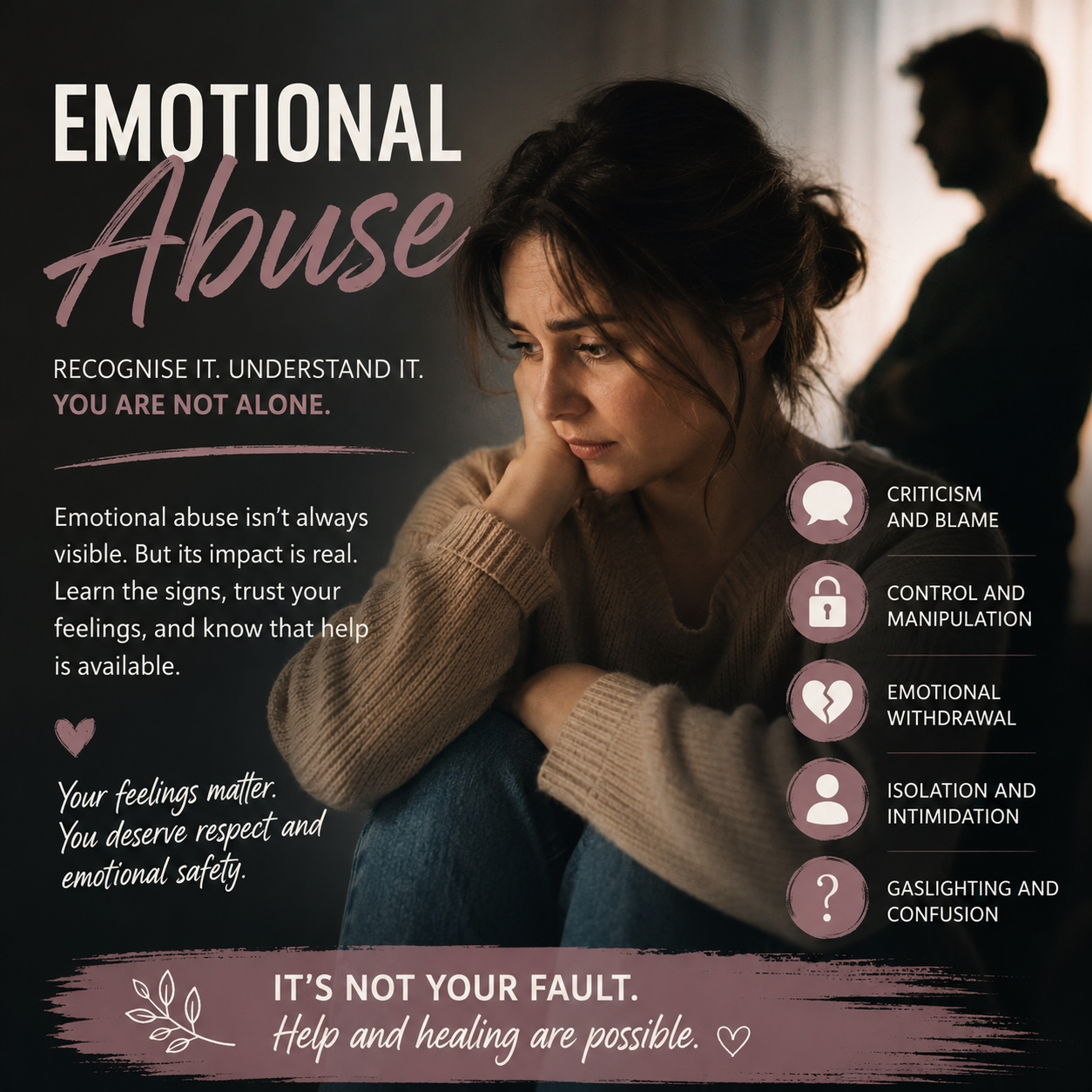
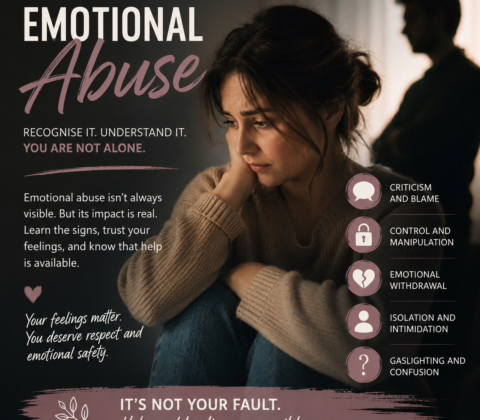
In this article, we will look at what emotional abuse is, how it can show up in everyday relationships, and why it can be so difficult to recognise while it is happening. We will explore common patterns such as criticism, control, gaslighting, blame-shifting, emotional withdrawal, and intimidation, as well as the effect these behaviours can have on a person’s confidence, well-being, and sense of self. The aim is to help readers identify unhealthy dynamics more clearly, trust their own perceptions, and begin thinking about what support, boundaries, or next steps may be needed.

What is Emotional Abuse?

Emotional abuse is a pattern of behaviour to undermine another person’s confidence, independence, and sense of reality. Unlike a normal conflict, emotional abuse is not simply about hurt feelings or disagreement; it is about power and control. Because emotional abuse often happens privately and may be subtle or denied by the person causing harm, it can be difficult to recognise, but its impact can be deeply damaging.

Emotional abuse is best understood as a repeated pattern of behaviour rather than a single isolated incident. The key elements often include power and control, manipulation, criticism, blame, intimidation, emotional withdrawal, humiliation, isolation, and the distortion of reality through gaslighting or denial.

These behaviours may be subtle at first, but over time they can create a relationship dynamic in which the person on the receiving end feels increasingly anxious, confused, ashamed, overly responsible, isolated, diminished, unable to trust their own judgment, or afraid to express their own needs. What makes the behaviour abusive is the way it is used repeatedly to destabilise the other person, reduce their confidence, and keep them emotionally dependent, compliant, or unsure of themselves.

Identifying Emotional Abuse

We can begin to identify emotional abuse by looking less at isolated incidents and more at the repeated emotional pattern of the relationship. Ordinary conflict may involve disagreement, frustration, or hurt feelings, which are quickly resolved through apologies and discussion.

In contrast, emotional abuse tends to leave one person feeling consistently smaller, confused, anxious, guilty, afraid, or responsible for keeping the other person calm.

We may recognise that we are in an emotionally abusive relationship if we notice a repeated pattern in which our confidence, freedom, judgement, or emotional well-being is being worn down. We may feel as though they are constantly walking on eggshells, apologising to keep the peace, doubting our own memory or perception, or changing our behaviour to avoid criticism, anger, sulking, ridicule, or withdrawal.

Signs can include being belittled, blamed, mocked, isolated from friends or family, controlled financially or socially, threatened, intimidated, ignored as punishment, or made to feel “too sensitive” when they try to raise concerns.

A key warning sign is that the relationship no longer feels emotionally safe: instead of feeling respected and able to speak freely, the person feels confused, diminished, anxious, trapped, or afraid of the consequences of being themselves.

The most useful question for the reader is: “Do I feel more like myself in this relationship, or less?” Emotional abuse often creates self-doubt and dependence; coercive control can include isolation, monitoring, threats, financial control, and intimidation, and it is recognised in UK domestic abuse guidance as a serious pattern of harm.  

Why is Emotional Abuse Happening?

If we are someone who is naturally happy and who enjoys making friends and spending time with people, we may begin to wonder why emotional abuse can occur. What purpose does it serve in any relationship?

People may become emotionally abusive for different reasons, but the behaviour often has one central function: it gives them power, control, or emotional relief at another person’s expense. Some people have learned these patterns in childhood, some feel deeply insecure or threatened by another person’s independence, and some use blame, criticism, intimidation, withdrawal, or manipulation because they cannot manage their own shame, anger, jealousy, fear, or vulnerability in a healthy way.

Others may have a strong sense of entitlement, a need to dominate, or narcissistic traits that make it difficult for them to take responsibility for the impact of their behaviour.

Whatever the cause, emotional abuse is not caused by the victim, and it should not be excused as stress, love, trauma, or passion. The responsibility remains with the person using abusive behaviour to recognise it, stop it, and seek help if they are unable to change.

Understanding Is Not Excusing

Understanding why someone behaves abusively is not the same as excusing the behaviour. A person may have experienced trauma, insecurity, abandonment, shame, or unhealthy relationship patterns in their own past, but these experiences do not give them the right to control, intimidate, belittle, manipulate, or emotionally harm another person.

Explanations can help us recognise where abusive patterns may come from, but responsibility still belongs to the person choosing those behaviours. This distinction is important because victims of emotional abuse are often encouraged to feel sorry for the abuser, understand their pain, or make endless allowances for their wounds. Compassion may explain someone’s suffering, but it should never be used to minimise the damage they cause or to pressure another person into staying in an unsafe relationship.

What to Do If You Think You Are Being Emotionally Abused

If something does not feel right in a relationship, that concern is worth expressing to a trusted friend or therapist, especially where hurtful behaviour is repeatedly excused or minimised.

If you think you may be in an emotionally abusive relationship, try to take your concerns seriously, even if the other person denies the behaviour or tells you that you are overreacting. Emotional abuse often creates confusion and self-doubt, so it can help to step back and look at the pattern: how often it happens, how it makes you feel, and whether you feel free, safe, respected, and able to be yourself.

You may want to keep a private record of incidents, speak to someone you trust, contact a therapist, GP, or specialist domestic abuse service, and begin thinking carefully about your emotional and practical safety. It is usually safer not to confront an abusive person impulsively, especially if there is intimidation, coercive control, threats, stalking, financial control, or fear of escalation.

Support can help you make sense of what is happening, rebuild trust in your own judgement, and consider your next steps at a pace that feels safe.

Shamanic Healing for Emotional Support

Shamanic healing may assist someone recovering from emotional abuse by helping them reconnect with their own inner strength, intuition, and sense of self after a relationship that has left them feeling diminished, confused, or disconnected. Emotional abuse can affect a person not only psychologically, but also spiritually and energetically, leaving them feeling drained, fragmented, fearful, or unable to trust their own judgement. Within a safe and supportive healing space, shamanic work may help the person release emotional heaviness, restore personal boundaries, recover lost confidence, and begin to feel more grounded in their own body and truth. It offers healing for those seeking to rebuild their energy, reclaim their voice, and move towards a deeper sense of wholeness through Extraction, to remove any darkness, Soul Retrieval, to get your soul parts (life force energy) back from an abuser, and Shamanic Subconscious Repatterning to reprogramme the subconscious from trauma response to a new way of being.

Further Reading

This blog post is part of a recent series exploring my experience of abusive behaviour in daily life:

Read about my experience of one-sided communication here: https://www.roseautumn.com/2026/06/when-someone-talks-at-you/

Read about my experience of emotional dumping here: https://www.roseautumn.com/2026/06/emotional-dumping

Read about my experience of setting boundaries here: https://www.roseautumn.com/2026/06/boundary-setting-reactions/

Read about my experience of gaslighting here: https://www.roseautumn.com/2026/06/gaslighting/

For further information about Shamanic Healing, go to: https://www.roseautumn.com/shamanic-healing/
About Rose

Rose is a Shamanic Practitioner trained in traditional shamanism. She is a member of the Federation of Holistic Therapists and is fully insured for in-person and distance Shamanic Healing sessions, as well as Shamanic Life Coaching. She specialises in supporting people recovering from narcissistic abuse.

Rose works without hallucinogenic or psychedelic plant medicines. Instead, she uses an ancient drumming method to access this altered state of consciousness. A session may include a tailored combination of Power Animal Retrieval, Divination, Soul Retrieval, Energy Body Healing, Psychopomp, and Extraction to remove negative energy and blockages.

Each session with me includes Shamanic Subconscious Repatterning. A powerful system that changes the subconscious programmes that drive unwanted behaviour. This method heals trauma at its source, removes the self-limiting programme, and then rewrites a new way of being.

Shamanic Healing can be accessed face-to-face in the Rose Healing Room, Petersfield, East Hampshire or remotely through Distance Healing Sessions. Because the work is carried out in the Spirit Realm with the support of Rose’s Spirit Guides, the client does not need to be physically present in the same room. Distance sessions are narrated in real time, and clients receive an audio recording by email afterwards.

For further information about Shamanic Healing, go to: https://www.roseautumn.com/shamanic-healing/
Why Emotional Abuse Is So Hard to Leave

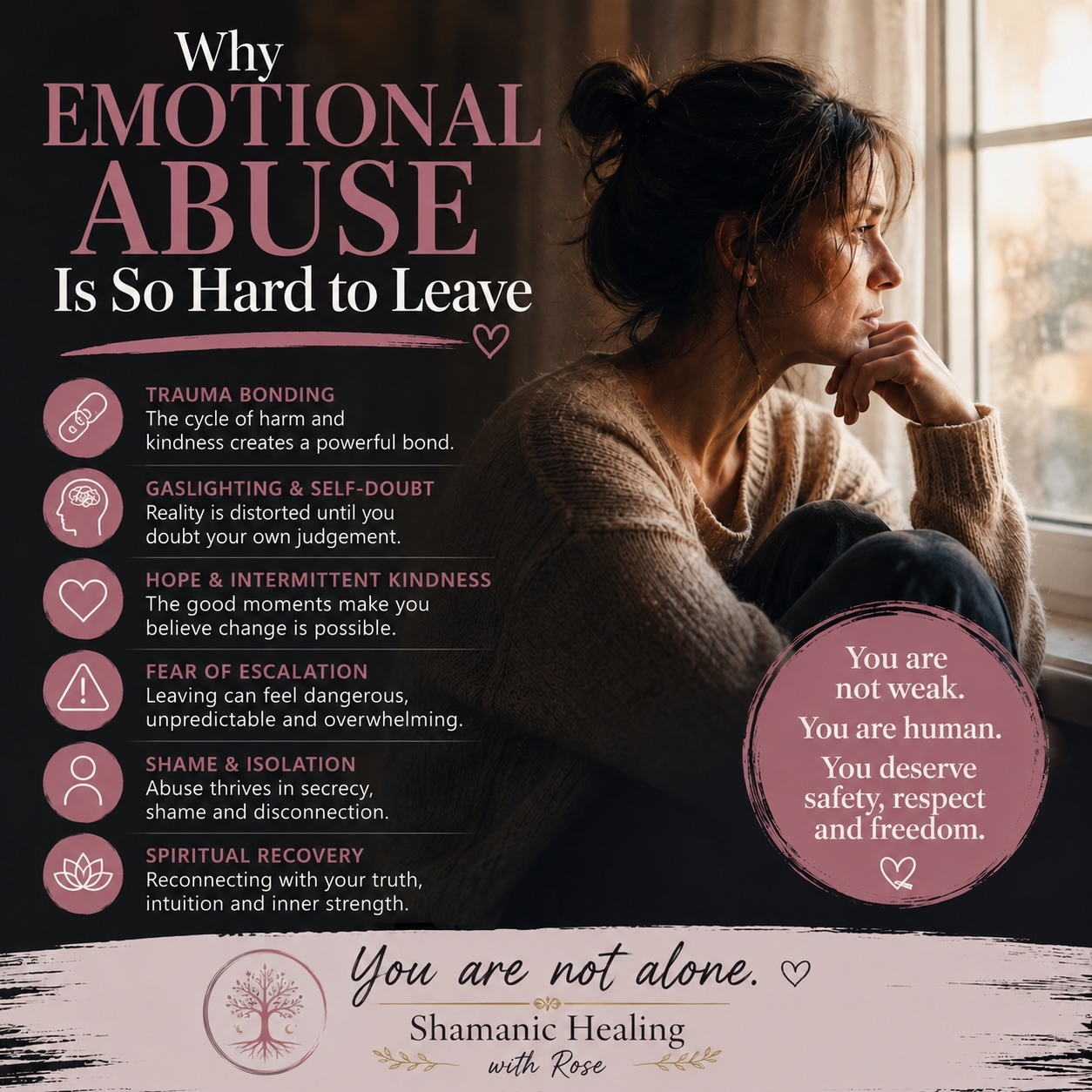
One of the most misunderstood aspects of emotional abuse is why someone stays. From the outside, it may seem obvious that a person should simply leave, but emotional abuse often works by gradually weakening a person’s confidence, clarity, independence, and trust in themselves. By the time they recognise the pattern, they may feel confused, ashamed, frightened, financially trapped, emotionally attached, or responsible for the other person’s well-being. This article explores why emotional abuse can be so difficult to leave, and why compassion, support, and understanding are far more helpful than judgment.

Trauma Bonding

One reason emotional abuse can be so difficult to leave is trauma bonding. This happens when periods of criticism, control, cruelty, withdrawal, or intimidation are mixed with moments of affection, apology, kindness, or apparent remorse. The relationship becomes emotionally unpredictable. One day, the person may feel rejected, blamed, or afraid; another day, they may feel loved, needed, or reassured that things will change.

This cycle can create a powerful attachment. The victim may begin to focus on the good moments and minimise the harm, hoping that the loving version of the person will return permanently. They may believe that if they can just explain themselves better, behave differently, avoid certain topics, or become more understanding, the relationship will improve. Over time, the nervous system becomes caught in a cycle of fear, relief, hope, and disappointment.

Trauma bonding is not a weakness. It is a survival response to an unstable emotional environment. The person may not be choosing the abuse; they may be trying to hold on to the moments of connection that make the relationship feel meaningful. This is why it can be so hard to leave, even when part of them knows that the relationship is damaging them.

Gaslighting and Self-Doubt

Emotional abuse often involves gaslighting, denial, blame-shifting, or the repeated distortion of reality. The person causing harm may insist that the abuse did not happen, that it was not serious, that the victim is too sensitive, too dramatic, unstable, selfish, or imagining things. They may twist conversations, deny what was said, or turn every attempt to raise a concern into an accusation against the victim.

Over time, this can seriously damage a person’s trust in their own judgement. They may start asking themselves: “Am I overreacting?” “Was it really that bad?” “Maybe it is my fault.” “Maybe I am the problem.” This self-doubt can make leaving feel almost impossible, because the person may no longer feel clear enough to trust their own perception of what is happening.

Gaslighting is especially harmful because it attacks the victim’s inner compass. When someone has been repeatedly told that their feelings, memories, and reactions are wrong, they may need time and support to reconnect with their own reality. Leaving an emotionally abusive relationship often begins with the quiet but powerful recognition: “I am allowed to trust what I know. I am allowed to believe my own experience.”

Hope and Intermittent Kindness

Another reason people stay is hope. Emotional abuse is rarely abusive every moment of every day. There may be times when the relationship feels loving, exciting, intimate, or normal. The abusive person may apologise, cry, promise to change, become affectionate, give gifts, or speak about the future in a way that feels convincing. These moments can be very confusing.

Intermittent kindness can make the relationship harder to leave because it gives the victim something to hold on to. They may remember who the person was at the beginning, or who they still seem to be in their better moments. They may believe the abuse is caused by stress, trauma, insecurity, alcohol, work pressure, family problems, or past wounds. They may keep waiting for the “real” person to come back.

This hope is understandable, but it can also keep someone trapped in a painful cycle. A relationship should not require someone to endure repeated harm in exchange for occasional kindness. Genuine change requires responsibility, consistency, accountability, and respect over time. Promises alone are not enough if the same damaging pattern continues.

Fear of Escalation

For some people, leaving does not feel emotionally difficult; it may feel unsafe. Emotional abuse can include intimidation, threats, stalking, financial control, social isolation, coercive control, or the fear that the other person will punish them for trying to leave. Even if there has been no physical violence, the victim may sense that the situation could escalate if they challenge the relationship or try to end it.

This is why it is not always helpful to tell someone to “just leave.” Leaving may involve practical risks around housing, money, children, pets, work, reputation, family pressure, or safety. The person may need to plan carefully, gather support, speak to a trusted friend or professional, and contact a specialist domestic abuse service before making decisions.

If there is any risk of danger, threats, coercive control, or escalation, safety should come first. The priority is not to prove a point to the abusive person or force them to understand. The priority is to protect the victim’s well-being and help them take the next safest step.

Shame and Isolation

Emotional abuse often creates shame. The victim may feel embarrassed that they stayed, ashamed that they tolerated certain behaviour, or afraid that others will judge them. They may worry that people will say, “Why didn’t you leave sooner?” or “Why did you put up with that?” These reactions can make it even harder to ask for help.

Abusive relationships can also become isolating. The person may have been criticised for seeing friends, discouraged from speaking openly, made to feel guilty for having outside support, or slowly cut off from the people who might have helped them see the situation more clearly. Even when friends and family are still present, the victim may hide what is happening because they feel confused, protective of the relationship, or afraid of not being believed.

Shame keeps abuse hidden. Compassion helps bring it into the light. If someone has stayed in an emotionally abusive relationship, it does not mean they are foolish, weak, or responsible for the abuse. It means they have been living inside a dynamic that may have slowly worn down their confidence, clarity, and sense of self. What they need is not judgment, but support, patience, and a safe space to tell the truth.

Spiritual Recovery

Emotional abuse can affect more than the mind. Many people describe feeling as though they have lost themselves. They may feel disconnected from their intuition, their body, their voice, their creativity, their confidence, or their spiritual centre. After living in a relationship where they have been criticised, controlled, blamed, or made to doubt themselves, they may need time to remember who they are outside the abusive dynamic.

Spiritual recovery can involve reconnecting with the self at a deeper level. This may include rebuilding boundaries, listening again to inner guidance, restoring a sense of personal power, and releasing the emotional weight of fear, shame, guilt, or confusion. For some people, therapy, journaling, time in nature, meditation, prayer, creative practice, bodywork, or shamanic healing may help them begin to feel grounded and whole again.

Shamanic healing, in particular, may support someone who feels emotionally fragmented, energetically drained, or disconnected from their own truth. For those who are ready to rebuild their inner strength and reclaim their voice, soul retrieval and Shamanic Subconscious Repatterning will assist, along with extraction.

By extracting any negative residues, one can clear the body and reset the energy body. Soul retrieval will bring back the soul parts (life force energy) stolen by the abuser, reinstalling empowerment and confidence. Shamanic Subconscious Repatterning will rewrite the subconscious programmes so that you can create new, supportive relationships.

Conclusion

Leaving emotional abuse is rarely simple. It can involve trauma bonding, self-doubt, fear, hope, shame, isolation, practical barriers, and a deep emotional attachment to the person causing harm. This is why victims need understanding rather than judgment. From the outside, the answer may seem obvious, but from the inside, emotional abuse can feel confusing, frightening, and painfully difficult to untangle.

If you recognise yourself in this article, try to take your feelings seriously. You do not have to make every decision at once. Begin by noticing the pattern, trusting your own experience, and reaching out for safe, confidential support. Healing starts when you are able to say, even quietly to yourself, “What happened to me matters. My feelings matter. I deserve to feel safe, respected, and free to be myself.”

About Rose

Rose is a Shamanic Practitioner offering in-person and distance Shamanic Healing Sessions and Shamanic Life Coaching, specialising in narcissistic abuse.

Rose works without hallucinogenic or psychedelic plant medicines. Instead, she uses an ancient drumming method to access this altered state of consciousness. A session may include a tailored combination of Power Animal Retrieval, Divination, Soul Retrieval, Energy Body Healing, Psychopomp, and Extraction to remove negative energy and blockages.

Each session with me includes Shamanic Subconscious Repatterning. A powerful system that changes the subconscious programmes that drive unwanted behaviour. This method heals trauma at its source, removes the self-limiting programme, and then rewrites a new way of being.

Shamanic Healing can be accessed face-to-face in the Rose Healing Room, Petersfield, East Hampshire or remotely through Distance Healing Sessions. Because the work is carried out in the Spirit Realm with the support of Rose’s Spirit Guides, the client does not need to be physically present in the same room. Distance sessions are narrated in real time, and clients receive an audio recording by email afterwards.

For further information about Shamanic Healing, go to: https://www.roseautumn.com/shamanic-healing/
Plant Medicine Retreats: The Need for Discernment

This is a personal testimony about the shadow side of some plant medicine retreats, and the harm that can occur when powerful medicines are served without sufficient protection or integrity. Plants can offer profound healing; I know from repeated personal experience with psychedelics, including Iboga. But I also know that poorly held ceremonial spaces can leave participants vulnerable to spiritual, emotional, and psychological harm.

I am not against the use of plant medicines, nor is this a criticism of all practitioners who work with them. My concern is with the people who may be under-trained, psychologically unintegrated, spiritually inflated, or operating from ego rather than service to others.

Over the past seven years, I have witnessed troubling patterns in spiritual and plant medicine circles: exploitation, weak boundaries, manipulation, and narcissism. I have encountered issues that may put both the paying participants and those assisting at risk.

The danger is the unsafe container, not the plant medicine retreat

My first Iboga experience as a participant brought me dramatic physical, mental, and spiritual healing. The “wood”, as Iboga is sometimes called, is an intelligent plant; its Spirit assessed my needs and responded with a profound healing that I was ready to accept.

At that time, I had already done preparatory work on myself: I had been teetotal for over fifteen years, had completed ten years of daily meditation practice and five years of psychotherapy, and had spent twenty years studying nutrition and natural health in relation to optimising mental health. I believe this preparation is the main reason Iboga worked so well for me.

As a Shamanic Practitioner, now working with drumming rather than plant medicines, my understanding is that the power of Shamanic Healing is dependent on the practitioner having a direct, clear connection between Mother Earth and Father Sky to bring down and ground the energy for the client.

Looking back at my fifteen Iboga experiences, both as a participant and an assistant, I no longer believe that the healings came because of the healing capacity of those holding the ceremonial space. I believe the healing came due to the medicine itself and because I was ready. What I did not understand at the time was that while I had opened myself to deep healing, I had also opened myself to something darker.

In practical terms, I did not do what I would now advise others to do. The retreat was booked for me by my then-husband after he met someone connected with the ceremonies at a party. I did not properly research the practitioners, the lineage, the safety protocols, or the risks. I packed a bag and arrived in trust. That openness helped the medicine work, but it also left me vulnerable.

Financial exploitation

One of the clearest warning signs for a retreat is the use of unpaid assistants or “space holders” who work all weekend without payment, while the retreat leader charges large sums to those attending. The title sounds elevated, but in practice, the role includes general unpaid domestic labour, such as cleaning, dealing with vomit, and working in the kitchen.

Of the three practitioners I worked with, only one offered payment, and he was the one with the greatest integrity. Assistants were told they were receiving healing, gaining experience, or being of service. I have seen the same pattern in the spiritual festival circuit, where charisma and spiritual language can be used to extract unpaid labour for workshops and talks while the organisers profit financially.

This is where discernment is needed. Spiritual language should never be used to disguise exploitation. True service does not require people to override their instincts, accept poor treatment, or donate their labour to someone else’s profitable enterprise. In healing communities, we need to recover our spiritual sovereignty and the ability to say no without guilt. Sacred service should not become a mask for exploitation.

Boundaries and conduct

The patterns of exploitation I witnessed also had a darker aspect. I have witnessed vulnerable participants in search of healing becoming entangled in dynamics that, in my view, crossed ethical lines. Plant medicines can open a person very deeply, making them emotionally raw, psychically open, and highly impressionable. This is why retreat leaders must have strong boundaries, maturity, and integrity. Where these qualities are lacking, the ceremonial space itself can become spiritually unsafe.

A further concern is sexual and emotional boundary-crossing. In my experience, some vulnerable women became drawn into confusing personal or sexual dynamics. Where plant medicine has opened someone, the practitioner carries great responsibility to maintain impeccable boundaries. Any blurring of boundaries through inappropriate hands-on healing, romantic attraction, or spiritual authority should be treated as a serious warning sign.

Sadly, I have also repeatedly witnessed male healers and participants using retreats as a way of meeting women. In my opinion, the focus should always be on the healing, as sexual distractions can interfere with the participant’s healing process.

Additionally, I twice experienced fellow female retreat workers losing control and screaming at me in rage for something they considered I had done wrong. They later realised that I was working with the medicine for the benefit of the participant in both instances. But at the time, it was deeply upsetting to be in an open state and experience unprovoked verbal abuse.

My first experience: profound healing, followed by confusion

I have learned that confusion is always an early warning sign that a situation or person is out of alignment with me and my journey.

As a participant at a retreat for the first time, I had a strong inner experience that I could not then explain. I felt as though something was trying to persuade me to leave my husband and draw me towards the ceremony leader. I remember feeling tormented, yet inwardly very clear: I am married. I do not want this.
It felt as though I was under some kind of spell. Later, I became intuitively aware of nightly attempts at psychic connection by one of the retreat support workers. I later discovered that she was a kitchen sink witch. I believe that I was under spiritual attack, and that work was being done in the spiritual realm with the intention of influencing my behaviour in the physical world.

In the months that followed, my life began to unravel in ways that shocked me. I left my husband of nineteen years, becoming a broke single parent with a serious illness that required major surgery.

I found myself drawn into a confusing, emotional and energetic dynamic connected to the man involved in these ceremonies. I later met a woman who had also been a participant in one of his ceremonies and who had become entangled in an emotionally abusive relationship with him for four years.

Space-holding failure

Further serious concerns emerged when, due to my psychic skills, I was invited by the same practitioner to act as an unpaid “space holder”. On one occasion, there were ten participants in the room, and I was left alone to hold the space without either the retreat leader or the others being present. I now understand that this was dangerous. I had natural psychic sensitivity, but I had not been trained to hold that kind of field, and I should never have been placed in that position.

A medicine as powerful as Iboga requires a tightly held and protected ceremonial container, not only for participants but for those assisting. To leave a novice assistant alone is not a minor lapse; it reveals a fundamental misunderstanding of ceremonial responsibility.

That night, I felt a dark energy enter the space, and I believe it entered me. Afterwards, something in me felt blocked, as though I was no longer moving forward with my healing. At the time, I could not fully explain it, but I knew something was wrong.

After-effects and confirmation

The first confirmation came when I later went to another shamanic practitioner, someone who worked without plant medicine and used traditional methods, including drumming and extraction work. He found a dark energy in me and removed it.

What struck me most was that he said the energetic imprint of what he found in me was the same as he had found in another woman I knew who had also worked for the same Iboga practitioner. He had also encountered a similar energy in another client who had attended one of those retreats. For me, this was deeply significant. It suggested that what I had experienced was neither random nor imagined.

The clearest confirmation came later with a second healer, again someone working without plant medicine, using hypnosis techniques to work on the subconscious. During a weekend retreat, his partner was working with me on deep trauma, but she could not get through. She found I was blocked in an unusual way. She had successfully used the same method with others, so the issue was not a lack of skill on her part. The problem was something inside me.

She called in her partner, who was a more experienced healer. He worked on me and then said he was getting an image of someone and described, very precisely, the Iboga practitioner I had been involved with. His perception was that this man had placed a block on my healing.

This was a profound and shocking moment. This healer identified the man exactly, without prompting, and recognised that something had been done energetically to obstruct my progress. Whether that blockage had been placed consciously, as a means of control, or unconsciously through darker forces working through him, I cannot say with certainty.

From that point onward, a great deal made sense. It explained why I had felt confused, why my healing had stalled, and why some people in his circle, even after years around such a powerful medicine, still appeared to be operating from ego and denial rather than genuine transformation and heart-centred care.

It felt as though something had deliberately obstructed my spiritual development to prevent me from moving forward. But it also felt as though the universe stepped in, leading me to practitioners who were able to recognise and correct the problem.

After that blockage was removed, my healing deepened, I grew stronger, and stopped taking plant medicines. I continued my training and my own shamanic healing work using drumming. I went through a process of observing my behaviour, identifying the underlying trauma, extracting anything that shouldn’t be there, carrying out soul retrievals, and changing the beliefs and patterns that had previously led me into harmful dynamics.

Shamanic healing enabled me to make significant progress in a gentle and manageable way that naturally unfolded. It smoothed dramatic shifts and created subtle changes that were much less disruptive to my daily life, but just as effective for my healing journey.

No aftercare

The biggest issue with weekend plant medicine retreats is the total lack of aftercare for the participants. If they have fully surrendered to the medicine and allowed it to work, they may be hit with the realisation that many aspects of their lives have been a lie. They may suddenly find that their job is unfulfilling, they don’t truly love their romantic partner, or dislike the place where they live.

Finding one’s true self is a beautiful gift, but it can be disconcerting to realise the extent to which one’s life may be out of alignment with one’s soul purpose. In my experience, follow-up counselling or integration support is rarely provided after weekend plant medicine retreats, and counsellors in local communities may not always understand the spiritual, emotional, and psychological aftermath of these experiences. At such a vulnerable time, participants need support from someone with appropriate experience, whether that is a practitioner familiar with plant medicine, a trauma-informed counsellor, or someone trained in psychedelic integration.

Ego and charisma

Discernment is essential when it comes to any healing retreat, particularly those involving powerful plant medicines. A practitioner may appear charismatic, psychic, spiritually knowledgeable, or confident, and still be deeply compromised by ego, narcissism, or darker distortions. In my experience, unsafe practitioners are a real danger in all healing communities.

Over time, I came to question how teachings are transmitted, particularly where Westerners travel abroad for initiations before bringing that work back into Western retreat settings. A person may undergo powerful initiatory experiences, meet guides, open psychic perception, and then return believing themselves ready to hold space for others. But if their trauma, ego, sexuality, and need for status remain unintegrated, what they transmit may be distorted. The medicine may be sacred, and the tradition itself may carry deep ancestral wisdom, but the human vessel through which that medicine is served still matters.

Another thing I learned is that plant medicines do not always work on everyone in the same way. They may reveal, cleanse, and deeply heal trauma where there is willingness, humility, and readiness. But where there is denial, spiritual pride, or refusal to examine one’s own behaviour, the medicine may not produce any transformation. This is why psychic ability or repeated exposure to plant medicine should never be confused with spiritual wisdom.

I also believe that in the modern West, many people are approaching plant medicines too early, before they have done enough foundational inner work. Traditionally, plant medicines were often held within strong initiatory and cultural containers. There was preparation, humility, training, accountability, and community. They were not simply offered to anyone able to pay as a means of earning an income.

In Britain, much of our own indigenous healing wisdom was broken long ago. Our traditions were attacked, suppressed, absorbed, and driven underground through successive waves of religious, political, and cultural control. That loss has consequences. Many Western seekers now look elsewhere for healing, but without enough grounding, context, or discernment. At the same time, we live in a culture saturated with ego, image, consumerism, and narcissism. Under those conditions, powerful medicines can easily become entangled with spiritual inflation rather than true service to others.

Advice to readers

I still believe Iboga is an extraordinary medicine that can bring profound change. But because it is so powerful, it must be approached with great care. Surrendering to the medicine should not mean surrendering your discernment.

Participants need a properly held ceremonial space, professional aftercare, and retreat organisers who are ethically sound, spiritually mature, and psychologically integrated.

My advice to anyone considering such a retreat is to find personal recommendations and ask questions. Find out how the practitioner was trained, how long they have been practising, how they handle safety, what support they provide, and whether their clients truly trust them. Do not place anyone on a pedestal simply because they appear spiritually gifted or wear an impressive outfit.

Build your own grounding first. For me, this meant cutting out alcohol, focusing on nutrition, daily meditation, regular contact with the earth, and honest self-observation.

There are ethical healers with humility, grounded experience, and strong boundaries. I know this because I have worked alongside one and seen the difference firsthand. My journey has left me deeply grateful for the profound, life-changing healing I received, but also sobered by the behaviour I encountered. This is not a condemnation of the medicine, nor of everyone who serves it; it is a call for discernment.

The medicine is powerful, but those who serve it must do so with integrity.

About Rose

Rose is a Shamanic Practitioner trained in traditional shamanism. She is a member of the Federation of Holistic Therapists and is fully insured for in-person and distance Shamanic Healing sessions, as well as Shamanic Life Coaching. She specialises in supporting people recovering from narcissistic abuse and those who are unsettled following plant medicine experiences.

Rose works without hallucinogenic or psychedelic plant medicines. Instead, she uses an ancient drumming method to access this altered state of consciousness. A session may include a tailored combination of Power Animal Retrieval, Divination, Soul Retrieval, Energy Body Healing, Psychopomp, and Extraction to remove negative energy and blockages.

Each session with me includes Shamanic Subconscious Repatterning. A powerful system that changes the subconscious programmes that drive unwanted behaviour. This method heals trauma at its source, removes the self-limiting programme, and then rewrites a new way of being.

Shamanic Healing can be accessed face-to-face in the Rose Healing Room, Petersfield, East Hampshire or remotely through Distance Healing Sessions. Because the work is carried out in the Spirit Realm with the support of Rose’s Spirit Guides, the client does not need to be physically present in the same room. Distance sessions are narrated in real time, and clients receive an audio recording by email afterwards.

For further information about Shamanic Healing, go to: https://www.roseautumn.com/shamanic-healing/
How to Avoid Crossing Emotional Boundaries in Conversation

There are times when life becomes painful, confusing, frightening, or overwhelming, and we naturally turn to other people for comfort and perspective. Healthy relationships depend on this kind of sharing.  But there is a difference between mutual support and crossing emotional boundaries.

Emotional dumping happens when one person offloads intense feelings, problems, complaints, or distress onto another person without checking whether they have the time, energy, or willingness to receive it. It can also happen when someone dominates a conversation, talks at length without noticing the other person’s responses, or repeatedly uses casual social encounters as an opportunity to process their own emotions.

Most people who do this are not deliberately trying to be unkind. Often, they are lonely, anxious, overwhelmed, or unaware of how much space they are taking up. But even when there is no bad intention, the impact can still be draining for the person on the receiving end.

Learning to respect other people’s conversational and emotional boundaries is an important part of emotional maturity. It allows relationships to feel safer, more balanced, and more genuinely connected.

Ask Before You Offload

One of the simplest ways to avoid crossing a boundary is to ask permission before sharing something heavy.

Instead of launching straight into a painful story or stressful situation, you might say:

“Do you have the headspace for something a bit heavy?”

“Is now a good time to talk about something I’m struggling with?”

“I’d really value your perspective, but I don’t want to overwhelm you.”

“Can I share something, or would another time be better?”

This gives the other person a choice. It shows that you recognise they have their own inner world, their own responsibilities, and their own limits.

If they say they are not available, try not to take it as rejection. A person can care about you and still not be able to hold a difficult conversation at that moment.

Notice the Difference Between Sharing and Dumping

Sharing is relational. It leaves room for the other person.

Dumping is one-sided. It pours everything out without checking what is happening for the listener.

A useful question to ask yourself is:

“Am I having a conversation, or am I using this person as a container for my distress?”

In a healthy conversation, both people have space to speak. There are pauses, questions, responses, and a sense of mutual presence. In emotional dumping, one person may talk for a long time while the other becomes quiet, tired, trapped, or overwhelmed.

If you notice that you have been speaking continuously for several minutes, pause and say:

“I’ve been talking for a while. How are you doing with all this?”

“I don’t want to dominate the conversation.”

“I realise I’ve gone into a lot of detail. Shall I pause there?”

These small moments of self-awareness can make a significant difference.

Watch the Other Person’s Signals

People often communicate discomfort before they say it directly.

They may start giving shorter answers. They may look away, check the time, step backwards, become physically still, or stop asking questions. Their tone may become flat. They may say things like “Oh dear,” “That sounds difficult,” or “I’m sorry to hear that,” without adding much else.

These can be signs that the person is listening politely but no longer has the capacity to engage.

If you notice this, do not push harder. Pause. Give them an exit.

You could say:

“I realise this is a lot. I’ll leave it there.”

“You look as though you may need to get on.”

“Thank you for listening. I don’t want to keep you.”

This is not awkward. It is considerate.

Be Careful With Casual Encounters

Not every meeting is an invitation for a deep emotional conversation.

If you bump into someone in the street, at the shops, while they are walking their dog, or when they are clearly on their way somewhere, it is usually best to keep the conversation light unless you have checked first.

Someone may be polite, but that does not mean they are available. They may be tired, busy, recovering from their own difficult day, or simply wanting a quiet moment.

A good rule is: do not assume access to someone’s time simply because they are physically present.

You can say:

“It’s lovely to see you. I won’t keep you.”

“I’d love to catch up properly another time.”

“Are you in a rush, or do you have five minutes?”

This gives the other person space to answer honestly.

Keep an Eye on Time

When we are emotionally activated, we often lose track of time. What feels like a quick update to us may feel like a long monologue to someone else.

If you know you tend to talk a lot, practise setting internal limits. For example, aim to explain the main issue in two or three minutes, then pause.

You might say:

“The short version is…”

“I’ll try not to give you the whole saga.”

“There’s a lot to this, but the main thing is…”

This helps you become clearer and less overwhelming. It also respects the listener’s attention.

Ask Yourself Why You Are Telling This Person

Before sharing something intense, it can help to ask:

“What am I hoping for from this conversation?”

Do I want comfort? Advice? Validation? A witness? Practical help? Or am I simply trying to discharge anxiety?

There is nothing wrong with needing support. But if you are repeatedly turning to the same person, without their clear agreement, it may be time to widen your support system.

Some things are better taken to a therapist, counsellor, support group, journal, helpline, or trusted friend who has explicitly agreed to be part of that conversation.

Friends and acquaintances can offer kindness, but they cannot be expected to function as an unlimited emotional processing service.

Practise Reciprocal Conversation

A good conversation has movement in both directions.

If you have shared something about yourself, make space for the other person. Ask:

“How are things with you?”

“What has your week been like?”

“I’ve talked a lot. I’d like to hear how you are.”

Then listen to the answer. Do not immediately turn the conversation back to yourself.

Reciprocity is not about keeping a perfect score. It is about being genuinely interested in the other person’s experience, not just their usefulness as a listener.

Learn to Tolerate a Boundary

One of the clearest signs of emotional maturity is how we respond when someone sets a limit.

If someone says they cannot talk, need to go, or do not have the capacity, try to receive that boundary respectfully.

You might say:

“Of course. Thanks for letting me know.”

“I understand. We can speak another time.”

“Thank you for being honest.”

Avoid sulking, guilt-tripping, pushing, or making the other person responsible for your feelings. A boundary is not necessarily a rejection. It is often an attempt to keep the relationship healthy.

Develop Self-Awareness

If you are worried that you may sometimes talk too much or emotionally dump, that concern itself is a good sign. It means part of you is already becoming more aware.

You can build on that by reflecting after conversations:

Did I ask whether it was a good time?

Did the other person have space to speak?

Did I notice their body language?

Did I repeat the same points several times?

Did I leave the conversation feeling relieved, while they seemed drained?

Did I ask how they were?

This is not about shaming yourself. Shame rarely helps people change. It is about becoming more conscious, more considerate, and more able to regulate your own emotional needs.

Find Healthier Ways to Process Emotions

Sometimes people emotionally dump because they do not yet have enough ways to process distress internally.

Useful alternatives include journaling, walking, therapy, voice notes to yourself, meditation, creative practice, breathwork, or writing down the key points before speaking to someone else. These practices can help you calm your nervous system before you reach for another person.

Then, when you do speak, you are more likely to communicate clearly rather than flood the conversation.

Final Thoughts

We all need care, compassion, and human connection. But other people also have limits. Respecting those limits does not make relationships colder; it makes them safer.

Before sharing something intense, pause. Ask permission. Notice the other person. Leave room for them. Be willing to stop.

The aim is not to become guarded or emotionally silent. The aim is to become relationally aware.

When we learn to share with consent, listen with curiosity, and respect the emotional capacity of others, our conversations become less draining and more genuinely connected.

Further Reading

Read about my experience of one-sided communication here: https://www.roseautumn.com/2026/06/when-someone-talks-at-you/

Read about my experience of emotional dumping here: https://www.roseautumn.com/2026/06/emotional-dumping

Read about my experience of setting boundaries here: https://www.roseautumn.com/2026/06/boundary-setting-reactions/

Read about my experience of gaslighting here: https://www.roseautumn.com/2026/06/gaslighting/

For further information about Shamanic Healing, go to: https://www.roseautumn.com/shamanic-healing/
About Rose

Rose is a Shamanic Practitioner trained in traditional shamanism. She is a member of the Federation of Holistic Therapists and is fully insured for in-person and distance Shamanic Healing sessions, as well as Shamanic Life Coaching. She specialises in supporting people recovering from narcissistic abuse.

Rose works without hallucinogenic or psychedelic plant medicines. Instead, she uses an ancient drumming method to access this altered state of consciousness. A session may include a tailored combination of Power Animal Retrieval, Divination, Soul Retrieval, Energy Body Healing, Psychopomp, and Extraction to remove negative energy and blockages.

Each session with me includes Shamanic Subconscious Repatterning. A powerful system that changes the subconscious programmes that drive unwanted behaviour. This method heals trauma at its source, removes the self-limiting programme, and then rewrites a new way of being.

Shamanic Healing can be accessed face-to-face in the Rose Healing Room, Petersfield, East Hampshire or remotely through Distance Healing Sessions. Because the work is carried out in the Spirit Realm with the support of Rose’s Spirit Guides, the client does not need to be physically present in the same room. Distance sessions are narrated in real time, and clients receive an audio recording by email afterwards.

For further information about Shamanic Healing, go to: https://www.roseautumn.com/shamanic-healing/

Gaslighting

Some people react badly when you set a boundary. This post explores gaslighting, narcissistic traits, emotional abuse, and how to recognise the pattern to protect your emotional well-being.

My recent blog posts have discussed a pattern of one-sided communication and emotional dumping. I explained how one person in particular would talk at length, often in public, when I was trying to relax or get things done, forcing me into the role of listener. Because I was given little or no natural opening to speak, the dynamic became habitual: she spoke, I was caught off-guard, and accommodated.

In the most recent interaction, I attempted to break that pattern. Because she was not leaving space for me to participate, I spoke over her to get my point across. In effect, I briefly mirrored the very behaviour she had been using with me. Her reaction was disproportionate: she became deeply offended, had an emotional outburst, and stormed away.

She later became triggered upon seeing the title of one of my blog posts, and, without having read it, left me a voice note containing accusations that diverted the attention away from her.

She reframed the situation so that my boundary became the problem, rather than the long-standing pattern that led to it. Instead of acknowledging that she had repeatedly monopolised conversations, she shifted the focus onto my behaviour, my perceived lack of empathy, and my personal shortcomings.  She even gave me her diagnosis of a perceived medical condition as though she were an expert.

A reaction like this can make one question whether we were unreasonable to raise the issue in the first place.  This kind of self-doubt is a key feature of gaslighting and a clue that you may be in a dysfunctional relationship.

What Gaslighting Is

Gaslighting is a form of psychological manipulation in which someone causes another person to doubt their own perception, memory, judgment, or emotional response. It often involves denying what happened, minimising the impact of their behaviour, reversing blame, or presenting the other person as irrational, oversensitive, confused, cruel, or unstable.

In boundary-setting situations, gaslighting often appears when the person who crossed the boundary refuses to engage with the boundary itself. Instead, they make the issue about the tone, timing, character, or mental state of the person who objected. The result is that the original problem disappears from view, and the person setting the boundary is pressured to defend themselves instead.

In my experience, the gaslighting was an attempt to reframe my boundary as the problem, rather than acknowledging the repeated one-sided communication and emotional dumping that made it necessary for me to set the boundary in the first place.

Distorting Reality

Gaslighting is a behaviour that occurs when someone distorts or denies reality to make another person doubt their own experience.

Distorting, denying, minimising, or reframing reality causes a person to doubt their own perception or judgement about the situation. As such, gaslighting is recognised as a form of psychological abuse, especially when it is repeated and used to gain control over a person.

Over time, in close relationships, it can form part of a pattern of emotional abuse. Gaslighting is one form of emotional abuse, but emotional abuse is much broader because it involves the display of additional traits.

Emotional abuse is a pattern of behaviour where one person undermines, controls, frightens, belittles, manipulates, or destabilises another person psychologically or emotionally. It does not always involve shouting or obvious cruelty. It can be subtle, repeated, and deniable, which is why it can be so confusing.

Narcissism

Gaslighting can occur in relationships where a person is unwilling or unable to tolerate accountability. It is sometimes associated with narcissistic traits and narcissistic abuse.

Narcissism is a personality style or trait pattern. Someone with strong narcissistic traits may have a fragile ego, a need to be right, difficulty accepting criticism, low accountability, entitlement, or a tendency to reverse blame. In that context, gaslighting can become one of the tools they use to protect their self-image or maintain control.

Narcissistic Abuse

Gaslighting can be part of narcissistic abuse.  In narcissistic abuse, gaslighting often appears after you challenge the person, set a boundary, or name their behaviour. Instead of reflecting on what they did, they may say or imply:

  • “That never happened.”
  • “You’re too sensitive.”
  • “You’ve misunderstood everything.”
  • “You’re the one being cruel.”
  • “I was only trying to help.”
  • “You have no empathy.”
  • “There’s something wrong with you.”

The key move is that the focus shifts away from their behaviour and onto your alleged defect. That is why it can feel so destabilising. You start by trying to discuss a real boundary issue, and suddenly you are defending your sanity, character, memory, or emotional stability.

In my incident, the possible narcissistic-abuse pattern is: I disrupted a long-standing dynamic in which she expected to speak, and I was expected to listen. When I strongly asserted myself, she responded as though my boundary was the offence. She then reframed me as unkind, unempathic, unstable, or the real aggressor, which fits the gaslighting pattern.

Gaslighting is reversing the moral frame so that the person setting the boundary is made to feel guilty for objecting.

Many people struggle to recognise gaslighting when it happens, especially when it follows an attempt to set a boundary. The reversal can be so sudden and convincing that the person who objected begins questioning themselves rather than the behaviour that harmed them. Learning to recognise that shift is an important part of protecting one’s emotional well-being.

Prevalence of Narcissism

Research suggests that Narcissistic Personality Disorder is relatively uncommon. Estimates vary: one large US study found a lifetime prevalence of 6.2%, while a systematic review found an average prevalence of 1.06% in non-clinical adult samples. However, I think these figures can be misleading if they are used to suggest that narcissistic behaviour itself is rare. This also raises a practical difficulty with prevalence statistics.

People with strong narcissistic traits may not experience themselves as the problem. They may blame others, feel wronged when challenged, or see boundaries as an attack. As a result, they may be less likely to seek therapy for narcissism itself, even if they later enter therapy because of depression, relationship breakdown, anger, anxiety, or another crisis.

But a person does not need to have diagnosed Narcissistic Personality Disorder to behave in ways that are narcissistic, damaging, or emotionally unsafe. Many people show narcissistic traits without ever receiving, seeking, or qualifying for a formal diagnosis.

Narcissistic traits exist on a spectrum. At the milder end, they may appear as vanity, defensiveness, self-importance, or a need for admiration. At the more harmful end, they may appear as entitlement, lack of empathy, manipulation, refusal to respect boundaries, or a tendency to make themselves the victim when challenged.

Narcissistic traits are very common, with up to 80% of the population having them. These traits can be harmful in relationships.

Around half of the population score above the midpoint on a trait scale, displaying behaviours such as:

  • repeatedly talking over others;
  • dominating conversations;
  • using people as an emotional dumping ground;
  • refusing accountability;
  • becoming angry when a boundary is set;
  • twisting events to make themselves the victim;
  • dismissing another person’s needs or feelings; or
  • feeling entitled to other people’s time, attention, labour, or sympathy.

Those traits can appear in people who are immature, emotionally dysregulated, entitled, traumatised, socially unaware, selfish, or simply used to getting their own way.

Rather disturbingly, 10-25% of the population display more noticeable entitlement, superiority, admiration seeking, and defensiveness. They may not meet the threshold for a personality disorder, but they can still cause real harm in relationships.

For that reason, I think it is important to distinguish between clinical Narcissistic Personality Disorder and harmful narcissistic behaviour. The former may be relatively uncommon; the latter is, in my experience, far more widespread. We live in a culture where self-promotion, entitlement, emotional dumping, and poor respect for boundaries are increasingly visible, and people need language for recognising these patterns before they become trapped inside them.

Narcissistic traits have become prevalent in society, and it is time that more people became aware so that they can protect themselves from emotional abuse.

Further Reading

Read about my experience of one-sided communication here: https://www.roseautumn.com/2026/06/when-someone-talks-at-you/

Read about my experience of emotional dumping here: https://www.roseautumn.com/2026/06/emotional-dumping

Read about my experience of setting boundaries here: https://www.roseautumn.com/2026/06/boundary-setting-reactions/

For further information about Shamanic Healing, go to: https://www.roseautumn.com/shamanic-healing/
About Rose

Rose is a Shamanic Practitioner trained in traditional shamanism. She is a member of the Federation of Holistic Therapists and is fully insured for in-person and distance Shamanic Healing sessions, as well as Shamanic Life Coaching. She specialises in supporting people recovering from narcissistic abuse.

Rose works without hallucinogenic or psychedelic plant medicines. Instead, she uses an ancient drumming method to access this altered state of consciousness. A session may include a tailored combination of Power Animal Retrieval, Divination, Soul Retrieval, Energy Body Healing, Psychopomp, and Extraction to remove negative energy and blockages.

Each session with me includes Shamanic Subconscious Repatterning. A powerful system that changes the subconscious programmes that drive unwanted behaviour. This method heals trauma at its source, removes the self-limiting programme, and then rewrites a new way of being.

Shamanic Healing can be accessed face-to-face in the Rose Healing Room, Petersfield, East Hampshire or remotely through Distance Healing Sessions. Because the work is carried out in the Spirit Realm with the support of Rose’s Spirit Guides, the client does not need to be physically present in the same room. Distance sessions are narrated in real time, and clients receive an audio recording by email afterwards.

For further information about Shamanic Healing, go to: https://www.roseautumn.com/shamanic-healing/

Why Some People React Badly When You Set a Boundary

Some people are comfortable crossing your boundaries, but become deeply offended the first time you stop accommodating them.

In my previous two blog posts, I explored my experiences of one-sided communication and emotional dumping from several acquaintances over the past seven years. These episodes would come when I was out walking my dog or shopping in town, and always took me by surprise when I was trying to relax or get things done. This element of surprise left me unable to set boundaries successfully, and, as such, the situation became habitual for the speakers.

With one person in particular, I noticed a repeated pattern of both one-sided communication and emotional dumping. Every encounter went on too long, often leaving me feeling derailed.

After a couple of recent interactions with her in quick succession, which both occurred while I was trying to relax with a friend after a busy week, I realised that I have become fed up with the dynamic.

As a single working parent with two children and a dog, together with being the only child of an aged mother with dementia, I have too much on my plate to have time to take on board other people’s problems.

Over the years, I tried several ways of managing the dynamic, but nothing changed. In our most recent interaction, she had left me no natural opportunity to participate in the communication, so this time I just talked over her with my points.

Double Standards

Although she had repeatedly spoken over me over the years, the first time I did the same to her, she became deeply offended, reacted with an emotional outburst and stormed away. The double standard was illuminating. My attempt to speak had not merely interrupted her sentence; it had disrupted a relationship in which she expected to speak and expected me to listen.

That reaction revealed an established relational role. She was accustomed to speaking while I listened. I talked over her because she provided no natural opportunity for me to speak, and I disrupted that arrangement.

Rather than consider why I needed to interrupt and talk over her, she became angry and accusatory, blaming me for overstepping her boundary and interrupting her speech.

Understanding the Dynamic

This outburst may have involved:

  • A sense of entitlement: She considered interrupting me acceptable, but experienced being interrupted as an offence.
  • Loss of control: My intervention prevented her from controlling the conversation.
  • Shame sensitivity: A small challenge may have been experienced as humiliation or rejection.
  • Poor emotional regulation: Instead of expressing irritation calmly, she discharged it through an outburst and departure.
  • A perceived boundary violation: Ironically, someone who routinely crossed my conversational boundaries reacted strongly when she believed their own boundary had been crossed.
  • A rupture in the listener–speaker arrangement: I stopped functioning exclusively as her audience and asserted myself as an equal participant.

The double standard is significant: she expected me to tolerate repeatedly being spoken over, yet could not tolerate it happening to her on one occasion.

Her response also performed an interpersonal function. By becoming offended and storming off, she shifted attention away from her conversational dominance and towards my alleged wrongdoing. I could have felt compelled to apologise, comfort her or become more cautious about speaking in future. Whether deliberate or unconscious, the outburst can restore the original arrangement by training me not to interrupt again.

It didn’t work. I allowed her to walk away feeling relieved.

Psychology

On a psychological level, the storming off was possibly an escape response to an emotion she could not regulate in the moment. The interruption itself was the trigger, but its meaning to her produced the outburst.

A plausible sequence is:

  1. I interrupted her monologue.
  2. She interpreted this as rejection, disrespect, criticism or loss of control.
  3. This activated shame, humiliation, anger or fear.
  4. She defended against the vulnerable feeling by becoming angry.
  5. She stormed off to escape the discomfort and reassert control.

Research shows that perceived rejection can generate hurt, shame and anger, while people who feel greater rejection sensitivity may interpret ambiguous behaviour as rejection and respond through anger, withdrawal or aggression.

Mechanisms

These three mechanisms may be relevant:

  • Narcissistic injury: a psychological term for experiencing an ordinary frustration as an assault on one’s importance, entitlement or self-image. My speaking challenged her expectation of having my uninterrupted attention.
  • Shame converted into anger: A momentary awareness that she was being interrupted, challenged, or no longer accommodated may have produced shame. Anger externalises that uncomfortable feeling and places the fault onto me. Research supports a relationship between shame, aversive emotional reactions and anger.
  • Loss of interpersonal control: By walking away dramatically, she ended the conversation on her terms. It also left me with possible discomfort and potentially pressured me to apologise, pursue her, or avoid interrupting her again.

It is also possible that she simply has a strong sensitivity to being interrupted because of earlier life experiences from a caregiver around being dismissed, silenced, or not heard. This can happen when the mother is a narcissist. The mother wound is a core wounding that is difficult for many to face and address.

Aftermath

The decisive question is what will happen after you set a boundary with someone who has a pattern of disregarding your boundaries. A psychologically reflective person could calm down, reconsider the incident and recognise the double standard. Someone who insists that only my interruption mattered, while remaining unable to acknowledge their persistent domination of the conversation, is protecting the existing power arrangement rather than repairing the relationship.

A useful question is whether someone will later be able to reflect and say something like, “I became upset, but I realise I had not been giving you room to speak.” That would indicate some capacity for insight and repair. If they instead blame me entirely, demanding an apology or showing no curiosity about it would suggest a more entrenched problem with reciprocity and accountability.

In my case, I did not receive any response from her until she had seen a link to my blog posts on social media. Then she decided not to read the blog for further insight, instead getting triggered and assuming the blog post was about her. She then left a voice message that made accusations against me.

She experienced my blog post as a personal accusation, even without properly checking whether it was directed at her. That suggests a high level of self-reference: she sees herself in the material, feels exposed, and reacts from that feeling rather than from the facts.

Several things are happening at once.

First, she starts the message with apparent kindness, but quickly becomes corrective. Phrases like “I’m sending this with kindness” and “there is absolutely no bad feeling on my side” sit alongside quite pointed accusations, diagnoses, and moral correction.

Second, she shifts the focus away from the original issue: her emotional dumping and my boundary. Instead, the focus becomes defensive by attacking me. That can happen when someone feels ashamed or exposed. Rather than staying with, “Did I overwhelm you? Did I take up too much space?” the conversation moves to, “You are also flawed.”

Third, she appears to be trying to reframe emotional dumping as mutual healing. There is a difference between two people consensually sharing personal difficulties and one person repeatedly unloading in a way that leaves the other drained, trapped, or unable to speak. Her message blurs that distinction. “Being present” and “having empathy” are important, but they do not oblige someone to become an unbounded emotional container.

Fourth, the allegations about me are inappropriate. It is not her place to diagnose me, and in this context, it functions less like genuine concern and more like a way to undermine my perception: “You only see it this way because something is wrong with your empathy.” That is psychologically significant. It pathologises my boundary, which can have a gaslighting effect because it encourages me to question my own perception rather than examine the behaviour itself. Gaslighting is a narcissistic trait which I will discuss in my next blog post.

Storming off and then leaving a voice note that attempts to shift the focus away from her own behaviour may both come from the same place: shame, loss of control, and a need to restore moral position. If she recognised herself in the blog post, even without reading it, she may have felt exposed. Instead of reflecting quietly, she appears to have moved into defence: explaining, accusing, equalising, and repositioning herself as kind, understanding, and wronged.

The key point is this: her reaction does not prove that my boundary was wrong. It may prove that the boundary touched exactly the part of the dynamic that had previously gone unchallenged. The issue is not simply that she was interrupted; it is that my interruption exposed a one-sided relational arrangement that had previously benefited her. 

Healing

Where a pattern of storming off in anger and making accusations when someone sets a boundary is rooted in early childhood wounds, Shamanic Healing can help a person heal the subconscious behaviours that are damaging their relationships.

A shamanic healing session can heal the underlying trauma and remove the resulting destructive subconscious behaviour patterns. Through Shamanic Subconscious Repatterning, we can receive a more positive way of being, improving the quality of our interactions and friendships.

For further information, go to: https://www.roseautumn.com/shamanic-healing/

Further Reading

Read about my experience of one-sided communication here: https://www.roseautumn.com/2026/06/when-someone-talks-at-you/

Read about my experience of emotional dumping here: https://www.roseautumn.com/2026/06/emotional-dumping

Read about my experience of gaslighting here: https://www.roseautumn.com/2026/06/gaslighting/

For further information about Shamanic Healing, go to: https://www.roseautumn.com/shamanic-healing/

About Rose

Rose is a Shamanic Practitioner trained in traditional shamanism. She is a member of the Federation of Holistic Therapists and is fully insured for in-person and distance Shamanic Healing sessions, as well as Shamanic Life Coaching. She specialises in supporting people recovering from narcissistic abuse.

Rose works without hallucinogenic or psychedelic plant medicines. Instead, she uses an ancient drumming method to access this altered state of consciousness. A session may include a tailored combination of Power Animal Retrieval, Divination, Soul Retrieval, Energy Body Healing, Psychopomp, and Extraction to remove negative energy and blockages.

Each session with me includes Shamanic Subconscious Repatterning. A powerful system that changes the subconscious programmes that drive unwanted behaviour. This method heals trauma at its source, removes the self-limiting programme, and then rewrites a new way of being.

Shamanic Healing can be accessed face-to-face in the Rose Healing Room, Petersfield, East Hampshire or remotely through Distance Healing Sessions. Because the work is carried out in the Spirit Realm with the support of Rose’s Spirit Guides, the client does not need to be physically present in the same room. Distance sessions are narrated in real time, and clients receive an audio recording by email afterwards.

For further information about Shamanic Healing, go to: https://www.roseautumn.com/shamanic-healing/
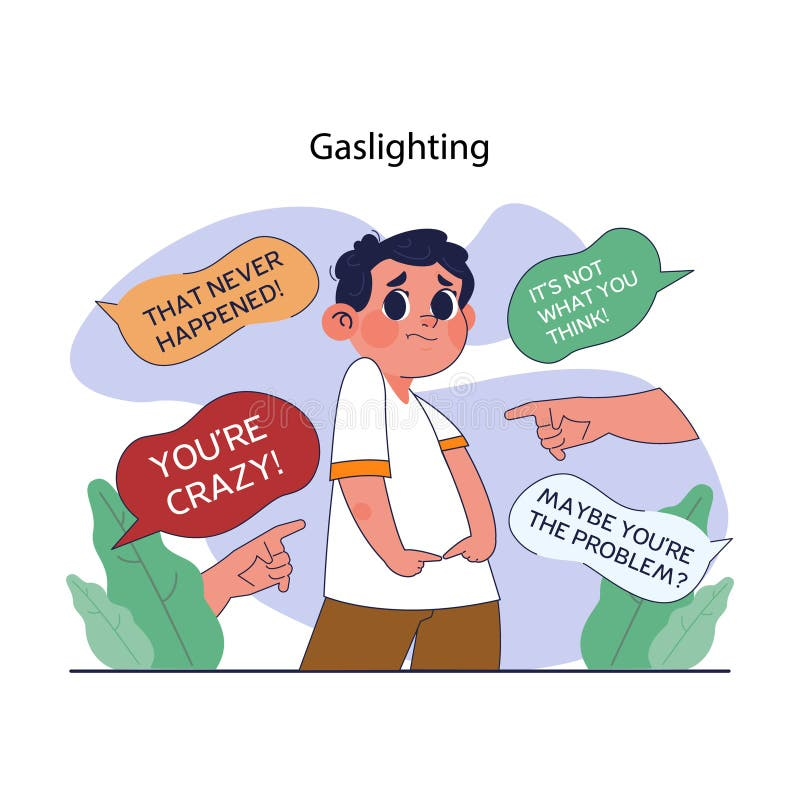
Emotional Dumping

In my last post, I explored the pattern of one-sided communication with acquaintances in my local community.  Additionally, I have also experienced some of those women persistently unloading their life problems onto me, causing the relationship to develop into a pattern of one-sided emotional regulation. Instead of processing and regulating their feelings themselves, they repeatedly shift the emotional burden onto me.  This is often called emotional dumping.

“Trauma dumping” may apply when highly distressing or intimate material is repeatedly disclosed without checking whether the listener has the willingness or capacity to receive it.

The Dynamic

The person unloading may be using the listener as:

  • an emotional container for distress they cannot tolerate alone;
  • a source of reassurance, validation or calming;
  • an unpaid therapist or crisis manager;
  • an audience who confirms their interpretation of events; or
  • a substitute for taking decisions or changing their circumstances.

Talking provides temporary relief. The listener absorbs some of the distress, so the speaker feels calmer afterwards. Because that relief is rewarding, the speaker returns and repeats the process. However, little may actually be resolved.

A cycle can develop:

  1. The person becomes distressed.
  2. They urgently contact or approach the listener.
  3. They recount their problems at length.
  4. The listener sympathises, reassures and offers solutions.
  5. The speaker feels temporarily relieved.
  6. Advice is ignored, or the underlying problem remains unchanged.
  7. The cycle begins again.

The speaker leaves feeling lighter; the listener leaves feeling heavier.

Healthy Sharing Versus Emotional Dumping

Healthy emotional sharing includes consent and reciprocity. A person might ask, “Do you have the capacity to listen to something difficult?” They remain aware of time, show interest in the listener’s life, accept boundaries and take some responsibility for addressing the problem.

Emotional dumping tends to involve:

  • repeated crises and the same unresolved stories;
  • little interest in the listener’s well-being;
  • contacting the listener mainly when something is wrong;
  • excessive detail or intensity without consent;
  • rejecting advice while continuing to demand attention;
  • becoming offended when the listener is unavailable;
  • treating access to the listener as an entitlement;
  • leaving the listener depleted, anxious or responsible.

The central issue is not that somebody has problems or needs support. Everyone sometimes needs to be heard. The problem is the persistent absence of consent, reciprocity, containment, and personal responsibility.

What May Underlie It

The behaviour can arise from loneliness, anxiety, trauma, emotional immaturity, poor boundaries, insecure attachment or difficulty regulating emotions. Some people grew up in families where feelings were either suppressed or expressed without limits. Others have discovered that repeatedly presenting themselves as helpless secures attention and closeness.

In some cases, adopting the role of the perpetual victim protects the person from confronting their own choices. Every solution may be met with a reason it cannot work because resolution would threaten the relationship organised around rescue.

This does not automatically mean the person has a personality disorder or is deliberately manipulative; however, the trait of emotional dumping is common for narcissists. The behaviour may be unconscious, but its effect on the listener remains real.

The Listener’s Role

The listener may become the rescuer, counsellor or dependable “strong one.” They may tolerate it because they:

  • equate caring with absorbing another person’s distress;
  • feel guilty when setting limits;
  • fear rejection, anger or appearing selfish;
  • derive identity or value from being needed;
  • learned in childhood to manage other people’s emotions;
  • hope that enough support will eventually create a reciprocal relationship.

A useful question is: “Am I supporting this person, or am I repeatedly regulating their emotions for them?”

A clear boundary might be:

“I care about what you are experiencing, but I do not have the capacity to keep discussing this at length. I think you need support that I cannot provide.”

Their response is informative. A person seeking genuine support may feel disappointed but respect the boundary. Someone invested in unrestricted emotional access may use guilt, anger, accusation or another crisis to pull the listener back into position.

Support

The one-sided emotional dumper should seek professional counselling to unravel their thoughts in combination with Shamanic Healing to resolve the underlying trauma.  Shamanic Subconscious Repatterning will reprogram the speaker into a new pattern of interaction, enabling friendships to flourish.

For the listener with weak boundaries, a tailored combination of Power Animal Retrieval, Cord Cutting, Soul Retrieval, Energy Body Healing, Spiritual Parasite/Entity Removal, and the removal of negative energy and blockages through Shamanic Extraction, alongside Shamanic Subconscious Repatterning to change restrictive subconscious thought patterns, will create an empowered way of being.

For further information, go to: https://www.roseautumn.com/shamanic-healing/

Further Reading

Read about my experience of one-sided communication here: https://www.roseautumn.com/2026/06/when-someone-talks-at-you/

Read about my experience of setting boundaries here: https://www.roseautumn.com/2026/06/boundary-setting-reactions/

Read about my experience of gaslighting here: https://www.roseautumn.com/2026/06/gaslighting/

For further information about Shamanic Healing, go to: https://www.roseautumn.com/shamanic-healing/
About Rose

Rose is a Shamanic Practitioner trained in traditional shamanism. She is a member of the Federation of Holistic Therapists and is fully insured for in-person and distance Shamanic Healing sessions, as well as Shamanic Life Coaching. She specialises in supporting people recovering from narcissistic abuse.

Rose works without hallucinogenic or psychedelic plant medicines. Instead, she uses an ancient drumming method to access this altered state of consciousness. A session may include a tailored combination of Power Animal Retrieval, Divination, Soul Retrieval, Energy Body Healing, Psychopomp, and Extraction to remove negative energy and blockages.

Each session with me includes Shamanic Subconscious Repatterning. A powerful system that changes the subconscious programmes that drive unwanted behaviour. This method heals trauma at its source, removes the self-limiting programme, and then rewrites a new way of being.

Shamanic Healing can be accessed face-to-face in the Rose Healing Room, Petersfield, East Hampshire or remotely through Distance Healing Sessions. Because the work is carried out in the Spirit Realm with the support of Rose’s Spirit Guides, the client does not need to be physically present in the same room. Distance sessions are narrated in real time, and clients receive an audio recording by email afterwards.

For further information about Shamanic Healing, go to: https://www.roseautumn.com/shamanic-healing/
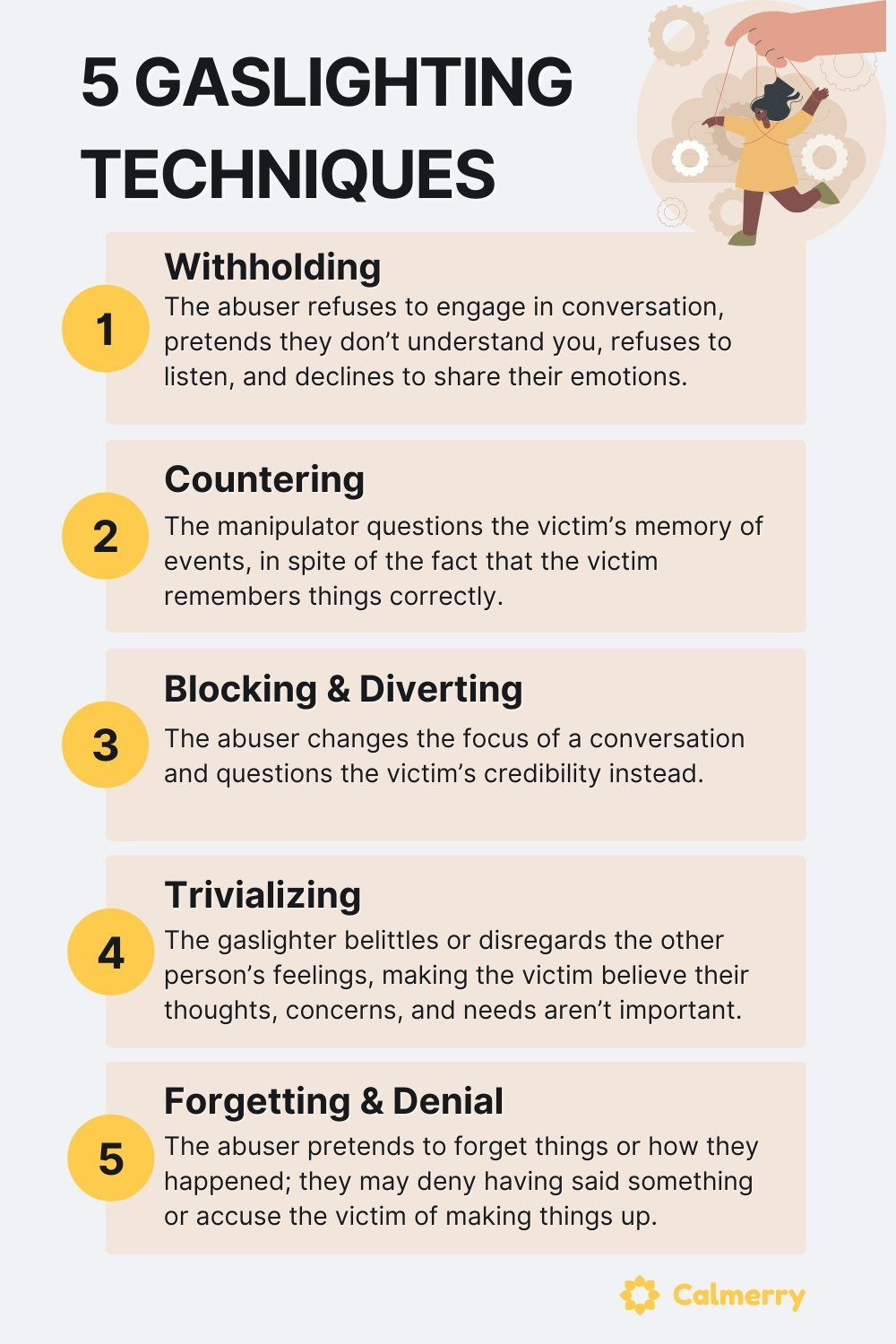
When Someone Talks at You: Recognising One-Sided and Emotionally Draining Relationships

Since moving house seven years ago, I have encountered a handful of women whose behaviour follows a remarkably similar pattern. I have realised they have consistently displayed behaviour towards me which I have never enjoyed.  I have tried to address it, but to no real effect. Over the past few weeks, these one-sided relationships have become intolerable. 

My experience is of interpersonal communication that is one-sided and poorly attuned, which happens when I’m out in town, either shopping or enjoying a dog walk. These people catch me off-guard, and I feel unprepared for the onslaught.

They always dominate the conversation, talking at me rather than with me. They tell me everything they want to say, but show little interest in what I might think or feel. They interrupt when I try to respond, and often redirect any response back towards themselves. The pattern is for them to continue speaking, often changing topics without stopping for breath, without noticing that I have withdrawn. As such, I feel that I have been treated more like an audience or emotional container than a participant.

At first, I considered each encounter separately. Over time, however, I began to recognise a recurring pattern. I was not participating in a mutually nourishing conversation. I had been assigned the role of listener.

Many people may be having similar experiences without fully recognising what is happening. They may leave certain encounters feeling unusually tired, irritated, invisible or overwhelmed, but assume they are simply being intolerant. In reality, their response may be telling them something important about the relationship.

Possible Explainations

Several very different factors can produce this pattern of behaviour:

  • Loneliness or unmet emotional needs: They may release a backlog of thoughts and feelings whenever somebody appears receptive.
  • Anxiety: Some people manage social anxiety by talking continuously, filling every silence and mentally rehearsing what they will say instead of listening.
  • Poor social awareness: They may not recognise pauses, facial expressions or attempts to contribute.
  • Emotional dysregulation: Speaking can become a way of discharging distress into another person.
  • Habitual self-centredness: They may have learned that relationships revolve around their experiences and have little curiosity about other people.
  • ADHD or impulsivity: Difficulty inhibiting speech, interrupting and holding onto a thought can affect conversational balance.
  • Hypomania or mania: Pressured, rapid and difficult-to-interrupt speech can occur, although this is usually accompanied by other significant changes in mood, energy, sleep and behaviour.
  • Narcissistic traits: Some people seek attention, admiration or emotional service without offering reciprocity. That does not automatically mean narcissistic personality disorder.
  • Trauma or insecure attachment: They may urgently seek connection while lacking the capacity to notice and respond to the person with whom they are trying to connect.

BioBots

Some of these characters will be the unensouled biobots whose purpose it is to run particular programmes aimed at training the ensouled.  The talking at people programme has been something I seem to have attracted in particular.  So it seems clear to me that this is something I need to learn how to address.

Feeling Drained

When someone monopolises a conversation, we are not merely listening; we are also doing a considerable amount of invisible psychological work. However, these encounters cause us to continually:

  • search for an opening to speak;
  • suppress your own responses;
  • absorb material you did not consent to hold;
  • monitor the other person’s emotional state;
  • manage frustration while remaining polite;
  • cope with the experience of being socially present but psychologically unseen.

That creates substantial cognitive and emotional load. The nervous system may move into a restrained fight, flight or freeze response: you want to interrupt, leave or defend your space, but social convention inhibits you. Exhaustion often follows.

The feeling of being drained is therefore not necessarily mysterious or imaginary. It may be the natural consequence of being subjected to an intense, one-sided interaction in which my presence is used, but one’s soul or self is not fully acknowledged.

Conversation Requires Reciprocity

A healthy conversation involves a natural exchange. Both people speak, listen, respond and make room for one another. There is curiosity in both directions.

When someone talks at me, that reciprocity is missing. The person may tell long stories without checking whether I am interested, interrupt when I begin speaking, or use something I have said merely as an opportunity to return to their own experiences.

I may be physically present, but I do not feel psychologically recognised.

This is sometimes described as conversational dominance, poor interpersonal attunement or a lack of conversational reciprocity. The informal term “conversational narcissism” may also be used when someone repeatedly turns conversations back towards themselves.

Why does it keep happening

A repeated experience does not necessarily mean that we are causing or that we are responsible for another person’s behaviour. The responsibility for interrupting, dominating and disregarding other people belongs to the person doing it.

Nevertheless, some qualities may make us particularly attractive to people seeking an audience. We may appear warm, thoughtful, empathic and willing to listen. We may ask perceptive questions and give another person our full attention. These are valuable qualities in reciprocal relationships, but they can be exploited in one-sided ones.

We may also wait patiently for a natural pause that never arrives, or remain polite long after we want to leave, concealing our discomfort or continuing to give someone access after the first encounter has revealed the problem.

Moving house places one among a new and relatively unfiltered group of acquaintances. People who are lonely, intrusive or hungry for attention may attach quickly to somebody who appears warm, thoughtful and willing to listen.

It is worth observing whether you:

  • remain polite long after you want to leave;
  • ask thoughtful questions that invite further disclosure;
  • wait for a natural pause that never arrives;
  • avoid interrupting because it feels rude;
  • disclose little yourself, unintentionally confirming the role of listener;
  • give further access after noticing that the first encounter was one-sided.

These are not faults. They are socially considerate behaviours that some people fail to reciprocate.

The Boundary Test

One of the clearest ways to understand the relationship is to introduce a reasonable boundary and observe what happens.

One could say:

  • “I would like to finish what I was saying.”
  • “Please let me respond before you continue.”
  • “I have noticed that I am not getting many opportunities to speak.”
  • “I only have ten minutes available.”
  • “I cannot take this in today.”
  • “I need to leave now.”

A socially anxious or overexcited person may notice, apologise and adjust. Someone with a more entrenched relational problem may ignore the boundary, speak over it, become offended, attempt to make one feel guilty or resume the same behaviour almost immediately. Someone who repeatedly ignores, contests or punishes reasonable boundaries is showing a more entrenched relational problem that will require one to reduce contact.

I personally recently experienced someone who became offended when I talked over them for the first time. They got triggered and stormed off in a fit of emotional outburst.

Their response tells me more than any label could.

Protection

By reflecting on how we feel after an encounter, we can decide that an interaction is unhealthy for us personally. Exhaustion, irritation, tension or a sense of invisibility may indicate that the exchange was not reciprocal and that we need to make a plan for future protection.

We can protect ourselves by:

  1. Setting a time limit in advance. I can state clearly that I have only five minutes available.
  2. Interrupting when necessary. It is not inherently rude to interrupt someone who consistently prevents me from participating.
  3. Naming the behaviour. Calmly saying, “I don’t feel that there is room for me in this conversation,” makes the problem visible.
  4. Avoiding unnecessary personal questions. If someone treats every question as an invitation to unload, I do not have to keep encouraging disclosure.
  5. Reducing access. I can shorten encounters, respond less frequently or stop meeting someone whose behaviour does not change.
  6. Resisting manufactured urgency. Another person’s desire to talk does not automatically create an obligation for me to listen.
  7. Examining my own beliefs. Journaling or therapy may help me understand why saying no, interrupting or leaving feels difficult.
  8. Looking for reciprocity. I can invest more deeply in people who remember what I tell them, ask thoughtful questions and make room for my experience.
  9. Trusting the evidence of repetition. If I repeatedly feel depleted around someone, I do not need to keep overriding that information.

Compassion does not require unlimited availability. I can understand that someone may be lonely, anxious or wounded while recognising that I am not obliged to become their captive audience or emotional dumping ground. Read my next post for this scenario.

Shamanic Healing

Shamanic Healing can address both sides of this scenario by removing the source or the underlying trauma, removing the belief that underlies the pattern of behaviour, and then reprogramming the subconscious with Shamanic Subconscious Repatterning to create a more positive way of interacting.

The poor communicator who wants to improve their social relationships can heal trauma and unmet emotional needs through extraction and soul retrieval.

Extraction will allow them to let go of pain and emotional baggage, reducing their need to unload on others.

Addressing the causes of social anxiety will prevent them from filling the silence with a stream of words.

Healing the trauma causing insecure attachment will increase their capacity to notice and respond to the person, improving connection.

For the listener with weak boundaries, a tailored combination of Power Animal Retrieval, Cord Cutting, Soul Retrieval, Energy Body Healing, Spiritual Parasite/Entity Removal, and the removal of negative energy and blockages through Shamanic Extraction, alongside Shamanic Subconscious Repatterning to change restrictive subconscious thought patterns, will create an empowered way of being.

About Rose

Rose is a Shamanic Practitioner trained in traditional shamanism. She is a member of the Federation of Holistic Therapists and is fully insured for in-person and distance Shamanic Healing sessions, as well as Shamanic Life Coaching. She specialises in supporting people recovering from narcissistic abuse.

Rose works without hallucinogenic or psychedelic plant medicines. Instead, she uses an ancient drumming method to access this altered state of consciousness. A session may include a tailored combination of Power Animal Retrieval, Divination, Soul Retrieval, Energy Body Healing, Psychopomp, and Extraction to remove negative energy and blockages.

Each session with me includes Shamanic Subconscious Repatterning. A powerful system that changes the subconscious programmes that drive unwanted behaviour. This method heals trauma at its source, removes the self-limiting programme, and then rewrites a new way of being.

Shamanic Healing can be accessed face-to-face in the Rose Healing Room, Petersfield, East Hampshire or remotely through Distance Healing Sessions. Because the work is carried out in the Spirit Realm with the support of Rose’s Spirit Guides, the client does not need to be physically present in the same room. Distance sessions are narrated in real time, and clients receive an audio recording by email afterwards.

For further information about Shamanic Healing, go to: https://www.roseautumn.com/shamanic-healing/
Solomon Kane – A Lesson in Power Without Higher Consciousness

Directed by Michael J. Bassett in 2009, Solomon Kane explores how badly the decisions of those in power can go wrong in a free-will environment when they are not in control of their own minds or guided by higher consciousness. Without a connection to Christ Consciousness and the love of the Father, humanity leaves itself wide open to negative influences that can prove disastrous for our communities.

Solomon Kane: Mercenary and Outcast

James Purefoy stars as Solomon Kane, a brutally efficient 16th-century mercenary who has spent his youth fighting for England in wars across the continents after being disinherited by his father.

Solomon is the second son of Josiah Kane, a powerful nobleman who resides at the ancestral family home, Kane Castle, in Devon, in the West Country of England.

Patriarchal Control and the Denial of Free Will

In this film, we witness how patriarchal energy has infected Josiah’s mind, with far-reaching consequences. His need for control causes chaos not only within his own family, but also for the local community.

His denial of love and Natural Law causes Josiah to be driven by the need to dominate. He denies the free will of his second son and attempts to determine Solomon’s path for him.

This raises one of the central questions of the film. We are told that Earth is a free-will environment, but what happens when free will is exercised within a hijacked system of patriarchy that consistently seeks control? Solomon chooses for himself, but he is punished for that choice. His free will is not treated as a sacred right, but as an act of rebellion.

The Firstborn Son and the Energy of Domination

Josiah is not in control of his own mind. He is being controlled by an energy that causes him to favour his firstborn son, Marcus, so that Marcus inherits the family estate. Patriarchal energy favours the firstborn son regardless of character, and in this case we are shown that Marcus is not worthy. Solomon makes it clear that Marcus is undeserving because of his poor character and bullying nature.

This pattern is important. Marcus is oppressive towards others, just as Josiah is oppressive towards Solomon. The energy of domination is being passed down through the family line.

Religion as Control

Solomon, Josiah’s second son, is made to feel less important when Josiah tries to remove him from worldly ambition by forcing him into the church. Again, Josiah is connecting with patriarchal control energy. He is not guiding Solomon towards God, love, or spiritual truth; he is using religion as another instrument of control.

The core teaching of Jesus was to love God the Father with all your heart, soul, and mind, and to love your neighbour as you love yourself. He asks us not to do unto others what we would not want done unto ourselves.

Yet institutional religion, in the form of Roman Catholicism and Christianity, has often sought to control the minds of the people rather than spiritually nourish them. In this reading, the church becomes part of the matrix of control, severing people from their direct connection to God and placing a hierarchical priesthood between humanity and the divine.

This separation from God causes people to lose their natural connection to higher consciousness. Instead of living from love, care, and service to others, humanity is pulled down into lower vibrational energy that serves the ego.

In The Lost Disciples, Jarett argues that the Romans invented Catholicism to distract the people away from Christ’s The Way, as taught by Jesus’ disciples. Jesus was killed by the decision of the Sadducean high priest Caiaphas, who then sought to kill the disciples to suppress the teaching of The Way. When the Roman armies failed to defeat the Celts, who were protecting the disciples, the Romans invented Roman Catholicism, venerating Jesus’ Mother and taking attention away from the teachings of Christ.

This is the same pattern we see in Josiah. When direct connection to God is replaced by hierarchy, fear, and control, ego begins to rule the mind, leading to the downfall of society.

Solomon Chooses Freedom

Solomon knows his own mind and rejects his father’s instruction to join the church. He chooses freedom and disinheritance.

As he walks away from the family castle, he sees Marcus forcing himself on a woman. Solomon instinctively knows this is wrong and stands up to him. Marcus takes no notice. They scuffle, and Marcus falls from a cliff. Solomon continues his solitary journey in the belief that he has killed his brother.

Solomon leaves England and becomes a ruthless privateer and mercenary, leading men into battle and plunder. His life becomes one of vicious violence, conquest, and bloodshed, until a terrifying encounter with demonic forces causes him to realise that his soul is damned.

Josiah’s Bargain with Darker Forces

We later learn that Marcus did not die in the fall. Instead, his face was badly injured and disfigured. In Solomon’s absence, Josiah seeks the assistance of a magician, King Malachi, in an attempt to restore power to his firstborn son. This is another disastrous decision made by a man whose mind is not aligned with love or God’s wisdom.

Josiah foolishly hands power over to Malachi and is eventually held prisoner in his own castle. The father who sought to control his son is himself controlled. This is the consequence of choosing domination over love. By trying to preserve power through patriarchal force, he opens the door to an even darker power.

Solomon’s Repentance

After a terrifying encounter with demonic forces, the Devil’s reaper announces that he has come to claim Solomon’s soul. In that moment, Solomon realises that his life of violence has damned his soul. His only hope of redemption is to renounce bloodshed and devote himself to repentance, becoming a wanderer committed to a life of peace.

Fear in the Monastery

Having given his wealth to a group of monks, Solomon seeks sanctuary in their monastery. They soon expel him in fear that his presence endangers them.

Ironically, more weakness ensues when God’s men become fearful of doing the right thing to support a man in spiritual need. They do not trust in the power of God. Their minds are controlled by fear, not love, causing them to commit harm against Solomon. They do not show the bravery of the Celts, who gave refuge to the disciples of Christ after the killing of Jesus. The Celts protected the disciples for 300 years and were under attack from the Roman Army for the entire time, with one battle lasting nine years.

The Journey Home

However, this rejection marks the start of Solomon’s journey home and the beginning of his true path. As he travels across Southern England, his spirituality is tested when he witnesses how the Raiders are ravaging the people. This savage group destroys villages and brings terror to communities through torture, killing, and imprisonment. The survivors are brutally herded up as slaves.

Demonic Energy and the Loss of Humanity

The peaceable Solomon witnesses the savage treatment of the English people by a fearsome head of the army, who fills each conscript with demonic energy. This force causes their inhumane behaviour towards the people. They become automatons empowered by demons.

When an innocent Puritan family is attacked and a young woman is kidnapped by the Raiders, Solomon is forced back into violence. The story becomes a redemption quest. He must confront sorcery, demons, and his own past to save her and possibly redeem his soul.

The Return to Kane Castle

King Malachi is an evil sorcerer whose forces have taken control of the land. He has also taken over Kane Castle, bringing Solomon’s outer battle back to the place where his original wound began.

We later discover that the fearsome masked leader of Malachi’s army is Marcus himself. Josiah’s bargain with Malachi has given his firstborn son greater power, but that power has not brought wisdom, love, or justice. It has brought misery for others. Villages are burned. Families are slaughtered. Survivors are enslaved. A barbaric system is upheld through sorcery, demonic energy, and the corrupted will of men who have surrendered their minds to darkness.

Natural Law and the Question of Influence

The cause of this misery can be traced back to Josiah. He was filled with controlling patriarchal power and, instead of submitting to love and finding God’s energy within himself, he sought more power through Malachi. This is what happens when the human mind is not disciplined, not spiritually connected, and not guided by Natural Law.

Natural Law asks us to cause no loss, harm, or injury, and to commit no fraud. It requires us to act from truth, love, and personal responsibility. Josiah does the opposite. He seeks to dominate, manipulate, and control. In doing so, he becomes the doorway through which darker forces enter.

Choosing Love Over Control

Solomon Kane must ultimately confront Malachi, along with the deeper demonic power behind him. In doing so, the film asks us to consider which forces guide our own choices. Are we acting from love, truth, and higher consciousness, or are we being influenced by fear, domination, and forces we have not yet learned to recognise?

This is why it is fundamental to meditate, take control of the mind, and connect with God’s love within us. Only then can we begin to recognise the influences acting upon us and choose a path aligned with Natural Law, love and truth, rather than fear, domination, and control.

Shamanic Healing

Shamanic healing can help by supporting people to become more conscious of the energies, beliefs, wounds, and influences that may be shaping their choices beneath the surface. Through practices such as journeying, energy clearing, soul retrieval, cord cutting, and reconnection with spiritual guidance, a person can begin to recognise where fear, control, trauma, or inherited patterns are directing their life. This deeper awareness helps restore personal sovereignty, strengthen the connection to higher consciousness, and bring the individual back into alignment with love, truth, Natural Law, and the wisdom of the soul.

About Rose

Rose is a Shamanic Practitioner trained in traditional shamanism. She is a member of the Federation of Holistic Therapists and is fully insured for in-person and distance Shamanic Healing sessions, as well as Shamanic Life Coaching. She specialises in supporting people recovering from narcissistic abuse.

Rose works without hallucinogenic or psychedelic plant medicines. Instead, she uses an ancient drumming method to access this altered state of consciousness. A session may include a tailored combination of Power Animal Retrieval, Divination, Soul Retrieval, Energy Body Healing, Psychopomp, and Extraction to remove negative energy and blockages.

Each session with me includes Shamanic Subconscious Repatterning. A powerful system that changes the subconscious programmes that drive unwanted behaviour. This method heals trauma at its source, removes the self-limiting programme, and then rewrites a new way of being.

Shamanic Healing can be accessed face-to-face in the Rose Healing Room, Petersfield, East Hampshire or remotely through Distance Healing Sessions. Because the work is carried out in the Spirit Realm with the support of Rose’s Spirit Guides, the client does not need to be physically present in the same room. Distance sessions are narrated in real time, and clients receive an audio recording by email afterwards.

For further information about Shamanic Healing, go to: https://www.roseautumn.com/shamanic-healing/
In-Person Shamanic Healing Sessions in the Rose Healing Room, Petersfield, Hampshire, England.

Watch this three-minute video for a tour of the Rose Healing Room and an introduction to In-Person Shamanic Healing Sessions and how they work.  The Rose Healing Room is located in central Petersfield, Hampshire, southern England.

For further information on Traditional Shamanism, go to: https://www.roseautumn.com/shamanic-healing/ or go to my YouTube Channel: https://youtu.be/J-GYYjt8y5c

Women’s History Month: the Silencing of Wise Women

A woodcut dated 1613 showing a woman being drowned by men during a ‘trial’ to discover if she is a witch, or not. If she drowned, she was innocent.

Remembering Europe’s “Burned Women”

March is Women’s History Month, a time to honour the truth about the women whose lives shaped communities and were erased through organised persecution by the government. 

One of the most overlooked stories in European history is the long wave of witch trials that surged between the 15th and 18th centuries. Over roughly 350–400 years, mass hysteria, religious persecution, scapegoating, and patriarchal power converged into a system that targeted women across Europe and its colonies.

Many of the accused were tortured into confession. Their executions were public and violent — most commonly burning, but also hanging, drowning, and beheading. Entire communities were drawn into a machinery of suspicion where rumour became “evidence,” and cruelty could be reframed as righteousness.

In my view, the elimination of village healers and keepers of natural wisdom did more than destroy lives; it helped clear the ground for a medical system increasingly built around controlled institutions and patentable chemical formulas.


The witch trials were not “hysteria” in the abstract — they were a social weapon

This was a deliberate, sustained extermination of people across wide regions — but the true death toll remains contested. Mainstream estimates are far lower than the figures cited by some writers, while others argue the scale has been radically undercounted; some claim numbers as high as nine million victims across Europe.

Whatever figure a reader accepts, the documented cruelty is staggering.

Your neighbours could become your accusers. Accusations could begin with something as small as being “difficult,” “unusual,” or “too knowledgeable.” From there, fear spread quickly.  Families were forced to testify against each other. “Ordeals” inverted justice: if a woman floated, she was deemed guilty; if she sank and drowned, she was declared innocent — too late. People were thrown off cliffs or into deep holes, and death itself was framed as proof.

All of this unfolded within an environment of religious oppression and patriarchal control, where fear and scapegoating were weaponised against the vulnerable.


Who was targeted—and why women were frequently punished

Across Europe and North America, both men and women were accused — but women were disproportionately targeted; estimated at around 80–85% of the accused. Over time, “witchcraft” became a brutal tool for punishing women who wouldn’t conform to social rules shaped by patriarchal and religious authority.

Three recurring dynamics appear again and again:

  • Scapegoating: women who were seen as “unusual” were easy to blame for crises they didn’t cause — especially healers, midwives, widows, and unmarried women.

  • Control: accusations were used to police women’s independence, influence, and sexuality — female autonomy was framed as dangerous, then punished.

  • Misogyny and fear: women who held knowledge (especially healing knowledge) or defied traditional roles were met with suspicion; the trials enforced obedience.

The label of “witch” became a container for anything society wanted to punish in a woman:

  • The healer, whose knowledge wasn’t sanctioned by church or state

  • The midwife, blamed when childbirth went wrong

  • The widow, without male “protection” and often seen as suspicious

  • The unmarried woman, who didn’t fit the expected mould

  • The outspoken woman, perceived as disruptive or threatening

  • The outsider, culturally, spiritually, socially, or economically

Witchcraft accusations did not only punish behaviour; they policed identity. They taught women what would happen if they stepped beyond the role assigned to them.


“Wicce”: the wise women of the village

Strip away the propaganda, and many of the accused look less like villains—and more like the first community doctors.  Many of the women labelled “witches” were the village healers — carriers of ancestral knowledge passed down through generations. They understood the cycles of nature and used that knowledge to support their communities.

In Old English, wicce is often linked with the idea of a wise woman: a keeper of practical knowledge and spiritual understanding encompassing healers, herbalists, midwives, mystics, and people whose rituals were dismissed as “magic.”

These were the women who knew the local plants, seasonal rhythms, and the quiet medicines of the land. They understood which herbs might soothe a fever, support the body through illness, or help ease childbirth.

They were trusted by their communities for thousands of years, until the Romans brought religion and government.  As religious and patriarchal power tightened across Europe, women who held knowledge outside official institutions became unsettling. When authority depends on control, an autonomous woman—especially one with influence—can be framed as a threat.

As power in England shifted away from Celtic tribal culture — where Mother Earth and the feminine were revered — toward rule by men and clergy, women’s independence became threatening. These women operated outside church authority and outside the male-dominated rise of early allopathic medicine. They were answerable to no one, and that autonomy made them dangerous to systems built on control.

Over time, communities were trained to fear what they once respected. Healing plants could be recast as “devil’s work.” Spiritual practice outside church structures could be rebranded as heresy. Wisdom could be twisted into evidence .  And punishment followed.


The Inquisition and the machinery of persecution

And it wasn’t only healers who died. Many were persecuted for having a voice — for being outspoken, independent, or socially “inconvenient.” The trials became a systematic method for suppressing feminine power.

The witch-trial era grew from a broader environment of religious persecution in multiple Christian contexts, shaped by state power and institutional authority. Accusations became formalised. Fear became codified. Systems emerged that rewarded denunciation and made it dangerous to defend the accused.

Once a culture learns to treat accusation as proof, it becomes incredibly easy to escalate cruelty—especially when the targets have limited power to resist.

That is one of the deeper lessons of this era: persecution doesn’t always arrive as a sudden event. It often builds slowly, normalising itself step-by-step until violence feels inevitable—or even “justified.”


From folk healing to profit-driven medicine: what changed?

This clearing-out of folk healing helped prepare the ground for a later shift: medicine moving from apothecaries and compounded remedies toward industrial manufacturing, standardisation, and patentable products designed for profit.

As women’s grassroots healing traditions were suppressed, medicine gradually became more institutional, commercial, and controlled by credentialed systems—often excluding the very people who had served communities for generations.

Over the centuries that followed, Western medicine shifted further toward standardisation, industrial production, and patentable products. Whatever your views on modern medicine today, it is worth asking: what knowledge was lost when the healers were silenced? What community wisdom was erased—and who benefited from that erasure?

Women’s history includes both the brilliance of women’s knowledge and the coordinated efforts to remove it from public life.

From “witch hunts” to petro-medicine: a timeline of suppression and takeover

Our modern pharmaceutical industry developed from the gap created by the killing of the wise ones.

  • 1400s–1700s: European witch trials; herbalists, midwives, and natural healers demonised and executed

  • 1486: publication of the Malleus Maleficarum (“Hammer of Witches”), a key text used to fuel witch-hunting ideology

  • 1782: the last widely cited “witch” execution in Europe occurred in Switzerland (often linked to the case of Anna Göldi)

  • Mid-1800s: Rockefeller builds an empire through Standard Oil; petrochemistry expands; oil and coal-tar derivatives are developed and commercialised

  • Early 1900s: Rockefeller and Carnegie invest heavily in reshaping medical education and institutional medicine

  • 1910: the Flexner Report (published by the Carnegie Foundation) transforms medical education; it marginalised herbalism, homoeopathy, and naturopathy and led to widespread closure of “natural” schools, leaving drug-based medicine dominant

  • 1920s–40s: rapid expansion of pharmaceutical development; WWII accelerates industrial medicine

  • By the 1950s: petro-medicine reaches near-total dominance; natural healing is widely sidelined


Why this belongs in Women’s History Month

Women’s History Month is not only about celebrating achievement. It is also about restoring memory.

The witch trials reveal recurring dynamics that many women still recognise in different forms:

  • scapegoating during crisis

  • rumour presented as truth

  • dehumanising labels used to justify harm

  • punishment for nonconformity

  • control of women’s bodies, voices, and choices

  • the targeting of women who threaten established power

The “witch” is not only a figure of superstition. She is also a symbol: of women’s knowledge, women’s autonomy, women’s spiritual authority—and the backlash that can follow when those things challenge systems built on dominance.


A candle for the accused

This Women’s History Month, I’m holding a candle for the women (and the men) who were accused, tortured, and executed—many of them Shamen, healers, midwives, herbalists, mystics, and ordinary women who simply didn’t fit.

Remembering them is not about romanticising the past. It’s about telling the truth: that women were terrorised out of knowledge, power, and voice—and that the echoes of that fear still ripple through families, cultures, and collective memory.


Healing the inheritance: generational and spiritual trauma

Violence on that scale doesn’t vanish when the fires go out. Trauma leaves patterns—sometimes in family systems, sometimes in the body, sometimes in the nervous system, and sometimes in the deeper places we can’t easily name.

If you feel called to explore this—whether through your ancestry, your inner landscape, or your spiritual path— Shamanic Healing can offer a way to work gently with inherited fear, soul loss, and the energetic residue of persecution. The intention is not to stay in the wound, but to release what is no longer yours to carry, and reclaim what was taken: voice, power, wholeness.

Matthew Hopkins, Witch Finder, Norfolk 1647

Breaking the Compulsion to Repeat

How Shamanic Healing with Shamanic Subconscious Repatterning can help you change repeating behavioural patterns

Have you ever noticed how life can feel like it’s running on a loop?

Different people, different places, different years… but somehow it’s the same storyline: the same heartbreak, the same conflict, the same betrayal, the same crash-and-burn ending. You promise yourself this time will be different.

And then—almost without understanding how—you end up right back in the same mess.

You’re not alone, and you’re not “broken”. You may simply be caught in a pattern that was written long before you had the power to choose differently.

Why we repeat what hurts

Repeating patterns aren’t usually the result of bad luck or weak willpower. More often, they’re the result of something deeper: survival strategies that formed early in childhood, which are held deep in the subconscious mind.

When you were young, you adapted to the emotional temperament of those around you:

  • If I stay quiet, no one gets angry.

  • If I keep the peace, I’ll be loved.

  • If I fix everything, I’ll be safe.

  • If I don’t need anyone, I won’t be abandoned.

Those strategies can be intelligent and lifesaving in childhood. But when they become your default settings as an adult, they shape your relationships, your work life, your confidence, and even your ability to receive support.

Psychoanalyst Christopher Bollas described something similar as “unthought knowns”—deep inner knowledge you carry without consciously thinking about it. It’s like your nervous system “knows” the rules of the old world, even if your adult mind wants something different.

And neuroscience echoes this in its own language: when you’ve experienced stress, instability, or trauma, your system can become trained to scan for danger and familiarity. The amygdala (your threat detector) may become more reactive, while the parts of the brain involved in reasoning and long-term decision-making can get overridden in moments of intensity. That’s why people often say:

“I knew better… but I couldn’t stop myself.”

That isn’t stupidity. It’s conditioning.

The painful truth: repetition recruits other people

This is one of the hardest parts to see (and one of the most liberating once you do).

When someone is caught in a repeating pattern, they often—without meaning to—pull other people into their internal script. A partner becomes “the abandoner.” A friend becomes “the betrayer.” A boss becomes “the controller.” A colleague becomes “the critic.”

And if you’ve ever felt like you were suddenly playing a role you didn’t agree to… you probably were.

From the inside, it can feel like fate.
From the outside, it can feel like being trapped in someone else’s loop.

This is why true healing isn’t just about “behaving better”. It’s about changing the pattern underneath the behaviour.

Why trying harder often doesn’t work

Many people come to healing already doing “all the right things”:

  • journalling

  • meditation apps

  • affirmations

  • self-help books

  • therapy insights

  • mindset work

These can be powerful. But if the pattern lives in the subconscious and the nervous system, conscious effort alone can hit a ceiling.

Because repetition isn’t always a choice—it’s often an unconscious pull toward what feels familiar, even when it hurts. Familiarity can masquerade as chemistry. Chaos can feel like passion. Emotional distance can feel “normal”. Pressure can feel like purpose.

And when that’s your baseline, peace can feel suspicious.

What Shamanic Subconscious Repatterning aims to do

In my work, Shamanic Healing with Shamanic Subconscious Repatterning is focused on one core intention:

Find the original imprint… and update it.

Not by forcing you to relive your past endlessly, but by working at the level where the pattern was formed—where your system learned what love costs, what safety requires, and who you have to be to survive.

Shamanic work approaches repeating patterns as more than habits. They can be understood as:

  • energetic imprints

  • protective parts of the psyche

  • unresolved emotional shock

  • cords to old dynamics

  • inherited or ancestral echoes

  • soul fragmentation / loss of power through experience

The goal isn’t to judge the pattern. The goal is to honour the part of you that created it, thank it for protecting you… and help your system discover new options.

What changes when the pattern changes

When the underlying pattern begins to shift, you may notice:

  • you pause before reacting

  • you stop chasing what’s unavailable

  • you become less “hooked” by drama

  • your boundaries get clearer (without guilt)

  • you tolerate peace and stability more easily

  • your intuition gets louder (and easier to trust)

  • your choices start matching your values, not your wounds

This is what repatterning looks like in real life: not perfection—freedom.

If you’re caught in someone else’s loop

Sometimes you’re not the one repeating—you’re the one being pulled into it.

If you’re dealing with a partner, friend, or coworker who seems to recreate the same emotional war again and again, here are three grounded reminders:

  1. Their behaviour may not be about you.
    It may be about an older wound you’ve been cast into.

  2. Compassion doesn’t require self-abandonment.
    You can understand someone and refuse the role they assign you.

  3. Boundaries protect your spirit.
    You are not here to become collateral damage in someone else’s inner battle.

Sometimes the most loving thing you can do—for them and for you—is to step out of the script.

A gentle self-inquiry to begin repatterning

If this resonates, try sitting with these questions (slowly—no forcing):

  • What situation do I keep finding myself in?

  • What “type” of person or dynamic repeats?

  • What does this pattern ask me to believe about myself?

  • When did I first learn this was normal?

  • What was I trying to protect or preserve back then?

  • What would it feel like to choose differently—really?

Even asking these questions begins to break the trance of repetition.

Ready to change the story?

Repeating patterns usually continue until the pain of staying the same becomes greater than the fear of change. But you don’t have to wait for another collapse, another loss, another betrayal to begin.

Shamanic Subconscious Repatterning is for the moment you decide:

“I’m done reliving this.”

If you’d like support shifting a repeating pattern, such as relationship cycles, self-sabotage, people-pleasing, avoidance, conflict loops, scarcity scripts — I offer distance healing sessions and in-person in East Hampshire, England.

By conducting Shamanic Subconscious Repatterning, we can alter the underlying belief systems that drive our behaviour. Eliminating the behaviours that contributed to parasitic infection and soul loss, allows a new cycle to begin that harnesses renewed empowerment.  Most Shamanic Healers do not change subconscious programmes held by their clients, which allows negative patterns of behaviour to continue; this causes their clients to return for repeated Spiritual Parasite Removal, Extraction and Soul Retrieval.

For further information, visit: https://www.roseautumn.com/shamanic-healing/ 

Holocaust Memorial Day 27 January 2026: Remembering Europe’s Burned Women

Holocaust Memorial Day is observed each year on 27 January.  The focus of this day is often on Nazi Germany during WWII, but it is important to remember that there have been other holocausts throughout history, including the slaying of the First Nation Native people of North America.

This year, I want to hold a candle for an older European story that is often overlooked or downplayed: the Inquisition and witch hunts.

The Catholic Inquisition gave rise to the medieval and early modern witch trials, which surged between the 15th and 18th centuries.  Over a period of 350 to 400 years, mass hysteria, religious persecution, fear, and scapegoating fuelled waves of violence against women across communities in Europe and its colonies.

Following torture and coerced confession, innocent women’s lives were ended publicly and violently, usually through burning, but also beheading, drowning, or hanging.  The religious leaders successfully eliminated the healers and keepers of natural wisdom, paving the way for the profitable pharmaceutical industry based on patented chemical formulas.


The “witch hunts” were real — and they were lethal

This was the biggest, deliberate extermination of people across Europe, but the true death toll remains contested. Mainstream estimates are often far lower than the figures cited by some writers, who argue the numbers have been radically undercounted.  Some claim there were as many as nine million victims across Europe.

Whatever the exact number, the persecutions represent an often forgotten mass atrocity that is truly horrifying.  Families and friends were forced to testfy against one another when their babies were held under ice.  Children were tortured to force confessions from their mothers.  Women were subjected to “ordeals” that inverted justice: if a woman floated, she was deemed guilty and executed; if she sank and drowned, she was declared innocent – too late.  Women were thrown off cliffs and forced into deep holes in the ground, their deaths framed as proof.

All of this unfolded within a wider environment of patriarchal power and religious oppression, where fear, control, and scapegoating were weaponised against the vulnerable.

The Witch Hunts: Who Was Targeted and Why

Across Europe and North America, the witch hunts of the 15th to 18th centuries targeted both male and female healers, but disproportionately targeted women, often estimated at around 80–85% of the accused. As time went on, the label of “witchcraft” became a brutal tool for punishing any women who wouldn’t conform to societal norms and those living beyond the rigid expectations of patriarchal and religious control.

Some of the reasons why women were targeted include:

SCAPEGOATING – Women who were considered unusual in any way were easy targets and were blamed for issues that had nothing to do with them. Healers, midwives, herbalists, widows, and unmarried women were especially vulnerable.

CONTROL – Accusations became a tool for controlling women’s independence, influence, and sexuality.  Female autonomy was perceived as a threat and framed as dangerous.  Witchcraft provided a socially sanctioned way suppress their autonomy and subdue feminine power.

MISOGYNY & FEAR – Women who defied traditional roles or possessed feminine wisdom and healing knowledge were often met with suspicion and hostility.  The widespread fear of women’s perceived spiritual or social power fuelled hysteria, and the trials became a mechanism for enforcing obedience.

The Silencing of Wise Women

The so-called “witches” of old Europe were often nothing more than the village healers who held centuries of ancient knowledge passed down through generations.  They were the ones who understood the cycles of nature and used their wisdom to protect and nurture their communities.

In Old English “Wicce” meant Wise Woman and included Healers, Herbalists, Midwives, Mystics and those whose rituals and knowledge were dismissed as “magic.” 

They knew which herbs could soothe fevers, which roots might ease childbirth, and which leaves could prevent infection or even help a woman control her fertility in an age when few choices existed. To their neighbours, they had been trusted guides in times of sickness and uncertainty.

But as power in England shifted away from Celtic tribal culture, where Mother Earth and the feminine were revered, towards patriarchal rule by men and clergy, their independence became deeply unsettling.  These women operated outside the sanctioned authority of the church and the male-dominated field of early allopathic medicine. They were answerable to no one, and that autonomy made them dangerous.

Over time, the church planted fear and superstition into communities.  Their wisdom and knowledge were weaponised against them and twisted into accusations of witchcraft, with their healing herbs branded as instruments of the devil.

Countless women paid with their lives for daring to hold knowledge that couldn’t be controlled, but in the end, it wasn’t only the healers. 

Some defied societal norms and refused to conform, but many were persecuted simply for having a voice in the community.  Being outspoken and independent was seen as a “threat”, so the witch trials were a systematic way to suppress feminine power.  

Who were they?

When you strip away the fear and propaganda, the so-called witches weren’t the villains of history — they were the first doctors and keepers of the forgotten science of nature.

Healers and herbalists: Women (and some men) who practised folk medicine, used herbs for healing, or provided remedies for common ailments were often suspected of witchcraft.

Midwives and wise women: Those who helped with childbirth or reproductive health were sometimes accused, especially if a birth went wrong or a baby was stillborn.

Non-conforming individuals: Those who were socially outcast, widows, unmarried women, or men who didn’t fit the expected roles could be labelled as witches.

Religious dissenters: Those of Celtic origin who followed non-Christian or unorthodox spiritual practices could be targeted.

Scapegoats: People blamed for natural disasters, plagues, crop failures, and livestock deaths were often accused of using magic to cause these misfortunes.

People with mental illness or neurological disorders: Strange behaviours, hallucinations, seizures, or anything that seemed unusual could be interpreted as signs of demonic possession or witchcraft.


The Inquisition

After the Roman army left England, the Catholic and Christian religious leaders were left in control, destroying our cultural heritage.  Witch hunt history started with the Inquisition across multiple Christian contexts, both Catholic and Protestant.  St Teresa of Avila was even harassed for meditating.  Religious persecution and state power paved the way for allopathic drugs and the control of the pharmaceutical industry, responsible for poisoning billions of people with untested vaccines.  

Witchcraft originally meant the skill of a wise person, someone connected to nature and spirit.  But as Christianity spread, church leaders began associating it with heresy, devil-worship, and harmful magic. This shift fueled centuries of persecution, especially during the European witch hunts. The idea that witches were evil was a later invention rooted more in fear and control than truth.

Accusers typically believed witchcraft involved pacts with the Devil, harmful magic (maleficium), and supernatural powers used to harm others.

It was likely the employment of plant medicines that posed the biggest issue for the Catholic Church during this time. In Western Europe, midwives often used belladonna, deadly nightshade, and ergot, a fungus which grows on rye, during the labour process. These remedies seemed to be generally effective in easing some of the suffering of childbirth, but the church perceived any attempt to assuage this pain as a violation of God’s wishes.  Major European churches enforced the belief that pain during childbirth was punishment for Eve’s Original Sin. Therefore, ameliorating the pain of delivery could have been equated with witchcraft.


When did the pharmaceutical industry “as we know it today” begin?

The witch trials peaked during the 15th and 18th centuries, stripping communities of their trusted wisdom keepers.  This paved the way for the later growth of the modern pharmaceutical industry as medicine shifted from small-scale apothecaries and compounded remedies to industrial manufacturing and patented, standardised products made for profit. 

In the early nineteenth century, apothecaries moved into wholesale production of purified plant compounds such as morphine, quinine.  In the mid-19th century, dye and chemical companies started building research labs and finding medical uses for their chemicals.  

Morphine was isolated from opium by Friedrich Sertürner in the early 1800s and is often described as the first isolation of a plant alkaloid and a landmark in moving from crude plant mixtures to purified chemicals. The first industrial branded and chemically synthesised pharmaceutical product was Aspirin (acetylsalicylic acid), which was synthesised in 1897 at Bayer.

From “Witch Hunts” to Petro-Medicine: How the Suppression Evolved

The pharmaceutical industry was built on oil money, but the attack on natural healing started centuries before.

1400s–1700s: Witch trials of Europe,
 when herbalists, midwives, and natural healers were hunted and executed as “witches.” Healing wisdom was demonized, silenced, and burned.

1486: The Malleus Maleficarum (“Hammer of Witches”) was published and became the manual for persecuting healers, especially women who worked with herbs and nature.

1782: The last recorded witch execution in Europe took place in Switzerland.


Mid 1800s: Rockefeller built his empire on petroleum (Standard Oil).
 Chemists soon refined oil + coal tar into dyes, then into synthetic drugs like aspirin.

Early 1900s: Rockefeller and Carnegie poured millions into reshaping medicine to replace natural healing with petroleum-based drugs that could be patented for profit.

1910 Flexner Report: Funded by Rockefeller and Carnegie it labelled herbalism, homoeopathy, and naturopathy as “unscientific.”  Hundreds of natural schools were shut down.  Only drug-based medicine survived.

1920s–40s: Pharma exploded — antibiotics, vaccines, synthetic drugs.
  WWII sped it up.

By the 1950s: Petro-medicine had near total dominance.
 Natural healing was suppressed and forgotten by design.


Why remember the witch-trial victims on Holocaust Memorial Day?

Holocaust Memorial Day is not only about the past; it is about recognising how ordinary societies can slide into organised cruelty.

The witch-hunt era shows recurring dynamics that feel uncomfortably familiar:

  • Scapegoating during crisis (disease, harvest failure, war, economic stress)

  • Rumour as “evidence”

  • Dehumanising labels (“witch,” “heretic,” “enemy within”)

  • Gendered violence (most of those executed for witchcraft were women) 

  • Punishing difference, especially when someone sits outside approved institutions of “authority”

The story of the “witch” is not only a story about superstition.  It is a story about women’s knowledge, women’s bodies, women’s voices — and what happens when those things threaten systems built on control.


A candle for the accused

On 27 January 2026, I’ll remember the millions of men and women who were victims of earlier European persecution — including the healers and Shamen who were swept into witch trials, accused, tortured, and executed.


Generational Trauma

The horrors inflicted upon women and their families during the witch trials will likely have created trauma that many of us are still carrying today.  Past life trauma and generational trauma can be released by Shamanic Healing.

Remedios Varo ‘The Call’ 1961

Shamanic Healing with Rose – FAQ

What is shamanic healing?
Shamanic healing is a spiritual, nature-rooted approach that works with energy, symbolism, and the unseen causes behind emotional, mental, and spiritual imbalance. Sessions can support clarity, reconnection, and a deeper sense of wholeness.

What can shamanic healing help with?
People often come for support with stress, anxiety, grief, life transitions, relationship patterns, burnout, confidence, creative blocks, feeling “stuck,” spiritual awakening, or a sense of disconnection from self and purpose.

What happens in a session?
We begin with intention-setting and a brief check-in. I then journey (a meditative shamanic practice) to gather insight and bring through healing work—this may include energy clearing, soul retrieval, cord-cutting, power animal guidance, or ancestral healing. We close with grounded integration steps.

Do I need to believe in it for it to work?
No. Openness and curiosity help, but you don’t need any specific beliefs.

Is this therapy or medical treatment?
No. Shamanic healing is complementary and spiritual in nature. It does not diagnose, treat, or replace medical or psychological care. If you’re under clinical care, you can usually receive shamanic support alongside it.

Is it done online or in person?
Many clients choose distance sessions online, which can be just as effective as in-person work. If you prefer, in-person sessions are conducted in central Petersfield, Hampshire, England.

How many sessions will I need?
Some people feel a shift after one session; others prefer a short series for deeper pattern work. We can decide together based on your intention and how you respond.

How do I prepare and integrate?
Arrive hydrated, avoid alcohol/drugs a week beforehand, and allow quiet time after. Journaling, gentle movement, nature time, and restful sleep support integration.

How do I book?
Visit https://www.roseautumn.com/bookings/ to choose a session and book your appointment.

Fasting & Human Growth Hormone: Boost Your Health

One of the benefits of fasting is the production of Human Growth Hormone (HGH).  HGH is a peptide hormone made by the pituitary gland that plays a central role in growth, tissue repair, metabolism, brain function, and healthy ageing. It’s sometimes called the body’s repair and regeneration hormone.


What Human Growth Hormone (HGH) Does

HGH affects almost every system in the body:

1. Cell Repair & Regeneration

  • Stimulates tissue repair (muscle, skin, organs)

  • Increases collagen production → healthier skin and joints

  • Speeds wound healing

2. Muscle & Fat Metabolism

  • Promotes fat burning (lipolysis)

  • Preserves lean muscle mass

  • Shifts the body toward using fat and ketones for fuel

3. Brain & Nervous System

  • Supports neuroplasticity and memory

  • Improves sleep quality (especially deep sleep)

  • Supports mood regulation

4. Immune & Longevity Effects

  • Enhances immune cell regeneration

  • Supports mitochondrial health

  • Declines naturally with age (significantly after ~30)


What Happens to HGH When We Fast

Fasting is one of the strongest natural stimulators of HGH.

During Fasting:

  • Insulin drops

  • Blood glucose stabilises

  • HGH rises dramatically

Studies show:

  • 24-hour fast → HGH increases up to 5×

  • 48-hour fast → HGH may increase 10–20×

This rise happens because:

  • Low insulin removes suppression of HGH release

  • The body shifts into repair mode rather than growth mode

  • HGH protects muscle while fat is burned


Why HGH Rises During Fasting (Evolutionary Logic)

From a survival standpoint:

  • When food is scarce, the body does not want to break down muscle

  • HGH preserves muscle and organs

  • Energy is drawn from stored fat

  • Repair processes are prioritised

This is why fasting often leads to:

  • Fat loss without muscle loss

  • Mental clarity

  • Reduced inflammation


HGH, Autophagy & Healing

HGH works alongside autophagy (cellular recycling):

Process Role
HGH Repairs and rebuilds tissue
Autophagy Clears damaged cells and proteins

Fasting activates both — creating a powerful clean-up and repair cycle.


Health Benefits Linked to Fasting-Induced HGH

  • Improved insulin sensitivity

  • Reduced inflammation

  • Enhanced fat loss

  • Skin rejuvenation

  • Better recovery from injury

  • Possible longevity benefits

This is why fasting is used therapeutically in:

  • Metabolic syndrome

  • Inflammatory conditions

  • Neurodegenerative disease research

  • Anti-ageing medicine


What Blocks HGH Release

To maximise natural HGH:

  • ❌ Frequent snacking

  • ❌ High sugar intake

  • ❌ Late-night eating

  • ❌ Alcohol before sleep

  • ❌ Chronic stress and poor sleep


Natural Ways to Increase HGH (Without Fasting)

  • Deep sleep (especially before midnight)

  • Resistance training

  • High-intensity exercise

  • Protein cycling (not constant grazing)

  • Cold exposure

  • Short fasts (14–18 hours)


Important Safety Notes

Fasting is not appropriate for everyone. Avoid or seek supervision if you have:

  • Eating disorders

  • Pregnancy or breastfeeding

  • Advanced adrenal fatigue

  • Type 1 diabetes

  • Certain medications


A Nervous-System Perspective

From a trauma-informed and somatic lens:

  • Fasting shifts the body from sympathetic “survival” mode into parasympathetic repair

  • Lower insulin and inflammation reduce nervous-system hypervigilance

  • HGH supports restoration rather than defence

This is one reason many people report emotional clarity or spiritual insight during fasting — the nervous system is no longer dominated by constant metabolic demand.


1️⃣ What Happens Between 14–18 Hours of Fasting

By ~12–14 hours

  • Insulin is low and stable

  • The body switches from glucose → fat burning

  • Hunger hormones (ghrelin) begin to calm

  • Mental clarity often improves

By ~14–16 hours

  • HGH rises significantly (muscle-protective, fat-burning)

  • Autophagy begins (cellular clean-up)

  • Inflammation starts to reduce

  • Gut gets a true rest-and-repair window

By ~16–18 hours

  • Deeper fat metabolism and ketone use

  • Improved insulin sensitivity

  • Increased mitochondrial efficiency

  • Nervous system shifts toward parasympathetic repair

  • Appetite regulation improves long-term

This window is where many people get most of the benefits with the least stress.


2️⃣ Key Benefits of 14–18 Hour Fasting

Metabolic & Hormonal

  • Fat loss without muscle loss

  • Lower insulin resistance

  • Improved blood sugar control

  • Increased HGH release

Brain & Nervous System

  • Better focus and calm

  • Reduced anxiety and reactivity

  • Improved sleep quality over time

Digestive & Immune

  • Gut lining repair

  • Reduced bloating and inflammation

  • Improved microbiome rhythm

Anti-Ageing & Repair

  • Autophagy activation

  • Cellular renewal

  • Reduced oxidative stress


3️⃣ Is It Good to Do This Daily?

Yes — for most people, daily 14–16 hours is:

  • Safe

  • Sustainable

  • Beneficial long-term

This is often called time-restricted eating rather than “fasting” in the clinical sense.

18 hours daily, however, depends on the person.


4️⃣ Does Daily Fasting Achieve Better Results?

Consistency > Length

Approach Result
Daily 14–16 hrs Steady metabolic repair
Occasional 18 hrs Deeper fat & autophagy pulses
Random fasting Less effective
Constant grazing Worst outcomes

Daily fasting works best because:

  • Insulin remains consistently low

  • Hormones re-entrain to a rhythm

  • Hunger signals reset

  • The nervous system learns safety in stillness

Results compound over weeks, not days.


5️⃣ When Daily Fasting Can Be Too Much

Be cautious with daily 18-hour fasts if you notice:

  • Cold intolerance

  • Fatigue or dizziness

  • Sleep disturbance

  • Hair thinning

  • Loss of menstrual regularity

  • Increased anxiety or irritability

These are signs of excess stress, not healing.


6️⃣ Best Practice: A Nervous-System-Friendly Approach

Given your interest in trauma-informed healing, this matters.

🌿 Recommended rhythm:

  • Most days: 14–16 hours

  • 1–2 days per week: 16–18 hours (if it feels easy)

  • Occasional rest days: 12–13 hours

This avoids turning fasting into a stressor.


7️⃣ What to Eat When You Break the Fast (Very Important)

To avoid cortisol spikes:

  • Protein first

  • Healthy fats second

  • Carbs last (if included)

Avoid:

  • Sugary foods

  • Large caffeine doses on an empty stomach

  • Ultra-processed foods


8️⃣ Who Benefits Most From Daily 14–16 Hour Fasting

  • Insulin resistance or weight gain

  • Inflammation or auto-immune issues

  • Brain fog or fatigue

  • Emotional dysregulation

  • Poor sleep


9️⃣ Who Should Be Careful or Avoid Daily Fasting

  • History of eating disorders

  • Pregnancy / breastfeeding

  • Underweight individuals

  • High chronic stress or burnout

  • Certain endocrine conditions


🔑 Bottom Line

Yes — daily 14–16 hour fasting is one of the most reliable, low-risk health interventions available.

  • It works because it’s rhythmic, not extreme

  • Daily consistency beats long fasts

  • 18 hours is powerful but optional, not required

Shamanic Healing for Borderline Personality Disorder

Borderline Personality Disorder (BPD) is often misunderstood, stigmatised, and spoken about in ways that miss its deeper truth.  Rather than being a “personality flaw,” BPD is increasingly understood as a nervous-system and attachment response shaped by early relational trauma.  Behind the intense emotions, fear of abandonment, and relationship difficulties is a highly sensitive system that learned to stay in survival mode to cope.  This article explores BPD through a trauma-informed, compassionate lens — focusing on what’s really happening beneath the behaviours, and how healing becomes possible when safety and regulation are restored.

Core Features

  • Emotional instability – intense, rapidly shifting emotions (anger, sadness, anxiety) often triggered by relationships

  • Fear of abandonment – extreme sensitivity to real or perceived rejection; frantic efforts to avoid being left

  • Unstable relationships – idealising someone one moment, then devaluing them the next (“all good / all bad” thinking)

  • Unstable self-image – shifting sense of identity, values, goals, or sense of self

  • Impulsivity – risky behaviours (spending, sex, substances, binge eating, reckless driving)

  • Self-harm or suicidal behaviour – cutting, burning, threats or attempts (not always present, but common)

  • Chronic emptiness – persistent feelings of inner void or boredom

  • Intense anger – difficulty controlling anger; outbursts or simmering resentment

  • Stress-related paranoia or dissociation – feeling unreal, disconnected, or suspicious under stress

Key Patterns

  • Emotion-driven reactions rather than reasoned responses

  • Black-and-white thinking (splitting)

  • High sensitivity to tone, silence, or small changes in others

  • Symptoms often ease with age, especially with therapy

Important Notes

  • BPD is not a character flaw — it’s a trauma-linked nervous system pattern

  • Many people with BPD are highly empathetic, intuitive, and creative

  • Effective treatments exist, especially Dialectical Behaviour Therapy (DBT)

Cause of BPD

In my experience, those with BPD are empaths who grew up with Narcissistic Abuse from Narcissistic Mothers.  A caregiver with Narcissistic Personality Disorder will cause many emotional problems in children.  Those children who are very sensitive will be the worst affected and may end up with extreme damage in the form of BPD.  Children will be further affected by harsh and unfair treatment by teachers, resulting from the institutional narcissism within schools.

How Shamanic Healing Can Support Recovery from BPD

Shamanic Healing approaches recovery from Borderline Personality Disorder by working at the level where many BPD patterns originate: the subconscious, energetic, and nervous-system imprint of early trauma.  Rather than focusing on symptoms alone, shamanic work seeks to restore wholeness, safety, and inner sovereignty.

Shamanic Subconscious Repatterning

Shamanic Subconscious Repatterning, as offered by Rose, supports recovery from BPD by addressing the deep-rooted subconscious programmes and emotional imprints that drive automatic responses and survival patterns.  This approach uses shamanic journeying to access and shift dysfunctional, self-limiting beliefs held in the subconscious mind, replacing them with more empowering patterns that reduce reactivity, fear-based behaviours, and emotional overwhelm — essentially rewiring how the limbic (emotional) brain responds to triggers.  By releasing old trauma imprints, removing energetic blockages, and reinstating lost life-force energy, Shamanic Subconscious Repatterning can help people with BPD feel more grounded, regulated, and in control of their emotional responses, creating space for new, healthier ways of being.

Restoration

From a shamanic perspective, chronic emotional instability, fear of abandonment, and identity disturbance can be understood as forms of power loss — where parts of the self disconnect during overwhelming experiences.  Practices such as soul retrieval and energy-body clearing are designed to gently restore these lost aspects, allowing the individual to feel more grounded, present, and internally anchored.

Drumming

Shamanic healing also emphasises regulation through the rhythm of the drumming to calm the nervous system, bringing it out of survival mode and into a state of connection and safety.  This mirrors modern somatic trauma approaches, helping emotions become less overwhelming and more manageable over time.

Indirect Healing

Another key element is working with spiritual allies and symbolic imagery rather than cognitive analysis alone.  For many people with BPD, direct talking can re-trigger emotional flooding.  Shamanic work allows healing to occur indirectly, through imagery, sensation, and felt experience, bypassing the analytical mind while still creating profound shifts in behaviour and emotional response.

Nervous System Regulation

Importantly, shamanic healing can support nervous-system regulation, repair attachment wounds, and strengthen a sense of inner stability.  Over time, this combination can help individuals move from survival-driven reactions toward greater self-trust, emotional balance, and a felt sense of belonging within themselves.

Restoration

At its core, shamanic healing reframes recovery from BPD not as “fixing what is broken,” but as remembering what was lost — and restoring the individual’s innate capacity for balance, connection, and self-compassion.

Healing Ego with Shamanism in the Film Changing Lanes

The film ‘Changing Lanes’ demonstrates how a moment of distraction quickly spirals into a dangerous feud, and how ego, as an expression of unhealed trauma, can derail lives.  It is a cautionary tale and a reminder of the importance of mindfulness and healing in creating a peaceful and loving New Earth.

Samuel L Jackson and Ben Affleck star in this tense and gripping drama that explores anger, greed, and the battle of wills.  This film probes the limits of morality and human behaviour in modern society when people put themselves under extreme pressure.

A seemingly minor car accident on a busy New York City morning rapidly spirals out of control, setting off a chain of extreme conflict that ripples through both men’s lives.  Preoccupied by the stress of their separate court appointments, neither of them is focusing on the road or the cars around them.

Affleck is a lawyer with an urgent legal filing, and Jackson is an insurance agent anxious about a custody hearing.  Instead of being aware of the traffic, they are in their minds, overthinking and planning what they will say in their respective court cases.  This lack of attention has far-reaching consequences for others around them.

Both men are living fast-paced lives, demonstrating how modern living has distorted our sense of well-being, creating triggered reactions to stressful events, resulting in destructive behaviour.  Instead of working things out amicably, they embark upon a competitive battle, each determined to impose greater harm on the other.

Mindfulness

The film illustrates how a lack of mindfulness and empathy can escalate ordinary frustrations into destructive battles.  Had they taken a mindful approach to their morning drive, the situation could have been avoided.  Daily meditation enables us to approach life as a peaceful observer who is in full command of our thoughts, feelings, and actions.  Acting from a place of peace enables us to have empathy for others, moderating our behaviour.

Healing Wounds

People who operate their lives through ego are often reacting from a place of unhealed trauma.  The ego will always come up to defend an old wound.  By becoming aware of our negative patterns of behaviour, we can start to peel the onion and get to the core of our wounds.  Shamanic Healing Distance Sessions can quickly identify the root cause of the pattern and create a new, positive programme.

Greed

As well as exploring the consequences of anger, two subplots also touch on the ego of greed, demonstrating how unchecked power leads to cheating and theft.  The two other partners at Afleck’s law firm are implicated in the theft of money from a charity for which they were acting.  These characters were acting from unrestrained greed and lack of moral standards, likely caused by an unhealed childhood trauma.  Throughout the film, the main characters are acting without consideration for the feelings of others and without thought for the consequences of their actions.

Anger & Alcoholism

Jackson’s character could have healed his alcoholism if he had gone for a Shamanic Healing Session to heal the wound that was causing him to self-medicate his anger.  There would likely have been a caregiver in his childhood with whom he was angry.  By repressing his emotions, they were being released in triggered moments, causing chaos in his life.  He sought to control this chaotic behaviour through alcohol.

Pride & Lust

Affleck’s character would have improved his marriage by addressing the reason he was having an affair with a work colleague and changing his behavioural pattern to a new one of fidelity and consideration for his wife.  He would also benefit from mindfulness so that he could act with consideration for others in all areas of his life.  His pride caused him to rush around, triggering rash actions with grave repercussions.  This arrogance was likely being fueled by an unresolved childhood wound, which could have been resolved through Shamanic Healing.

Forgiveness

The film entertainingly follows the two protagonists in a full day of sparring and concludes with them both stepping back to consider their actions.  By pausing to reflect on the day, they are able to explore forgiveness and the cost of redemption.

Healing the Web of Life

Changing Lanes serves as a cautionary tale, highlighting how a single rash choice, driven by ego, can unleash a cascade of consequences far beyond our control, impacting our lives and those around us.  It shows how urgently we need mindfulness and healing to navigate not just the roads we travel, but the shared journey of life itself.  Shamanic Healing can address trauma and create new patterns of behaviour that cascade out into our everyday lives to benefit the web of life.

For further information about transmuting the ego, see my previous post:

The Wise Words of the Desiderata

Go placidly amid the noise and the haste, and remember what peace there may be in silence. As far as possible, without surrender, be on good terms with all persons.

Speak your truth quietly and clearly; and listen to others, even to the dull and the ignorant; they too have their story.

Avoid loud and aggressive persons; they are vexatious to the spirit. If you compare yourself with others, you may become vain or bitter, for always there will be greater and lesser persons than yourself.

Enjoy your achievements as well as your plans. Keep interested in your own career, however humble; it is a real possession in the changing fortunes of time.

Exercise caution in your business affairs, for the world is full of trickery. But let this not blind you to what virtue there is; many persons strive for high ideals, and everywhere life is full of heroism.

Be yourself. Especially do not feign affection. Neither be cynical about love; for in the face of all aridity and disenchantment, it is as perennial as the grass.

Take kindly the counsel of the years, gracefully surrendering the things of youth.

Nurture strength of spirit to shield you in sudden misfortune. But do not distress yourself with dark imaginings. Many fears are born of fatigue and loneliness.

Beyond a wholesome discipline, be gentle with yourself. You are a child of the universe no less than the trees and the stars; you have a right to be here.

And whether or not it is clear to you, no doubt the universe is unfolding as it should. Therefore be at peace with God, whatever you conceive Him to be. And whatever your labors and aspirations, in the noisy confusion of life, keep peace in your soul. With all its sham, drudgery and broken dreams, it is still a beautiful world. Be cheerful. Strive to be happy.

Natural, Plant-Based Gut-Healing Foods

For over 15 years, I have recommended a gut-healing process developed by Dr. Natasha Campbell-McBride, which emphasizes the consumption of animal fats and bone broth. My family and I have experienced significant benefits from this approach, including improved mood and cognitive function, leading to greater overall well-being.

In recent years, veganism has grown in popularity, and there are now several natural, plant-based foods and methods that can aid in gut healing and digestion. These focus on reducing inflammation, repairing the gut lining, and supporting a healthy microbiome, all without animal products.

🌱 Vegan Gut Healing Foods

1. Fermented Foods (Probiotics) – Restore Gut Bacteria

Probiotics introduce beneficial bacteria to help rebalance your gut microbiome. Sources include:

  • Sauerkraut
  • Kimchi (ensure no fish sauce)
  • Miso
  • Tempeh
  • Kombucha
  • Coconut yogurt (unsweetened)

Eat small amounts daily to avoid bloating at first.


2. Prebiotic Foods – Feed Good Bacteria

Prebiotics help probiotic bacteria thrive by providing them with food.  Sources include:

  • Bananas (especially slightly green)
  • Garlic
  • Onions
  • Leeks
  • Chicory root
  • Jerusalem artichokes
  • Apples
  • Oats

These resistant starches help diversify gut bacteria and improve digestion.


3. Aloe Vera – Soothes & Repairs the Gut Lining

Aloe vera contains anti-inflammatory compounds that help heal the gut lining.

  • Aloe vera juice (ensure food-grade, no additives)
  • Aloe gel (blended into smoothies)

Start with small amounts, as it can have a mild laxative effect.


4. Slippery Elm & Marshmallow Root – Coat & Protect the Gut

These mucilaginous herbs form a protective barrier over the gut lining.

  • Slippery elm powder (mix with warm water)
  • Marshmallow root tea

Ideal for those with IBS, acid reflux, or leaky gut syndrome.


5. Omega-3 from Plant Sources – Reduce Inflammation

Omega-3s reduce gut inflammation and promote healthy cell membranes.

  • Chia seeds
  • Flaxseeds
  • Hemp seeds
  • Walnuts
  • Algal oil (vegan alternative to fish oil)

Grind flaxseeds before consuming for better absorption.  Or try a teaspoon of cold-pressed flaxseed oil in a daily smoothie.


6. Bone Broth Alternative – Seaweed & Mushroom Broth

Instead of animal-based broth, you can rebuild gut health with mineral-rich plant alternatives.

Ingredients for a Gut-Healing Broth:

  • Kombu or wakame seaweed
  • Shiitake mushrooms
  • Ginger & turmeric
  • Miso (added after cooking)

Drink daily as a warming gut-healing tonic.


7. Anti-Inflammatory Spices & Herbs

Chronic gut inflammation can be reduced with powerful anti-inflammatory spices used in cooking, teas, and smoothies.

  • Turmeric (curcumin reduces gut inflammation)
  • Ginger (soothes digestion and nausea)
  • Cinnamon (balances blood sugar)
  • Fennel seeds (reduces bloating)

Make turmeric tea with black pepper for better absorption.


🌿 Lifestyle Tips for Gut Healing

  • Reduce Processed Foods & Sugar – Excess sugar feeds bad bacteria.
  • Drink Plenty of Filtered Water – Hydration helps with digestion.
  • Manage Stress – High stress weakens the gut barrier (try meditation or deep breathing).
  • Chew Food Thoroughly – Digestion starts in the mouth!
  • Avoid Caffeine & Alcohol – Both can disrupt gut balance.

🌱 Conclusion

✔ A plant-based approach to gut healing is possible by focussing on probiotics, prebiotics, anti-inflammatory foods, and gut-soothing herbs.
✔ Fermented foods, aloe vera, slippery elm, omega-3s, and gut-friendly broths can help repair and balance the digestive system.
✔ Lifestyle changes (like reducing stress and sugar) are just as important as food.


🌱 Vegan Supplements for Gut Healing

For vegan clients seeking to heal their gut, quality food is essential, however, if you are travelling, supplements can maintain your programme by reducing inflammation, repairing the gut lining, and enhancing digestion. Below are some of the most effective vegan-friendly supplements for supporting gut health.


1. Probiotics – Restore Gut Bacteria

Supports digestion, balances gut flora, and improves immunity.

  • A multi-strain probiotic with Lactobacillus and Bifidobacterium species.
  • At least 10-20 billion CFUs per serving.
  • Soil-based probiotics for better survivability.

Vegan Brands:

  • Optibac Probiotics – Every Day (100% vegan, no dairy)
  • Garden of Life Dr. Formulated Probiotics – Once Daily
  • YourBiology Gut+ (Vegan Prebiotic & Probiotic Combo)

Pair with prebiotics (see below) for maximum effectiveness.


2. Prebiotics – Feed Good Bacteria

Helps probiotics thrive and supports digestion

  • Inulin (from chicory root)
  • Fructooligosaccharides (FOS)
  • Acacia fiber (gentler on digestion)

Vegan Brands:

  • NOW Foods Inulin Powder
  • Terranova Prebiotic Complex
  • Erbology Organic Jerusalem Artichoke Prebiotic Powder

Start with small amounts to prevent bloating!


3. L-Glutamine – Repairs the Gut Lining

Helps to heal leaky gut and supports intestinal cell regeneration.

  • Fermented plant-based L-glutamine
  • 5g per day for gut repair

Vegan Brands:

  • Naked Nutrition L-Glutamine (Vegan Fermented)
  • Bulk Vegan L-Glutamine Powder
  • Thorne L-Glutamine Powder

Mix in water or smoothies before meals for gut-healing benefits.


4. Aloe Vera – Soothes & Heals the Gut

Reduces inflammation and helps with acid reflux, IBS, and bloating.

  • Organic Aloe Vera Juice (inner leaf only, no added sugars)
  • Cold-pressed for maximum nutrients

Vegan Brands:

  • Pukka Aloe Vera Juice
  • Lily of the Desert Aloe Vera Juice
  • Fushi Organic Aloe Vera Juice

Drink 15–30ml before meals for digestive support.


5. Digestive Enzymes – Improves Nutrient Absorption

Helps break down fats, proteins, and carbohydrates.

  • A broad-spectrum enzyme formula with lipase, amylase, protease, bromelain, and papain.

Vegan Brands:

  • Enzymedica Digest Basic (Plant-Based)
  • VeganVitality Digestive Enzymes
  • Terranova Digestive Enzyme Complex

Take before meals to ease bloating and food intolerance symptoms.


6. Slippery Elm & Marshmallow Root – Coat & Protect the Gut

Creates a protective barrier over the gut lining, reduces acid reflux & IBS symptoms.

  • Powdered form for easy mixing
  • Organic and additive-free

Vegan Brands:

  • Nature’s Answer Slippery Elm Powder
  • Organic Marshmallow Root Capsules (Fushi or Indigo Herbs)

Mix slippery elm powder with warm water and drink before meals for a gut-soothing effect.


7. Omega-3 (Algal Oil) – Reduces Inflammation

Helps with gut inflammation and supports brain & heart health.

  • Algal-based DHA & EPA (vegan alternative to fish oil)
  • At least 250mg DHA per serving

Vegan Brands:

  • NothingFishy Omega-3 Algal Oil
  • Testa Omega-3 DHA + EPA
  • Vegetology Omega-3 Opti3

Take with food to boost absorption.


8. Turmeric & Black Pepper – An Anti-Inflammatory Powerhouse

Reduces gut inflammation and supports IBS, Crohn’s, and ulcerative colitis.

  • Curcumin extract (with black pepper for absorption)
  • 500-1000mg per serving

Vegan Brands:

  • Pukka Turmeric Capsules
  • Nature’s Way Turmeric & Black Pepper
  • VitaBright High-Strength Curcumin

Take with food & healthy fat (like avocado) to increase absorption.


🌱 Conclusion – Best Vegan Gut-Healing Supplements

Probiotics & Prebiotics – Balance gut bacteria
L-Glutamine – Repairs gut lining (especially for leaky gut)
Aloe Vera – Soothes gut inflammation
Digestive Enzymes – Helps with bloating & nutrient absorption
Slippery Elm & Marshmallow Root – Coats & protects gut lining
Omega-3 (Algal Oil) – Fights gut inflammation
Turmeric & Black Pepper – Anti-inflammatory for gut health

🌱 Gut-Healing Ginger-Turmeric Dressing

This anti-inflammatory, gut-friendly dressing is perfect for drizzling over pan-seared sea bass and stir-fried vegetables.

🛒 Ingredients:

  • 1 tbsp extra virgin olive oil (supports gut lining & reduces inflammation)
  • 1 tbsp flaxseed oil or hemp oil (rich in omega-3 for gut health)
  • 1 tsp fresh grated ginger (soothes digestion & reduces bloating)
  • ½ tsp ground turmeric (anti-inflammatory & supports gut lining)
  • 1 tsp miso paste (adds probiotics for a healthy microbiome)
  • 1 tbsp coconut aminos or tamari (gut-friendly alternative to soy sauce)
  • 1 tsp fresh lemon juice (aids digestion)
  • 1 tsp apple cider vinegar (supports digestion & gut bacteria)
  • ½ tsp maple syrup or raw honey (optional, for balance)
  • Pinch of black pepper (boosts turmeric absorption)
  • ¼ tsp sesame seeds or chia seeds (adds fiber & gut-friendly nutrients)

🥄 Instructions:

  1. In a small bowl, whisk together all ingredients until well combined.
  2. Taste and adjust—add more lemon juice for acidity, maple syrup for sweetness, or coconut aminos for saltiness.
  3. Let the dressing sit for 5–10 minutes to allow flavors to meld.

🫕 How to Use:

  • For Sea Bass → Brush onto the fish before cooking, or drizzle over after pan-searing.
  • For Stir-Fry → Toss with sautéed vegetables (like broccoli, mushrooms, and peppers) right before serving.

💡 Bonus: This dressing also works as a marinade or a gut-friendly dipping sauce!

Unlock Your Power: Shamanic Healing for a New Earth

Many of us are feeling disatisfied with the World, but instead of feeling disempowered and fed up with our lot lets unlock our power and create positive change.  We have been supressed into a state of being that accepts what the system creates for us, but we hold the power to create our own version of the Earth; an upgraded version where suffering and lack is replaced with abundance for all.


“How is it that man is content to crawl, and not only content to crawl but is obliged to do so?

If man was given dominion over all things, he was certainly given power to fly above the birds. If this is his dominion why has he not asserted his dominion long ago?

The fault must certainly be in man’s own mind.”

Life & Teaching of the Masters of the Far East


Heal trauma, remove blockages, and reprogramme your brain with Shamanic Healing Distance Sessions to enable you to co-create the New Earth using the Perfect Law of the Masters. 

Healing ourselves enables us to raise our vibration from fear to care, which in turn enables us to stop focusing on the negative and what is wrong with the World.

In the care vibration we can transmute that which is harmful to our Mother by feeling love for all from our heart-chakra.  In this state visualisation enables us to create our optimal version of reality and by speaking what we see we bring it down to the Earth.

Things we can manifest for the benefit of our Mother Earth, humanity, and all of the creatures, plants, minerals, and elements that share it with us may include, but are not limited to:

  • ending corrupt governments and councils by withholding taxes until they stop all wars;
  • putting debt collectors out of business by stopping payments;
  • ending usury by stopping credit card and loan payments;
  • ending the control of humanity through fear;
  • ending the mainstream media and their agendas to create division among ethnic and other specialist groups;
  • empowering the weak, sick, and traumatized;
  • providing clean, mineralized oxygenated primary water for all plants, animals, and humans;
  • ending deforestation by greedy corporations;
  • everyone taking control of their ego;
  • acting from heart-centered care for others;
  • creating more small businesses; and
  • building aesthetically pleasing, functional, and environmentally conscious homes for the homeless.

What have I missed? List your contributions in the comments.

For further informationg go to Shamanic Healing.


The Aging Myth: Natural Cellular Renewal

Our DNA is designed to renew our cells, not age them. The idea that we must age is a myth, influenced by media programming and a lack of essential nutrients, combined with exposure to excess environmental toxins.

What we eat and apply to our skin can promote cellular renewal or accelerate ageing. However, mainstream media, educational systems, and the companies that create toxins and put them into products do not educate us about this.

Natural Regeneration Timelines

  • Skin: Renews every 3 months
  • Blood: Renews every 6 months
  • Lungs: Renew every year
  • Liver: Recovers in 18 months
  • Brain: Restores its cells every 3 years
  • Skeleton: Fully regenerates in 10 years
  • Muscles and tissues: Regenerate in 15 years
  • Personality: Renews every 7 years.

Causes of Premature Aging

Nutrient-Depleted Soil:
Intensive farming by large agribusinesses has stripped essential minerals from the soil, leading to nutrient-poor food.

Processed Foods:
Many foods and drinks are highly processed and contain toxic additives and packaging, contributing to nutritional deficiencies and toxicity

Chemical-Loaded Skincare:
The skin, our largest organ, absorbs chemicals from popular soaps and lotions. Products from supermarkets and pharmacies, including perfumes, body sprays, and deodorants, often contain harmful chemicals that disrupt hormones and may cause cancer.

Understanding Aging

Ageing is not dictated by our DNA. Instead, it is a belief perpetuated by the idea that people naturally die of old age. In reality, our DNA continuously renews our cells, even in the elderly.

This natural process can be supported by eating homemade food from local, organic vegetables, fruits, meats, and herbs, whether home-grown or bought from small, independent farms, shops, or markets.

By being mindful of what we consume and apply to our skin, we can take control of our health and the ageing process.

Influences on Aging

Negative Thinking:
Negative thoughts, low energy states, and emotional instability can accelerate ageing. These issues can be addressed through Shamanic Healing.

Belief Systems:
Removing the self-limiting belief that “it is normal for our bodies to age and break down” allows the body to self-heal when supported by natural foods and skin products.

Both of these influences can be addressed with Shamanic Techniques in a tailored combination which may include the removal of Spiritual Parasites/Entities which may be influencing behaviour; Soul Retrieval to return stolen and lost life-force energy; changing negative beliefs to positive ones to support personal growth; and the removal of negative energy and blockages through Shamanic Extraction.

Understanding and supporting these natural processes can foster better health and slow the ageing process.

For more information on wellness and Shamanic Healing, visit www.roseautumn.com.

What is Clairaudience?

Clairaudient messages are communications received through clairaudience, a form of extrasensory perception (ESP) or psychic ability where an individual hears voices, sounds, or messages from the spiritual realm or higher planes of consciousness. Clairaudience means “clear hearing” and is one of the major psychic abilities.

For me, clairaudience developed with fragments of long-forgotten or unfamiliar songs popping into my head when I was washing up or in the shower.  If I can remember it for long enough I research the lyrics online and look for the messages. I have enjoyed listening to songs that I either don’t recall hearing or have long forgotten and I have felt supported by the messages they contain.

Characteristics of Clairaudient Messages

The notion of repetition is a characteristic for me: if I’m in the kitchen cooking I might not have time to write the lyrics down, and then when I’m walking the dog I’ll realise that I’ve forgotten.  Then a couple of days later it will come back to me and I make sure that I write it down and look it up immediately before it goes away again.

Internal Sound: These messages are often heard inside the mind, similar to thought but distinct in that they seem to come from an outside source.

External Sound: Less commonly, the messages may be heard externally, as if someone is speaking aloud to the person.

Variety of Sources: The messages can come from various sources, such as spirit guides, angels, deceased loved ones, or other spiritual entities.

Clarity and Repetition: Clairaudient messages are typically clear and distinct. Sometimes, they may be repeated to ensure the message is understood.

Guidance and Insight: These messages often provide guidance, insight, warnings, or information that can help the individual in their personal or spiritual journey.

How Clairaudience Can Manifest

We all have different experiences of clairaudience, so there is no set expectation.  Music is the only form I receive, but there are others.

Random Words or Phrases
Hearing random words or phrases that seem to pop into the mind without any apparent source.

Music or Sounds
Hearing music, sounds, or tones that have no physical source.

Names and Numbers
Receiving specific names or numbers that hold significance.

Conversations
Hearing parts of conversations or dialogues, either within the mind or externally.

Developing Clairaudience

I didn’t set out to develop clairaudience; it came to me later in life after fifteen years of mediation and a plant medicine ceremony which really brought it through as a mode of communication from my spirit guides/higher self.

Meditation:
Regular meditation can help quiet the mind and make it easier to discern clairaudient messages.

Listening Exercises:
Practice active listening in daily life to enhance auditory perception.

Trust and Openness:
Trusting in the messages received and remaining open to the experience without scepticism.

Journaling:
Keeping a journal of any messages, sounds, or voices heard can help in recognizing patterns and understanding the messages more clearly.

Distinguishing Clairaudience from Mental Health Issues

Clairaudient messages are a form of spiritual communication received through the sense of hearing. They can provide valuable insights, guidance, and support. Developing this ability involves practice, openness, and discernment, ensuring that the messages received are for the highest good.

It is important to distinguish between clairaudient experiences and symptoms of mental health conditions, such as auditory hallucinations associated with disorders like schizophrenia. Clairaudient messages are typically positive, guiding, and constructive, whereas auditory hallucinations in mental health conditions can be distressing, negative, and disruptive.

Of course, addictions may be the source of the problem such as taking street drugs,  drinking too much alcohol or taking too much plant medicine.  Pharmaceutical drugs can also disrupt mental health but you must discuss this with your doctor rather than abruptly stopping the medication which may cause other problems.

Shamanic Healing

If you are experiencing distressing experiences that are in the realm of mental health issues, a Shamanic Healing Distact Session may help.  It could be a Spiritual Parasite or Entity that is controlling an aspect of your behaviour.  Such entities attach via tears in the energy body created by trauma allowing negative influences to come in and take over.  Rose uses Shamanic Techniques to remove Spiritual Parasites and negative energy and change the agreements you made that have allowed them to resonate with you so that they cannot return.

The Narcissistic Abuse Cycle

The cycle of narcissistic abuse is a repetitive and destructive pattern of behaviour often experienced in relationships with narcissists. This cycle typically consists of three main phases: idealization, devaluation, and discard.  In my experience, these phases are common to all narcissists including mothers, spouses, partners, friends, group leaders, and work colleagues.

Understanding this cycle can help you to recognize and break free from abusive relationships. Here is a detailed explanation of each phase:

Idealization Phase

During this phase, the narcissist appears charming, attentive, and loving, creating a “honeymoon” period in the relationship. This stage is also known as “love bombing” because the narcissist overwhelms you with affection, praise, and gifts.  The narcissist may flatter, shower with compliments, and make grand gestures.  If you have a history of feeling undervalued this makes you feel valued, special, and deeply connected to the narcissist, creating a strong emotional bond.  It feels wonderful and is intoxicating.

Devaluation Phase

Once you are emotionally invested, the narcissist will gradually shift towards devaluation. The narcissist begins to criticize, belittle, and manipulate, eroding self-esteem and sense of self-worth.  The narcissist may engage in verbal abuse, gaslighting, passive-aggressive behaviour, and blame-shifting.  You may feel confused, anxious, and worthless, often questioning your reality and blaming yourself for the narcissist’s behaviour.

Discard Phase

In the discard phase, the narcissist abruptly ends the relationship or distances themselves emotionally, leaving you feeling abandoned and devastated. This phase can be temporary, with the narcissist returning to restart the cycle. The narcissist may ghost, withdraw affection, or abruptly end the relationship causing intense emotional pain, confusion, and a sense of betrayal.

Hoovering

After the discard phase, the narcissist may attempt to re-enter your life, a tactic known as “hoovering.” This is often done to regain control and restart the cycle of abuse.  The narcissist may apologize, make promises to change, or employ manipulative tactics to draw you back causing hope for change so that you re-enter the relationship, only to repeat the cycle.

Breaking the Cycle

Recognizing the cycle of narcissistic abuse is crucial for breaking free. Here are some steps to consider:

  • Education: Learn about narcissistic personality disorder and abuse patterns to understand what you are experiencing.
  • Feelings: Tune into your feelings and if something feels wrong, pay attention.
  • Boundaries: Set and enforce strong personal boundaries to protect yourself from further harm.
  • Support: Seek support from trusted friends, family, or professional counsellors who can offer guidance and validation.
  • Self-Care: Focus on self-care and rebuilding your self-esteem and sense of self-worth.
  • No Contact: Consider implementing a “no contact” rule to fully detach from the narcissist and prevent further manipulation.

Shamanic Healing

Narcissistic abuse is often an entrenched pattern, evolving from early childhood experiences where we develop beliefs and agreements about ourselves and others.  This could take the form of “I’m not good enough” which has far-reaching consequences for people in their lives, holding them back from experiencing their true potential.  It may stop them from applying to college to do a course, sabotage them from attending an interview for their dream job, or put them in a state of depression where they don’t want to socialise.  The pattern will repeat from early childhood caregivers through friendships, work colleagues, and partners/spouses.

Talking about our problem in psychotherapy can give us a cognitive understanding of the situation, but it cannot change our programmed behaviour on a subconscious level.  Shamanic healing can break the trauma bonds with the abuser by changing the agreements that have caused them to seek a detrimental relationship.  By shifting to “I am good enough” we can step into a new manifestation of life with a new job, home, and hobbies.

Soul Retrieval will enable you to get the life-force energy back that was stolen from you, which is a very empowering experience.  This gives solid confidence which is not in ego.  Energy Body Healing will seal up the holes in your energy body so that the soul parts cannot leave again.  Spiritual Parasite / Entity Removal will remove any external negative forces that may be controlling you without you knowing, such as causing you to drink too much which leads to emotional outbursts that the entity feeds off leaving you drained. The removal of negative energy and blockages through Shamanic Extraction will help you to feel refreshed, and more energetic and give you a positive frame of mind.

For further information go to Shamanic Healing and Shamanic Techniques.  To book a free 10-minute Zoom to discuss your needs, please go to the Contact and to make an online booking go to Bookings.

What is the Jezebel Spirit?

The Jezebel Spirit can be seen in all social groups and is particularly prevalent in the various Spiritual communities based on the ‘love and light’ model.  It is most obvious in the self-appointed leaders of these groups who often claim to receive ‘insights’ and ‘downloads’ from their guides but don’t have the discernment and wisdom to see that they are from a negative influence.

Key Characteristics of the Jezebel Spirit include:

Lack of Authenticity:
The individual being controlled by the Jezebel Spirit and comes across as insincere and false.  They say what they think you need to hear to do their bidding.

Manipulation and Control:
– A Jezebel spirit is often associated with controlling and manipulative behaviours. Individuals under this influence may use deceit, flattery, and seduction to achieve their goals and maintain power over others.

Rebellion and Idolatry:
– The Jezebel spirit is linked to rebellion against authority, especially spiritual authority and Natural Law.  They look to psychics on YouTube for guidance and lead people away from a true connection to the Creator.

Seduction and Immorality:
– Sexual immorality and seduction are common traits attributed to the Jezebel spirit. This includes physical acts and leading others into moral compromise through charm and allure.

False Prophecy and Deception:
– Individuals influenced by a Jezebel spirit may falsely claim to have spiritual insights or prophetic gifts. They use these claims to deceive and mislead others, often causing division and strife within communities.

Biblical Reference
The concept is primarily derived from the story of Queen Jezebel in the books of 1 Kings and 2 Kings. Jezebel, the wife of King Ahab, promoted the worship of Baal and Asherah in Israel, opposed the prophet Elijah, and orchestrated the murder of Naboth to seize his vineyard.

Modern Usage
In contemporary usage, the term Jezebel Spirit explains behaviours that disrupt communities, families, and relationships. In Christian teachings, it’s considered a spirit that needs to be confronted and cast out through prayer, spiritual warfare, and adherence to biblical principles.

Shamanic Healing

Shamanic Healing can assist both the victims and the perpetrators.

Rose can assist victims with Shamanic Techniques to extract negative intrusions, seal the energy body, get to the root cause of the problem, erase any detrimental subconscious programmes, retrieve lost soul parts and stolen life-force energy, and create a new way of being so that clients can shift their relationship dynamics and enjoy their lives.

Although it is unlikely that the Jezabel spirit will allow its host to either seek out or accept any healing, Rose can perform entity removal and the extraction of spiritual parasites for those who accept that they have a problem.

Resources for Further Reading

These sources provide detailed explanations and biblical context for understanding the concept of the Jezebel spirit and how it is applied in modern Christian teaching.

1. GotQuestions.org: Offers a comprehensive overview of the Jezebel spirit and its characteristics.
https://www.gotquestions.org/Jezebel-spirit.html

2. Charisma Magazine: Lists traits associated with the Jezebel spirit and provides insights into dealing with this influence.
https://www.charismamag.com/spirit/spiritual-warfare/18759-40-identifying-traits-of-a-jezebel-spirit

3. Bible Study Tools: Provides biblical context and interpretation related to the Jezebel spirit.
https://www.biblestudytools.com/bible-study/topical-studies/what-does-the-bible-say-about-the-jezebel-spirit.html

What is Narcissistic Abuse?

Narcissistic abuse refers to the psychological, emotional, and sometimes physical maltreatment inflicted by individuals with narcissistic traits or narcissistic personality disorder (NPD). This type of abuse often leaves deep, lasting impacts on victims. Here are some key aspects of narcissistic abuse:

Characteristics of Narcissistic Abuse

Manipulation

  • Gaslighting: This is a form of manipulation where the abuser makes the victim doubt their reality, memory, or perceptions. It involves lying, denying facts, and twisting the truth to make the victim question their sanity​​.
  • Triangulation: The narcissist might bring in a third party to reinforce their perspective or to create jealousy and rivalry, further destabilizing the victim​.

Emotional Abuse

  • Devaluation: After initially idealizing the victim, the narcissist begins to criticize, belittle, and demean them, stripping away their self-esteem and self-worth​.
  • Silent Treatment: Ignoring or refusing to communicate with the victim as a form of punishment or control​.

Control and Domination

  • Isolation: Narcissistic abusers often isolate their victims from friends, family, and support systems to maintain control and dependency​​.
  • Financial Control: They may control the victim’s finances, making it difficult for them to gain independence​​.

Psychological Manipulation

  • Love Bombing: Initially overwhelming the victim with affection, flattery, and attention to quickly gain their trust and affection​​.
  • Projection: Accusing the victim of the very behaviours and faults the narcissists exhibit themselves.

Physical and Sexual Abuse:

  • Though less common, narcissistic abuse can also involve physical and sexual violence. This aspect of abuse serves to further dominate and control the victim​​.

Impacts on Victims

Psychological Effects

  • Trauma and PTSD: Victims often experience symptoms of trauma and post-traumatic stress disorder (PTSD), including anxiety, flashbacks, and severe emotional distress​​.
  • Low Self-Esteem: Continuous devaluation erodes the victim’s self-esteem and self-worth, making it difficult for them to trust their own judgment​.

Emotional and Social Effects:

  • Isolation: The victim may become isolated from their support network, feeling alone and misunderstood​.
  • Depression and Anxiety: Chronic exposure to narcissistic abuse can lead to severe depression and anxiety​.

How You Can Heal:

Rose can assist you with recovering from narcissistic abuse with a Shamanic Healing Session using Shamanic Techniques that will:

  • Remove negative intrusions and energy;
  • Replace lost or stolen life-force energy;
  • Discover the source of abuse;
  • Heal the original trauma;
  • Erase the programmed responses;
  • Create new empowering behaviours;
  • Seal the energy body to prevent further leakage of energy or intrusions.

Spirit may include additional information and guidance tailored to your experience and healing process. More than one session may be required.

Resources for Further Reading:

These sources provide comprehensive insights into the dynamics of narcissistic abuse, its characteristics, and its profound impact on victims.

Psychology Today: https://www.psychologytoday.com/us/blog/toxic-relationships/201707/narcissistic-abuse

Healthline: https://www.healthline.com/health/narcissistic-abuse

Verywell Mind: https://www.verywellmind.com/signs-of-narcissistic-abuse-syndrome-4155227

Unmet Needs & Behaviour

In my experience, some people consider the voicing of an alternative opinion as an attack, no matter how respectful the delivery. This is because they are viewing the world through a lens of distortion based on negative experiences from the past.  This anchors them in the past and prevents them from being able to truly experience the present.

They are on an automatic pilot, repeatedly running an old programme that makes them unable to see things differently. These programmes are formed from experiences in childhood, with negative experiences from family members often being the strongest.  So if a child has an over-critical mother they will be the most damaged, causing them to be frequently triggered throughout their lives.

The most common negative programme is “I’m not good enough”, which wreaks havoc because it takes away our confidence in all aspects of our lives. When this program is running the ego will play a trick on their mind, causing the belief that everyone they meet will see them as a failure. If they are in a leadership position, either running their own business or social group, the false idea that everyone holds a negative opinion about every action they take will create some bizarre situations.

Their inner critic will bombard them with negative self-talk, priming them to being over-sensitive. Then, if a co-worker or associate expresses an alternative idea or view it will be taken as a personal attack and instantly trigger a robust defence mechanism. The ego has to preserve its sense of self at all costs, even though it is a distortion. As such it will start aggressive outbursts coloured by black-and-white thinking where they are always right and the other is wrong. The wrong person will be ordered to shut up or asked to leave creating unnecessary upset for everyone involved. This is particularly damaging for those souls who have problems expressing themselves due to throat chakra blockage, which triggers them back into self-doubt.

Over time, people will learn to keep away, but there is a solution to break these destructive patterns.

The Shamanic Spirit Medicine Healing Method is very good at resolving behavioural issues because it is conducted in Shamanic Conciousness, outside the restrictions of time and space. The healer goes on a Shamanic Journey using the beat of the drum to put them into theta state where they can access the power for healing on behalf of the client.

This system differs from the offerings of most contemporary Shamanic Healers in that not only does it remove blockages and negative energy, heal the energy body, and return lost life-force energy, but it also includes a technique that gets to the root cause of the problem, preventing it from recurring by reprogramming the subconscious.

By accessing Spirit Mind we can go into the limbic part of the brain to erase disempowering beliefs and consciously select positive ones to make permanent changes to the automatic operating system.  This process lays new foundations for more positive belief systems that will change instinctual response patterns and drive a behaviour change, assisting the achievement of better outcomes in all areas of life.

For further information please go to the Shamanic Healing page.

Rose can work with you face-to-face or remotely via distance sessions, which are just as effective.  She provides Shamanic Healing at The Centre of Complementary Medicine 13b Dragon Street, Petersfield, Hampshire GU31 4JN. For an appointment please telephone 01730 231655.

She takes bookings for distance sessions directly. To make an appointment please go to the Bookings Page.


Clair Audience – Messages from our Guides

I recently had the pleasurable experience of a song coming into my head which gave me messages about my current state of mind. I hadn’t listened to Joe Jackson’s Steppin’ Out since 2020, when it first came to me as a Clair Audient message. I had forgotten about it until it popped into my head again whilst I was washing up and I had to wrack my brain to remember who wrote it. It brought tears to my eyes once again as it beautifully addressed some recent personal issues.

You can listen to it here: https://www.youtube.com/watch?v=PJwt2dxx9yg

During 2019 and 2020 I had several experiences where a song was playing in my head that I hadn’t heard before and when I researched the lyrics there was always a message relating to my life at that time.

The development of Clair Audience happened to me in early 2019, after having had a profound plant medicine experience.  I later realised that the medicine had fully opened my Crown Chakra and activated my Clair Senses.

Clair Audience is the ability to hear sound through the inner ear of the mind and can be used as a channel of communication by our spirit guides or higher selves.

It is important to distinguish between music playing in the head as a message and the common phenomenon of ‘earworms’. These usually happen when we hear an annoying track on the radio whilst in a taxi or shop only for a snippet of it to return later to torture us, particularly before sleep.

Clair Audience was not related to the earworm phenomenon for me, as at that time I lived rurally and rarely entered places where music was playing. Additionally, I had not been listening to contemporary music regularly for at least ten years; I had mainly listened to podcasts and YouTube videos for research purposes and some choral or classical music. This was the opposite of how I was up to my early 30s when I had been an avid fan of many genres, particularly dance and house music.

Initially, the songs that came to my mind were fragments of songs related to the music I heard in my teens, during the early 1990s, which had been a challenging time for me. The lyrics related to my current emotional state and took me back on a journey through time to the events that had originally caused the emotions, enabling me to heal by releasing the sadness locked in my heart.

Sometimes the songs would be new to me; ones that I hadn’t consciously listened to as a child, teenager, or young adult. These were much harder to work with as they would start with only a couple of lyrics. I would try to focus on them to get enough for a lyric search. Then I focussed on hearing a melody to identify it from all of the similar tracks on YouTube. But the research came together very quickly and I soon found the complete lyrics and song.

I was drawn to repeating these songs over and over to really hear the messages that were being delivered by my guides and that practice delivered a beautiful form of healing.

Interview about Shamanic Healing on Shine Radio

I was unexpectedly interviewed about Shamanic Healing by Jo Gray of Petersfield’s Shine Radio at the recent opening of The Centre of Complementary Medicine, in Petersfield.

https://shineradio.uk/2024/02/a-new-centre-for-the-practice-of-complementary-therapies-officially-opens-2/

Petersfield Post 11 January 2024

The Petersfield Post has covered the opening of The Centre of Complementary Medicine at 13b Dragon Street, Petersfield, Hampshire GU31 4JN.

Rose provides Shamanic Healing on Saturdays, telephone 01730 231655 to book an appointment.

Like their Facebook Page.

Boundaries

Clients are usually given homework to complete after a Shamanic Healing Session. The setting of boundaries is one that often comes up after an extraction or soul retrieval to ensure the problem doesn’t return.

If we set an agreement around the event that created the Soul Loss and Intrusion, we can find that there are repeating patterns of behaviour that are difficult to change.

By changing the agreement to something positive, we can enable new ways of thinking and acting that align with our true selves and ultimately experience better outcomes in our relationships.

We will find it easier to confidently set boundaries with others so that soul loss doesn’t occur again through negative behaviour patterns.

My work is about changing behaviour to enable clients to move forward with their lives; not to create returning customers!

Shamanic Healing – Talk and Taster Journey

The Centre of Complementary Medicine has moved to a beautiful new building in Dragon Street, Petersfield.  To celebrate the opening practitioners are hosting an open day giving talks, taster sessions, and demonstrations about their healing modalities.

on Saturday 13th January 2024
from 10:00 until 12:00

at The Centre of Complementary Medicine
13a Dragon Street, Petersfield GU31 4JN
https://www.thecentre-petersfield.co.uk/

I will be talking about the ancient healing art of Shamanism and how it can support your health, vitality, and well-being. Participants can also take part in a Shamanic Journey to connect with the web of life. No need to book – just turn up on the day. The opening ceremony will start at 10:00.

About Shamanic Healing

I conduct Shamanic Journey sessions with a traditional drumming method used by indigenous cultures for over 50,000 years to heal physical illnesses, clear trauma, and change unwanted patterns of behaviour.  Through the repetitive beat of the drum, I access shamanic consciousness using it as a tool to shift the deep, subconscious agreements we hold about ourselves.

Healing occurs by restoring the physical, mental, emotional, and energetic body to balance and wholeness, which in turn heals the soul and spirit.  This promotes personal transformation and empowerment, enabling clients to reach their full potential.

Each session includes a tailored combination of Power Animal Retrieval, Divination, Soul Retrieval, Energy Body Healing, Changing Agreements, Psychopomp, and removing negative energy and blockages through Shamanic Extraction. Shamanic Healing can be performed face-to-face or remotely via distance sessions, which are just as effective.

I am a member of the Federation of Holistic Therapists and fully insured. I have completed over 120 hours of training during my Shamanic Apprenticeship with Scott Silverston, founder of Shamanic Spirit Medicine.

Further Information
https://www.roseautumn.com/

Bookings
Shamanic Healing Sessions are available at
The Centre of Complementary Medicine, 13b Dragon Street, Petersfield, Hampshire GU31 4JN. To book an appointment please telephone 01730 231655. £155.00 per session.

Distance Healing Sessions can be booked via my website here: https://www.roseautumn.com/bookings/

FHT Membership

Rose is delighted to be accepted as a Member of the Federation of Holistic Therapists (FHT), the largest organisation of Complementary Therapists in England, Ireland, and Internationally.

You can find her on the FHT Therapist Register. Clients will feel reassured knowing she is fully insured for Shamanic Healing, Energy Healing, Sound Therapy, Singing Bowls, Drumming, and Wellness Coaching.

Genetics: MTHFR & B-Vitamin Deficiency

About MTHFR

People with MTHFR gene mutations cannot process synthetic B vitamins. Diagnosis is via a saliva test which tests your genes. If you feel too overwhelmed to do this test Dr Ben Lynch, an expert on MTHFR, says you can just take the methylated B12 and Folate along with a good methylated B complex and see if helps your anxiety and depression within three to six months.

MTHFR may increase the risk of:

  • Learning disorders;
  • Mood disorders;
  • Fibromyalgia;
  • Neurodegeneration;
  • Heart disease;
  • Digestive issues;
  • Addictive behaviours;
  • Down Syndrome;
  • Autoimmunity;
  • Chronic Fatigue;
  • Allergies;
  • Hormonal issues;
  • Food sensitivities;
  • Sleep disturbance;
  • Anxiety; and
  • Depression.

Genetic Testing

Genetic testing is relatively new and, as such, there is very little information available on the impact that damaged genes will have on the way the body functions. Everyone inherits two copies of each gene, one from their mother and one from their father. If you have two defective genes you are homozygous and you may experience worse symptoms than heterozygous people who have only one.

Remember that mutations mean that there is a ‘risk’ – it’s not always a certainty or a diagnosis. Some companies offer specific genetic tests to access your entire genome by doing a saliva test. The advantage of doing your whole genome is that you can find out about many other genetic issues, not just MTHFR. You can then upload your results to a site like Livewello and search in the sandbox for individual rs codes (eg rs225014).

B12

Low B12 has been linked with depression and anxiety. Get your Active B12 tested by blood test either via your GP or the Medichecks finger prick home test. Ask your GP for a printout of your results and check them yourself – your result should be in the upper quarter of the range.

Supplements to Support MTHFR Mutations

Dr Ben Lynch, an MTHFR expert, says that if you have depression or anxiety and you can’t afford the 23andMe test you can supplement with the methylated versions of B12 and Folic Acid and see if you feel better.

The methylated version of B12 is Methylcobalamin. https://yoganutrition.co.uk/products/liquid-b12-mix

The methylated version of Folic Acid is Folate or Folinic Acid.

You can increase your levels with B12 injections. It is best taken sublingually by sucking B12 lozenges, or using a spray.

Always take individual B12 alongside a good B-Vitamin Complex.

A good methylated complex is Jarrow B Right. I take one capsule in the morning and one at lunch.

B vitamins are water-soluble which means the excess is excreted through urine so you can’t overdose.

Take B supplements in a split dose at breakfast and lunch to give you energy throughout the day. Keep a diary and note down when you started the supplement and how you feel.

Further Information

https://stopthethyroidmadness.com/mthfr/

Dr Ben Lynch’s website: http://mthfr.net/

There is a chapter by Ben Lynch in the new Stop the Thyroid Madness II book.

Support Groups

MTHFR – Understanding Gene Mutations and Epigenetics: https://www.facebook.com/groups/308940392595187/

Links

https://www.23andme.com/en-gb/
https://livewello.com/
http://geneticgenie.org/
https://www.nutrahacker.com/
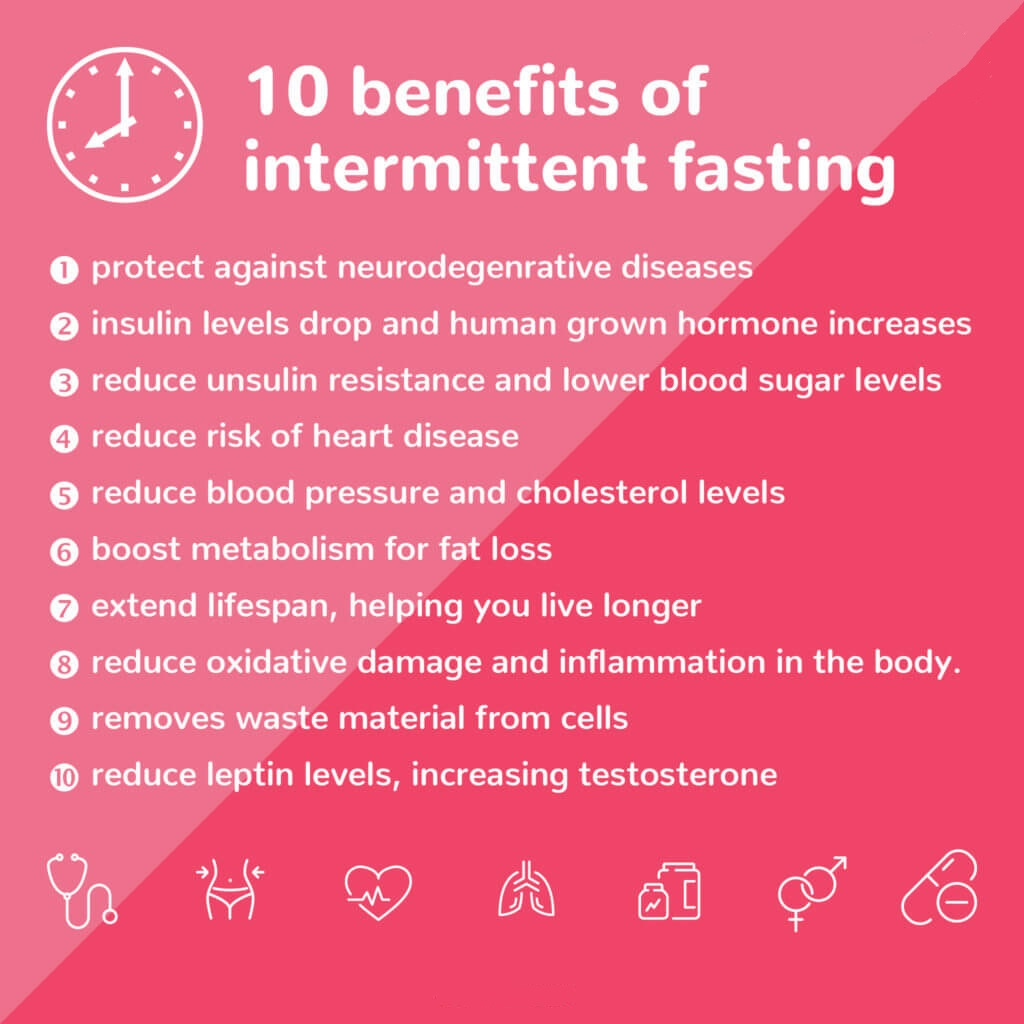
Overcoming Narcissistic Abuse

This is an excellent article, written by my teacher Scott Silverston, explaining narcissistic abuse from a Shamanic perspective: https://shamanicspiritmedicine.com/shamanic-blog/2018/12/8/healing-from-narcissistic-abuse-a-shamanic-approach

Watch an interview with Scott Silverston on narcissistic abuse here:
https://www.youtube.com/watch?v=nzyJEs1OtzY

Alchemising the Ego through the Seven Sins

Alchemy

At its basic level of meaning, the word alchemy relates to physical matter and is commonly understood to be the scientific process of converting base metals into gold.  This notion is based on the human egos of greed and sloth, whereby one seeks to generate vast fortunes with minimal effort.  History tells us that many men have spent entire lifetimes selfishly seeking the philosopher’s stone for personal gain.  This behaviour translates into contemporary society as competition for the easiest and most well-paid jobs, which creates our own personal hell based on lack and fear.

Transmutation

This third-dimensional notion of alchemy is in contrast to the higher, spiritual meaning, which aids personal growth work and soul development.  By learning to transmute fear into love and transform ego into soul, we can achieve self-mastery and experience heaven on Earth in the fifth dimension.

Ego

The Archontic matrix control system, as identified by the pre-Christian Gnostics who sought knowledge through research, holds at its core the manipulation of the human ego as the ultimate means of control.  In contemporary society, the ego manifests in behaviours symbolised by the seven deadly sins: lust, gluttony, greed, sloth, wrath, envy, and pride.  Humanity is programmed by society to act in ego, which perpetuates our enslavement in hell, preventing us from ascending to a higher form of experience.

  • Advertising plays on lust to subjugate the feminine, whereby a woman is simply a vessel for male pleasure, which diminishes the power of the divine feminine.
  • The food industry plays on emotional insecurity to promote gluttony, whereby inner lack is filled with junk food to provide a short-term dopamine hit.
  • The focus on the scarcity of resources causes us to stockpile resources and wealth at the expense of others.
  • The education system takes away our enquiring mind by spoon-feeding us facts without any effort on our part to find the truth for ourselves, creating an attitude of sloth whereby someone else will solve our problems.
  • Newspapers and news programmes pitch groups against each other to create an environment of wrath or anger, which prevents unity and ultimately freedom from the system.
  • The media plays on our propensity to envy by encouraging us to ‘keep up the the Joneses’. If our friends boast about their expensive new purchases, this motivates us to competitively consume more.
  • Pride prevents us from working in service to others and closes off the benevolence the universe can offer those who live in true humility.

Self Awareness

Gnosticism teaches us that ascension can only occur once the ego is eliminated. However, there is another belief that we cannot be expected to totally eliminate the ego as we need it on a basic level for self-protection; therefore, it should be observed and controlled. We can use self-observation to monitor ourselves for egoic behaviour with the aim of holding it in awareness as opposed to automatically acting on it through programmed behaviour, which would leave us open to manipulation.

Transmutation of Ego

Once we have awareness of how the ego is playing out in our lives, we can work towards the elimination of each of the seven sins through transmutation.  We can identify egoic behaviour and replace it with the seven virtues: prudence, justice, temperance, courage (or fortitude), faith, hope, and charity.

Lust = Chastity (purity, abstinence)
Gluttony = Temperance (humanity)
Greed = Charity (sacrifice, generosity, benevolence)
Sloth = Diligence (persistence)
Wrath (Anger) = Patience (forgiveness)
Envy = Kindness (compassion)
Pride = Humility (bravery, modesty)

5D vs 3D Living

It is possible for a human holding love in their hearts to exist in a different dimension from a neighbour living in fear.  Both live on the same street, but one experiences abundance in all aspects of their life and the other experiences seemingly constant misfortune.  The woman in heart-centred service to others is given rewards from the universe that fulfil all her needs: nourishing friendships, an income from work that she enjoys, and a happy home.

In contrast, the man next door, who consumes the media and lives in fear, lives selfishly and receives instant karma.  This gives him the challenging experiences that may appear on the surface to be misfortune, but are purposefully sent by the universe to assist with his soul development.  He may experience redundancy from the job he hates, loss of the partner he doesn’t love, disease due to his addictions to sugar and alcohol, or loss of his home due to lack of gratitude.  Through these trials, he will learn about love, service to others, forgiveness, and humility, but it might take thousands of lifetimes to reach completion.

Shamanic Healing

For anyone living on Earth in bodily form to say that they are not living in ego, to a greater or lesser extent, is in a state of self-deception and denial.  We are here on Earth to learn how to overcome our triggered ego responses.  This can be done by addressing the wound that is creating the ego.  Childhood trauma can create deep wounds that are protected by certain repeating patterns of behaviour.  Shamanic Healing can reach the core of these wounds and reprogram our limbic system to create more positive attitudes and ways of being.  Once we have overcome triggered ego responses, we can be aware of how the ego can protect us by setting firm boundaries.

Natural Healing After Hysterectomy

Having had two months of prolonged bleeding during menstruation I ended up in A&E at QA in Cosham for urine retention. I remained in hospital for a week on a catheter whilst having two blood transfusions and various investigations. A CT scan showed an 11cm x 11cm fibroid attached down one side to the muscle core of my uterus, which had been sitting on my bladder causing the urine retention. I was advised to have an emergency hysterectomy due to the risk of further bleeding. They were so busy I had to wait five agonising weeks while taking blood clotting medication to stop me from bleeding out. It was a very stressful time. My haemoglobin was still low before the operation so I had to have another blood transfusion the day before surgery for them to be able perform the operation. Fortunately my blood loss during the operation was minimal so another blood transfusion was not required but due to issues with my bowel I remained in hospital for another week.

Here are my post operative experiences which I treated naturally.

Homeopathy

I spoke to a homeopath at Helios (a homeopathic remedies company who can be contacted on 01892 537254) and asked her which remedies she recommended for hysterectomy. She gave me a combination remedy for surgery to help bruising and inflammation which contains Arnica, Bellis Perennis, Calendula, Hypericum, and Staphysagria. All of these can be found as separate remedies in the Helios Basic Kit but I chose to buy the combination bottle so that I didn’t have to take my kit into hospital. I also took a remedy called Anaesthetic to clear the general anaesthetic out of my system (which isn’t in the Basic Kit).

I started the remedies on day two in hospital according to the directions and I came off the painkillers after around eight days which I put down to having had the remedy and the binding. My swelling also went down during the second week which can also be due to the help of both the homeopathy and the binding.

Gut Issues

The painkillers I was given in hospital were in tablet form: Tramadol, Codine, and Paracetamol and these made my stomach upset so I was given anti nausea medication. I started to eat again but I found the hospital food very heavy. After two days I ended up vomiting 4 litres of liquid over an 8 hour period – everything that I had eaten since the operation. This meant I had to be on a drip for a day.

I later discovered that during the operation the bowel is moved up and an out of the way and that this causes aggravation, which is normal. I wasn’t aware of this in advance and I believe that I should have been put on more simple foods to give my bowl chance to recover. Instead they put me on normal food and laxatives which didn’t work for me.

I eventually went home on day six where I gave myself bone broth and pureed fruit for a few days, followed by vegan yoghurt and banana. I then introduced Yorkshire puddings into which I poured the bone broth, and organic soups. I was craving carbs so I bought french fries which were thin and soft and also garlic french bread which was soft and easy to digest.

I stopped the laxatives when I returned home and instead took a table spoon of organic Flax Oil every morning. You can also take a table spoon of Psyllium Husks in water if extra help is required but I didn’t need this as I soon started having regular bowel movements.

After a week I went onto muesli for breakfast, soup for lunch, and a normal dinner such as chicken with rice. I haven’t had any further bowel issues.

I would recommend drinking bone broth to heal the gut and only eating simple foods such as soup and pureed fruit for the first week of recovery, particularly the first few days.

Binding

I tried belly binding after the birth of my second child by c-section which involved wearing a corset to keep the abdomen supported which in turn helped the incision to heal. I bought three step-in/pull-up corsets from John Lewis so that I could wash them and fortunately I kept them. A hysterectomy involves removal of the womb causing a gap to occur which can cause problems for the surrounding organs. Binding causes gentle compression that holds muscle and ligaments in place and which may help the organs to gently shift into a new position. I waited until my incision was healed and dry before wearing them. If found it helpful for lessening the pain of daily activities, the abdominal swelling reduced within a couple of days of wearing it. I intend to wear them for six to eight weeks which is the estimated recovery period for a hysterectomy.

Shamanic Healing

I asked a Shaman friend of mine to perform a removal of negative energy and a soul retrieval for my by distance session while I was in the hospital. She successfully removed a small amount of ‘grey’ energy from the space that was left where my womb was removed and she also returned some soul parts which gave me more power and energy. I found this power useful when the staff were badgering me to leave hospital on day two. I told them in the afternoon that I was in pain and that I didn’t feel confident leaving. I refused to leave and by the evening I had started to vomit so I’m glad that I stood my ground as I would never have managed fourteen vomits which totalled four litres on my own at home.

Cranial Osteopathy

I had already been seeing Josephine Luard at The Centre of Complementary Medicine in Petersfield for an ongoing neck problem so I understood the benefits of the treatment for the whole body. I saw her two weeks after the operation, and booked in for a week after that, and then fortnightly, and finally monthly. She was able to assist with adjusting the organs and the spinal fluid to support my recovery. She also helped to bring my emotions up to be dealt with and after the first session I had quite a big grieving process for the loss of my womb. I would recommend this treatment post operatively and after child birth.

Acupuncture

I have received regular acupuncture for hormonal balancing over the last ten years, which I have found to be very effective. I went to The Centre of Complementary Medicine in Petersfield to see Tamara Kircher on the weeks when I wasn’t having cranial with Josephine. After one session my liver had cleared and my concentration dramatically improved. I also had a lot of release of emotion which had been blocked in my womb space and after two sessions the feelings of grief gradually subsided.

Shamanic Journey Work

One of the biggest problems I had after the surgery was the inability to meditate or do my Shamanic journey work. My connection to my higher self, spirit guides, and the Father had been cut. My teacher, Scott Silverston, described opiate painkillers as being like a dark hood over the head, blocking the crown chakra. I attempted meditation and repeated the visits to my spirit guides every day and eventually managed to get back into my routine after a week of very dedicated practice. I was shocked to hear from Scott that the disconnection I felt after my surgery is how most people feel on a daily basis.

Sexual Issues

It is standard procedure at Queen Alexandra Hospital in Portsmouth to remove the cervix during the hysterectomy. I requested to keep my cervix because I had read that it leads to shortening of the vagina which can cause sexual problems for some women. I’m glad that I did because after the procedure my consultant phone me to ask how I was getting on. I asked her what problems might occur and she said ‘sexual problems’ but that I wouldn’t be affected because ‘I kept my cervix’. It begs the question why they remove the cervix as standard if they know that it causes problems? My advice is to read up on this issue and to ask to keep it if you don’t want to take the risk of having your sex life affected.

Shamanic Equipment

Rose is very pleased with the sound of her bespoke Red Deer hide Shamanic drum handmade in Lancashire by Nicola Smalley at Anglezarke Hallows.

The Red Deer hide cape was handmade in Scotland by Anthony Right at Barrhead Leather.

Rose made her own headdress using English Pheasant feathers and ethically sourced Red Deer Antlers.

https://www.anglezarkedrums.co.uk

https://barrhead-leather.co.uk