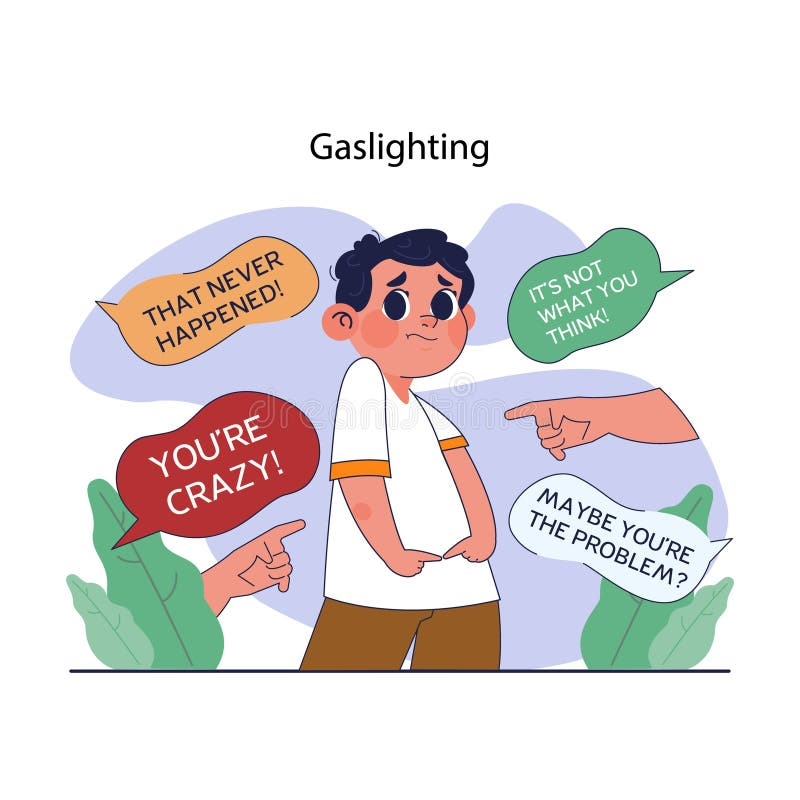
Gaslighting
Some people react badly when you set a boundary. This post explores gaslighting, narcissistic traits, emotional abuse, and how to recognise the pattern to protect your emotional well-being.
My recent blog posts have discussed a pattern of one-sided communication and emotional dumping. I explained how one person in particular would talk at length, often in public, when I was trying to relax or get things done, forcing me into the role of listener. Because I was given little or no natural opening to speak, the dynamic became habitual: she spoke, I was caught off-guard, and accommodated.
In the most recent interaction, I attempted to break that pattern. Because she was not leaving space for me to participate, I spoke over her to get my point across. In effect, I briefly mirrored the very behaviour she had been using with me. Her reaction was disproportionate: she became deeply offended, had an emotional outburst, and stormed away.
She later became triggered upon seeing the title of one of my blog posts, and, without having read it, left me a voice note containing accusations that diverted the attention away from her.
She reframed the situation so that my boundary became the problem, rather than the long-standing pattern that led to it. Instead of acknowledging that she had repeatedly monopolised conversations, she shifted the focus onto my behaviour, my perceived lack of empathy, and my personal shortcomings. She even gave me her diagnosis of a perceived medical condition as though she were an expert.
A reaction like this can make one question whether we were unreasonable to raise the issue in the first place. This kind of self-doubt is a key feature of gaslighting and a clue that you may be in a dysfunctional relationship.
What Gaslighting Is
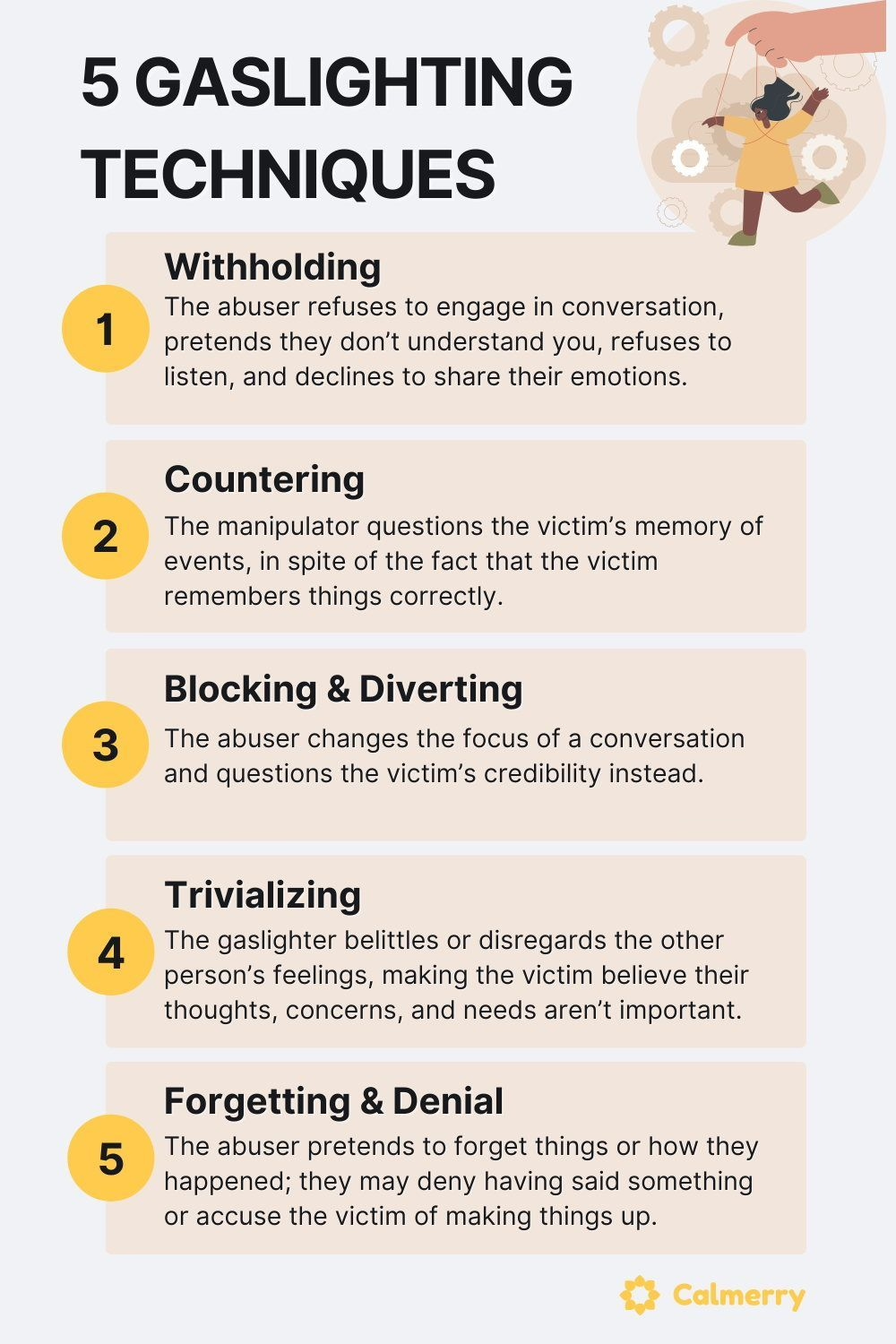
Gaslighting is a form of psychological manipulation in which someone causes another person to doubt their own perception, memory, judgment, or emotional response. It often involves denying what happened, minimising the impact of their behaviour, reversing blame, or presenting the other person as irrational, oversensitive, confused, cruel, or unstable.
In boundary-setting situations, gaslighting often appears when the person who crossed the boundary refuses to engage with the boundary itself. Instead, they make the issue about the tone, timing, character, or mental state of the person who objected. The result is that the original problem disappears from view, and the person setting the boundary is pressured to defend themselves instead.
In my experience, the gaslighting was an attempt to reframe my boundary as the problem, rather than acknowledging the repeated one-sided communication and emotional dumping that made it necessary for me to set the boundary in the first place.
Distorting Reality
Gaslighting is a behaviour that occurs when someone distorts or denies reality to make another person doubt their own experience.
Distorting, denying, minimising, or reframing reality causes a person to doubt their own perception or judgement about the situation. As such, gaslighting is recognised as a form of psychological abuse, especially when it is repeated and used to gain control over a person.
Over time, in close relationships, it can form part of a pattern of emotional abuse. Gaslighting is one form of emotional abuse, but emotional abuse is much broader because it involves the display of additional traits.
Emotional abuse is a pattern of behaviour where one person undermines, controls, frightens, belittles, manipulates, or destabilises another person psychologically or emotionally. It does not always involve shouting or obvious cruelty. It can be subtle, repeated, and deniable, which is why it can be so confusing.
Narcissism
Gaslighting can occur in relationships where a person is unwilling or unable to tolerate accountability. It is sometimes associated with narcissistic traits and narcissistic abuse.
Narcissism is a personality style or trait pattern. Someone with strong narcissistic traits may have a fragile ego, a need to be right, difficulty accepting criticism, low accountability, entitlement, or a tendency to reverse blame. In that context, gaslighting can become one of the tools they use to protect their self-image or maintain control.
Narcissistic Abuse
Gaslighting can be part of narcissistic abuse. In narcissistic abuse, gaslighting often appears after you challenge the person, set a boundary, or name their behaviour. Instead of reflecting on what they did, they may say or imply:
- “That never happened.”
- “You’re too sensitive.”
- “You’ve misunderstood everything.”
- “You’re the one being cruel.”
- “I was only trying to help.”
- “You have no empathy.”
- “There’s something wrong with you.”
The key move is that the focus shifts away from their behaviour and onto your alleged defect. That is why it can feel so destabilising. You start by trying to discuss a real boundary issue, and suddenly you are defending your sanity, character, memory, or emotional stability.
In my incident, the possible narcissistic-abuse pattern is: I disrupted a long-standing dynamic in which she expected to speak, and I was expected to listen. When I strongly asserted myself, she responded as though my boundary was the offence. She then reframed me as unkind, unempathic, unstable, or the real aggressor, which fits the gaslighting pattern.
Gaslighting is reversing the moral frame so that the person setting the boundary is made to feel guilty for objecting.
Many people struggle to recognise gaslighting when it happens, especially when it follows an attempt to set a boundary. The reversal can be so sudden and convincing that the person who objected begins questioning themselves rather than the behaviour that harmed them. Learning to recognise that shift is an important part of protecting one’s emotional well-being.
Prevalence of Narcissism
Research suggests that Narcissistic Personality Disorder is relatively uncommon. Estimates vary: one large US study found a lifetime prevalence of 6.2%, while a systematic review found an average prevalence of 1.06% in non-clinical adult samples. However, I think these figures can be misleading if they are used to suggest that narcissistic behaviour itself is rare. This also raises a practical difficulty with prevalence statistics.
People with strong narcissistic traits may not experience themselves as the problem. They may blame others, feel wronged when challenged, or see boundaries as an attack. As a result, they may be less likely to seek therapy for narcissism itself, even if they later enter therapy because of depression, relationship breakdown, anger, anxiety, or another crisis.
But a person does not need to have diagnosed Narcissistic Personality Disorder to behave in ways that are narcissistic, damaging, or emotionally unsafe. Many people show narcissistic traits without ever receiving, seeking, or qualifying for a formal diagnosis.
Narcissistic traits exist on a spectrum. At the milder end, they may appear as vanity, defensiveness, self-importance, or a need for admiration. At the more harmful end, they may appear as entitlement, lack of empathy, manipulation, refusal to respect boundaries, or a tendency to make themselves the victim when challenged.
Narcissistic traits are very common, with up to 80% of the population having them. These traits can be harmful in relationships.
Around half of the population score above the midpoint on a trait scale, displaying behaviours such as:
- repeatedly talking over others;
- dominating conversations;
- using people as an emotional dumping ground;
- refusing accountability;
- becoming angry when a boundary is set;
- twisting events to make themselves the victim;
- dismissing another person’s needs or feelings; or
- feeling entitled to other people’s time, attention, labour, or sympathy.
Those traits can appear in people who are immature, emotionally dysregulated, entitled, traumatised, socially unaware, selfish, or simply used to getting their own way.
Rather disturbingly, 10-25% of the population display more noticeable entitlement, superiority, admiration seeking, and defensiveness. They may not meet the threshold for a personality disorder, but they can still cause real harm in relationships.
For that reason, I think it is important to distinguish between clinical Narcissistic Personality Disorder and harmful narcissistic behaviour. The former may be relatively uncommon; the latter is, in my experience, far more widespread. We live in a culture where self-promotion, entitlement, emotional dumping, and poor respect for boundaries are increasingly visible, and people need language for recognising these patterns before they become trapped inside them.
Narcissistic traits have become prevalent in society, and it is time that more people became aware so that they can protect themselves from emotional abuse.
Further Reading
Read about my experience of one-sided communication here: https://www.roseautumn.com/2026/06/when-someone-talks-at-you/
Read about my experience of emotional dumping here: https://www.roseautumn.com/2026/06/emotional-dumping
Read about my experience of setting boundaries here: https://www.roseautumn.com/2026/06/boundary-setting-reactions/
For further information about Shamanic Healing, go to: https://www.roseautumn.com/shamanic-healing/
About Rose
Rose is a Shamanic Practitioner trained in traditional shamanism. She is a member of the Federation of Holistic Therapists and is fully insured for in-person and distance Shamanic Healing sessions, as well as Shamanic Life Coaching. She specialises in supporting people recovering from narcissistic abuse.
Rose works without hallucinogenic or psychedelic plant medicines. Instead, she uses an ancient drumming method to access this altered state of consciousness. A session may include a tailored combination of Power Animal Retrieval, Divination, Soul Retrieval, Energy Body Healing, Psychopomp, and Extraction to remove negative energy and blockages.
Each session with me includes Shamanic Subconscious Repatterning. A powerful system that changes the subconscious programmes that drive unwanted behaviour. This method heals trauma at its source, removes the self-limiting programme, and then rewrites a new way of being.
Shamanic Healing can be accessed face-to-face in the Rose Healing Room, Petersfield, East Hampshire or remotely through Distance Healing Sessions. Because the work is carried out in the Spirit Realm with the support of Rose’s Spirit Guides, the client does not need to be physically present in the same room. Distance sessions are narrated in real time, and clients receive an audio recording by email afterwards.
For further information about Shamanic Healing, go to: https://www.roseautumn.com/shamanic-healing/
 0
0 0
0
 20
20