Posts in Category: Art Tutor
Henry Bright’s ‘The Moorland Path’: Landscape in Pastel and Chalk
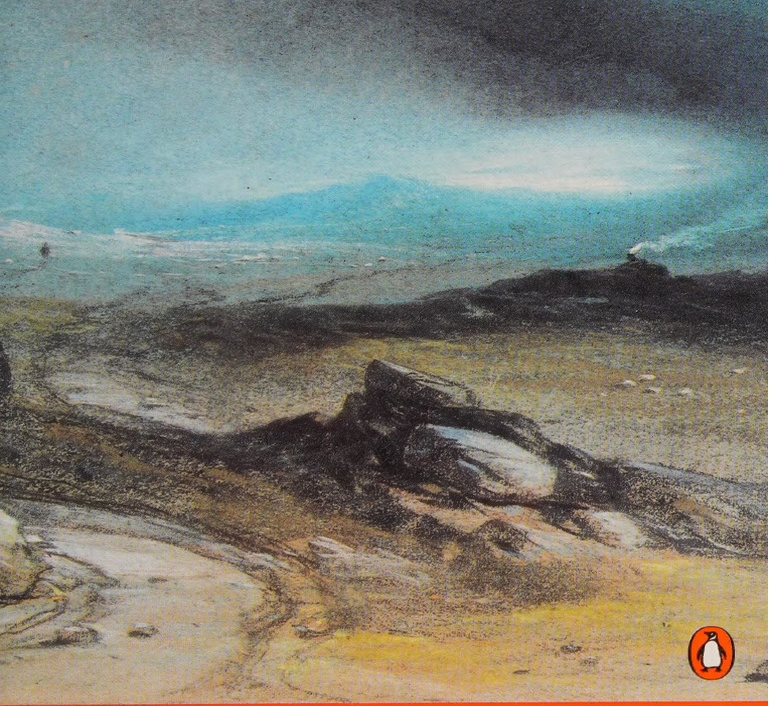
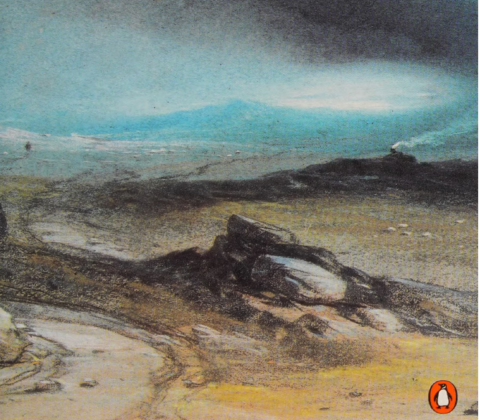
I read about Bright’s Moorland Path in the book Landscape in Britain 1830-1950. Sadly, most of the works were published in black and white and no reproductions exist online except for part of the picture, which was used to illustrate a book. It is this book cover that I have included in this post.
Henry Bright’s The Moorland Path, in the collection of Ipswich Museums, is a beautiful example of the nineteenth-century tradition of landscape drawing in coloured chalk and pastel. The work depicts an apparently simple subject: a rough path disappearing through open moorland beneath an expansive sky. Yet its simplicity is deceptive. Rather than describing every feature of the landscape equally, Bright builds the image through broad tonal masses, softened passages and carefully selected accents of light and colour.
Bright (1810–1873) was particularly accomplished in the use of coloured chalks and pastels. He was also a successful drawing master and published several instructional books, including Elementary Drawing Book in Landscape for the Use of Beginners (1840) and Bright’s Advanced Landscape Drawing Book (1845). His approach was closely connected with the nineteenth-century landscape-drawing tradition associated with James Duffield Harding, whose teaching practice Bright eventually took over.
The Coloured Paper
One of the most important aspects of Bright’s technique is his use of coloured paper for the midtones of his drawings. Bright deliberately selected different coloured papers according to the atmospheric effect he wanted to achieve.
A Ruined Castle at the Yale Centre for British Art, for example, is executed in black chalk and pastel on slightly textured brown wove paper. Moonlight Scene on the Rhine, also at Yale, combines pastel, gouache, black chalk and graphite on blue wove paper. Other Bright drawings are recorded on buff, grey, tan and drab papers. This is fundamental to understanding his technique. Rather than beginning with white paper and covering the entire surface with pastel, Bright could allow the natural colour of the paper to provide a unifying mid-tone. He then worked both darker and lighter than this ground.
A warm buff or brown paper, for example, could already provide the colour of distant earth, haze, dry vegetation and passages of sky. Dark chalk could establish trees, foreground vegetation and shadow, while pale chalk and white could bring forward clouds, paths and highlights. The result is an extraordinary economy of means. Some passages that initially appear to contain complex mixtures of muted colour may actually consist of relatively little drawing material, with the coloured paper itself doing much of the work.
Drawing Before Colour
Bright’s landscapes are perhaps better understood as coloured drawings rather than pastel paintings in the modern sense. His surviving works frequently combine black chalk or charcoal with white and coloured chalks. A landscape in the Cleveland Museum of Art, for example, is made simply with charcoal and white chalk on tan paper. With only these materials, Bright already possesses three fundamental values: the dark charcoal, the middle tone of the paper and the light of the white chalk.
Colour can then be introduced selectively. This helps explain the coherence of The Moorland Path. Bright does not appear to have approached the landscape as a collection of individually coloured objects — green grass, brown earth, blue sky and so forth. Instead, the landscape is organised primarily through relationships of light and dark, warm and cool, solid and atmospheric. Colour remains subordinate to the larger tonal structure.
Chalk, Pastel and the Stump
Another important part of Bright’s technique was rubbing and blending. Surviving drawings are specifically catalogued as being executed in black chalk and stump. A stump — tightly rolled paper or similar material — allows dry chalk to be pushed into the paper, spread, softened and partially removed from its original drawn form.
This provides an important clue to the atmospheric quality of Bright’s landscapes. A passage could first be drawn relatively strongly and subsequently rubbed down. Fresh chalk could then be placed over the softened material. The process might therefore be thought of as:
drawing → rubbing → softening → redrawing.
The distinction is important. An atmospheric passage need not be vague because the artist never put information there. Detail can first be established and subsequently suppressed. Bright can therefore juxtapose very soft, rubbed areas with surprisingly decisive marks. A sharp piece of chalk dragged across textured paper produces broken, irregular marks quite different from the velvety passage produced by a stump. The combination gives the landscape its vitality.
Bright’s Colour
Across Bright’s landscape drawings we encounter blacks and deep browns, ochre-like earth colours, subdued greens, muted reds and russets, blues and blue-greys, creams and white. Just as importantly, the colour of the paper remains visible amongst them.
Rather than mixing numerous colours to reproduce the precise local colour of every object, Bright seems to have used a limited family of colours capable of shifting the temperature and atmosphere of an already established tonal drawing.
How The Moorland Path May Have Been Made
Without a conservation examination, we cannot reconstruct the precise order in which Bright made The Moorland Path. Comparison with his documented works does, however, suggest a plausible working method.
The composition would first be established on a toned sheet rather than brilliant white paper. The major dark masses could then be introduced using black chalk or charcoal.
Some of these passages would be rubbed with the stump, spreading the chalk into the texture of the paper and establishing broad atmospheric masses rather than sharply defined objects.
The colour of the support could remain exposed through large areas of the drawing.
A small selection of coloured chalks could then introduce changes of temperature — warmer earth and vegetation against cooler distance and sky. Pale chalk and white would establish the strongest lights.
Finally, sharper dark and coloured marks could be returned to selected areas of the drawing.
This last stage is particularly important. Once a passage has been rubbed and softened, a fresh chalk mark placed over it acquires considerable visual strength. Bright can therefore suggest vegetation, branches, grasses and irregular ground with relatively few marks. The picture becomes highly detailed in certain places while remaining remarkably open in others.
The Importance of What Is Left Out
For me, this is perhaps the most interesting lesson contained in The Moorland Path. The drawing demonstrates that simplification does not necessarily mean a lack of observation. Bright appears to understand the landscape extremely well, but he does not give every piece of information equal importance. Some forms are stated. Others are softened. Some disappear almost completely into the colour of the paper.
There is an interesting parallel here with the later landscape practice of Frederick Walker. J. W. North recalled that Walker sought suggestiveness in his work not simply by omitting detail, but by putting detail in and subsequently partially erasing or “wearing” it away. North described the result as “not emptiness, but veiled detail.”
Bright’s procedure is not necessarily the same as Walker’s, but his use of chalk and stump offers a related possibility. Information can be drawn, rubbed back, partly lost and then selectively reinstated. The resulting landscape feels observed without becoming over-described.
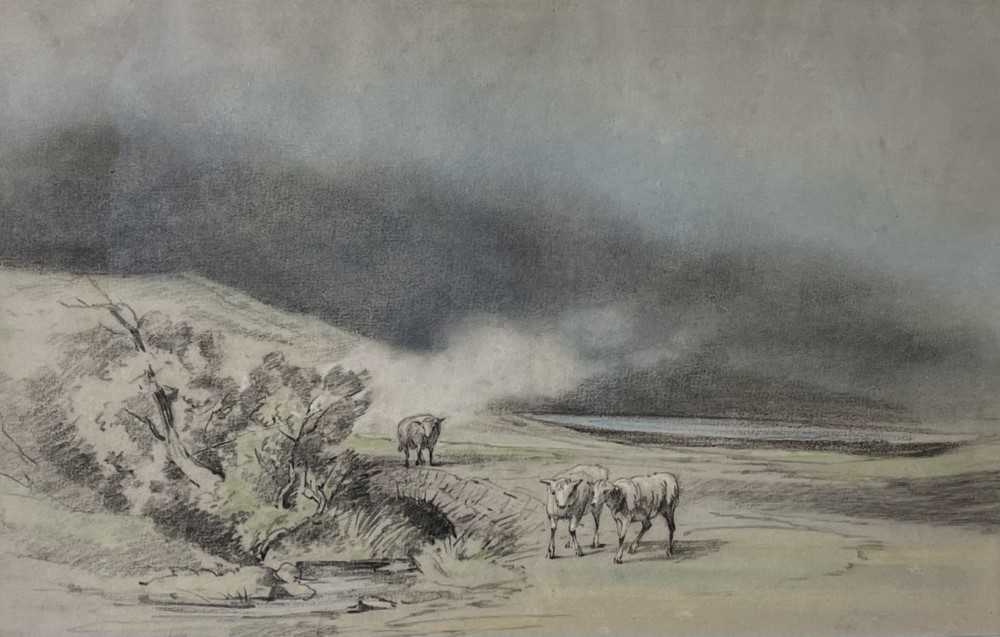
Sheep in a Landscape, 22cm x 31cm
A Lesson for Landscape Painting
Although The Moorland Path is a work in pastel and chalk, its lessons extend well beyond those materials.
Beginning on a middle tone immediately reduces the temptation to fill every part of the surface. Establishing the major tonal masses before introducing colour prevents local colour from fragmenting the composition. Rubbing down information allows forms to merge into atmosphere. And returning at the end with a small number of decisive marks creates detail without requiring every part of the landscape to be equally resolved.
Perhaps most importantly, Bright demonstrates how much can be achieved by allowing the support itself to remain part of the finished image.
The landscape is not constructed by continually adding more. Instead, the artist establishes information, suppresses some of it, strengthens selected passages and allows other areas to remain unresolved.
In The Moorland Path, what Bright chooses not to state becomes every bit as important as the marks he leaves behind.
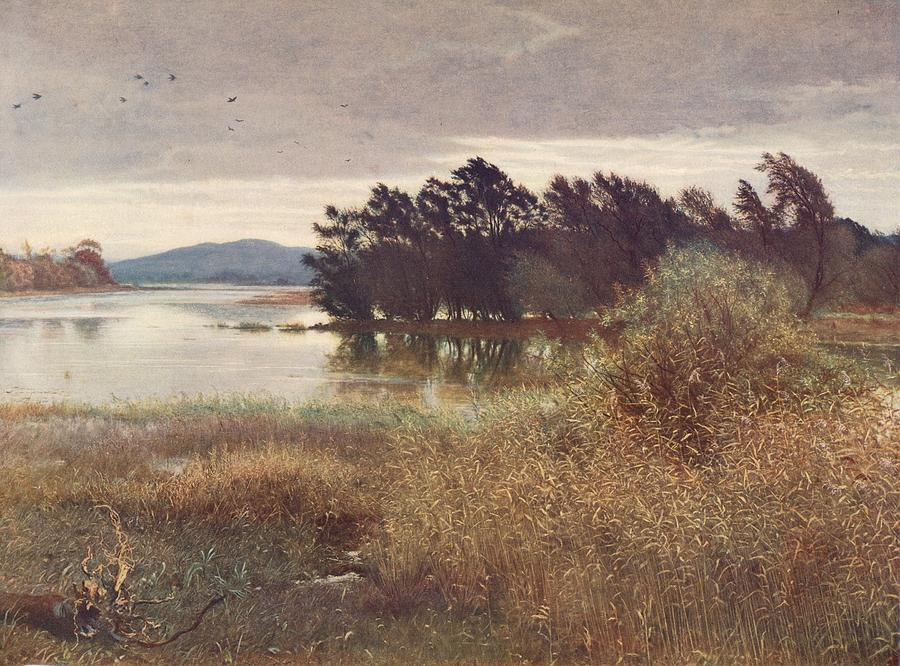

John Everett Millais — Chill October, 1870
John Everett Millais — Chill October, 1870
Oil on canvas, 141 × 186.7 cm
Andrew Lloyd Webber Collection, private collection.
Chill October is particularly valuable to study as a painter because it occupies an interesting position between the intensely observed naturalism of Millais’s earlier Pre-Raphaelite work and the broader, more atmospheric landscape painting of his later career. It was his first major “pure” landscape — a painting in which landscape itself, rather than figures or narrative, carries the emotional content. Contemporary and later commentators recognised it as an unusually important work: Hubert von Herkomer described it as both “masterly in painting” and “poetic in feeling”.
The subject and composition
The painting depicts a backwater of the River Tay near Kinfauns, outside Perth, looking across marshy ground, reeds and water towards a low distant hill. Millais knew the location from travelling on the Perth–Dundee railway and returned specifically to paint it.
What is immediately striking is the absence of a conventional picturesque subject. There is no building, dramatic mountain, prominent tree, human figure or narrative event around which the composition is organised.
Instead, Millais makes weather, vegetation, water and distance the subject.
The composition can be understood as a sequence of broad horizontal zones:
- a dense foreground of marsh grasses and reeds;
- water opening towards the left;
- a dark, irregular mass of trees crossing the middle distance;
- a distant blue-grey hill;
- and an exceptionally large expanse of grey sky.
Against these horizontals, the reeds and grasses provide a mass of fine vertical and diagonal marks. The wind-blown trees introduce another directional movement, preventing the horizontal structure from becoming static.
There is also a very effective asymmetry. The strongest dark mass — the trees — sits right of centre. The left-hand side opens into water and distant space. Consequently, the eye tends to move from the detailed foreground, through the trees, across the reflective water and finally towards the distant hill.
This produces considerable spatial depth without relying upon theatrical perspective.
Painting directly from nature
One of the most important technical facts about Chill October is that Millais painted it outdoors rather than simply producing studies to be turned into a finished landscape in the studio.
The location was awkward and marshy, so a special wooden platform was constructed to support Millais and his easel. Because the area was affected by the Tay’s estuarial tides, working there was difficult. A railway porter reportedly helped carry the large canvas to the site each day.
Millais himself described making: “every touch from nature on the canvas itself” despite the wind and rain.
For a painting student, this is significant. The canvas is approximately 1.87 metres wide. Painting a canvas of this scale directly in front of the motif is very different from making a plein-air sketch.
It means that Millais was attempting to reconcile two things: immediate observation with the sustained construction of a major exhibition painting.
The landscape therefore isn’t an enlarged oil sketch. It is the result of repeated looking.
Brushwork
This is one of the most interesting aspects of the painting.
Compare Chill October with the microscopic description found in Millais’s early Pre-Raphaelite landscapes and the difference is substantial.
The early Pre-Raphaelite ideal encouraged an almost botanical recording of nature. By 1870 Millais was no longer painting every individual blade of grass with equal emphasis. Accounts of his later development describe his brushwork as becoming broader and looser, while remaining closely based upon observation.
Look closely at Chill October and there are essentially different languages of brushwork operating simultaneously.
Foreground
The reeds and grasses contain a dense accumulation of relatively fine strokes.
But these marks do not simply describe individual plants.
Instead, they accumulate into a textural field.
This distinction is important.
Rather than:
blade + blade + blade = grass
Millais increasingly allows:
brushmarks + tonal variation + directional movement = sensation of grass.
That represents a considerable change from early Pre-Raphaelite practice.
Trees
The central trees are handled much more as masses.
Their foliage creates a dark, relatively compressed silhouette against the lighter sky and water.
Within this mass, smaller marks break the edges and suggest leaves and branches without requiring every element to be described individually.
The distinction between mass and detail is fundamental to the painting.
Water
The water becomes smoother and more horizontal.
Reflections beneath the trees dissolve the solidity of the trunks and foliage into vertical and horizontal interruptions.
Consequently the handling itself helps distinguish materials:
grass = broken / linear
foliage = clustered / massed
water = horizontal / reflective
sky = broad / relatively unified
This is a sophisticated example of allowing brushwork to describe the physical character of different parts of a landscape.
Colour
Perhaps the most useful aspect of Chill October for a contemporary landscape painter is its extremely restrained colour structure.
Published descriptions consistently identify muted greens, yellows, ochres, browns and greys as dominating the painting.
There are remarkably few strongly saturated colours.
The foreground moves through approximately:
yellow ochre → dull yellow-green → olive → brown → deep green-brown.
The trees contain:
olive greens → brown-greens → extremely dark green/brown neutrals.
The distant landscape shifts towards:
blue-grey → violet-grey → cool green-grey.
And the sky consists largely of:
warm grey → cool grey → pale grey-blue.
The effect is therefore not achieved through strong complementary colour contrasts.
It depends much more upon temperature and tonal relationships within muted colour.
A note about the actual pigments
There is an important distinction to make here.
I have searched specifically for technical pigment analysis of Chill October and have not found a published conservation study identifying the individual pigments by scientific analysis.
Therefore I would not state that Millais definitely used particular pigments such as Yellow Ochre, Raw Umber, Viridian, Cobalt Blue, etc. in this painting unless documentary or conservation evidence emerges.
That would turn a visual inference into a historical fact.
What we can identify confidently is the visible palette:
|
Area |
Observed colour family |
|---|---|
|
Sky |
cool and warm greys, muted grey-blue |
|
distant hill |
blue-grey / muted violet-grey |
|
water |
grey, ochre, muted blue-grey |
|
trees |
deep olive, brown-green, near-black green |
|
reeds |
ochre, straw yellow, olive |
|
foreground |
olive green, yellow-brown, umber-like darks |
This distinction is particularly important at degree level:
observed colour is not necessarily pigment identification.
Neutralisation rather than bright colour
One of the strongest lessons in the painting is that Millais does not seem to approach autumn as an opportunity for brilliant orange and yellow.
Instead he suppresses chroma.
The greens are generally broken greens — greens pushed towards brown, grey or yellow.
The yellows are earthy rather than brilliant.
Even the blue of the distant landscape is strongly greyed.
The result is a remarkably unified colour world.
A useful exercise for a painting student would therefore be to attempt a study using a deliberately restricted palette and mix almost every colour from several components rather than using colours directly from the tube.
For example, a modern approximation — not a claim about Millais’s historical palette — might use:
Yellow Ochre Raw Umber Burnt Umber Ultramarine Blue Viridian Alizarin Crimson Titanium or Lead White
From those colours it would be possible to construct much of the painting’s visual colour range.
The key would be neutralising rather than intensifying colour.
Tonal organisation
The painting works exceptionally well when imagined in monochrome.
There are roughly four major tonal groups:
1. Light: water and lighter portions of sky.
2. Light-middle: distant landscape and some grasses.
3. Middle-dark: foreground vegetation.
4. Dark: the principal group of trees.
The trees consequently function almost like a tonal anchor.
This allows Millais to place extremely delicate tonal differences elsewhere.
Notice particularly that the distant hill does not require much detail. Its lighter value and cooler colour are sufficient to push it backwards.
This is atmospheric perspective produced primarily through:
reduced contrast + cooler colour + softer edges.
The importance of edges
Another sophisticated feature is the hierarchy of edges.
The foreground contains numerous relatively sharp interruptions.
The central trees possess a recognisable silhouette but contain broken edges where foliage meets sky.
The distant hill is much softer.
This gives the painting considerable atmospheric depth.
The viewer experiences:
foreground texture → middle-distance mass → distant softness.
For a contemporary landscape painter, this is perhaps more useful than copying individual objects.
Millais is controlling how much information the viewer receives at each distance.
The sky
The sky occupies an unusually important proportion of the canvas.
Yet it contains remarkably little incident.
There are no spectacular clouds or dramatic sunset colours.
Instead Millais paints a heavy, low, essentially grey atmosphere.
Herkomer’s later criticism is interesting here. He admired the painting greatly but argued that the sky was “non-essential” and that the painting was more a transcription of an observed section of nature than a formally invented composition.
For a painter today, I would almost argue the opposite.
The apparent emptiness of the sky is important because it creates visual pressure.
The dark trees and reeds sit beneath this large grey weight.
The sky therefore contributes strongly to the sensation implied by the title: cold, damp October weather.
Atmosphere rather than topography
This is ultimately what makes Chill October particularly important.
Millais certainly describes a recognisable place. But topographical description is not the painting’s final purpose.
He is painting an experience of weather.
Wind bends vegetation.
Moisture reduces distant contrast.
Water reflects rather than asserts colour.
Autumn drains saturation from the landscape.
The low sky suppresses light.
Nothing dramatic happens, yet the entire landscape feels temporary.
The modern significance of the painting lies partly here. A recent discussion of British landscape painting describes Millais as moving from Pre-Raphaelite precision towards “broader effects, sensation, and affect” in Chill October.
That is an excellent way of understanding it.
Why the painting matters to painting students
Chill October demonstrates that close observation does not necessarily require exhaustive description.
Millais had been one of the great technicians of microscopic Pre-Raphaelite naturalism. Here he retains the habit of intense observation while becoming increasingly selective about how that observation is translated into paint.
That creates an important distinction:
He is not simplifying what he sees because he has stopped looking closely.
He is looking closely and then deciding which visual information is necessary.
The foreground requires texture.
The trees require mass.
The water requires reflection.
The distant hill requires almost nothing except a cool, soft tonal shape.
The sky requires atmosphere rather than detail.
That hierarchy is one of the painting’s greatest lessons.
Painting analysis in brief
Millais, Chill October, 1870
Subject:
Autumn marshland beside the River Tay.
Method:
Large-scale oil painting worked directly from nature on a specially constructed platform.
Composition:
Strong horizontal structure interrupted by reeds and wind-blown vegetation; asymmetrical dark tree mass balanced against open water.
Colour:
Restricted, low-chroma harmony of ochres, muted yellow-greens, olives, browns, blue-greys and greys.
Tone:
Strong dark middle-distance trees against relatively light water and sky.
Brushwork:
Combination of fine linear foreground marks, broader foliage masses, horizontal water handling and comparatively broad atmospheric passages.
Space:
Created through tonal recession, reduced contrast, softened edges and cooler distant colour rather than elaborate linear perspective.
Principal technical lesson:
Different parts of the landscape receive different degrees and kinds of description.
Principal colour lesson:
Atmosphere can be created through extremely subtle changes of neutralised colour rather than high saturation.
Principal compositional lesson:
A landscape does not require an obvious focal “subject”. Relationships between masses, intervals, textures and weather can themselves provide the structure.
Principal lesson for painters:
Observation and simplification are not opposites. The sophistication lies in observing intensely enough to know what can be left out.
The Tate essay by poet Kathleen Jamie is particularly useful supplementary reading because it considers the experience of the actual landscape and Millais’s physical engagement with the location: Tate — Poetic Encounters: Millais’s Chill October. For a historical painter’s perspective, Herkomer’s discussion is also valuable: Landscape Painting and Millais’s Chill October.

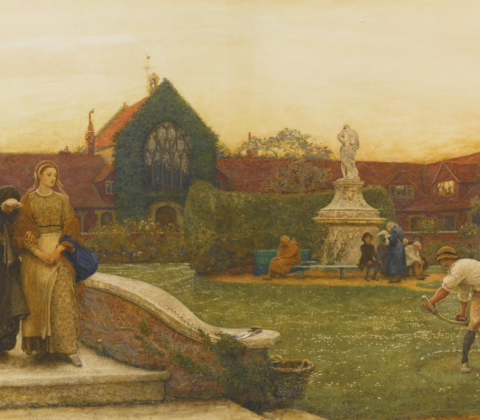
Frederick Walker: Painting Detail to Take It Away
While researching nineteenth-century British landscape painting, I came across a fascinating description of the working methods of the English painter Frederick Walker (1840–1875). It challenges the assumption that simplification in painting necessarily means leaving out detail from the beginning.
Frederick Walker was a British painter and illustrator. He achieved considerable success in both oils and watercolour before his early death. According to John Everett Millais, he was “the greatest artist of the century”.
Walker was associated with the group of Victorian artists sometimes described as the Idyllic School, and his watercolours are particularly interesting for their combination of close observation, softness and suggestion. His friend and fellow painter J. W. North had observed his methods at first hand and described an unusual process in which Walker would initially develop a painting to an extraordinary degree of detail, only to deliberately remove or obscure much of that information later.
Writing about Walker’s approach, North observed:
“His ideal appeared to be to have suggestiveness in his work; not by leaving out, but by painting in, detail, and then partly erasing it. This was especially noticeable in his water-colour landscape work, which frequently passed through a stage of extreme elaboration of drawing, to be afterwards carefully worn away, so that a suggestiveness and softness resulted—not emptiness, but veiled detail.”
— J. W. North, quoted in John George Marks, Life and Letters of Frederick Walker, A.R.A. (1896)
This idea of “veiled detail” is particularly interesting. Walker did not necessarily simplify the landscape before painting it. He first studied and described what he saw, sometimes in considerable detail, and then deliberately reduced the amount of information remaining visible in the finished work. (Wikimedia Commons)
Observation Before Simplification
North’s account suggests that Walker’s approach was founded upon an extremely close knowledge of nature. He worked directly from the landscape and was dissatisfied with conventional painterly shorthand for things such as grass, leaves and branches. Rather than beginning with a generic mark representing a tree or a patch of grass, he wanted the structure of his painting to originate in what he had actually observed. (Wikimedia Commons)
This creates an important distinction between two approaches to simplification.
A painter might look at a complicated hedgerow and immediately reduce it to a broad green shape. Walker’s method suggests another possibility: study the branches, leaves, spaces, changes of direction, light and colour first; establish some of that complexity in the painting; and only afterwards begin removing information.
The final result may be equally simple, but the simplicity has emerged from knowledge of the subject rather than avoidance of its complexity.
Walker himself described doing something very similar. In a letter concerning his work he remarked on how much he had “rubbed out in order to keep it simple”, adding that his first two days’ work had effectively disappeared. (Wikimedia Commons)
His process might therefore be summarised as:
observe → describe → elaborate → remove → simplify → selectively restate.
How Did Walker “Wear Away” His Paintings?
Exactly what North meant by “carefully worn away” deserves some caution. I have not found documentary evidence establishing one particular tool or procedure that Walker always used for this purpose.
There is, however, good evidence that his watercolour technique involved considerably more physical manipulation than we might associate with conventional transparent watercolour.
Catalogues of surviving Walker works repeatedly identify combinations of pencil, watercolour, bodycolour, gum arabic and scratching out.
His The Bouquet of 1865, for example, is described as pencil, watercolour and bodycolour with gum arabic and scratching out. The Harbour of Refuge similarly combines pencil and watercolour with bodycolour and scratching out. (Christie’s)
Scratching out allowed the artist physically to disturb or remove parts of the painted surface, revealing lighter material or paper underneath. This could produce highlights and fine linear structures, but more importantly it demonstrates that Walker treated a watercolour as a surface that could be worked, altered and partially reconstructed, rather than simply accumulating transparent washes.

Chinese White and Bodycolour
Another important part of Walker’s technique was his enthusiastic use of Chinese White.
The Victoria and Albert Museum uses Walker’s Autumn of 1865 as an example of the possibilities of bodycolour. Adding Chinese White to watercolour produces a thicker, more opaque paint and can soften otherwise brilliant colours, producing what the V&A describes as a deeper, velvety quality. Walker could also use Chinese White directly for highlights. (Victoria and Albert Museum)
His use of the material was considered sufficiently unconventional to provoke controversy when Autumn was exhibited at the Old Water Colour Society in 1865. Walker even caricatured himself squeezing Chinese White from an enormous tube and wondering what the Society would think if its members could see him. (Victoria and Albert Museum)
This is significant when thinking about “veiled detail”.
Traditional transparent watercolour depends heavily upon preserving the white of the paper and progressively adding transparent colour. Bodycolour makes a much more complicated process possible. An artist can establish information, cover or partially obscure it with semi-opaque paint, modify the surface and then reintroduce selected details.
The painting can consequently acquire a history of addition and subtraction.
Detail Beneath the Surface
This may help explain the particular visual quality North recognised in Walker’s paintings.
Imagine that Walker carefully establishes grasses, branches and leaves. He subsequently softens, covers, rubs down or otherwise disrupts some of this information. Some forms disappear completely; others remain barely perceptible beneath subsequent layers; occasional details are allowed to remain sharp.
The viewer therefore does not see every piece of information Walker originally recorded.
But neither does the resulting area feel empty.
There are remnants of observation embedded within it.
Hence North’s wonderfully precise description:
“not emptiness, but veiled detail.”
The viewer senses complexity without being required to inspect every component of it.
The Difference Between Leaving Out and Taking Away
For painters, I think this is the most valuable lesson in Walker’s technique.
There is an important difference between never painting something and painting it and subsequently taking it away.
Suppose I am painting a group of trees.
I could decide immediately that the trees constitute one large dark shape and paint them accordingly. This may produce a successful simplification, but there is also a danger that the resulting shape becomes a generic symbol for trees.
Alternatively, I could begin by studying the individual trunks, branches, gaps, foliage, changes of colour and overlapping forms. Having understood and painted some of this complexity, I could then begin merging shapes, softening edges, obscuring branches and removing unnecessary information.
The final painting might eventually contain only a fraction of the original detail.
Yet the remaining shapes have been informed by everything that was previously there.
That seems to be the essential principle behind Walker’s method.
Simplification as a Final Stage
We often think that an experienced painter should know what to leave out.
Walker suggests another possibility.
Perhaps sometimes we need to put things in before we can understand what should be left out.
This makes simplification part of the editing process rather than merely a decision made at the beginning of a painting.
It also explains why apparent looseness can sometimes contain an extraordinary sense of specificity. The artist may have understood and described considerably more than remains visible.
A Walker landscape could therefore pass through several visual states:
observational drawing
↓
elaborated detail
↓
colour and bodycolour
↓
partial obliteration
↓
removal and softening
↓
selective restatement
↓
veiled detail
The finished surface contains traces of that history.
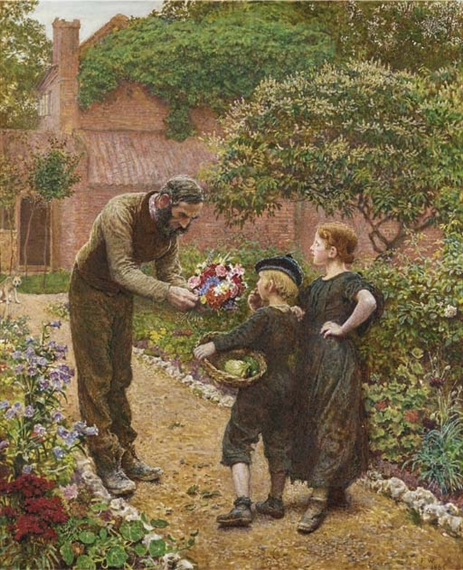
A Useful Exercise for Contemporary Painters
Walker’s method suggests an interesting studio exercise.
Rather than deliberately making a loose landscape study, choose a small section of landscape—perhaps a hedgerow, grasses or a group of trees—and initially allow yourself to become too descriptive.
Look carefully.
Paint the branches, spaces, variations of colour and changes of direction. Allow the passage to become considerably more elaborate than you would normally want in a finished painting.
Then stop describing and begin editing.
Merge adjacent forms. Soften some edges. Partially cover details. Remove marks where the medium permits it. Allow some forms to disappear into neighbouring shapes. Then selectively restore only those details that seem essential.
The aim is not to make the painting vague.
It is to discover how much information can disappear while the experience of complexity remains.
This is fundamentally different from trying to paint loosely from the outset.
From Observation to Suggestion
Walker’s technique is particularly interesting within nineteenth-century British landscape painting because it demonstrates that close observation and painterly simplification are not opposites.
His apparent softness was grounded in looking.
The finished painting did not necessarily show everything he had observed, or even everything he had originally painted. Instead, detail could be accumulated and subsequently sacrificed in pursuit of the larger visual experience.
There is an important lesson here for contemporary landscape painters.
Simplification does not have to mean seeing less.
It can mean looking intensely, understanding the complexity of what is there, and then deciding how little of that information the finished painting actually needs.
Perhaps that is the real significance of North’s phrase “veiled detail”: the detail has not simply been omitted. Its presence is still felt beneath the surface.
Sources
John George Marks, Life and Letters of Frederick Walker, A.R.A. (London, 1896), particularly North’s account of Walker’s working methods. A digitised historical study reproduces North’s account alongside Walker’s own description of rubbing out work to maintain simplicity. (Wikimedia Commons)
The Victoria and Albert Museum’s discussion of watercolour technique uses Walker’s Autumn (1865) to explain his unusually extensive use of Chinese White and bodycolour. (Victoria and Albert Museum)
Christie’s technical cataloguing of surviving works including The Bouquet and The Harbour of Refuge records Walker’s use of pencil, watercolour, bodycolour, gum arabic and scratching out. (Christie’s)
I think “not emptiness, but veiled detail” is strong enough to become the central idea of the post—and potentially a useful principle to return to in your own writing about simplification in landscape painting.
Best works to study online
- Frederick Walker, Autumn, 1865 — Victoria and Albert Museum This would be my first choice for studying Walker’s surfaces. The V&A specifically discusses it in relation to Walker’s unconventional use of Chinese White/bodycolour. The addition of white produces softened, opaque, “velvety” colour rather than conventional transparent watercolour. It is particularly useful for examining how foliage can remain richly observed without every detail remaining sharply articulated. View Autumn and the V&A’s technical discussion
- Frederick Walker, The Bouquet, 1865 This is probably the strongest documented example for your research because Christie’s gives the medium unusually precisely as: “pencil, watercolour and bodycolour with gum arabic and with scratching out.” The large areas of vegetation are particularly worth examining. Look for the alternation between very specific description and passages where information seems to dissolve into colour and tone. The surface has clearly been manipulated rather than simply painted once in transparent washes. View The Bouquet at Christie’s
- Frederick Walker, The Harbour of Refuge, watercolour version, c.1873 Another exceptionally important example. Christie’s records pencil and watercolour heightened with bodycolour and scratching out. It is a large watercolour—57.2 × 92 cm—so Walker was able to develop an unusually complex surface. Look particularly at the grass, distant architecture and trees. Individual information seems to emerge from larger atmospheric masses rather than sitting uniformly on the surface. View The Harbour of Refuge watercolour at Christie’s
- Frederick Walker, The Cottage Door, 1860 — Courtauld Gallery This is useful because the Courtauld provides both a good online image and precise technical information. The medium is: graphite, watercolour, gum arabic, bodycolour and scratching out. It is an early work, so comparing this with Autumn and The Harbour of Refuge helps reveal how Walker’s handling developed. View The Cottage Door at the Courtauld
- Frederick Walker, Spring This precedes Autumn and belongs to the important sequence of large watercolours of figures within landscape settings that culminated in works such as The Bouquet. Christie’s specifically identifies Spring, Autumn and The Bouquet as related works. I would examine the vegetation rather than the figures: look at the distinction between described leaves and branches and passages that have been allowed to coalesce into broader tonal areas. See Walker’s illustrated watercolours, including Spring
- Frederick Walker, The Old Farm Garden This is particularly relevant if your interest is landscape rather than Walker’s figure compositions. An online reproduction is included in the Victorian Web’s catalogue of his watercolours. View Walker’s watercolour catalogue
- Frederick Walker, The Old Gate, watercolour Another useful comparison because Walker treated The Old Gate in both watercolour and oil. Looking at the two versions helps distinguish what is specifically happening through the watercolour medium. Both are illustrated online. View The Old Gate and other Walker works
- Frederick Walker, study for The Harbour of Refuge — Yale Center for British Art This is especially valuable because it allows you to compare a study with the highly worked finished watercolour. The Yale work is graphite, watercolour and gouache on textured cream wove paper. View the Yale Harbour of Refuge study
1. Autumn — best for bodycolour, opacity, softness and veiling.
2. The Bouquet — best documentary evidence for bodycolour + gum arabic + scratching out.
3. The Harbour of Refuge — a mature example in which detailed observation has been subordinated to an overall atmospheric effect.
The Bouquet may actually be the most revealing of the three when enlarged on screen. Christie’s describes it as “fascinating in technique”, and the documented combination of pencil, transparent watercolour, bodycolour, gum arabic and scratching out gives us unusually strong evidence that the apparent softness is the product of a complex worked surface, rather than simply loose brushwork.
This is exactly where North’s phrase “not emptiness, but veiled detail” becomes understandable as a physical painting process rather than merely a poetic description.
Viridian in Landscape Painting: Artists Who Used This Important Green Pigment
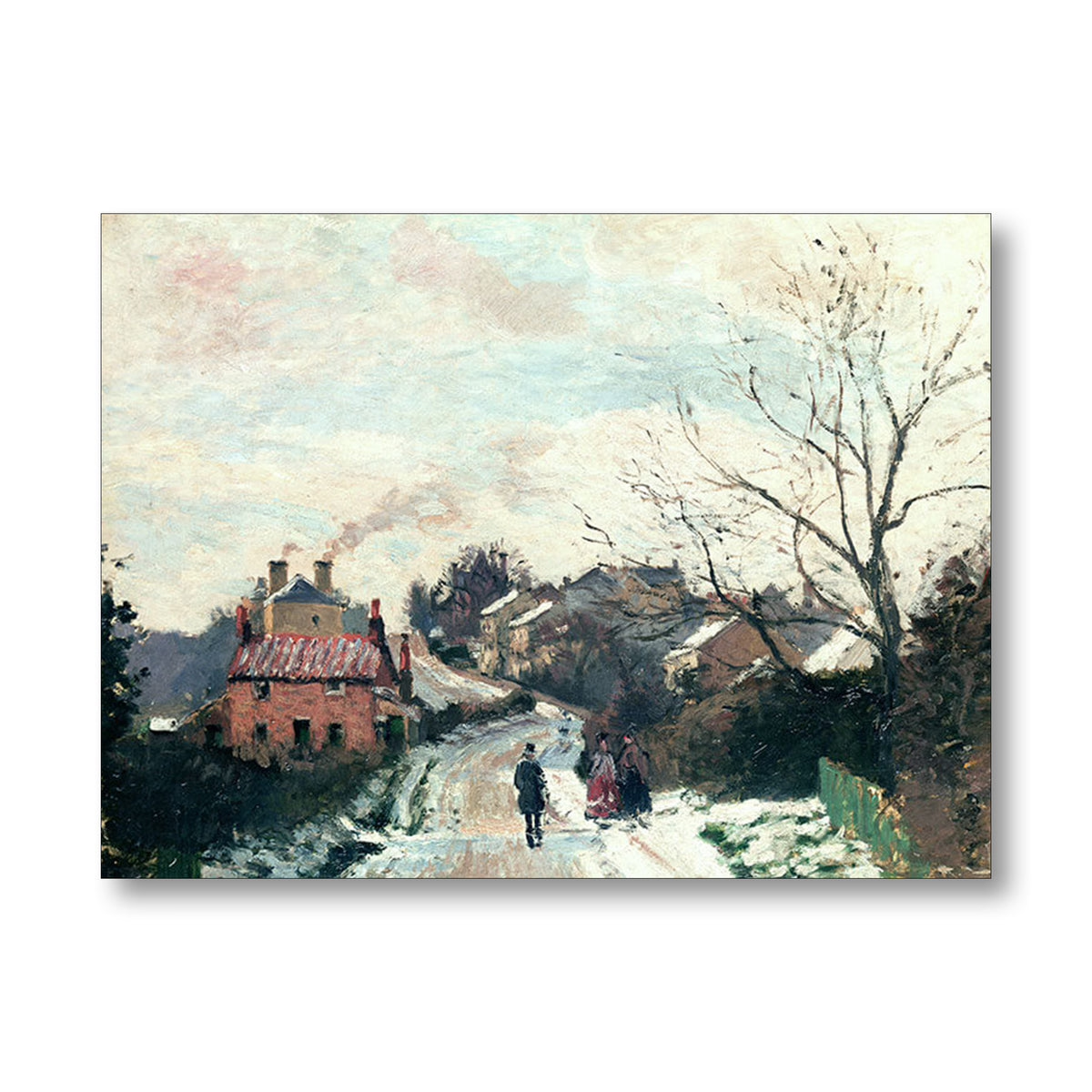
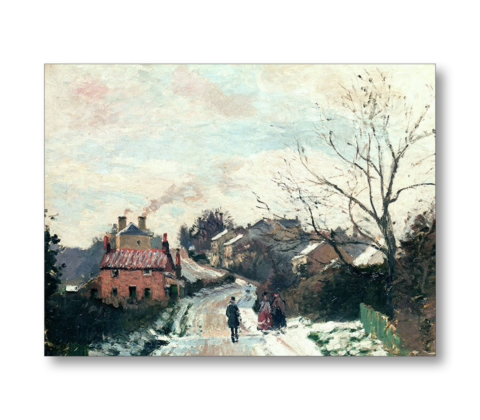
Featured Image: Camille Pissarro, Fox Hill, Upper Norwood, 1870, oil on canvas, National Gallery, London. Pigment analysis has identified Viridian in the green fence, mixed with other pigments.
Viridian was an important pigment in the development of landscape painting because it changed what painters could do with green.
Viridian gave landscape painters a permanent, cool, transparent green that could be used to create both vivid and naturalistic greens. Unlike many earlier greens, it was more stable, more versatile and safer than poisonous pigments such as Emerald Green. Its bluish undertone made it especially valuable for painting foliage, distance, cool shadow, reflected light and atmospheric landscape effects.
Before Viridian, many green pigments were either dull, unstable, poisonous, difficult to control, or visually harsh. Viridian offered artists a strong, cool, bluish-green that was more reliable and useful for serious painting. It is hydrated chromium oxide, usually identified today as PG18. ColourLex describes it as a vivid green with a bluish tint, while Winsor & Newton describes it as an intense bluish-green that can be mixed with yellow, orange or red to create a wide range of natural greens.
For landscape painters, this mattered enormously. Green is one of the hardest colours to manage in landscape painting. Straight-from-the-tube greens can look artificial, acidic or decorative. Viridian is powerful, but because it is transparent or semi-transparent and cool in temperature, it can be modified into many more natural landscape greens. Mixed with yellow, it can create fresh foliage greens; mixed with earth colours, it can become subdued and natural; mixed with red, orange or burnt sienna, it can be neutralised into greys, shadow greens and atmospheric darks.
It was also historically important because it provided a safer alternative to earlier poisonous greens such as Emerald Green, which contained arsenic. Winsor & Newton notes that Viridian was produced in Paris in the nineteenth century as a replacement for hazardous Emerald Green.
Viridian was important because it offered painters a cool, bluish, transparent green that was more stable and far safer than arsenic-based greens such as Emerald Green. It was also more luminous and versatile than duller pigments such as Chromium Oxide Green. For landscape painters, this meant they could mix fresher foliage greens, cooler shadows, atmospheric distance and more subtle natural greens without relying on unstable or highly poisonous earlier pigments.
Its transparency is another reason painters value it. Viridian can be used in glazes, thin passages, cool shadows and optical mixtures. This makes it particularly useful for painting distance, reflected light, foliage, water, shadowed grass and atmospheric recession. It is not just a “green”; it is a way of controlling temperature, depth and luminosity in a painting.
Artists Who Used Viridian
Viridian became part of the modern nineteenth-century palette used by Impressionist and Post-Impressionist painters. Artists such as Pissarro, Monet, Cézanne and Van Gogh used modern synthetic pigments to break away from the darker, earthier palettes of earlier academic painting. Viridian helped make possible a brighter, more light-filled approach to landscape. Viridian Green, PG18, is found in Impressionist and Post-Impressionist painting and remains popular today.
The strongest examples of artists who used Viridian in landscape painting are Turner, Corot, Pissarro, Monet, Cézanne, and Van Gogh. These artists are particularly of note because their use of green was not merely descriptive. Viridian allowed them to explore atmosphere, optical vibration, reflected light, cool shadow, distance and the living structure of the landscape.
J. M. W. Turner
J. M. W. Turner was one of the great experimental colourists of English painting. He is known to have used new synthetic pigments as they became available, and Viridian appears among the pigments associated with his later practice. Turner’s interest in luminous atmospheric effects makes his use of modern greens particularly significant for landscape painters.
Jean-Baptiste-Camille Corot
Corot is an important figure in the development of nineteenth-century landscape painting, standing between the classical landscape tradition and the more broken, naturalistic handling that would influence the Impressionists. Technical research and museum discussion of Corot’s materials indicate the possible or identified use of Viridian in his landscape work.
Camille Pissarro
Camille Pissarro is one of the clearest examples of an Impressionist landscape painter known to have used Viridian. Pigment analysis of works such as Fox Hill, Upper Norwood has identified Viridian among his materials. This is especially relevant because Pissarro’s landscapes often depend on subtle modulations of green, grey, blue and earth colour rather than a simple local green.
Claude Monet
Claude Monet made extensive use of modern nineteenth-century pigments, and Viridian was part of the expanded colour range available to the Impressionists. In his landscapes, garden paintings and water-lily subjects, green was not treated as a flat descriptive colour but as a shifting optical field, affected by light, atmosphere, reflection and surrounding colour.
Paul Cézanne
Paul Cézanne is known to have used Viridian in landscape paintings, including Provençal subjects. His use of green is particularly interesting because he did not simply imitate natural appearances. Instead, he built landscape through structured colour relationships, using greens, blues, ochres and earth colours to create form, rhythm and spatial weight.
Vincent van Gogh
Vincent van Gogh used Viridian in some of his landscape paintings, including works where greens are mixed with other strong pigments such as chrome yellow, emerald green and white. His use of green was often expressive rather than purely naturalistic, helping to intensify the emotional force of the landscape.
Alfred Sisley
Alfred Sisley, like the other Impressionists, worked within the new nineteenth-century palette made possible by modern synthetic pigments. Viridian is associated with Impressionist landscape practice, although any claim about Sisley should ideally be tied to a specific technical analysis of an individual painting. His landscapes are useful to study because of their cool, silvery greens and atmospheric handling.
Édouard Manet
Édouard Manet was not primarily a landscape painter in the same sense as Monet, Pissarro or Sisley, but he painted outdoor subjects and garden scenes and made use of modern nineteenth-century pigments. Where Viridian is discussed in relation to Manet, it is best treated as part of the wider modern palette of the period rather than as a defining feature of his landscape practice.
Berthe Morisot
Berthe Morisot’s outdoor scenes and garden subjects belong to the same modern painting context in which Viridian became important. As with Sisley and Manet, her work is highly relevant to the broader discussion of modern greens, broken colour and Impressionist light.
Earlier Green Pigments
A list of earlier green pigments that were used before Viridian became widely available.
Green Earth / Terre Verte
Green Earth, also known as Terre Verte, is one of the oldest green pigments used by painters. It is a natural earth pigment, usually soft, muted and grey-green rather than bright. It was useful for underpainting, flesh tones, shadows and subdued landscape greens, but it lacked the intensity needed for brilliant foliage or strong modern landscape colour.
Malachite
Malachite is a natural copper carbonate mineral pigment. It was used from antiquity and through the medieval and Renaissance periods. It can produce a beautiful green, but it is relatively coarse, expensive, variable in colour and not as strong or flexible as later synthetic greens.
Verdigris
Verdigris is a copper-based green made from the corrosion of copper. It was widely used historically and could produce a bright bluish green, but it was chemically unstable and could darken or change over time. This made it problematic for permanent painting.
Sap Green
Sap Green was originally a lake pigment made from plant material, especially buckthorn berries. It was used as a transparent green, useful for glazing and botanical effects, but traditional Sap Green was not very permanent. Modern Sap Greens are usually mixtures rather than the original plant-based pigment.
Green Verditer
Green Verditer is an artificial copper carbonate pigment. It was used as a blue-green pigment, but it was not as durable or versatile as later greens. It belongs to the older group of copper-based greens that were gradually displaced by more reliable nineteenth-century pigments.
Scheele’s Green
Scheele’s Green was developed in the late eighteenth century and became popular because it was much brighter than many earlier greens. However, it contained arsenic and was highly poisonous. It was used not only in artists’ materials but also in wallpapers, fabrics and decorative objects, which made it notorious for its toxicity.
Emerald Green / Paris Green / Schweinfurt Green
Emerald Green, also known as Paris Green or Schweinfurt Green, was introduced in the early nineteenth century. It was one of the most brilliant greens available to artists before Viridian, but it was also arsenic-based and extremely toxic. It was valued for its vivid colour but was dangerous to manufacture, handle and use.
Chromium Oxide Green
Chromium Oxide Green was introduced before Viridian and was more stable and less toxic than the arsenic greens. However, it is a dull, opaque, earthy green. It is useful in painting, but it does not have Viridian’s clarity, transparency or bluish luminosity.
Cobalt Green
Cobalt Green was another nineteenth-century green available before Viridian became widely used. It was more stable than the arsenic greens, but it was often weak in tinting strength and expensive. Its colour could also be rather subdued compared with Viridian.
Landscape Painters and Viridian: Why PG18 Matters in Oil Painting
After writing about the change in the Winsor & Newton Artists’ Oil Colour range from traditional Viridian to Viridian Hue, I wanted to look more closely at why Viridian matters in landscape painting.
This is not just a technical question about pigment codes. It is a question about the behaviour of green in painting.
Green is one of the most difficult colour families for landscape painters to control. It can so easily become too bright, too acidic, too decorative, or too illustrative. A good landscape green often has to be broken, softened, greyed, cooled, warmed, or pushed backwards to create a subtle atmosphere. That is where genuine Viridian, made with PG18, becomes important.
In my previous post, I wrote about my disappointment at discovering that the current Winsor & Newton Artists’ Oil Colour Viridian Hue is no longer the same as my old Winsor & Newton Artists’ Oil Colour Viridian 692, AA, Series 4, which I had kept since art school. Winsor & Newton’s current Artists’ Oil Colour Viridian Hue is listed as pigment code PG26 and PG7, not PG18. PG7 is phthalo green, a much stronger and more assertive pigment.
For a landscape painter, that change matters.
What is Viridian?
Viridian is a cool, bluish green pigment. Its pigment code is PG18. Chemically, it is hydrated chromium oxide.
Viridian was first prepared in Paris by Pannetier around 1838, and later patented by the French chemist Guignet in 1859. Because of that, it has also been known historically as Guignet’s Green.
It arrived at an important moment in European painting. The nineteenth century transformed the artist’s palette. New synthetic pigments gave artists colours that were brighter, more stable, more varied, and more reliable than many of the older materials. Viridian belonged to this new world of colour.
Before Viridian, many green pigments were problematic. Some were dull. Some were unstable. Some were poisonous. Emerald green, for example, was vivid but arsenic-based. Viridian offered a more stable, transparent, cool green that could be used in oil, watercolour, and other media.
For landscape painters, this was significant. Viridian was not merely a tube green. It was a modern green that could be used to explore light, air, water, foliage, distance, and shadow.
Why Viridian became important to landscape painters
Viridian is particularly useful in landscape because it is not a loud, opaque, yellowish green. It is cool, transparent to semi-transparent, and slightly blue in character. Viridian Green PG18 is a semi-transparent green pigment with a distinctive blue undertone, found in the paintings of the Impressionists and Post-Impressionists.
That blue undertone is important.
In landscape painting, greens are rarely simple. The green of a nearby leaf is different from the green of a distant tree. The green of grass in sunlight is different from the green of a shadowed bank. The green of a tree against the sky is different from the green reflected in water.
Viridian helps because it can be modified. It can be warmed with yellows, ochres, and earths. It can be neutralised with reds and crimsons. It can be cooled with blues. It can be pushed into greys, blue-greens, sea-greens, and atmospheric shadow colours.
This is why genuine PG18 Viridian is so different from a phthalo-based Viridian Hue. A phthalo green mixture may look similar from the tube, but it often has a much stronger tinting strength. It can take over a mixture very quickly. That may be useful in some kinds of painting, but it is not always helpful in naturalistic landscape painting, where subtle control is everything.
Viridian and the Impressionists
Viridian became closely associated with the Impressionists and Post-Impressionists. This is not surprising because their work depended on outdoor observation, broken colour, optical vibration, and a much more direct engagement with modern pigments.
The Impressionists were not simply painting “green fields”. They were painting the effect of light on green. They were painting air, weather, reflection, distance, and changing conditions.
A pigment like Viridian gave them a cool green that could be used in mixtures and contrasts. It could be set against warmer colours, and it could assist in building the optical complexity of foliage, water, and shadow.
Viridian’s importance is not that every Impressionist used it in exactly the same way. Its importance is that it belonged to the modern palette that made this new approach to landscape possible.
Claude Monet and modern green
Claude Monet is one of the painters most closely associated with the modern landscape palette. His work depends on the relationship between colour, light, water, reflection, and atmosphere.
Viridian belongs naturally to this world. A cool, transparent green is useful in painting water, reflected trees, shadowed banks, and the cooler notes in foliage. Viridian and chromium oxide greens entered painting at a time when plein-air landscape painting was becoming increasingly important.
Monet’s use of greens was never simply descriptive. He was not just filling in trees or grass. He was building a colour structure. In that kind of painting, a green pigment has to be capable of subtle relationships. It has to work with blues, violets, yellows, reds, and earth colours. It has to sit within the whole atmospheric key of the painting.
That is why genuine Viridian is so useful. It is not merely bright. It is adjustable.
Van Gogh and Viridian
Vincent van Gogh also used Viridian. In his case, the pigment becomes part of a more expressive and structural use of colour.
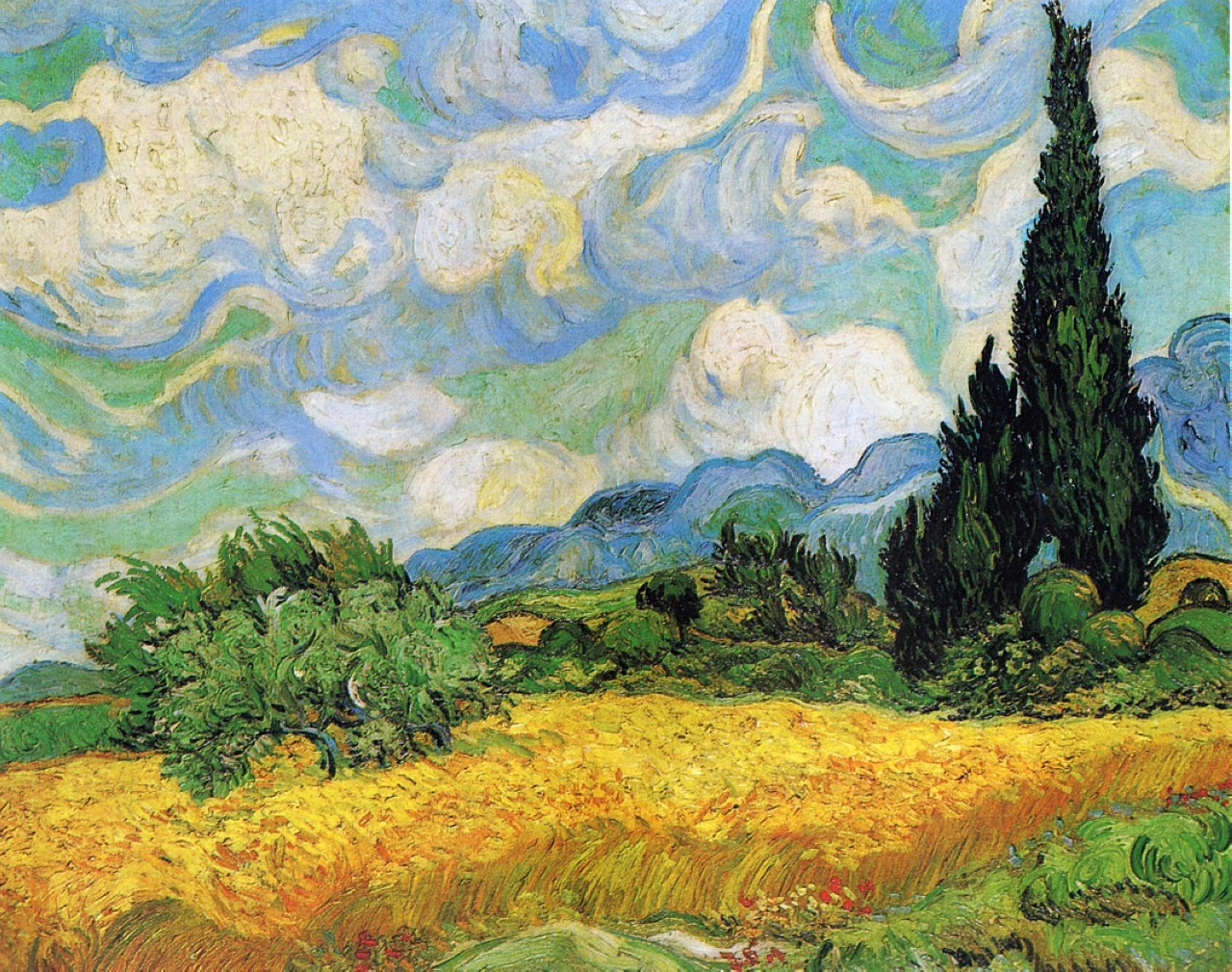
Viridian can be identified in Van Gogh’s A Wheatfield with Cypresses. In one area of the painting, the pale green bush below the blue mountain is described as containing Viridian, chrome yellow, and zinc white. Other green passages contain mixtures involving emerald green, hydrated chromium oxide green, zinc white, and chrome yellow.
That example is useful because Van Gogh was not using green timidly. He was using modern pigments to create force, rhythm, heat, structure, and emotion. The National Gallery describes A Wheatfield, with Cypresses as one of several versions Van Gogh painted in 1889 while he was at Saint-Rémy.
Viridian, in Van Gogh’s hands, is not merely naturalistic. It becomes part of a heightened landscape language. It can contribute to the intensity of the painting while still retaining its cool, bluish character.
This shows one of the great strengths of Viridian. It can be used subtly, but it can also be used expressively. It is not a weak pigment. It is a controlled pigment.
Viridian and the problem of distant trees
One of the reasons I became interested in Viridian again was because I am now working with landscape after twenty years of working almost entirely in charcoal. In charcoal, tone, edge, pressure, and atmosphere are everything. Returning to oil paint, I am very aware that colour can easily become too literal, which is particularly true when painting trees in the distance.
Distant trees are not usually bright local green. They are affected by air, light, moisture, and distance. They often need to be cooler, greyer, softer, and less saturated than the trees in the foreground. A strong phthalo-based green can easily come forward. It can sit on the surface of the painting rather than receding into space.
Genuine PG18 Viridian is useful because it can be persuaded into distance. Mixed with earthy reds and ochres, it can produce broken greens that feel more natural and less artificial. It can help create a green that belongs to the landscape rather than sitting on top of it.
That is why I think the move from PG18 to PG26 and PG7 in the Winsor & Newton Artists’ Oil Colour Viridian Hue is a real issue for landscape painters because it changes the way the colour behaves.
Why PG18 is different from PG7 in practice
PG18 Viridian is generally quieter, cooler, more transparent, and more subtle. It has a restrained tinting strength. It can be used in glazes and in delicate mixtures. It is very useful when a painter wants natural greens without garishness.
PG7, phthalo green, is a very different pigment. It is powerful, staining, highly tinting, and intensely chromatic. It is an excellent pigment in its own right, but it does not behave like traditional Viridian.
The problem with a Viridian Hue containing PG7 is not that it is unusable. The problem is that it is not a direct replacement. It may look close enough in a colour chart, but it will not necessarily mix like PG18 on the palette or behave like PG18 in a painting.
For serious painters, pigment behaviour matters more than colour name.
English landscape painting and restrained green
As someone particularly interested in English landscape painting, I think this question of restraint is important.
English landscape painting has often depended on subtle tonal and atmospheric relationships. Whether one is thinking about Constable’s broken naturalism, Turner’s atmosphere and light, the tonal restraint of later landscape traditions, or the painterly handling of twentieth-century British landscape painters, green is rarely just green.
The English landscape is full of muted colour: damp fields, grey skies, winter hedges, blue-green distance, dark tree masses, chalk paths, wet leaves, and low light. A landscape painter needs greens that can be moderated.
Viridian is useful because it can help produce these cooler, quieter notes. It is especially valuable when mixed away from its full chromatic strength. It can be taken into greys, soft blue-greens, shadow greens, and atmospheric mixtures.
This is the opposite of the crude “grass green” problem that ruins so many amateur landscapes. The aim is not to find the brightest green. The aim is to find the right green in relation to the whole painting.
Why I am replacing my old Winsor & Newton Viridian with Rembrandt 616
My old Winsor & Newton Artists’ Oil Colour Viridian 692 is now something I will use sparingly. It appears to belong to the older PG18 formulation. The current Winsor & Newton Artists’ Oil Colour Viridian Hue 696 is listed as PG26 and PG7.
That makes me reluctant to buy it as a replacement.
Instead, I am going to try Rembrandt Oil Colour Viridian 616. Royal Talens lists Rembrandt Viridian 616 as PG18, semi-transparent, with its highest lightfastness rating. It also appears to be one of the best-value genuine PG18 Viridian paints currently available in a large tube.
For my purposes, that makes sense. I want a genuine Viridian for landscape painting: a cool, transparent, restrained green that can be used in mixtures, glazes, distant trees, shadowed foliage, and atmospheric passages.
I do not want a phthalo-based approximation when the whole point is subtlety.
Other artist-quality PG18 Viridian options
For artists looking for genuine Viridian, the key is to check the pigment code. Do not rely only on the colour name. Look for PG18. Some artist-quality oil paint manufacturers that produce or have produced genuine PG18 Viridian include:
Rembrandt Oil Colour Viridian 616
Gamblin Artist Oil Viridian
Jackson’s Professional Oil Viridian Green
Michael Harding Viridian
Old Holland Viridian Green Deep
Williamsburg Viridian
Holbein Viridian
M. Graham Viridian
Blockx Viridian
Lefranc Bourgeois Viridian
Maimeri Viridian
Cranfield Viridian Green
Rublev/Natural Pigments Viridian
Availability changes, so I would always check the current pigment information before buying. Paint names are not enough. The pigment code is the important part.
Conclusion: Viridian is not just a green
Viridian has a serious place in the history of landscape painting. It belongs to the nineteenth-century expansion of the artist’s palette, to the rise of modern plein-air painting, and to the colour language of Impressionist and Post-Impressionist landscape.
It is useful because it is subtle. It is cool, transparent, bluish, and capable of being modified into natural greens. It can help a landscape painter avoid crude, illustrative colour.
That is why the change from traditional PG18 Viridian to a PG26 and PG7 Viridian Hue matters. For some painters, the hue may be perfectly acceptable. But for artists who care about pigment behaviour, especially in landscape painting, it is not the same thing.
For serious landscape painters, the advice is simple: check the pigment code. If you want traditional Viridian, look for PG18.
That is what I am doing now. My old Winsor & Newton Viridian has reminded me what a useful pigment genuine Viridian can be. My next step is to test Rembrandt Oil Colour Viridian 616 and see how closely it performs as an affordable replacement in my own landscape painting.


The Problem with the new Windsor & Newton Viridian Oil Paint
Why I Am Replacing Winsor & Newton Viridian: The Problem with Moving from PG18 to PG26 + PG7
After twenty years of working almost exclusively in charcoal, I have recently started landscape painting again. As part of that return to oil paint, I opened up some old tubes of Winsor & Newton Artists’ Oil Colour that I had kept since art school. Among them was a tube of Viridian 692, AA, Series 4, dating from around 2006.
That tube matters because it appears to be the older, genuine Winsor & Newton Viridian: a traditional single-pigment colour made with PG18, hydrated chromium oxide. To my disappointment, when I looked at the current Winsor & Newton Artists’ Oil Colour range, I found that the old Viridian has effectively been replaced by Viridian Hue, colour number 696, made with PG26 and PG7 rather than PG18.
That is not a minor change. For a landscape painter, it changes the behaviour of the paint.
I have not been able to find a published date for the change, but Winsor & Newton’s older Artists’ Oil Colour Viridian 692 was a PG18 paint, while the current Winsor & Newton Artists’ Oil Colour Viridian Hue 696 is listed as PG26 and PG7. The change appears to have happened sometime after the early-2000s version of the range and before the current product listing.
Viridian: why PG18 matters
Traditional Viridian is PG18, hydrated chromium oxide. It is a cool, transparent to semi-transparent blue-green pigment. It has a distinctive bluish undertone and a restrained, slightly elusive quality.
That subtlety is exactly why it matters in landscape painting.
Viridian is not simply a bright green. It is a mixing green. Used intelligently, it can make natural greens, blue-greens, greys, shadow greens, distant tree colour, sea greens, and cool atmospheric mixtures.
Genuine Viridian is valuable because it is not too strong, it can be mixed into naturalistic colour.
What is the problem with Viridian Hue?
In artists’ paint, the word “hue” usually means that a colour is intended to resemble a traditional pigment, but is made from different pigments rather than the original material.
A hue is not automatically bad. Sometimes a hue is useful: it may be cheaper, safer, more lightfast, or more consistent than an older pigment. But in this case, the problem is that Viridian Hue is not just a cheaper version of the same thing. It is a different pigment mixture.
The current Winsor & Newton Artists’ Oil Colour Viridian Hue uses PG26 and PG7. PG7 is phthalo green, a powerful modern synthetic pigment with very high tinting strength. It is useful, but it behaves very differently from PG18.
For landscape painting, this matters because phthalo-based greens can easily dominate mixtures. They can become too vivid, synthetic, staining, and insistent. They can pull a painting towards a more illustrative or decorative green unless handled with great restraint.
Traditional PG18 Viridian is quieter, with a more subdued strength. It can sit back in a mixture. It is particularly useful when painting trees in the distance, cool passages in foliage, shadowed greens, and atmospheric landscape effects where the colour needs to be alive but not artificial.
The issue is not simply that Winsor & Newton changed the name; it is that they changed the material behaviour of the paint.
In painting terms, why PG18 behaves differently
In painting terms, genuine Viridian PG18 is usually a quieter, more subtle green. It is transparent, cool, and slightly bluish. It is very useful for landscape mixing because it can make natural greens without becoming too garish. It also behaves beautifully in glazes and in restrained mixtures with earth colours, ochres, reds, and yellows.
Viridian Hue is an approximation. Because the current Winsor & Newton Artists’ Oil Colour version includes PG7, which is phthalo green, it may have a much stronger tinting strength and can more easily dominate mixtures. It may look similar straight from the tube, but it will not necessarily mix in the same way.
For my purposes — painterly landscape work and avoiding an illustrative green — my old Viridian 692 Series 4 tube is probably the more valuable and useful paint. I will use it sparingly. It now seems much closer in character to expensive genuine Viridian paints from ranges like Old Holland than to the cheaper current Winsor & Newton Viridian Hue.
This is not just a question of nostalgia or brand loyalty. It is a question of how the paint behaves on the palette and in the painting. A pigment with a lower, more restrained tinting strength gives me more control when I am trying to create broken, atmospheric landscape colour. A phthalo-containing hue may be perfectly useful in some circumstances, but it is not a direct replacement for traditional Viridian.
Why this matters for serious landscape painters
In landscape painting, green is one of the hardest colour families to control. It is very easy for a landscape to become crude, acidic, or illustrative. The best greens are often made indirectly: by modifying, greying, cooling, warming, and breaking the colour.
A traditional Viridian helps because it is already somewhat restrained. It is cool and transparent. Mixed with earth colours, ochres, reds, alizarin-type crimsons, or warm yellows, it can produce a wide range of natural greens. It is also useful for distant trees because distance usually reduces chroma and contrast. A heavy-handed phthalo-based green can easily come forward in the picture plane, when what is needed is recession.
For the sort of painting I am now interested in — painterly, atmospheric landscape painting rather than illustration — I want a green that can be pushed into subtlety. I do not want a paint that immediately overpowers the palette.
That is why I was disappointed to find that my old Winsor & Newton Viridian has been replaced by a hue mixture. I am now researching alternatives, and I am going to try Rembrandt Oil Colour Viridian 616 as a close, affordable match.
A short history of Viridian in European painting
Viridian belongs to the history of nineteenth-century colour chemistry. The element chromium was discovered in 1797, and the use of chromium oxide greens goes back to the first half of the nineteenth century. Viridian was first prepared by Pannetier around 1838 in Paris and later patented by the French chemist Guignet in 1859.
This places Viridian in the period when artists’ palettes were being transformed by new industrial pigments. The nineteenth century gave painters access to colours that earlier artists either did not have or could not rely on. Some earlier greens were fugitive, poisonous, chemically unstable, or visually crude. Viridian offered a comparatively stable, transparent, cool green that was especially useful for modern landscape and outdoor painting.
Viridian became more affordable after Guignet’s manufacturing method and became popular with the Impressionists and Post-Impressionists. It is sometimes referred to historically as Guignet’s Green.
This is important because Impressionist and Post-Impressionist painting depended heavily on new relationships between colour, light, atmosphere, and outdoor observation. Viridian was part of that technical expansion. It gave painters a modern green that could be used for cool landscape notes, mixtures, shadows, and glazes without the instability or toxicity problems associated with some earlier greens.
For me, this matters because Viridian is not just a tube of green. It is part of the technical history of modern landscape painting.
Manufacturers still making artist-quality PG18 Viridian
I have been looking for genuine PG18 Viridian, not Viridian Hue. The following are artist-quality oil paint options, listed broadly in order of value based on the current UK prices I found for the largest available tubes.
1. Rembrandt Oil Colour Viridian 616
Pigment: PG18
Largest tube found: 150ml
Approximate UK price found: £33.45
This appears to be the best-value genuine PG18 Viridian I found. Royal Talens lists Rembrandt Viridian 616 as PG18, semi-transparent, with its highest lightfastness rating. For my own painting, this is the one I am going to try first as a close, affordable replacement for my old Winsor & Newton Viridian.
2. Gamblin Artist Oil Viridian
Pigment: PG18
Largest tube found: 150ml
Approximate UK price found: around £64–£72
Gamblin makes a genuine artist-quality Viridian using PG18. It is more expensive than Rembrandt, but still less expensive than some of the premium European ranges. Gamblin has a strong reputation among professional painters, and this would be a good option for artists who want a high-quality genuine Viridian but do not want to pay Old Holland or Michael Harding prices.
3. Jackson’s Professional Oil Viridian Green
Pigment: PG18
Largest tube found: 225ml
Approximate UK price found: around £88–£97
Jackson’s Professional Oil Viridian Green appears to offer strong value in a larger 225ml tube. It is a useful option for painters who want a large quantity of genuine Viridian at a more manageable price than the premium handmade ranges. As with all pigment substitutions, I would still check the current pigment code on the tube or retailer listing before buying.
4. Michael Harding Viridian
Pigment: PG18
Largest tube found: 225ml
Approximate UK price found: around £132–£138
Michael Harding Viridian is a premium handmade paint with a high pigment load and an excellent reputation. This is likely to be a beautiful paint, especially for artists who are very particular about handling and pigment quality. The drawback is price. It is considerably more expensive than Rembrandt and Gamblin.
5. Old Holland Viridian Green Deep
Pigment: PG18
Largest tube found: 225ml
Approximate UK price found: around £139–£154
Old Holland Viridian Green Deep is a premium traditional option. It is probably close in spirit to the old single-pigment Viridian I was looking to replace, but it is expensive. For painters who want the most traditional, high-end option, it is worth considering. For painters looking for the best value, Rembrandt appears to be the more practical choice.
There are also other artist-quality manufacturers that have produced PG18 Viridian, including Williamsburg, Holbein, M. Graham, Blockx, Lefranc Bourgeois, Maimeri, Cranfield, and Rublev/Natural Pigments. Availability in the UK varies, and for any of these I would always check the pigment code on the actual retailer listing or tube before buying.
My conclusion
The change from Winsor & Newton’s older Viridian 692 to the current Viridian Hue 696 is significant. The old paint was a traditional Viridian based on PG18. The current Artists’ Oil Colour Viridian Hue is a mixture of PG26 and PG7.
That matters because landscape painting depends on subtle control of green. A phthalo-containing hue may be useful in some contexts, but it will not behave like genuine Viridian. It is likely to be stronger, more assertive, and less naturally restrained in mixtures.
For serious painters who care about pigment behaviour, the answer is simple: check the pigment code. If you want traditional Viridian, look for PG18.
For my own work, I am going to try Rembrandt Oil Colour Viridian 616. It appears to be the best-value genuine PG18 option currently available in a large tube, and it should be a close, affordable replacement for the old Winsor & Newton Viridian I used at art school.
Monthly Tutored Observational Drawing Class
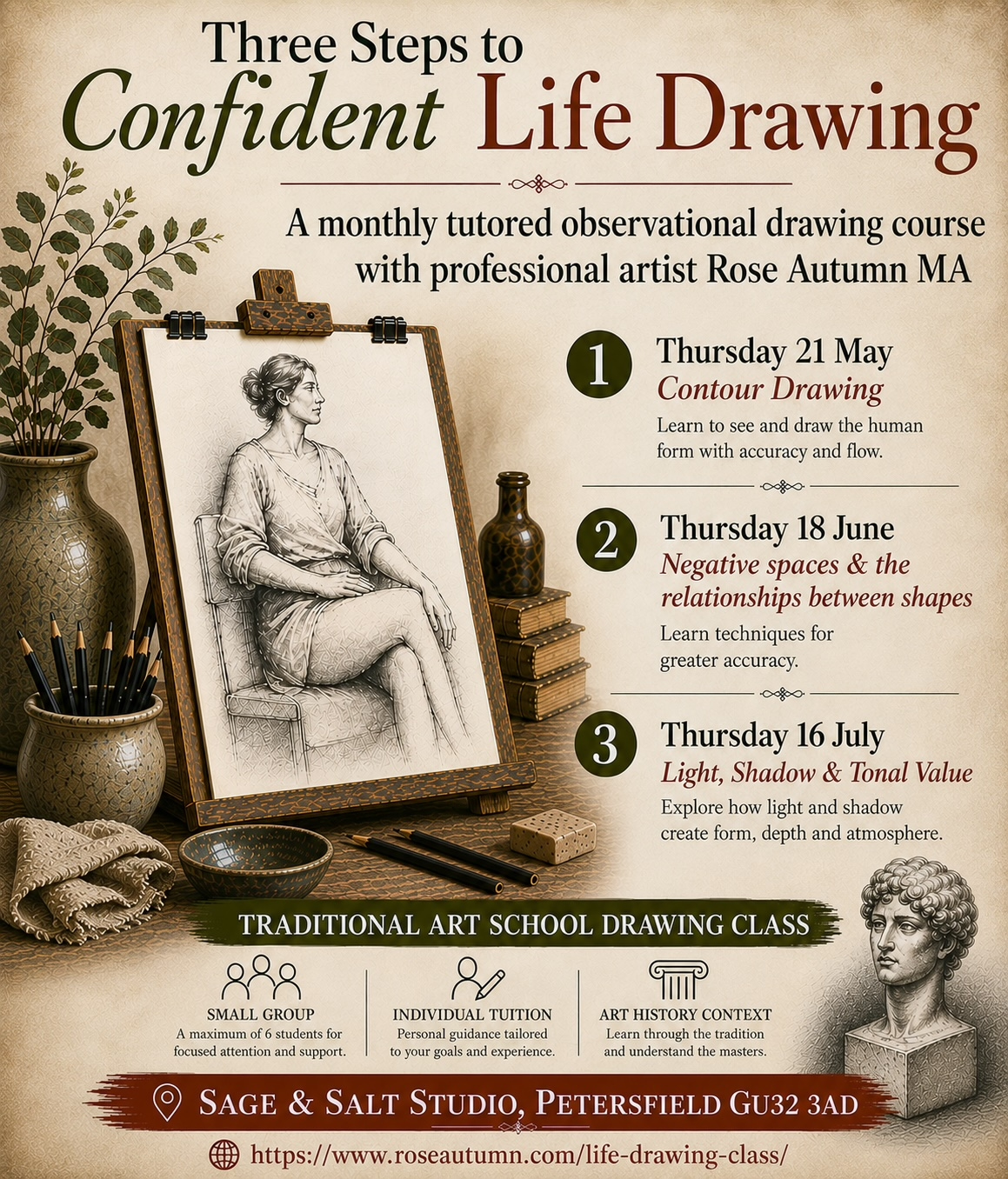
Three Steps to Confident Life Drawing
Monthly Tutored Observational Drawing Class with Petersfield Artist Rose Autumn MA
09:30 to 12:30
Thursday 21 May – Contour Drawing
Thursday 18 June -Proportion & Negative Space
Thursday 16 July – Light, Shadow & Tonal Value
Sage & Salt Studio, 4 Swan Street, Petersfield, Hampshire GU32 3AD
Experience a traditional art school drawing class in a small group with individual practical tuition in an art history context.
Develop confidence in drawing from a live model, with a structured drawing process from line, through proportion, to tonal value.
Across the three classes, you will learn three essential observational drawing skills: finding the edges of the figure, recognising negative spaces and the relationships between shapes, and understanding how the interplay of light and shadow creates form.
You will learn drawing techniques in graphite and charcoal, and how to measure, compare angles, and plot key points around the figure for greater accuracy.
This is a small class limited to eight places for beginners and improvers who want to learn foundational observational skills.
By the end of the course, you will have a practical step-by-step method for approaching the figure with more confidence, accuracy, and clarity.
Please bring
A sketching easel, an A3/A2 drawing board, paper, and clips or an A3/A2 sketchbook if you prefer to sit and work on your lap,
and any putty rubbers and/or erasers that you have.
Graphite pencils, graphite sticks, willow charcoal, compressed charcoal, craft knife, and cloths will be provided.
To book your place, go to: https://www.sageandsaltstudio.co.uk/service-page/three-steps-to-confident-life-drawing
Rose Autumn MA is a Petersfield-based artist and tutor specialising in drawing and painting. She holds a BA and MA in Fine Art from the City & Guilds of London Art School, as well as a teaching qualification. She was formerly a visiting lecturer to undergraduate painting students and has taught amateur artists privately. She has given lectures and demonstrations in drawing and painting to local art groups and schools.
Like my Facebook Page for regular updates: https://www.facebook.com/DrawingWithRose


Art School at Home
British Artist Rose Autumn MA, is a practicing artist who lives and works in Petersfield, East Hampshire. She is offering Art School Tutorials to professional and amateur artists in their homes and studios, either in-person or via Zoom.
Rose is bringing art school quality teaching to the artists of Hampshire with one-to-one private tutoring. If you have artist’s block; are struggling to finish a project; or are looking to move your work forward Rose can gently guide you onto a new course.
With training to Masters level in Art History, Drawing, and Oil Painting she has a deep understanding of her subject combined with teacher training and art school teaching experience. She will offer personalised learning to help build your confidence, develop positive habits, encourage problem-solving skills, and unleash your potential.
Rose will start by reviewing your recent work, research material, and sketchbooks. She will then critique your work, providing feedback on research methods, technique, compositional elements, use of materials, and subject matter. She will advise on further research, art theory, strategies for improvement, setting goals, and offer her creative ideas to progress your projects.
As a trained Tutor and Lecturer in Fine Art with a certificate in teaching adults from Chichester College, she was formerly a visiting lecturer at the City & Guilds of London Art School, where she delivered professional practice seminars and individual tutorials to undergraduate and postgraduate painting students. She now gives tutorials to professional and amateur artists and provides lectures and demonstrations in drawing and painting to local art groups and schools.
Having achieved a First Class BA in Painting and a Distinction in MA Fine Art, she was represented by Long & Ryle Gallery, London and has twenty years of experience as an artist. She was shortlisted for the Jerwood Drawing Prize and has been awarded the drawing prize at the National Open Art Competition, The Brian Sinfield Fine Arts Award at Pastels Today, and the Visitors’ Choice Award at the Brighton Festival Selectors’ Choice exhibition. Drawings were also included in the Manifest International Drawing Annual IV, and Drawing Room II, a survey of contemporary drawing at the Royal West of England Academy. She was an elected Member of the Chelsea Arts Club in London.
With a 2:1 degree in BA (Hons) Business Administration, she has excellent written and oral communication skills. She has written three academic dissertations and was formerly a Public Relations Manager liaising at director level with blue-chip corporations in the Financial and Consumer sectors, writing press and publicity materials for national television and print media.
One-to-one Tutorials via Zoom can be booked online at a rate of £60.00 per hour. Studio visits are £60.00 per hour plus travel costs if the venue is outside Petersfield.
To arrange an informal chat and preliminary meeting please go to the Contact Page.
To book an appointment go to the Bookings Page.
 0
0