Posts Tagged: viridian green pigment
Viridian in Landscape Painting: Artists Who Used This Important Green Pigment
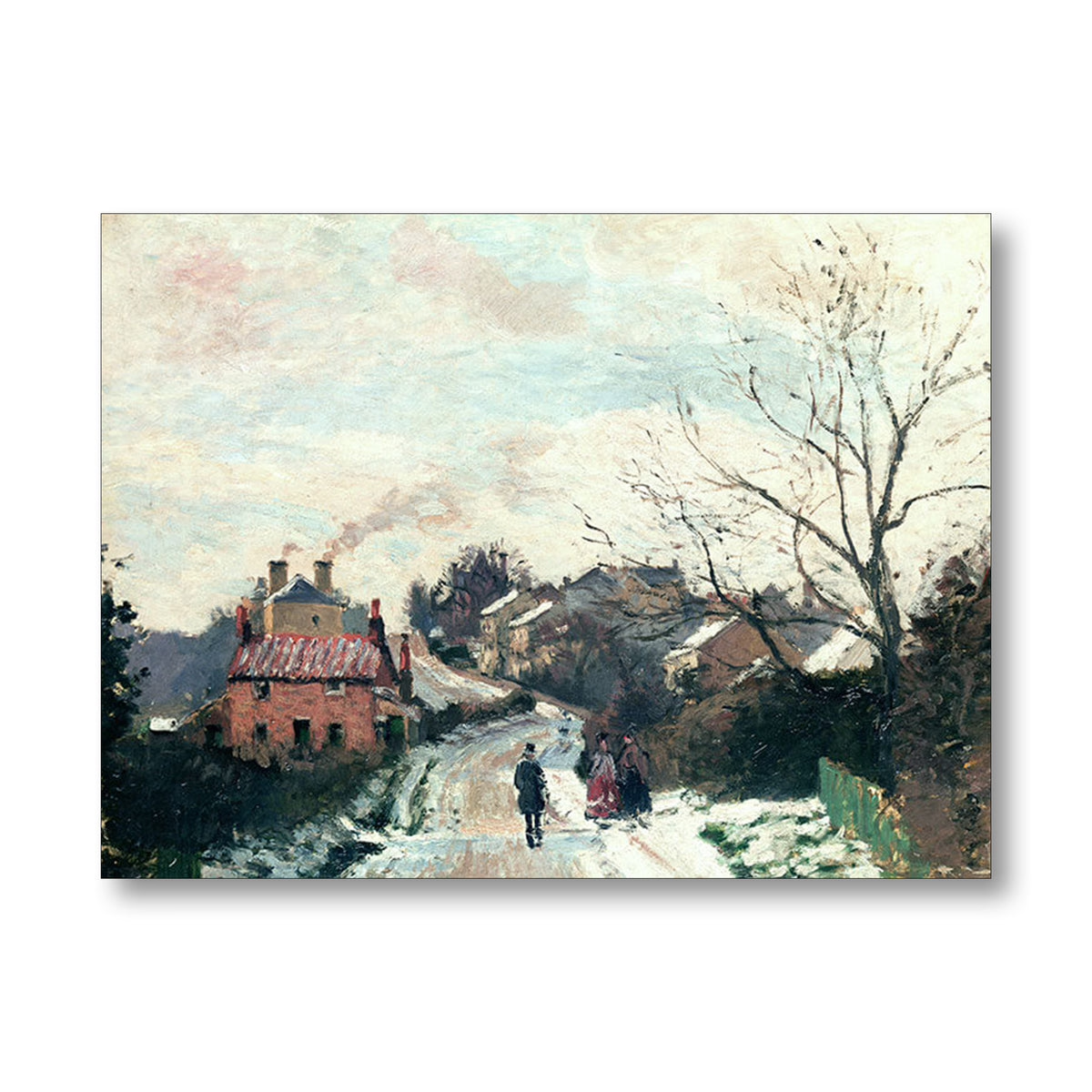
Featured Image: Camille Pissarro, Fox Hill, Upper Norwood, 1870, oil on canvas, National Gallery, London. Pigment analysis has identified Viridian in the green fence, mixed with other pigments.
Viridian was an important pigment in the development of landscape painting because it changed what painters could do with green.
Viridian gave landscape painters a permanent, cool, transparent green that could be used to create both vivid and naturalistic greens. Unlike many earlier greens, it was more stable, more versatile and safer than poisonous pigments such as Emerald Green. Its bluish undertone made it especially valuable for painting foliage, distance, cool shadow, reflected light and atmospheric landscape effects.
Before Viridian, many green pigments were either dull, unstable, poisonous, difficult to control, or visually harsh. Viridian offered artists a strong, cool, bluish-green that was more reliable and useful for serious painting. It is hydrated chromium oxide, usually identified today as PG18. ColourLex describes it as a vivid green with a bluish tint, while Winsor & Newton describes it as an intense bluish-green that can be mixed with yellow, orange or red to create a wide range of natural greens.
For landscape painters, this mattered enormously. Green is one of the hardest colours to manage in landscape painting. Straight-from-the-tube greens can look artificial, acidic or decorative. Viridian is powerful, but because it is transparent or semi-transparent and cool in temperature, it can be modified into many more natural landscape greens. Mixed with yellow, it can create fresh foliage greens; mixed with earth colours, it can become subdued and natural; mixed with red, orange or burnt sienna, it can be neutralised into greys, shadow greens and atmospheric darks.
It was also historically important because it provided a safer alternative to earlier poisonous greens such as Emerald Green, which contained arsenic. Winsor & Newton notes that Viridian was produced in Paris in the nineteenth century as a replacement for hazardous Emerald Green.
Viridian was important because it offered painters a cool, bluish, transparent green that was more stable and far safer than arsenic-based greens such as Emerald Green. It was also more luminous and versatile than duller pigments such as Chromium Oxide Green. For landscape painters, this meant they could mix fresher foliage greens, cooler shadows, atmospheric distance and more subtle natural greens without relying on unstable or highly poisonous earlier pigments.
Its transparency is another reason painters value it. Viridian can be used in glazes, thin passages, cool shadows and optical mixtures. This makes it particularly useful for painting distance, reflected light, foliage, water, shadowed grass and atmospheric recession. It is not just a “green”; it is a way of controlling temperature, depth and luminosity in a painting.
Artists Who Used Viridian
Viridian became part of the modern nineteenth-century palette used by Impressionist and Post-Impressionist painters. Artists such as Pissarro, Monet, Cézanne and Van Gogh used modern synthetic pigments to break away from the darker, earthier palettes of earlier academic painting. Viridian helped make possible a brighter, more light-filled approach to landscape. Viridian Green, PG18, is found in Impressionist and Post-Impressionist painting and remains popular today.
The strongest examples of artists who used Viridian in landscape painting are Turner, Corot, Pissarro, Monet, Cézanne, and Van Gogh. These artists are particularly of note because their use of green was not merely descriptive. Viridian allowed them to explore atmosphere, optical vibration, reflected light, cool shadow, distance and the living structure of the landscape.
J. M. W. Turner
J. M. W. Turner was one of the great experimental colourists of English painting. He is known to have used new synthetic pigments as they became available, and Viridian appears among the pigments associated with his later practice. Turner’s interest in luminous atmospheric effects makes his use of modern greens particularly significant for landscape painters.
Jean-Baptiste-Camille Corot
Corot is an important figure in the development of nineteenth-century landscape painting, standing between the classical landscape tradition and the more broken, naturalistic handling that would influence the Impressionists. Technical research and museum discussion of Corot’s materials indicate the possible or identified use of Viridian in his landscape work.
Camille Pissarro
Camille Pissarro is one of the clearest examples of an Impressionist landscape painter known to have used Viridian. Pigment analysis of works such as Fox Hill, Upper Norwood has identified Viridian among his materials. This is especially relevant because Pissarro’s landscapes often depend on subtle modulations of green, grey, blue and earth colour rather than a simple local green.
Claude Monet
Claude Monet made extensive use of modern nineteenth-century pigments, and Viridian was part of the expanded colour range available to the Impressionists. In his landscapes, garden paintings and water-lily subjects, green was not treated as a flat descriptive colour but as a shifting optical field, affected by light, atmosphere, reflection and surrounding colour.
Paul Cézanne
Paul Cézanne is known to have used Viridian in landscape paintings, including Provençal subjects. His use of green is particularly interesting because he did not simply imitate natural appearances. Instead, he built landscape through structured colour relationships, using greens, blues, ochres and earth colours to create form, rhythm and spatial weight.
Vincent van Gogh
Vincent van Gogh used Viridian in some of his landscape paintings, including works where greens are mixed with other strong pigments such as chrome yellow, emerald green and white. His use of green was often expressive rather than purely naturalistic, helping to intensify the emotional force of the landscape.
Alfred Sisley
Alfred Sisley, like the other Impressionists, worked within the new nineteenth-century palette made possible by modern synthetic pigments. Viridian is associated with Impressionist landscape practice, although any claim about Sisley should ideally be tied to a specific technical analysis of an individual painting. His landscapes are useful to study because of their cool, silvery greens and atmospheric handling.
Édouard Manet
Édouard Manet was not primarily a landscape painter in the same sense as Monet, Pissarro or Sisley, but he painted outdoor subjects and garden scenes and made use of modern nineteenth-century pigments. Where Viridian is discussed in relation to Manet, it is best treated as part of the wider modern palette of the period rather than as a defining feature of his landscape practice.
Berthe Morisot
Berthe Morisot’s outdoor scenes and garden subjects belong to the same modern painting context in which Viridian became important. As with Sisley and Manet, her work is highly relevant to the broader discussion of modern greens, broken colour and Impressionist light.
Earlier Green Pigments
A list of earlier green pigments that were used before Viridian became widely available.
Green Earth / Terre Verte
Green Earth, also known as Terre Verte, is one of the oldest green pigments used by painters. It is a natural earth pigment, usually soft, muted and grey-green rather than bright. It was useful for underpainting, flesh tones, shadows and subdued landscape greens, but it lacked the intensity needed for brilliant foliage or strong modern landscape colour.
Malachite
Malachite is a natural copper carbonate mineral pigment. It was used from antiquity and through the medieval and Renaissance periods. It can produce a beautiful green, but it is relatively coarse, expensive, variable in colour and not as strong or flexible as later synthetic greens.
Verdigris
Verdigris is a copper-based green made from the corrosion of copper. It was widely used historically and could produce a bright bluish green, but it was chemically unstable and could darken or change over time. This made it problematic for permanent painting.
Sap Green
Sap Green was originally a lake pigment made from plant material, especially buckthorn berries. It was used as a transparent green, useful for glazing and botanical effects, but traditional Sap Green was not very permanent. Modern Sap Greens are usually mixtures rather than the original plant-based pigment.
Green Verditer
Green Verditer is an artificial copper carbonate pigment. It was used as a blue-green pigment, but it was not as durable or versatile as later greens. It belongs to the older group of copper-based greens that were gradually displaced by more reliable nineteenth-century pigments.
Scheele’s Green
Scheele’s Green was developed in the late eighteenth century and became popular because it was much brighter than many earlier greens. However, it contained arsenic and was highly poisonous. It was used not only in artists’ materials but also in wallpapers, fabrics and decorative objects, which made it notorious for its toxicity.
Emerald Green / Paris Green / Schweinfurt Green
Emerald Green, also known as Paris Green or Schweinfurt Green, was introduced in the early nineteenth century. It was one of the most brilliant greens available to artists before Viridian, but it was also arsenic-based and extremely toxic. It was valued for its vivid colour but was dangerous to manufacture, handle and use.
Chromium Oxide Green
Chromium Oxide Green was introduced before Viridian and was more stable and less toxic than the arsenic greens. However, it is a dull, opaque, earthy green. It is useful in painting, but it does not have Viridian’s clarity, transparency or bluish luminosity.
Cobalt Green
Cobalt Green was another nineteenth-century green available before Viridian became widely used. It was more stable than the arsenic greens, but it was often weak in tinting strength and expensive. Its colour could also be rather subdued compared with Viridian.
 0
0