Posts Tagged: PG18
Landscape Painters and Viridian: Why PG18 Matters in Oil Painting
After writing about the change in the Winsor & Newton Artists’ Oil Colour range from traditional Viridian to Viridian Hue, I wanted to look more closely at why Viridian matters in landscape painting.
This is not just a technical question about pigment codes. It is a question about the behaviour of green in painting.
Green is one of the most difficult colour families for landscape painters to control. It can so easily become too bright, too acidic, too decorative, or too illustrative. A good landscape green often has to be broken, softened, greyed, cooled, warmed, or pushed backwards to create a subtle atmosphere. That is where genuine Viridian, made with PG18, becomes important.
In my previous post, I wrote about my disappointment at discovering that the current Winsor & Newton Artists’ Oil Colour Viridian Hue is no longer the same as my old Winsor & Newton Artists’ Oil Colour Viridian 692, AA, Series 4, which I had kept since art school. Winsor & Newton’s current Artists’ Oil Colour Viridian Hue is listed as pigment code PG26 and PG7, not PG18. PG7 is phthalo green, a much stronger and more assertive pigment.
For a landscape painter, that change matters.
What is Viridian?
Viridian is a cool, bluish green pigment. Its pigment code is PG18. Chemically, it is hydrated chromium oxide.
Viridian was first prepared in Paris by Pannetier around 1838, and later patented by the French chemist Guignet in 1859. Because of that, it has also been known historically as Guignet’s Green.
It arrived at an important moment in European painting. The nineteenth century transformed the artist’s palette. New synthetic pigments gave artists colours that were brighter, more stable, more varied, and more reliable than many of the older materials. Viridian belonged to this new world of colour.
Before Viridian, many green pigments were problematic. Some were dull. Some were unstable. Some were poisonous. Emerald green, for example, was vivid but arsenic-based. Viridian offered a more stable, transparent, cool green that could be used in oil, watercolour, and other media.
For landscape painters, this was significant. Viridian was not merely a tube green. It was a modern green that could be used to explore light, air, water, foliage, distance, and shadow.
Why Viridian became important to landscape painters
Viridian is particularly useful in landscape because it is not a loud, opaque, yellowish green. It is cool, transparent to semi-transparent, and slightly blue in character. Viridian Green PG18 is a semi-transparent green pigment with a distinctive blue undertone, found in the paintings of the Impressionists and Post-Impressionists.
That blue undertone is important.
In landscape painting, greens are rarely simple. The green of a nearby leaf is different from the green of a distant tree. The green of grass in sunlight is different from the green of a shadowed bank. The green of a tree against the sky is different from the green reflected in water.
Viridian helps because it can be modified. It can be warmed with yellows, ochres, and earths. It can be neutralised with reds and crimsons. It can be cooled with blues. It can be pushed into greys, blue-greens, sea-greens, and atmospheric shadow colours.
This is why genuine PG18 Viridian is so different from a phthalo-based Viridian Hue. A phthalo green mixture may look similar from the tube, but it often has a much stronger tinting strength. It can take over a mixture very quickly. That may be useful in some kinds of painting, but it is not always helpful in naturalistic landscape painting, where subtle control is everything.
Viridian and the Impressionists
Viridian became closely associated with the Impressionists and Post-Impressionists. This is not surprising because their work depended on outdoor observation, broken colour, optical vibration, and a much more direct engagement with modern pigments.
The Impressionists were not simply painting “green fields”. They were painting the effect of light on green. They were painting air, weather, reflection, distance, and changing conditions.
A pigment like Viridian gave them a cool green that could be used in mixtures and contrasts. It could be set against warmer colours, and it could assist in building the optical complexity of foliage, water, and shadow.
Viridian’s importance is not that every Impressionist used it in exactly the same way. Its importance is that it belonged to the modern palette that made this new approach to landscape possible.
Claude Monet and modern green
Claude Monet is one of the painters most closely associated with the modern landscape palette. His work depends on the relationship between colour, light, water, reflection, and atmosphere.
Viridian belongs naturally to this world. A cool, transparent green is useful in painting water, reflected trees, shadowed banks, and the cooler notes in foliage. Viridian and chromium oxide greens entered painting at a time when plein-air landscape painting was becoming increasingly important.
Monet’s use of greens was never simply descriptive. He was not just filling in trees or grass. He was building a colour structure. In that kind of painting, a green pigment has to be capable of subtle relationships. It has to work with blues, violets, yellows, reds, and earth colours. It has to sit within the whole atmospheric key of the painting.
That is why genuine Viridian is so useful. It is not merely bright. It is adjustable.
Van Gogh and Viridian
Vincent van Gogh also used Viridian. In his case, the pigment becomes part of a more expressive and structural use of colour.
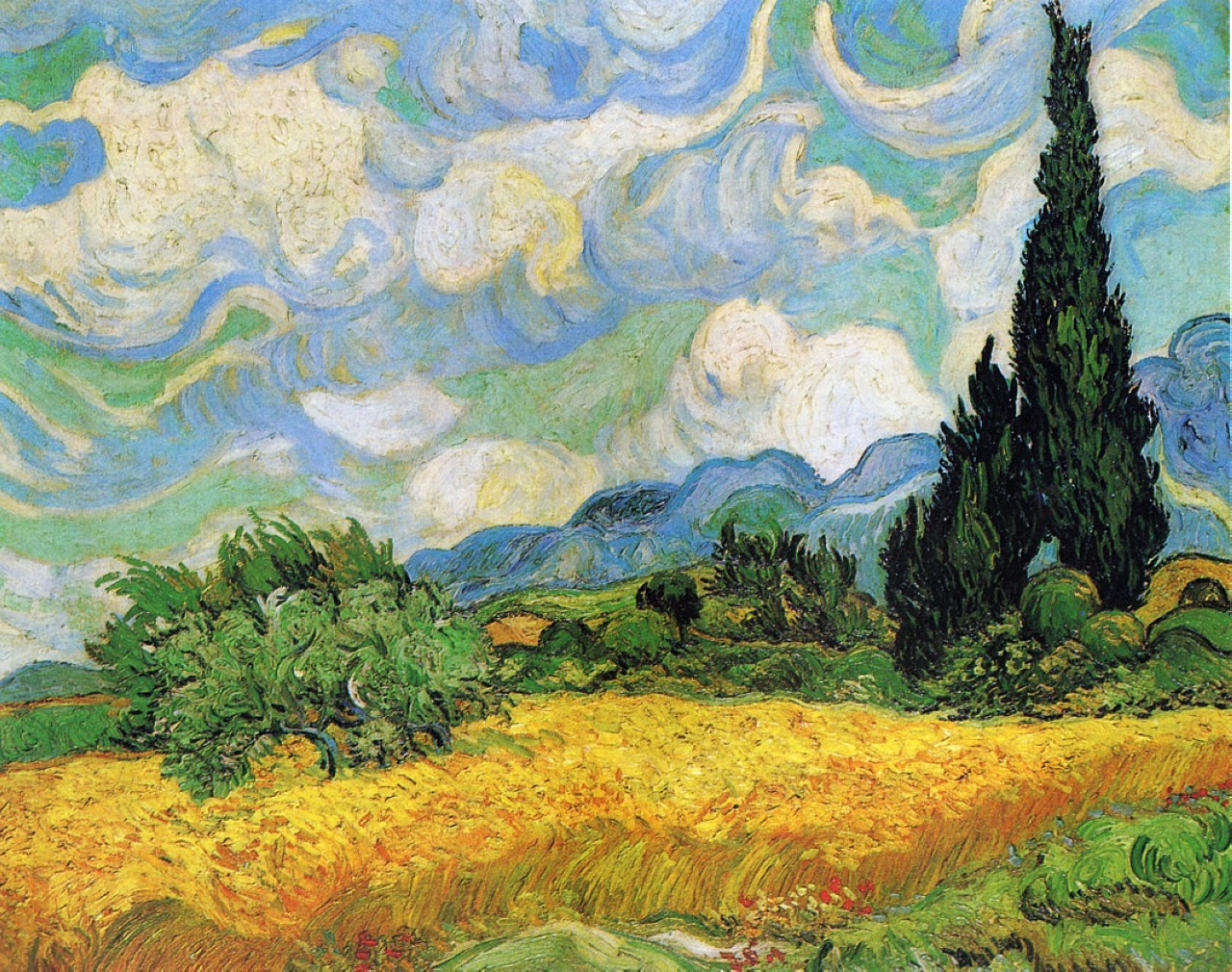
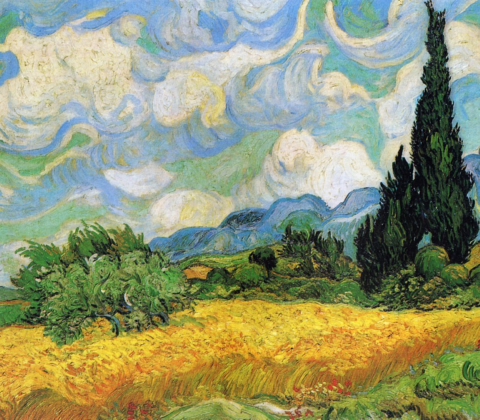
Viridian can be identified in Van Gogh’s A Wheatfield with Cypresses. In one area of the painting, the pale green bush below the blue mountain is described as containing Viridian, chrome yellow, and zinc white. Other green passages contain mixtures involving emerald green, hydrated chromium oxide green, zinc white, and chrome yellow.
That example is useful because Van Gogh was not using green timidly. He was using modern pigments to create force, rhythm, heat, structure, and emotion. The National Gallery describes A Wheatfield, with Cypresses as one of several versions Van Gogh painted in 1889 while he was at Saint-Rémy.
Viridian, in Van Gogh’s hands, is not merely naturalistic. It becomes part of a heightened landscape language. It can contribute to the intensity of the painting while still retaining its cool, bluish character.
This shows one of the great strengths of Viridian. It can be used subtly, but it can also be used expressively. It is not a weak pigment. It is a controlled pigment.
Viridian and the problem of distant trees
One of the reasons I became interested in Viridian again was because I am now working with landscape after twenty years of working almost entirely in charcoal. In charcoal, tone, edge, pressure, and atmosphere are everything. Returning to oil paint, I am very aware that colour can easily become too literal, which is particularly true when painting trees in the distance.
Distant trees are not usually bright local green. They are affected by air, light, moisture, and distance. They often need to be cooler, greyer, softer, and less saturated than the trees in the foreground. A strong phthalo-based green can easily come forward. It can sit on the surface of the painting rather than receding into space.
Genuine PG18 Viridian is useful because it can be persuaded into distance. Mixed with earthy reds and ochres, it can produce broken greens that feel more natural and less artificial. It can help create a green that belongs to the landscape rather than sitting on top of it.
That is why I think the move from PG18 to PG26 and PG7 in the Winsor & Newton Artists’ Oil Colour Viridian Hue is a real issue for landscape painters because it changes the way the colour behaves.
Why PG18 is different from PG7 in practice
PG18 Viridian is generally quieter, cooler, more transparent, and more subtle. It has a restrained tinting strength. It can be used in glazes and in delicate mixtures. It is very useful when a painter wants natural greens without garishness.
PG7, phthalo green, is a very different pigment. It is powerful, staining, highly tinting, and intensely chromatic. It is an excellent pigment in its own right, but it does not behave like traditional Viridian.
The problem with a Viridian Hue containing PG7 is not that it is unusable. The problem is that it is not a direct replacement. It may look close enough in a colour chart, but it will not necessarily mix like PG18 on the palette or behave like PG18 in a painting.
For serious painters, pigment behaviour matters more than colour name.
English landscape painting and restrained green
As someone particularly interested in English landscape painting, I think this question of restraint is important.
English landscape painting has often depended on subtle tonal and atmospheric relationships. Whether one is thinking about Constable’s broken naturalism, Turner’s atmosphere and light, the tonal restraint of later landscape traditions, or the painterly handling of twentieth-century British landscape painters, green is rarely just green.
The English landscape is full of muted colour: damp fields, grey skies, winter hedges, blue-green distance, dark tree masses, chalk paths, wet leaves, and low light. A landscape painter needs greens that can be moderated.
Viridian is useful because it can help produce these cooler, quieter notes. It is especially valuable when mixed away from its full chromatic strength. It can be taken into greys, soft blue-greens, shadow greens, and atmospheric mixtures.
This is the opposite of the crude “grass green” problem that ruins so many amateur landscapes. The aim is not to find the brightest green. The aim is to find the right green in relation to the whole painting.
Why I am replacing my old Winsor & Newton Viridian with Rembrandt 616
My old Winsor & Newton Artists’ Oil Colour Viridian 692 is now something I will use sparingly. It appears to belong to the older PG18 formulation. The current Winsor & Newton Artists’ Oil Colour Viridian Hue 696 is listed as PG26 and PG7.
That makes me reluctant to buy it as a replacement.
Instead, I am going to try Rembrandt Oil Colour Viridian 616. Royal Talens lists Rembrandt Viridian 616 as PG18, semi-transparent, with its highest lightfastness rating. It also appears to be one of the best-value genuine PG18 Viridian paints currently available in a large tube.
For my purposes, that makes sense. I want a genuine Viridian for landscape painting: a cool, transparent, restrained green that can be used in mixtures, glazes, distant trees, shadowed foliage, and atmospheric passages.
I do not want a phthalo-based approximation when the whole point is subtlety.
Other artist-quality PG18 Viridian options
For artists looking for genuine Viridian, the key is to check the pigment code. Do not rely only on the colour name. Look for PG18. Some artist-quality oil paint manufacturers that produce or have produced genuine PG18 Viridian include:
Rembrandt Oil Colour Viridian 616
Gamblin Artist Oil Viridian
Jackson’s Professional Oil Viridian Green
Michael Harding Viridian
Old Holland Viridian Green Deep
Williamsburg Viridian
Holbein Viridian
M. Graham Viridian
Blockx Viridian
Lefranc Bourgeois Viridian
Maimeri Viridian
Cranfield Viridian Green
Rublev/Natural Pigments Viridian
Availability changes, so I would always check the current pigment information before buying. Paint names are not enough. The pigment code is the important part.
Conclusion: Viridian is not just a green
Viridian has a serious place in the history of landscape painting. It belongs to the nineteenth-century expansion of the artist’s palette, to the rise of modern plein-air painting, and to the colour language of Impressionist and Post-Impressionist landscape.
It is useful because it is subtle. It is cool, transparent, bluish, and capable of being modified into natural greens. It can help a landscape painter avoid crude, illustrative colour.
That is why the change from traditional PG18 Viridian to a PG26 and PG7 Viridian Hue matters. For some painters, the hue may be perfectly acceptable. But for artists who care about pigment behaviour, especially in landscape painting, it is not the same thing.
For serious landscape painters, the advice is simple: check the pigment code. If you want traditional Viridian, look for PG18.
That is what I am doing now. My old Winsor & Newton Viridian has reminded me what a useful pigment genuine Viridian can be. My next step is to test Rembrandt Oil Colour Viridian 616 and see how closely it performs as an affordable replacement in my own landscape painting.


The Problem with the new Windsor & Newton Viridian Oil Paint
Why I Am Replacing Winsor & Newton Viridian: The Problem with Moving from PG18 to PG26 + PG7
After twenty years of working almost exclusively in charcoal, I have recently started landscape painting again. As part of that return to oil paint, I opened up some old tubes of Winsor & Newton Artists’ Oil Colour that I had kept since art school. Among them was a tube of Viridian 692, AA, Series 4, dating from around 2006.
That tube matters because it appears to be the older, genuine Winsor & Newton Viridian: a traditional single-pigment colour made with PG18, hydrated chromium oxide. To my disappointment, when I looked at the current Winsor & Newton Artists’ Oil Colour range, I found that the old Viridian has effectively been replaced by Viridian Hue, colour number 696, made with PG26 and PG7 rather than PG18.
That is not a minor change. For a landscape painter, it changes the behaviour of the paint.
I have not been able to find a published date for the change, but Winsor & Newton’s older Artists’ Oil Colour Viridian 692 was a PG18 paint, while the current Winsor & Newton Artists’ Oil Colour Viridian Hue 696 is listed as PG26 and PG7. The change appears to have happened sometime after the early-2000s version of the range and before the current product listing.
Viridian: why PG18 matters
Traditional Viridian is PG18, hydrated chromium oxide. It is a cool, transparent to semi-transparent blue-green pigment. It has a distinctive bluish undertone and a restrained, slightly elusive quality.
That subtlety is exactly why it matters in landscape painting.
Viridian is not simply a bright green. It is a mixing green. Used intelligently, it can make natural greens, blue-greens, greys, shadow greens, distant tree colour, sea greens, and cool atmospheric mixtures.
Genuine Viridian is valuable because it is not too strong, it can be mixed into naturalistic colour.
What is the problem with Viridian Hue?
In artists’ paint, the word “hue” usually means that a colour is intended to resemble a traditional pigment, but is made from different pigments rather than the original material.
A hue is not automatically bad. Sometimes a hue is useful: it may be cheaper, safer, more lightfast, or more consistent than an older pigment. But in this case, the problem is that Viridian Hue is not just a cheaper version of the same thing. It is a different pigment mixture.
The current Winsor & Newton Artists’ Oil Colour Viridian Hue uses PG26 and PG7. PG7 is phthalo green, a powerful modern synthetic pigment with very high tinting strength. It is useful, but it behaves very differently from PG18.
For landscape painting, this matters because phthalo-based greens can easily dominate mixtures. They can become too vivid, synthetic, staining, and insistent. They can pull a painting towards a more illustrative or decorative green unless handled with great restraint.
Traditional PG18 Viridian is quieter, with a more subdued strength. It can sit back in a mixture. It is particularly useful when painting trees in the distance, cool passages in foliage, shadowed greens, and atmospheric landscape effects where the colour needs to be alive but not artificial.
The issue is not simply that Winsor & Newton changed the name; it is that they changed the material behaviour of the paint.
In painting terms, why PG18 behaves differently
In painting terms, genuine Viridian PG18 is usually a quieter, more subtle green. It is transparent, cool, and slightly bluish. It is very useful for landscape mixing because it can make natural greens without becoming too garish. It also behaves beautifully in glazes and in restrained mixtures with earth colours, ochres, reds, and yellows.
Viridian Hue is an approximation. Because the current Winsor & Newton Artists’ Oil Colour version includes PG7, which is phthalo green, it may have a much stronger tinting strength and can more easily dominate mixtures. It may look similar straight from the tube, but it will not necessarily mix in the same way.
For my purposes — painterly landscape work and avoiding an illustrative green — my old Viridian 692 Series 4 tube is probably the more valuable and useful paint. I will use it sparingly. It now seems much closer in character to expensive genuine Viridian paints from ranges like Old Holland than to the cheaper current Winsor & Newton Viridian Hue.
This is not just a question of nostalgia or brand loyalty. It is a question of how the paint behaves on the palette and in the painting. A pigment with a lower, more restrained tinting strength gives me more control when I am trying to create broken, atmospheric landscape colour. A phthalo-containing hue may be perfectly useful in some circumstances, but it is not a direct replacement for traditional Viridian.
Why this matters for serious landscape painters
In landscape painting, green is one of the hardest colour families to control. It is very easy for a landscape to become crude, acidic, or illustrative. The best greens are often made indirectly: by modifying, greying, cooling, warming, and breaking the colour.
A traditional Viridian helps because it is already somewhat restrained. It is cool and transparent. Mixed with earth colours, ochres, reds, alizarin-type crimsons, or warm yellows, it can produce a wide range of natural greens. It is also useful for distant trees because distance usually reduces chroma and contrast. A heavy-handed phthalo-based green can easily come forward in the picture plane, when what is needed is recession.
For the sort of painting I am now interested in — painterly, atmospheric landscape painting rather than illustration — I want a green that can be pushed into subtlety. I do not want a paint that immediately overpowers the palette.
That is why I was disappointed to find that my old Winsor & Newton Viridian has been replaced by a hue mixture. I am now researching alternatives, and I am going to try Rembrandt Oil Colour Viridian 616 as a close, affordable match.
A short history of Viridian in European painting
Viridian belongs to the history of nineteenth-century colour chemistry. The element chromium was discovered in 1797, and the use of chromium oxide greens goes back to the first half of the nineteenth century. Viridian was first prepared by Pannetier around 1838 in Paris and later patented by the French chemist Guignet in 1859.
This places Viridian in the period when artists’ palettes were being transformed by new industrial pigments. The nineteenth century gave painters access to colours that earlier artists either did not have or could not rely on. Some earlier greens were fugitive, poisonous, chemically unstable, or visually crude. Viridian offered a comparatively stable, transparent, cool green that was especially useful for modern landscape and outdoor painting.
Viridian became more affordable after Guignet’s manufacturing method and became popular with the Impressionists and Post-Impressionists. It is sometimes referred to historically as Guignet’s Green.
This is important because Impressionist and Post-Impressionist painting depended heavily on new relationships between colour, light, atmosphere, and outdoor observation. Viridian was part of that technical expansion. It gave painters a modern green that could be used for cool landscape notes, mixtures, shadows, and glazes without the instability or toxicity problems associated with some earlier greens.
For me, this matters because Viridian is not just a tube of green. It is part of the technical history of modern landscape painting.
Manufacturers still making artist-quality PG18 Viridian
I have been looking for genuine PG18 Viridian, not Viridian Hue. The following are artist-quality oil paint options, listed broadly in order of value based on the current UK prices I found for the largest available tubes.
1. Rembrandt Oil Colour Viridian 616
Pigment: PG18
Largest tube found: 150ml
Approximate UK price found: £33.45
This appears to be the best-value genuine PG18 Viridian I found. Royal Talens lists Rembrandt Viridian 616 as PG18, semi-transparent, with its highest lightfastness rating. For my own painting, this is the one I am going to try first as a close, affordable replacement for my old Winsor & Newton Viridian.
2. Gamblin Artist Oil Viridian
Pigment: PG18
Largest tube found: 150ml
Approximate UK price found: around £64–£72
Gamblin makes a genuine artist-quality Viridian using PG18. It is more expensive than Rembrandt, but still less expensive than some of the premium European ranges. Gamblin has a strong reputation among professional painters, and this would be a good option for artists who want a high-quality genuine Viridian but do not want to pay Old Holland or Michael Harding prices.
3. Jackson’s Professional Oil Viridian Green
Pigment: PG18
Largest tube found: 225ml
Approximate UK price found: around £88–£97
Jackson’s Professional Oil Viridian Green appears to offer strong value in a larger 225ml tube. It is a useful option for painters who want a large quantity of genuine Viridian at a more manageable price than the premium handmade ranges. As with all pigment substitutions, I would still check the current pigment code on the tube or retailer listing before buying.
4. Michael Harding Viridian
Pigment: PG18
Largest tube found: 225ml
Approximate UK price found: around £132–£138
Michael Harding Viridian is a premium handmade paint with a high pigment load and an excellent reputation. This is likely to be a beautiful paint, especially for artists who are very particular about handling and pigment quality. The drawback is price. It is considerably more expensive than Rembrandt and Gamblin.
5. Old Holland Viridian Green Deep
Pigment: PG18
Largest tube found: 225ml
Approximate UK price found: around £139–£154
Old Holland Viridian Green Deep is a premium traditional option. It is probably close in spirit to the old single-pigment Viridian I was looking to replace, but it is expensive. For painters who want the most traditional, high-end option, it is worth considering. For painters looking for the best value, Rembrandt appears to be the more practical choice.
There are also other artist-quality manufacturers that have produced PG18 Viridian, including Williamsburg, Holbein, M. Graham, Blockx, Lefranc Bourgeois, Maimeri, Cranfield, and Rublev/Natural Pigments. Availability in the UK varies, and for any of these I would always check the pigment code on the actual retailer listing or tube before buying.
My conclusion
The change from Winsor & Newton’s older Viridian 692 to the current Viridian Hue 696 is significant. The old paint was a traditional Viridian based on PG18. The current Artists’ Oil Colour Viridian Hue is a mixture of PG26 and PG7.
That matters because landscape painting depends on subtle control of green. A phthalo-containing hue may be useful in some contexts, but it will not behave like genuine Viridian. It is likely to be stronger, more assertive, and less naturally restrained in mixtures.
For serious painters who care about pigment behaviour, the answer is simple: check the pigment code. If you want traditional Viridian, look for PG18.
For my own work, I am going to try Rembrandt Oil Colour Viridian 616. It appears to be the best-value genuine PG18 option currently available in a large tube, and it should be a close, affordable replacement for the old Winsor & Newton Viridian I used at art school.
 0
0