Posts Tagged: setting boundaries
Why Some People React Badly When You Set a Boundary
Some people are comfortable crossing your boundaries, but become deeply offended the first time you stop accommodating them.
In my previous two blog posts, I explored my experiences of one-sided communication and emotional dumping from several acquaintances over the past seven years. These episodes would come when I was out walking my dog or shopping in town, and always took me by surprise when I was trying to relax or get things done. This element of surprise left me unable to set boundaries successfully, and, as such, the situation became habitual for the speakers.
With one person in particular, I noticed a repeated pattern of both one-sided communication and emotional dumping. Every encounter went on too long, often leaving me feeling derailed.
After a couple of recent interactions with her in quick succession, which both occurred while I was trying to relax with a friend after a busy week, I realised that I have become fed up with the dynamic.
As a single working parent with two children and a dog, together with being the only child of an aged mother with dementia, I have too much on my plate to have time to take on board other people’s problems.
Over the years, I tried several ways of managing the dynamic, but nothing changed. In our most recent interaction, she had left me no natural opportunity to participate in the communication, so this time I just talked over her with my points.
Double Standards
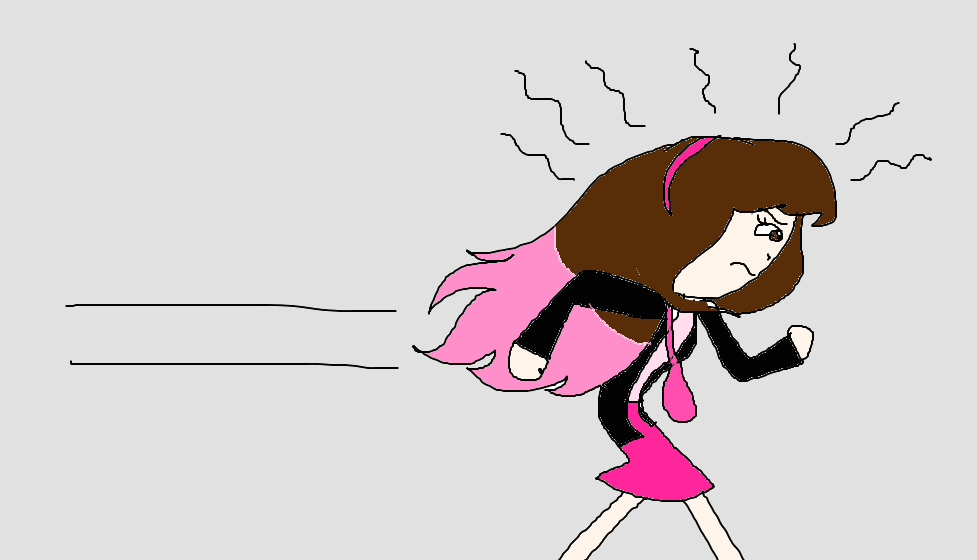
Although she had repeatedly spoken over me over the years, the first time I did the same to her, she became deeply offended, reacted with an emotional outburst and stormed away. The double standard was illuminating. My attempt to speak had not merely interrupted her sentence; it had disrupted a relationship in which she expected to speak and expected me to listen.
That reaction revealed an established relational role. She was accustomed to speaking while I listened. I talked over her because she provided no natural opportunity for me to speak, and I disrupted that arrangement.
Rather than consider why I needed to interrupt and talk over her, she became angry and accusatory, blaming me for overstepping her boundary and interrupting her speech.
Understanding the Dynamic
This outburst may have involved:
- A sense of entitlement: She considered interrupting me acceptable, but experienced being interrupted as an offence.
- Loss of control: My intervention prevented her from controlling the conversation.
- Shame sensitivity: A small challenge may have been experienced as humiliation or rejection.
- Poor emotional regulation: Instead of expressing irritation calmly, she discharged it through an outburst and departure.
- A perceived boundary violation: Ironically, someone who routinely crossed my conversational boundaries reacted strongly when she believed their own boundary had been crossed.
- A rupture in the listener–speaker arrangement: I stopped functioning exclusively as her audience and asserted myself as an equal participant.
The double standard is significant: she expected me to tolerate repeatedly being spoken over, yet could not tolerate it happening to her on one occasion.
Her response also performed an interpersonal function. By becoming offended and storming off, she shifted attention away from her conversational dominance and towards my alleged wrongdoing. I could have felt compelled to apologise, comfort her or become more cautious about speaking in future. Whether deliberate or unconscious, the outburst can restore the original arrangement by training me not to interrupt again.
It didn’t work. I allowed her to walk away feeling relieved.
Psychology
On a psychological level, the storming off was possibly an escape response to an emotion she could not regulate in the moment. The interruption itself was the trigger, but its meaning to her produced the outburst.
A plausible sequence is:
- I interrupted her monologue.
- She interpreted this as rejection, disrespect, criticism or loss of control.
- This activated shame, humiliation, anger or fear.
- She defended against the vulnerable feeling by becoming angry.
- She stormed off to escape the discomfort and reassert control.
Research shows that perceived rejection can generate hurt, shame and anger, while people who feel greater rejection sensitivity may interpret ambiguous behaviour as rejection and respond through anger, withdrawal or aggression.
Mechanisms
These three mechanisms may be relevant:
- Narcissistic injury: a psychological term for experiencing an ordinary frustration as an assault on one’s importance, entitlement or self-image. My speaking challenged her expectation of having my uninterrupted attention.
- Shame converted into anger: A momentary awareness that she was being interrupted, challenged, or no longer accommodated may have produced shame. Anger externalises that uncomfortable feeling and places the fault onto me. Research supports a relationship between shame, aversive emotional reactions and anger.
- Loss of interpersonal control: By walking away dramatically, she ended the conversation on her terms. It also left me with possible discomfort and potentially pressured me to apologise, pursue her, or avoid interrupting her again.
It is also possible that she simply has a strong sensitivity to being interrupted because of earlier life experiences from a caregiver around being dismissed, silenced, or not heard. This can happen when the mother is a narcissist. The mother wound is a core wounding that is difficult for many to face and address.
Aftermath
The decisive question is what will happen after you set a boundary with someone who has a pattern of disregarding your boundaries. A psychologically reflective person could calm down, reconsider the incident and recognise the double standard. Someone who insists that only my interruption mattered, while remaining unable to acknowledge their persistent domination of the conversation, is protecting the existing power arrangement rather than repairing the relationship.
A useful question is whether someone will later be able to reflect and say something like, “I became upset, but I realise I had not been giving you room to speak.” That would indicate some capacity for insight and repair. If they instead blame me entirely, demanding an apology or showing no curiosity about it would suggest a more entrenched problem with reciprocity and accountability.
In my case, I did not receive any response from her until she had seen a link to my blog posts on social media. Then she decided not to read the blog for further insight, instead getting triggered and assuming the blog post was about her. She then left a voice message that made accusations against me.
She experienced my blog post as a personal accusation, even without properly checking whether it was directed at her. That suggests a high level of self-reference: she sees herself in the material, feels exposed, and reacts from that feeling rather than from the facts.
Several things are happening at once.
First, she starts the message with apparent kindness, but quickly becomes corrective. Phrases like “I’m sending this with kindness” and “there is absolutely no bad feeling on my side” sit alongside quite pointed accusations, diagnoses, and moral correction.
Second, she shifts the focus away from the original issue: her emotional dumping and my boundary. Instead, the focus becomes defensive by attacking me. That can happen when someone feels ashamed or exposed. Rather than staying with, “Did I overwhelm you? Did I take up too much space?” the conversation moves to, “You are also flawed.”
Third, she appears to be trying to reframe emotional dumping as mutual healing. There is a difference between two people consensually sharing personal difficulties and one person repeatedly unloading in a way that leaves the other drained, trapped, or unable to speak. Her message blurs that distinction. “Being present” and “having empathy” are important, but they do not oblige someone to become an unbounded emotional container.
Fourth, the allegations about me are inappropriate. It is not her place to diagnose me, and in this context, it functions less like genuine concern and more like a way to undermine my perception: “You only see it this way because something is wrong with your empathy.” That is psychologically significant. It pathologises my boundary, which can have a gaslighting effect because it encourages me to question my own perception rather than examine the behaviour itself. Gaslighting is a narcissistic trait which I will discuss in my next blog post.
Storming off and then leaving a voice note that attempts to shift the focus away from her own behaviour may both come from the same place: shame, loss of control, and a need to restore moral position. If she recognised herself in the blog post, even without reading it, she may have felt exposed. Instead of reflecting quietly, she appears to have moved into defence: explaining, accusing, equalising, and repositioning herself as kind, understanding, and wronged.
The key point is this: her reaction does not prove that my boundary was wrong. It may prove that the boundary touched exactly the part of the dynamic that had previously gone unchallenged. The issue is not simply that she was interrupted; it is that my interruption exposed a one-sided relational arrangement that had previously benefited her.
Healing
Where a pattern of storming off in anger and making accusations when someone sets a boundary is rooted in early childhood wounds, Shamanic Healing can help a person heal the subconscious behaviours that are damaging their relationships.
A shamanic healing session can heal the underlying trauma and remove the resulting destructive subconscious behaviour patterns. Through Shamanic Subconscious Repatterning, we can receive a more positive way of being, improving the quality of our interactions and friendships.
For further information, go to: https://www.roseautumn.com/shamanic-healing/
Further Reading
Read about my experience of one-sided communication here: https://www.roseautumn.com/2026/06/when-someone-talks-at-you/
Read about my experience of emotional dumping here: https://www.roseautumn.com/2026/06/emotional-dumping
Read about my experience of gaslighting here: https://www.roseautumn.com/2026/06/gaslighting/
For further information about Shamanic Healing, go to: https://www.roseautumn.com/shamanic-healing/
About Rose
Rose is a Shamanic Practitioner trained in traditional shamanism. She is a member of the Federation of Holistic Therapists and is fully insured for in-person and distance Shamanic Healing sessions, as well as Shamanic Life Coaching. She specialises in supporting people recovering from narcissistic abuse.
Rose works without hallucinogenic or psychedelic plant medicines. Instead, she uses an ancient drumming method to access this altered state of consciousness. A session may include a tailored combination of Power Animal Retrieval, Divination, Soul Retrieval, Energy Body Healing, Psychopomp, and Extraction to remove negative energy and blockages.
Each session with me includes Shamanic Subconscious Repatterning. A powerful system that changes the subconscious programmes that drive unwanted behaviour. This method heals trauma at its source, removes the self-limiting programme, and then rewrites a new way of being.
Shamanic Healing can be accessed face-to-face in the Rose Healing Room, Petersfield, East Hampshire or remotely through Distance Healing Sessions. Because the work is carried out in the Spirit Realm with the support of Rose’s Spirit Guides, the client does not need to be physically present in the same room. Distance sessions are narrated in real time, and clients receive an audio recording by email afterwards.
For further information about Shamanic Healing, go to: https://www.roseautumn.com/shamanic-healing/
 0
0