Henry Bright’s ‘The Moorland Path’: Landscape in Pastel and Chalk
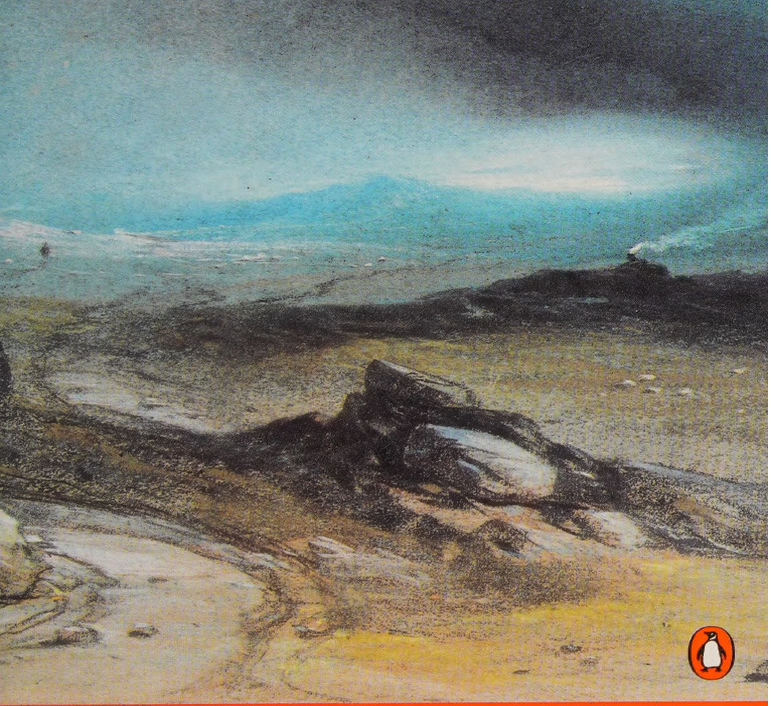
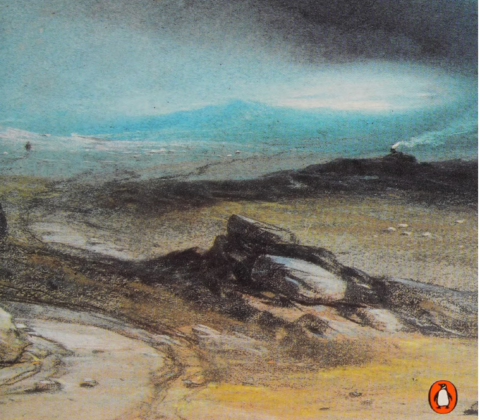
I read about Bright’s Moorland Path in the book Landscape in Britain 1830-1950. Sadly, most of the works were published in black and white and no reproductions exist online except for part of the picture, which was used to illustrate a book. It is this book cover that I have included in this post.
Henry Bright’s The Moorland Path, in the collection of Ipswich Museums, is a beautiful example of the nineteenth-century tradition of landscape drawing in coloured chalk and pastel. The work depicts an apparently simple subject: a rough path disappearing through open moorland beneath an expansive sky. Yet its simplicity is deceptive. Rather than describing every feature of the landscape equally, Bright builds the image through broad tonal masses, softened passages and carefully selected accents of light and colour.
Bright (1810–1873) was particularly accomplished in the use of coloured chalks and pastels. He was also a successful drawing master and published several instructional books, including Elementary Drawing Book in Landscape for the Use of Beginners (1840) and Bright’s Advanced Landscape Drawing Book (1845). His approach was closely connected with the nineteenth-century landscape-drawing tradition associated with James Duffield Harding, whose teaching practice Bright eventually took over.
The Coloured Paper
One of the most important aspects of Bright’s technique is his use of coloured paper for the midtones of his drawings. Bright deliberately selected different coloured papers according to the atmospheric effect he wanted to achieve.
A Ruined Castle at the Yale Centre for British Art, for example, is executed in black chalk and pastel on slightly textured brown wove paper. Moonlight Scene on the Rhine, also at Yale, combines pastel, gouache, black chalk and graphite on blue wove paper. Other Bright drawings are recorded on buff, grey, tan and drab papers. This is fundamental to understanding his technique. Rather than beginning with white paper and covering the entire surface with pastel, Bright could allow the natural colour of the paper to provide a unifying mid-tone. He then worked both darker and lighter than this ground.
A warm buff or brown paper, for example, could already provide the colour of distant earth, haze, dry vegetation and passages of sky. Dark chalk could establish trees, foreground vegetation and shadow, while pale chalk and white could bring forward clouds, paths and highlights. The result is an extraordinary economy of means. Some passages that initially appear to contain complex mixtures of muted colour may actually consist of relatively little drawing material, with the coloured paper itself doing much of the work.
Drawing Before Colour
Bright’s landscapes are perhaps better understood as coloured drawings rather than pastel paintings in the modern sense. His surviving works frequently combine black chalk or charcoal with white and coloured chalks. A landscape in the Cleveland Museum of Art, for example, is made simply with charcoal and white chalk on tan paper. With only these materials, Bright already possesses three fundamental values: the dark charcoal, the middle tone of the paper and the light of the white chalk.
Colour can then be introduced selectively. This helps explain the coherence of The Moorland Path. Bright does not appear to have approached the landscape as a collection of individually coloured objects — green grass, brown earth, blue sky and so forth. Instead, the landscape is organised primarily through relationships of light and dark, warm and cool, solid and atmospheric. Colour remains subordinate to the larger tonal structure.
Chalk, Pastel and the Stump
Another important part of Bright’s technique was rubbing and blending. Surviving drawings are specifically catalogued as being executed in black chalk and stump. A stump — tightly rolled paper or similar material — allows dry chalk to be pushed into the paper, spread, softened and partially removed from its original drawn form.
This provides an important clue to the atmospheric quality of Bright’s landscapes. A passage could first be drawn relatively strongly and subsequently rubbed down. Fresh chalk could then be placed over the softened material. The process might therefore be thought of as:
drawing → rubbing → softening → redrawing.
The distinction is important. An atmospheric passage need not be vague because the artist never put information there. Detail can first be established and subsequently suppressed. Bright can therefore juxtapose very soft, rubbed areas with surprisingly decisive marks. A sharp piece of chalk dragged across textured paper produces broken, irregular marks quite different from the velvety passage produced by a stump. The combination gives the landscape its vitality.
Bright’s Colour
Across Bright’s landscape drawings we encounter blacks and deep browns, ochre-like earth colours, subdued greens, muted reds and russets, blues and blue-greys, creams and white. Just as importantly, the colour of the paper remains visible amongst them.
Rather than mixing numerous colours to reproduce the precise local colour of every object, Bright seems to have used a limited family of colours capable of shifting the temperature and atmosphere of an already established tonal drawing.
How The Moorland Path May Have Been Made
Without a conservation examination, we cannot reconstruct the precise order in which Bright made The Moorland Path. Comparison with his documented works does, however, suggest a plausible working method.
The composition would first be established on a toned sheet rather than brilliant white paper. The major dark masses could then be introduced using black chalk or charcoal.
Some of these passages would be rubbed with the stump, spreading the chalk into the texture of the paper and establishing broad atmospheric masses rather than sharply defined objects.
The colour of the support could remain exposed through large areas of the drawing.
A small selection of coloured chalks could then introduce changes of temperature — warmer earth and vegetation against cooler distance and sky. Pale chalk and white would establish the strongest lights.
Finally, sharper dark and coloured marks could be returned to selected areas of the drawing.
This last stage is particularly important. Once a passage has been rubbed and softened, a fresh chalk mark placed over it acquires considerable visual strength. Bright can therefore suggest vegetation, branches, grasses and irregular ground with relatively few marks. The picture becomes highly detailed in certain places while remaining remarkably open in others.
The Importance of What Is Left Out
For me, this is perhaps the most interesting lesson contained in The Moorland Path. The drawing demonstrates that simplification does not necessarily mean a lack of observation. Bright appears to understand the landscape extremely well, but he does not give every piece of information equal importance. Some forms are stated. Others are softened. Some disappear almost completely into the colour of the paper.
There is an interesting parallel here with the later landscape practice of Frederick Walker. J. W. North recalled that Walker sought suggestiveness in his work not simply by omitting detail, but by putting detail in and subsequently partially erasing or “wearing” it away. North described the result as “not emptiness, but veiled detail.”
Bright’s procedure is not necessarily the same as Walker’s, but his use of chalk and stump offers a related possibility. Information can be drawn, rubbed back, partly lost and then selectively reinstated. The resulting landscape feels observed without becoming over-described.
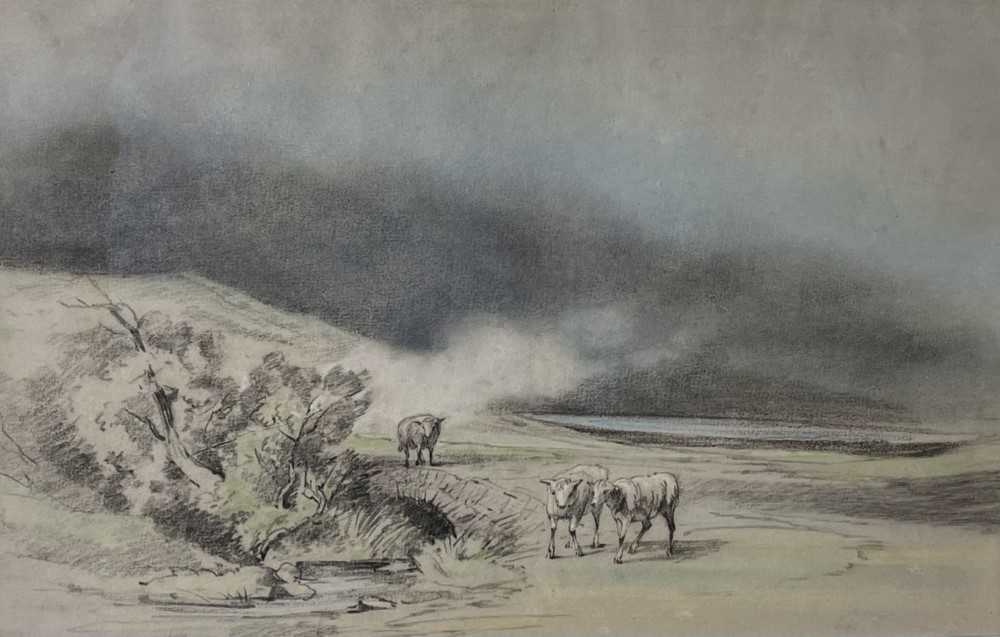
Sheep in a Landscape, 22cm x 31cm
A Lesson for Landscape Painting
Although The Moorland Path is a work in pastel and chalk, its lessons extend well beyond those materials.
Beginning on a middle tone immediately reduces the temptation to fill every part of the surface. Establishing the major tonal masses before introducing colour prevents local colour from fragmenting the composition. Rubbing down information allows forms to merge into atmosphere. And returning at the end with a small number of decisive marks creates detail without requiring every part of the landscape to be equally resolved.
Perhaps most importantly, Bright demonstrates how much can be achieved by allowing the support itself to remain part of the finished image.
The landscape is not constructed by continually adding more. Instead, the artist establishes information, suppresses some of it, strengthens selected passages and allows other areas to remain unresolved.
In The Moorland Path, what Bright chooses not to state becomes every bit as important as the marks he leaves behind.
 0
0 0
0
 20
20