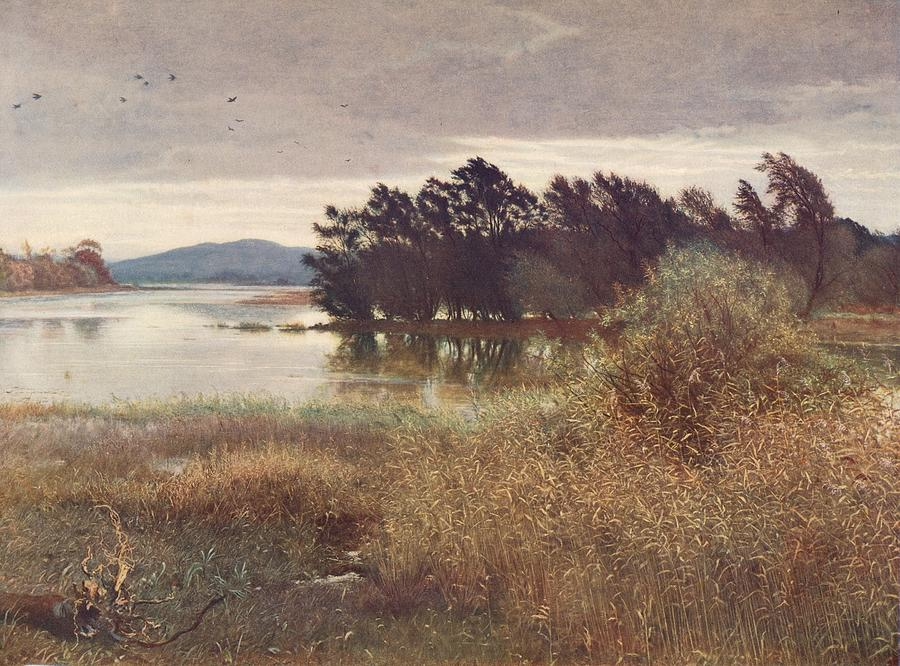

John Everett Millais — Chill October, 1870
John Everett Millais — Chill October, 1870
Oil on canvas, 141 × 186.7 cm
Andrew Lloyd Webber Collection, private collection.
Chill October is particularly valuable to study as a painter because it occupies an interesting position between the intensely observed naturalism of Millais’s earlier Pre-Raphaelite work and the broader, more atmospheric landscape painting of his later career. It was his first major “pure” landscape — a painting in which landscape itself, rather than figures or narrative, carries the emotional content. Contemporary and later commentators recognised it as an unusually important work: Hubert von Herkomer described it as both “masterly in painting” and “poetic in feeling”.
The subject and composition
The painting depicts a backwater of the River Tay near Kinfauns, outside Perth, looking across marshy ground, reeds and water towards a low distant hill. Millais knew the location from travelling on the Perth–Dundee railway and returned specifically to paint it.
What is immediately striking is the absence of a conventional picturesque subject. There is no building, dramatic mountain, prominent tree, human figure or narrative event around which the composition is organised.
Instead, Millais makes weather, vegetation, water and distance the subject.
The composition can be understood as a sequence of broad horizontal zones:
- a dense foreground of marsh grasses and reeds;
- water opening towards the left;
- a dark, irregular mass of trees crossing the middle distance;
- a distant blue-grey hill;
- and an exceptionally large expanse of grey sky.
Against these horizontals, the reeds and grasses provide a mass of fine vertical and diagonal marks. The wind-blown trees introduce another directional movement, preventing the horizontal structure from becoming static.
There is also a very effective asymmetry. The strongest dark mass — the trees — sits right of centre. The left-hand side opens into water and distant space. Consequently, the eye tends to move from the detailed foreground, through the trees, across the reflective water and finally towards the distant hill.
This produces considerable spatial depth without relying upon theatrical perspective.
Painting directly from nature
One of the most important technical facts about Chill October is that Millais painted it outdoors rather than simply producing studies to be turned into a finished landscape in the studio.
The location was awkward and marshy, so a special wooden platform was constructed to support Millais and his easel. Because the area was affected by the Tay’s estuarial tides, working there was difficult. A railway porter reportedly helped carry the large canvas to the site each day.
Millais himself described making: “every touch from nature on the canvas itself” despite the wind and rain.
For a painting student, this is significant. The canvas is approximately 1.87 metres wide. Painting a canvas of this scale directly in front of the motif is very different from making a plein-air sketch.
It means that Millais was attempting to reconcile two things: immediate observation with the sustained construction of a major exhibition painting.
The landscape therefore isn’t an enlarged oil sketch. It is the result of repeated looking.
Brushwork
This is one of the most interesting aspects of the painting.
Compare Chill October with the microscopic description found in Millais’s early Pre-Raphaelite landscapes and the difference is substantial.
The early Pre-Raphaelite ideal encouraged an almost botanical recording of nature. By 1870 Millais was no longer painting every individual blade of grass with equal emphasis. Accounts of his later development describe his brushwork as becoming broader and looser, while remaining closely based upon observation.
Look closely at Chill October and there are essentially different languages of brushwork operating simultaneously.
Foreground
The reeds and grasses contain a dense accumulation of relatively fine strokes.
But these marks do not simply describe individual plants.
Instead, they accumulate into a textural field.
This distinction is important.
Rather than:
blade + blade + blade = grass
Millais increasingly allows:
brushmarks + tonal variation + directional movement = sensation of grass.
That represents a considerable change from early Pre-Raphaelite practice.
Trees
The central trees are handled much more as masses.
Their foliage creates a dark, relatively compressed silhouette against the lighter sky and water.
Within this mass, smaller marks break the edges and suggest leaves and branches without requiring every element to be described individually.
The distinction between mass and detail is fundamental to the painting.
Water
The water becomes smoother and more horizontal.
Reflections beneath the trees dissolve the solidity of the trunks and foliage into vertical and horizontal interruptions.
Consequently the handling itself helps distinguish materials:
grass = broken / linear
foliage = clustered / massed
water = horizontal / reflective
sky = broad / relatively unified
This is a sophisticated example of allowing brushwork to describe the physical character of different parts of a landscape.
Colour
Perhaps the most useful aspect of Chill October for a contemporary landscape painter is its extremely restrained colour structure.
Published descriptions consistently identify muted greens, yellows, ochres, browns and greys as dominating the painting.
There are remarkably few strongly saturated colours.
The foreground moves through approximately:
yellow ochre → dull yellow-green → olive → brown → deep green-brown.
The trees contain:
olive greens → brown-greens → extremely dark green/brown neutrals.
The distant landscape shifts towards:
blue-grey → violet-grey → cool green-grey.
And the sky consists largely of:
warm grey → cool grey → pale grey-blue.
The effect is therefore not achieved through strong complementary colour contrasts.
It depends much more upon temperature and tonal relationships within muted colour.
A note about the actual pigments
There is an important distinction to make here.
I have searched specifically for technical pigment analysis of Chill October and have not found a published conservation study identifying the individual pigments by scientific analysis.
Therefore I would not state that Millais definitely used particular pigments such as Yellow Ochre, Raw Umber, Viridian, Cobalt Blue, etc. in this painting unless documentary or conservation evidence emerges.
That would turn a visual inference into a historical fact.
What we can identify confidently is the visible palette:
|
Area |
Observed colour family |
|---|---|
|
Sky |
cool and warm greys, muted grey-blue |
|
distant hill |
blue-grey / muted violet-grey |
|
water |
grey, ochre, muted blue-grey |
|
trees |
deep olive, brown-green, near-black green |
|
reeds |
ochre, straw yellow, olive |
|
foreground |
olive green, yellow-brown, umber-like darks |
This distinction is particularly important at degree level:
observed colour is not necessarily pigment identification.
Neutralisation rather than bright colour
One of the strongest lessons in the painting is that Millais does not seem to approach autumn as an opportunity for brilliant orange and yellow.
Instead he suppresses chroma.
The greens are generally broken greens — greens pushed towards brown, grey or yellow.
The yellows are earthy rather than brilliant.
Even the blue of the distant landscape is strongly greyed.
The result is a remarkably unified colour world.
A useful exercise for a painting student would therefore be to attempt a study using a deliberately restricted palette and mix almost every colour from several components rather than using colours directly from the tube.
For example, a modern approximation — not a claim about Millais’s historical palette — might use:
Yellow Ochre Raw Umber Burnt Umber Ultramarine Blue Viridian Alizarin Crimson Titanium or Lead White
From those colours it would be possible to construct much of the painting’s visual colour range.
The key would be neutralising rather than intensifying colour.
Tonal organisation
The painting works exceptionally well when imagined in monochrome.
There are roughly four major tonal groups:
1. Light: water and lighter portions of sky.
2. Light-middle: distant landscape and some grasses.
3. Middle-dark: foreground vegetation.
4. Dark: the principal group of trees.
The trees consequently function almost like a tonal anchor.
This allows Millais to place extremely delicate tonal differences elsewhere.
Notice particularly that the distant hill does not require much detail. Its lighter value and cooler colour are sufficient to push it backwards.
This is atmospheric perspective produced primarily through:
reduced contrast + cooler colour + softer edges.
The importance of edges
Another sophisticated feature is the hierarchy of edges.
The foreground contains numerous relatively sharp interruptions.
The central trees possess a recognisable silhouette but contain broken edges where foliage meets sky.
The distant hill is much softer.
This gives the painting considerable atmospheric depth.
The viewer experiences:
foreground texture → middle-distance mass → distant softness.
For a contemporary landscape painter, this is perhaps more useful than copying individual objects.
Millais is controlling how much information the viewer receives at each distance.
The sky
The sky occupies an unusually important proportion of the canvas.
Yet it contains remarkably little incident.
There are no spectacular clouds or dramatic sunset colours.
Instead Millais paints a heavy, low, essentially grey atmosphere.
Herkomer’s later criticism is interesting here. He admired the painting greatly but argued that the sky was “non-essential” and that the painting was more a transcription of an observed section of nature than a formally invented composition.
For a painter today, I would almost argue the opposite.
The apparent emptiness of the sky is important because it creates visual pressure.
The dark trees and reeds sit beneath this large grey weight.
The sky therefore contributes strongly to the sensation implied by the title: cold, damp October weather.
Atmosphere rather than topography
This is ultimately what makes Chill October particularly important.
Millais certainly describes a recognisable place. But topographical description is not the painting’s final purpose.
He is painting an experience of weather.
Wind bends vegetation.
Moisture reduces distant contrast.
Water reflects rather than asserts colour.
Autumn drains saturation from the landscape.
The low sky suppresses light.
Nothing dramatic happens, yet the entire landscape feels temporary.
The modern significance of the painting lies partly here. A recent discussion of British landscape painting describes Millais as moving from Pre-Raphaelite precision towards “broader effects, sensation, and affect” in Chill October.
That is an excellent way of understanding it.
Why the painting matters to painting students
Chill October demonstrates that close observation does not necessarily require exhaustive description.
Millais had been one of the great technicians of microscopic Pre-Raphaelite naturalism. Here he retains the habit of intense observation while becoming increasingly selective about how that observation is translated into paint.
That creates an important distinction:
He is not simplifying what he sees because he has stopped looking closely.
He is looking closely and then deciding which visual information is necessary.
The foreground requires texture.
The trees require mass.
The water requires reflection.
The distant hill requires almost nothing except a cool, soft tonal shape.
The sky requires atmosphere rather than detail.
That hierarchy is one of the painting’s greatest lessons.
Painting analysis in brief
Millais, Chill October, 1870
Subject:
Autumn marshland beside the River Tay.
Method:
Large-scale oil painting worked directly from nature on a specially constructed platform.
Composition:
Strong horizontal structure interrupted by reeds and wind-blown vegetation; asymmetrical dark tree mass balanced against open water.
Colour:
Restricted, low-chroma harmony of ochres, muted yellow-greens, olives, browns, blue-greys and greys.
Tone:
Strong dark middle-distance trees against relatively light water and sky.
Brushwork:
Combination of fine linear foreground marks, broader foliage masses, horizontal water handling and comparatively broad atmospheric passages.
Space:
Created through tonal recession, reduced contrast, softened edges and cooler distant colour rather than elaborate linear perspective.
Principal technical lesson:
Different parts of the landscape receive different degrees and kinds of description.
Principal colour lesson:
Atmosphere can be created through extremely subtle changes of neutralised colour rather than high saturation.
Principal compositional lesson:
A landscape does not require an obvious focal “subject”. Relationships between masses, intervals, textures and weather can themselves provide the structure.
Principal lesson for painters:
Observation and simplification are not opposites. The sophistication lies in observing intensely enough to know what can be left out.
The Tate essay by poet Kathleen Jamie is particularly useful supplementary reading because it considers the experience of the actual landscape and Millais’s physical engagement with the location: Tate — Poetic Encounters: Millais’s Chill October. For a historical painter’s perspective, Herkomer’s discussion is also valuable: Landscape Painting and Millais’s Chill October.
 0
0 0
0
 20
20