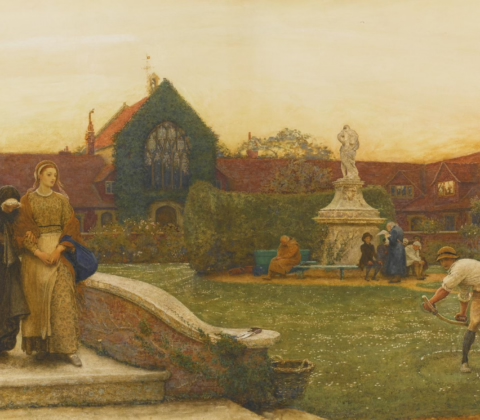
Frederick Walker: Painting Detail to Take It Away
While researching nineteenth-century British landscape painting, I came across a fascinating description of the working methods of the English painter Frederick Walker (1840–1875). It challenges the assumption that simplification in painting necessarily means leaving out detail from the beginning.
Frederick Walker was a British painter and illustrator. He achieved considerable success in both oils and watercolour before his early death. According to John Everett Millais, he was “the greatest artist of the century”.
Walker was associated with the group of Victorian artists sometimes described as the Idyllic School, and his watercolours are particularly interesting for their combination of close observation, softness and suggestion. His friend and fellow painter J. W. North had observed his methods at first hand and described an unusual process in which Walker would initially develop a painting to an extraordinary degree of detail, only to deliberately remove or obscure much of that information later.
Writing about Walker’s approach, North observed:
“His ideal appeared to be to have suggestiveness in his work; not by leaving out, but by painting in, detail, and then partly erasing it. This was especially noticeable in his water-colour landscape work, which frequently passed through a stage of extreme elaboration of drawing, to be afterwards carefully worn away, so that a suggestiveness and softness resulted—not emptiness, but veiled detail.”
— J. W. North, quoted in John George Marks, Life and Letters of Frederick Walker, A.R.A. (1896)
This idea of “veiled detail” is particularly interesting. Walker did not necessarily simplify the landscape before painting it. He first studied and described what he saw, sometimes in considerable detail, and then deliberately reduced the amount of information remaining visible in the finished work. (Wikimedia Commons)
Observation Before Simplification
North’s account suggests that Walker’s approach was founded upon an extremely close knowledge of nature. He worked directly from the landscape and was dissatisfied with conventional painterly shorthand for things such as grass, leaves and branches. Rather than beginning with a generic mark representing a tree or a patch of grass, he wanted the structure of his painting to originate in what he had actually observed. (Wikimedia Commons)
This creates an important distinction between two approaches to simplification.
A painter might look at a complicated hedgerow and immediately reduce it to a broad green shape. Walker’s method suggests another possibility: study the branches, leaves, spaces, changes of direction, light and colour first; establish some of that complexity in the painting; and only afterwards begin removing information.
The final result may be equally simple, but the simplicity has emerged from knowledge of the subject rather than avoidance of its complexity.
Walker himself described doing something very similar. In a letter concerning his work he remarked on how much he had “rubbed out in order to keep it simple”, adding that his first two days’ work had effectively disappeared. (Wikimedia Commons)
His process might therefore be summarised as:
observe → describe → elaborate → remove → simplify → selectively restate.
How Did Walker “Wear Away” His Paintings?
Exactly what North meant by “carefully worn away” deserves some caution. I have not found documentary evidence establishing one particular tool or procedure that Walker always used for this purpose.
There is, however, good evidence that his watercolour technique involved considerably more physical manipulation than we might associate with conventional transparent watercolour.
Catalogues of surviving Walker works repeatedly identify combinations of pencil, watercolour, bodycolour, gum arabic and scratching out.
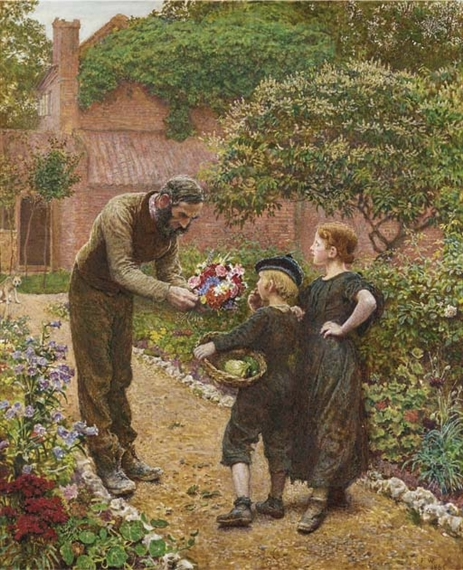
His The Bouquet of 1865, for example, is described as pencil, watercolour and bodycolour with gum arabic and scratching out. The Harbour of Refuge similarly combines pencil and watercolour with bodycolour and scratching out. (Christie’s)
Scratching out allowed the artist physically to disturb or remove parts of the painted surface, revealing lighter material or paper underneath. This could produce highlights and fine linear structures, but more importantly it demonstrates that Walker treated a watercolour as a surface that could be worked, altered and partially reconstructed, rather than simply accumulating transparent washes.

Chinese White and Bodycolour
Another important part of Walker’s technique was his enthusiastic use of Chinese White.
The Victoria and Albert Museum uses Walker’s Autumn of 1865 as an example of the possibilities of bodycolour. Adding Chinese White to watercolour produces a thicker, more opaque paint and can soften otherwise brilliant colours, producing what the V&A describes as a deeper, velvety quality. Walker could also use Chinese White directly for highlights. (Victoria and Albert Museum)
His use of the material was considered sufficiently unconventional to provoke controversy when Autumn was exhibited at the Old Water Colour Society in 1865. Walker even caricatured himself squeezing Chinese White from an enormous tube and wondering what the Society would think if its members could see him. (Victoria and Albert Museum)
This is significant when thinking about “veiled detail”.
Traditional transparent watercolour depends heavily upon preserving the white of the paper and progressively adding transparent colour. Bodycolour makes a much more complicated process possible. An artist can establish information, cover or partially obscure it with semi-opaque paint, modify the surface and then reintroduce selected details.
The painting can consequently acquire a history of addition and subtraction.
Detail Beneath the Surface
This may help explain the particular visual quality North recognised in Walker’s paintings.
Imagine that Walker carefully establishes grasses, branches and leaves. He subsequently softens, covers, rubs down or otherwise disrupts some of this information. Some forms disappear completely; others remain barely perceptible beneath subsequent layers; occasional details are allowed to remain sharp.
The viewer therefore does not see every piece of information Walker originally recorded.
But neither does the resulting area feel empty.
There are remnants of observation embedded within it.
Hence North’s wonderfully precise description:
“not emptiness, but veiled detail.”
The viewer senses complexity without being required to inspect every component of it.
The Difference Between Leaving Out and Taking Away
For painters, I think this is the most valuable lesson in Walker’s technique.
There is an important difference between never painting something and painting it and subsequently taking it away.
Suppose I am painting a group of trees.
I could decide immediately that the trees constitute one large dark shape and paint them accordingly. This may produce a successful simplification, but there is also a danger that the resulting shape becomes a generic symbol for trees.
Alternatively, I could begin by studying the individual trunks, branches, gaps, foliage, changes of colour and overlapping forms. Having understood and painted some of this complexity, I could then begin merging shapes, softening edges, obscuring branches and removing unnecessary information.
The final painting might eventually contain only a fraction of the original detail.
Yet the remaining shapes have been informed by everything that was previously there.
That seems to be the essential principle behind Walker’s method.
Simplification as a Final Stage
We often think that an experienced painter should know what to leave out.
Walker suggests another possibility.
Perhaps sometimes we need to put things in before we can understand what should be left out.
This makes simplification part of the editing process rather than merely a decision made at the beginning of a painting.
It also explains why apparent looseness can sometimes contain an extraordinary sense of specificity. The artist may have understood and described considerably more than remains visible.
A Walker landscape could therefore pass through several visual states:
observational drawing
↓
elaborated detail
↓
colour and bodycolour
↓
partial obliteration
↓
removal and softening
↓
selective restatement
↓
veiled detail
The finished surface contains traces of that history.
A Useful Exercise for Contemporary Painters
Walker’s method suggests an interesting studio exercise.
Rather than deliberately making a loose landscape study, choose a small section of landscape—perhaps a hedgerow, grasses or a group of trees—and initially allow yourself to become too descriptive.
Look carefully.
Paint the branches, spaces, variations of colour and changes of direction. Allow the passage to become considerably more elaborate than you would normally want in a finished painting.
Then stop describing and begin editing.
Merge adjacent forms. Soften some edges. Partially cover details. Remove marks where the medium permits it. Allow some forms to disappear into neighbouring shapes. Then selectively restore only those details that seem essential.
The aim is not to make the painting vague.
It is to discover how much information can disappear while the experience of complexity remains.
This is fundamentally different from trying to paint loosely from the outset.
From Observation to Suggestion
Walker’s technique is particularly interesting within nineteenth-century British landscape painting because it demonstrates that close observation and painterly simplification are not opposites.
His apparent softness was grounded in looking.
The finished painting did not necessarily show everything he had observed, or even everything he had originally painted. Instead, detail could be accumulated and subsequently sacrificed in pursuit of the larger visual experience.
There is an important lesson here for contemporary landscape painters.
Simplification does not have to mean seeing less.
It can mean looking intensely, understanding the complexity of what is there, and then deciding how little of that information the finished painting actually needs.
Perhaps that is the real significance of North’s phrase “veiled detail”: the detail has not simply been omitted. Its presence is still felt beneath the surface.
Sources
John George Marks, Life and Letters of Frederick Walker, A.R.A. (London, 1896), particularly North’s account of Walker’s working methods. A digitised historical study reproduces North’s account alongside Walker’s own description of rubbing out work to maintain simplicity. (Wikimedia Commons)
The Victoria and Albert Museum’s discussion of watercolour technique uses Walker’s Autumn (1865) to explain his unusually extensive use of Chinese White and bodycolour. (Victoria and Albert Museum)
Christie’s technical cataloguing of surviving works including The Bouquet and The Harbour of Refuge records Walker’s use of pencil, watercolour, bodycolour, gum arabic and scratching out. (Christie’s)
I think “not emptiness, but veiled detail” is strong enough to become the central idea of the post—and potentially a useful principle to return to in your own writing about simplification in landscape painting.
Best works to study online
- Frederick Walker, Autumn, 1865 — Victoria and Albert Museum This would be my first choice for studying Walker’s surfaces. The V&A specifically discusses it in relation to Walker’s unconventional use of Chinese White/bodycolour. The addition of white produces softened, opaque, “velvety” colour rather than conventional transparent watercolour. It is particularly useful for examining how foliage can remain richly observed without every detail remaining sharply articulated. View Autumn and the V&A’s technical discussion
- Frederick Walker, The Bouquet, 1865 This is probably the strongest documented example for your research because Christie’s gives the medium unusually precisely as: “pencil, watercolour and bodycolour with gum arabic and with scratching out.” The large areas of vegetation are particularly worth examining. Look for the alternation between very specific description and passages where information seems to dissolve into colour and tone. The surface has clearly been manipulated rather than simply painted once in transparent washes. View The Bouquet at Christie’s
- Frederick Walker, The Harbour of Refuge, watercolour version, c.1873 Another exceptionally important example. Christie’s records pencil and watercolour heightened with bodycolour and scratching out. It is a large watercolour—57.2 × 92 cm—so Walker was able to develop an unusually complex surface. Look particularly at the grass, distant architecture and trees. Individual information seems to emerge from larger atmospheric masses rather than sitting uniformly on the surface. View The Harbour of Refuge watercolour at Christie’s
- Frederick Walker, The Cottage Door, 1860 — Courtauld Gallery This is useful because the Courtauld provides both a good online image and precise technical information. The medium is: graphite, watercolour, gum arabic, bodycolour and scratching out. It is an early work, so comparing this with Autumn and The Harbour of Refuge helps reveal how Walker’s handling developed. View The Cottage Door at the Courtauld
- Frederick Walker, Spring This precedes Autumn and belongs to the important sequence of large watercolours of figures within landscape settings that culminated in works such as The Bouquet. Christie’s specifically identifies Spring, Autumn and The Bouquet as related works. I would examine the vegetation rather than the figures: look at the distinction between described leaves and branches and passages that have been allowed to coalesce into broader tonal areas. See Walker’s illustrated watercolours, including Spring
- Frederick Walker, The Old Farm Garden This is particularly relevant if your interest is landscape rather than Walker’s figure compositions. An online reproduction is included in the Victorian Web’s catalogue of his watercolours. View Walker’s watercolour catalogue
- Frederick Walker, The Old Gate, watercolour Another useful comparison because Walker treated The Old Gate in both watercolour and oil. Looking at the two versions helps distinguish what is specifically happening through the watercolour medium. Both are illustrated online. View The Old Gate and other Walker works
- Frederick Walker, study for The Harbour of Refuge — Yale Center for British Art This is especially valuable because it allows you to compare a study with the highly worked finished watercolour. The Yale work is graphite, watercolour and gouache on textured cream wove paper. View the Yale Harbour of Refuge study
1. Autumn — best for bodycolour, opacity, softness and veiling.
2. The Bouquet — best documentary evidence for bodycolour + gum arabic + scratching out.
3. The Harbour of Refuge — a mature example in which detailed observation has been subordinated to an overall atmospheric effect.
The Bouquet may actually be the most revealing of the three when enlarged on screen. Christie’s describes it as “fascinating in technique”, and the documented combination of pencil, transparent watercolour, bodycolour, gum arabic and scratching out gives us unusually strong evidence that the apparent softness is the product of a complex worked surface, rather than simply loose brushwork.
This is exactly where North’s phrase “not emptiness, but veiled detail” becomes understandable as a physical painting process rather than merely a poetic description.
 0
0 0
0
 20
20