Posts Tagged: Womens History Month

Women’s History Month: the Silencing of Wise Women

Remembering Europe’s “Burned Women”
March is Women’s History Month, a time to honour the truth about the women whose lives shaped communities and were erased through organised persecution by the government.
One of the most overlooked stories in European history is the long wave of witch trials that surged between the 15th and 18th centuries. Over roughly 350–400 years, mass hysteria, religious persecution, scapegoating, and patriarchal power converged into a system that targeted women across Europe and its colonies.
Many of the accused were tortured into confession. Their executions were public and violent — most commonly burning, but also hanging, drowning, and beheading. Entire communities were drawn into a machinery of suspicion where rumour became “evidence,” and cruelty could be reframed as righteousness.
In my view, the elimination of village healers and keepers of natural wisdom did more than destroy lives; it helped clear the ground for a medical system increasingly built around controlled institutions and patentable chemical formulas.
The witch trials were not “hysteria” in the abstract — they were a social weapon
This was a deliberate, sustained extermination of people across wide regions — but the true death toll remains contested. Mainstream estimates are far lower than the figures cited by some writers, while others argue the scale has been radically undercounted; some claim numbers as high as nine million victims across Europe.
Whatever figure a reader accepts, the documented cruelty is staggering.
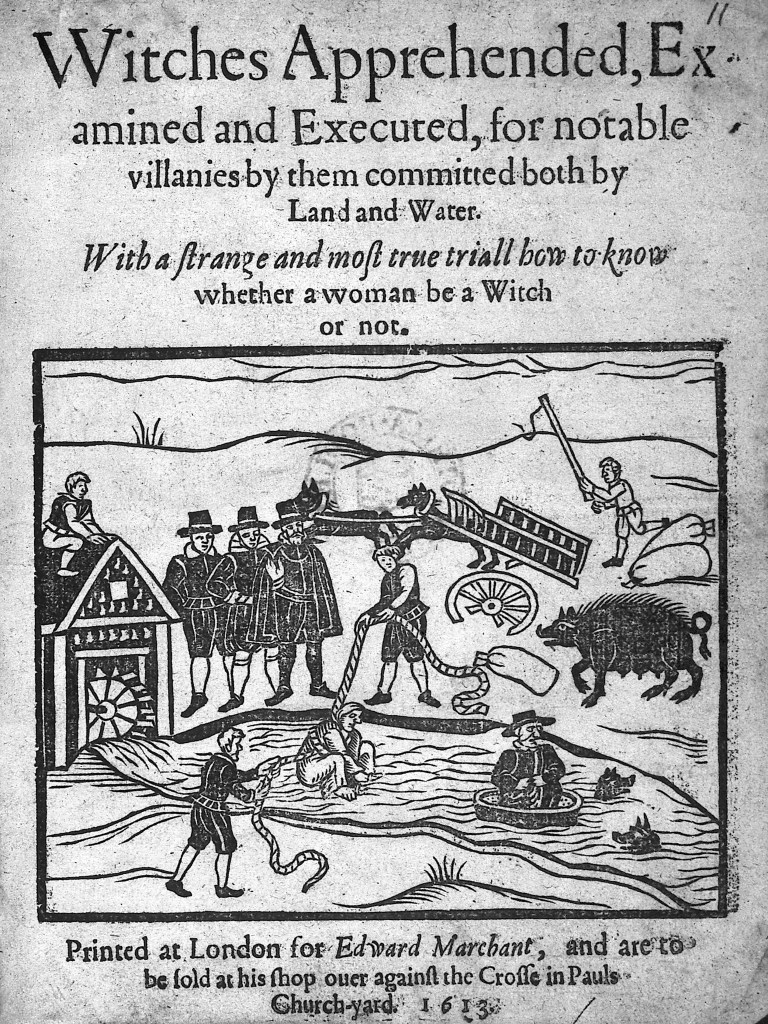
Your neighbours could become your accusers. Accusations could begin with something as small as being “difficult,” “unusual,” or “too knowledgeable.” From there, fear spread quickly. Families were forced to testify against each other. “Ordeals” inverted justice: if a woman floated, she was deemed guilty; if she sank and drowned, she was declared innocent — too late. People were thrown off cliffs or into deep holes, and death itself was framed as proof.
All of this unfolded within an environment of religious oppression and patriarchal control, where fear and scapegoating were weaponised against the vulnerable.
Who was targeted—and why women were frequently punished
Across Europe and North America, both men and women were accused — but women were disproportionately targeted; estimated at around 80–85% of the accused. Over time, “witchcraft” became a brutal tool for punishing women who wouldn’t conform to social rules shaped by patriarchal and religious authority.
Three recurring dynamics appear again and again:
-
Scapegoating: women who were seen as “unusual” were easy to blame for crises they didn’t cause — especially healers, midwives, widows, and unmarried women.
-
Control: accusations were used to police women’s independence, influence, and sexuality — female autonomy was framed as dangerous, then punished.
-
Misogyny and fear: women who held knowledge (especially healing knowledge) or defied traditional roles were met with suspicion; the trials enforced obedience.
The label of “witch” became a container for anything society wanted to punish in a woman:
-
The healer, whose knowledge wasn’t sanctioned by church or state
-
The midwife, blamed when childbirth went wrong
-
The widow, without male “protection” and often seen as suspicious
-
The unmarried woman, who didn’t fit the expected mould
-
The outspoken woman, perceived as disruptive or threatening
-
The outsider, culturally, spiritually, socially, or economically
Witchcraft accusations did not only punish behaviour; they policed identity. They taught women what would happen if they stepped beyond the role assigned to them.
“Wicce”: the wise women of the village
Strip away the propaganda, and many of the accused look less like villains—and more like the first community doctors. Many of the women labelled “witches” were the village healers — carriers of ancestral knowledge passed down through generations. They understood the cycles of nature and used that knowledge to support their communities.
In Old English, wicce is often linked with the idea of a wise woman: a keeper of practical knowledge and spiritual understanding encompassing healers, herbalists, midwives, mystics, and people whose rituals were dismissed as “magic.”
These were the women who knew the local plants, seasonal rhythms, and the quiet medicines of the land. They understood which herbs might soothe a fever, support the body through illness, or help ease childbirth.
They were trusted by their communities for thousands of years, until the Romans brought religion and government. As religious and patriarchal power tightened across Europe, women who held knowledge outside official institutions became unsettling. When authority depends on control, an autonomous woman—especially one with influence—can be framed as a threat.
As power in England shifted away from Celtic tribal culture — where Mother Earth and the feminine were revered — toward rule by men and clergy, women’s independence became threatening. These women operated outside church authority and outside the male-dominated rise of early allopathic medicine. They were answerable to no one, and that autonomy made them dangerous to systems built on control.
Over time, communities were trained to fear what they once respected. Healing plants could be recast as “devil’s work.” Spiritual practice outside church structures could be rebranded as heresy. Wisdom could be twisted into evidence . And punishment followed.
The Inquisition and the machinery of persecution
And it wasn’t only healers who died. Many were persecuted for having a voice — for being outspoken, independent, or socially “inconvenient.” The trials became a systematic method for suppressing feminine power.
The witch-trial era grew from a broader environment of religious persecution in multiple Christian contexts, shaped by state power and institutional authority. Accusations became formalised. Fear became codified. Systems emerged that rewarded denunciation and made it dangerous to defend the accused.
Once a culture learns to treat accusation as proof, it becomes incredibly easy to escalate cruelty—especially when the targets have limited power to resist.
That is one of the deeper lessons of this era: persecution doesn’t always arrive as a sudden event. It often builds slowly, normalising itself step-by-step until violence feels inevitable—or even “justified.”
From folk healing to profit-driven medicine: what changed?
This clearing-out of folk healing helped prepare the ground for a later shift: medicine moving from apothecaries and compounded remedies toward industrial manufacturing, standardisation, and patentable products designed for profit.
As women’s grassroots healing traditions were suppressed, medicine gradually became more institutional, commercial, and controlled by credentialed systems—often excluding the very people who had served communities for generations.
Over the centuries that followed, Western medicine shifted further toward standardisation, industrial production, and patentable products. Whatever your views on modern medicine today, it is worth asking: what knowledge was lost when the healers were silenced? What community wisdom was erased—and who benefited from that erasure?
Women’s history includes both the brilliance of women’s knowledge and the coordinated efforts to remove it from public life.
From “witch hunts” to petro-medicine: a timeline of suppression and takeover
Our modern pharmaceutical industry developed from the gap created by the killing of the wise ones.
-
1400s–1700s: European witch trials; herbalists, midwives, and natural healers demonised and executed
-
1486: publication of the Malleus Maleficarum (“Hammer of Witches”), a key text used to fuel witch-hunting ideology
-
1782: the last widely cited “witch” execution in Europe occurred in Switzerland (often linked to the case of Anna Göldi)
-
Mid-1800s: Rockefeller builds an empire through Standard Oil; petrochemistry expands; oil and coal-tar derivatives are developed and commercialised
-
Early 1900s: Rockefeller and Carnegie invest heavily in reshaping medical education and institutional medicine
-
1910: the Flexner Report (published by the Carnegie Foundation) transforms medical education; it marginalised herbalism, homoeopathy, and naturopathy and led to widespread closure of “natural” schools, leaving drug-based medicine dominant
-
1920s–40s: rapid expansion of pharmaceutical development; WWII accelerates industrial medicine
-
By the 1950s: petro-medicine reaches near-total dominance; natural healing is widely sidelined
Why this belongs in Women’s History Month
Women’s History Month is not only about celebrating achievement. It is also about restoring memory.
The witch trials reveal recurring dynamics that many women still recognise in different forms:
-
scapegoating during crisis
-
rumour presented as truth
-
dehumanising labels used to justify harm
-
punishment for nonconformity
-
control of women’s bodies, voices, and choices
-
the targeting of women who threaten established power
The “witch” is not only a figure of superstition. She is also a symbol: of women’s knowledge, women’s autonomy, women’s spiritual authority—and the backlash that can follow when those things challenge systems built on dominance.
A candle for the accused
This Women’s History Month, I’m holding a candle for the women (and the men) who were accused, tortured, and executed—many of them Shamen, healers, midwives, herbalists, mystics, and ordinary women who simply didn’t fit.
Remembering them is not about romanticising the past. It’s about telling the truth: that women were terrorised out of knowledge, power, and voice—and that the echoes of that fear still ripple through families, cultures, and collective memory.
Healing the inheritance: generational and spiritual trauma
Violence on that scale doesn’t vanish when the fires go out. Trauma leaves patterns—sometimes in family systems, sometimes in the body, sometimes in the nervous system, and sometimes in the deeper places we can’t easily name.
If you feel called to explore this—whether through your ancestry, your inner landscape, or your spiritual path— Shamanic Healing can offer a way to work gently with inherited fear, soul loss, and the energetic residue of persecution. The intention is not to stay in the wound, but to release what is no longer yours to carry, and reclaim what was taken: voice, power, wholeness.


 0
0