Posts Tagged: Mindfullness Day
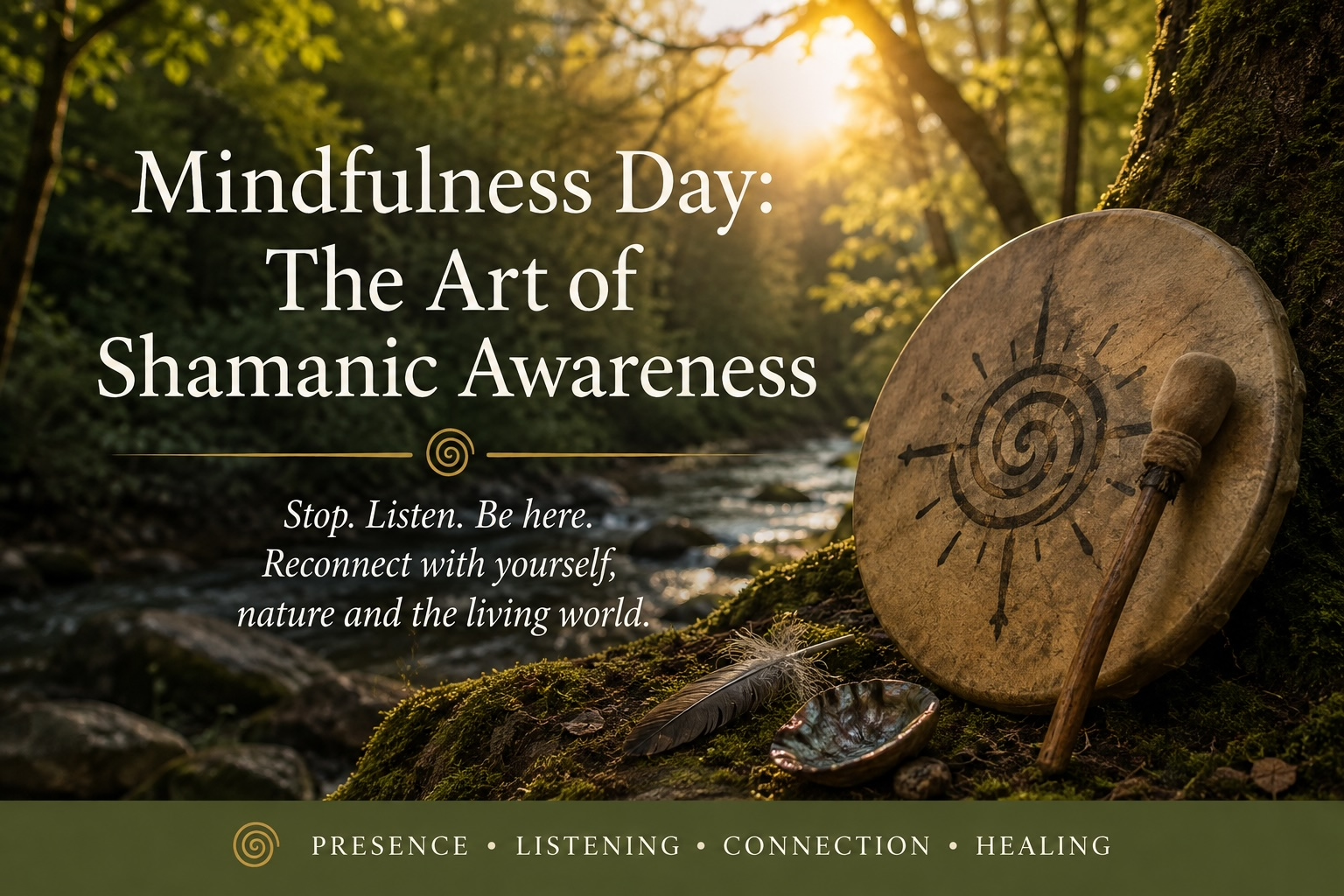

Mindfulness Day: The Art of Shamanic Awareness
Every year on 12 September, Mindfulness Day invites us to stop for a moment and pay attention to the present. It sounds remarkably simple, yet how often are we truly present? We can be walking while thinking about where we are going, eating while looking at a screen, or listening to somebody while already preparing what we are going to say next. We can spend our mornings thinking about the afternoon and our evenings replaying something that happened years ago.
Our body may be here, but our awareness is somewhere else. Mindfulness is the practice of bringing ourselves back. From a shamanic perspective, however, I believe we can take this further. Becoming present is not simply about becoming more aware of ourselves. It can also be about becoming aware of the living world around us and remembering that we are part of the Web of Life.
Mindfulness and Shamanic Awareness
The modern mindfulness movement has become associated with meditation, breathing exercises, stress reduction and wellbeing, but its roots are much older. The English word mindfulness has been used to translate the Buddhist concept of sati, although the meaning of the original term is richer and has been interpreted in different ways. It can encompass remembrance, attentiveness and a lucid awareness of present experience. Within Buddhist traditions, mindfulness forms part of a much wider spiritual and ethical practice rather than existing simply as a technique for relaxation.
At its simplest, mindfulness asks us to notice our breathing, our body and our thoughts without immediately becoming carried away by them. It also asks us to notice what is happening around us. There is something profoundly valuable in this simple act of paying attention, and it is here that mindfulness begins to overlap with something fundamental to shamanic practice: awareness.
Shamanism is rooted in an animistic understanding of the world. Animism recognises that we do not exist separately from nature. We are participants within a living world containing animals, plants, trees, rivers, mountains, stones, weather, landscape and spirit.
From this perspective, walking through a wood is not simply walking through scenery. The wood is alive around us. When we become quiet enough, our relationship with our surroundings begins to change. We hear the different layers of birdsong and notice the wind moving through the leaves. We feel changes in temperature as we move between sunlight and shade, and become conscious of the smell of damp earth, the texture of bark, the movement of insects and the changing shape of clouds. Things that were always there suddenly become visible because we have become present enough to notice them.
There is, however, an important difference between simply observing nature and approaching the natural world through an animistic consciousness. Modern mindfulness might invite us to sit beneath a tree and notice its bark, its leaves, the movement of its branches and the sensations arising within our own body. Shamanic awareness can invite us to go further, connecting with the tree’s spirit.
Instead of nature becoming the background against which we practise mindfulness, we begin to recognise ourselves as part of a relationship. The question changes from What can I get from spending time in nature? to What is here with me? It is a subtle but important shift. We stop placing ourselves at the centre of the experience and begin to listen.
Remembering How to Listen
Our modern lives are filled with noise. Phones ring, messages arrive, and notifications appear. Televisions, computers and radios fill quiet spaces, and even when the external noise stops, the internal conversation often continues. We think about what we need to do tomorrow, what somebody meant by something they said yesterday, what we should have done differently, or what might happen next.
Our attention moves continually between memory, anticipation and distraction. One of the gifts of mindfulness is the recognition that we do not have to follow every thought that passes through the mind. We can notice the thought, allow it to pass and return our attention to the breath, the body, the ground beneath our feet, the sounds around us and the present moment. The more we practise returning, the more we begin to discover how rarely we were completely present in the first place.
The body is one of the simplest ways of returning ourselves to the present. You cannot breathe yesterday’s breath or feel tomorrow’s ground beneath your feet. The physical body exists here and now, which is why becoming conscious of physical sensation can provide such a powerful anchor.
We can feel our feet upon the earth, notice where our body touches the chair, become aware of our breathing without trying to control it and observe where we are holding tension. Rather than attempting to force the mind to become empty, we can simply allow our awareness to settle into the body. For me, this kind of embodied presence also has an important place within shamanic healing. Before we journey elsewhere, it is valuable to know where we are.
The Shamanic Drum and Altered Awareness
People sometimes imagine that meditation must take place in silence, but shamanic practice offers another possibility. The repetitive beat of the drum can become a focus for awareness. Instead of the mind jumping continually from thought to thought, our attention can begin to settle into the rhythm.
The drum occupies a particularly important place within my own shamanic practice. I use drumming as part of shamanic journeying, where the repetitive rhythm supports a movement away from ordinary everyday awareness and into another state of consciousness. This creates an interesting relationship between mindfulness and shamanic journeying.
Mindfulness can begin by bringing us completely into the present moment, while shamanic journeying can then involve intentionally directing awareness beyond our ordinary experience of that moment. The two practices are not the same, but presence can provide a powerful foundation for journeying. Before travelling, we become still. Before asking questions, we listen. Before seeking an answer, we make space in which an answer might be heard.
There is another reason why mindfulness interests me as a shamanic practitioner. Our awareness can become extraordinarily scattered. Part of us may be thinking about something that happened yesterday while another part is worrying about next week. We may be answering messages while eating, watching television while scrolling through our phones and mentally rehearsing tomorrow’s conversation at the same time. We can become everywhere except where we actually are.
Difficult experiences can also leave us feeling disconnected from ourselves. Within different shamanic traditions, there are teachings concerning fragmentation, loss and restoration, including practices commonly described today as soul retrieval. These traditions have their own spiritual understanding and should not simply be reduced to modern psychological terminology.
There is nevertheless an interesting resonance between the two approaches. Mindfulness repeatedly asks us to notice where our awareness is now. Shamanic practice can take us towards the deeper question of what it might mean to become fully present within ourselves again.
The Sacred Art of Paying Attention
We live in a culture that places enormous value upon doing. We are encouraged to achieve something, fix something, buy something, improve something or become something. Even spiritual practice can become another task on the list: ten minutes of meditation completed before moving on to the next job.
Perhaps mindfulness does not always need to become another thing that we do. Sometimes it may be about what happens when we stop doing. There is a wonderful simplicity in sitting outside without needing the experience to achieve anything. We do not need the tree to heal us, the birds to give us a message or the universe to provide an answer. We can simply be there and listen. Paradoxically, it is often when we stop demanding answers that we become quiet enough to hear.
For Mindfulness Day, I invite you to spend five or ten minutes outside. You do not need a special or sacred place. A garden, woodland, park, field or quiet place beneath a tree is enough. Leave your telephone behind if you can, then stand or sit comfortably and become aware of the ground supporting you. Do not deliberately change your breathing. Simply notice it.
Gradually expand your awareness to what is happening around you. Listen to the sounds. Rather than simply identifying ‘birds’, listen more closely. How many different birds can you hear? Which sounds are nearby and which are far away? Notice the temperature of the air against your skin, the ground beneath your feet and the movement of the breeze. Become aware of scents such as earth, rain, leaves, flowers, wood or grass.
Then begin to notice what you can see. You might try noticing movement before objects: leaves stirring in the wind, clouds crossing the sky, grasses moving or insects passing through your field of vision. Allow yourself gradually to become still.
Instead of asking what you can gain from the experience, quietly ask yourself: What is here with me? Then listen. Do not force anything to happen and do not worry if nothing unusual occurs. Simply practise being present. That is enough.
Coming Home to Ourselves
Mindfulness does not necessarily require a meditation cushion, an app or an hour of silence. It can happen while walking, washing dishes, sitting beneath a tree or listening properly to somebody we love. It happens whenever we suddenly remember: I am here.
Shamanic awareness adds another dimension to that recognition. I am here, but I am not here alone. I exist within an extraordinary living web of relationships: with the earth beneath me, the air entering my lungs, the plants and animals around me, the people whose lives intersect with mine and, within the shamanic understanding of reality, the unseen world of spirit.
Perhaps that is one of the deeper gifts of becoming present. We begin by paying attention to ourselves. As our awareness expands, we notice the world around us. Eventually, we may remember that the separation between ourselves and the living world was never as absolute as we imagined.
This process of slowing down, listening and reconnecting is also woven through my shamanic healing practice. A shamanic healing session creates a space away from the continual demands and distractions of everyday life. My work can incorporate intention setting, energy body healing, shamanic drumming and journeying, alongside other shamanic healing practices according to the needs of the individual.
At its heart, however, there is something very simple. We create space, we listen, and we allow ourselves the opportunity to reconnect. So, on Mindfulness Day this year, perhaps give yourself a few minutes in which there is nowhere else you need to be. Put down the telephone, go outside, feel your feet upon the earth and listen. Notice what is around you and, for a little while, simply be here.
Shamanic Life Coaching
If you would like to develop mindfulness and meditation as part of your everyday life, I can support you through my Shamanic Life Coaching sessions. I work individually with clients to help them develop greater awareness, become more grounded and present, and establish mindfulness and meditation practices that feel natural and sustainable rather than becoming another task to complete. Drawing upon my experience of shamanic practice, meditation and working with altered states of awareness, I can also help you explore ways of quietening the continual activity of the mind, strengthening your connection with your body and intuition, and developing a deeper relationship with yourself and the natural world. You can find out more about my Shamanic Life Coaching and how I work here: https://www.roseautumn.com/shamanic-coaching/
 0
0