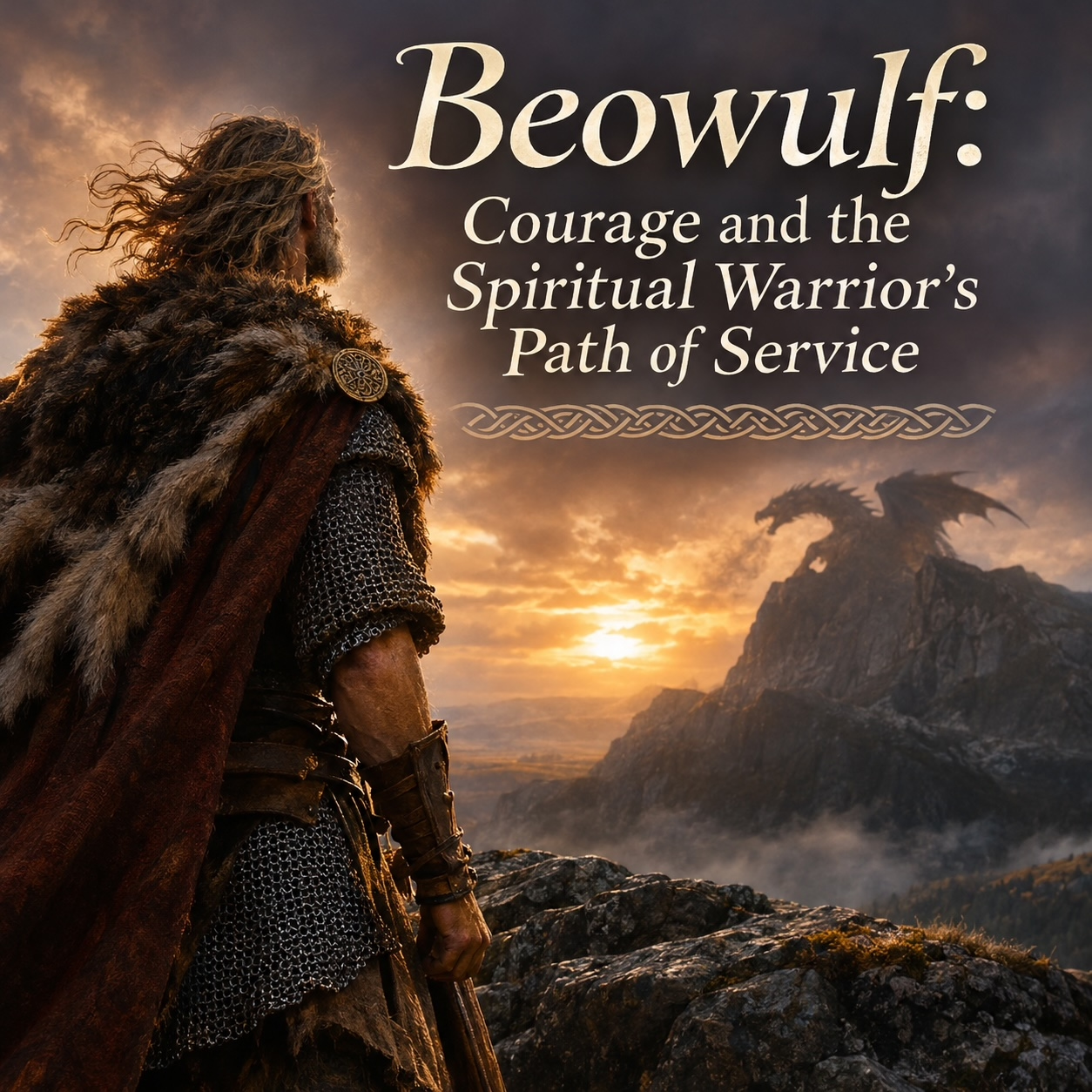
Beowulf: Courage and the Spiritual Warrior’s Path of Service
Listen to an audio recording of this article on YouTube here: https://youtu.be/vW4_x4Fi25g
A Different Reading
I recently read Maria Dahvana Headley’s translation of Beowulf, the Old English epic poem recounting the extraordinary deeds of a warrior who defeats two monsters and eventually becomes king of the Geats. I was particularly struck by Beowulf’s courage, loyalty, and willingness to place the interests of others before his own, particularly in the face of three threatening adversaries. But these qualities seemed at odds with the interpretation of his character presented by the publisher and some literary critics.
The book’s cover describes the poem as a tale of entitlement and encroachment, in which powerful men seek to become more powerful. [1] Although I greatly enjoyed Headley’s contemporary language and interpretation, I found myself increasingly uncomfortable with the characterisation of Beowulf as arrogant; indeed, I felt rather defensive of him and saw him as an ancient Spiritual Warrior.
Rather than encountering a man driven by ego, I admired a brave man whose actions repeatedly demonstrated commitment to duty, restraint, and, in personally defeating two monsters, a willingness to expose himself to danger in the protection of others. His third confrontation, this time with a dragon, particularly strengthened my conviction. Here was an ageing king who understood that he might die, yet chose to confront a terrifying creature threatening his people. This led me to question whether Beowulf’s death was really a tragic consequence of excessive pride, or whether his actions might be better understood through the qualities of courage, loyalty, and service.
As a Shamanic Practitioner, undertaking protective spiritual work, such as shamanic extraction, I was struck by Beowulf’s characteristics and the qualities I associate with the Spiritual Warrior archetype: courage in the face of uncertainty, humility in the exercise of power, and a commitment to service rather than personal advancement.
Courage or Arrogance?
The interpretation of Beowulf as a hero whose pride in confronting the dragon alone contributes to his downfall has a long history in literary scholarship. J. R. R. Tolkien [2] noted the tragic significance of Beowulf’s final confrontation with the dragon, while other scholars have questioned whether his decision reflects excessive pride or the heroic obligation to confront danger.
John Leyerle [3] examined the tension between Beowulf’s identity as a heroic warrior and his responsibilities as king, raising questions about the wisdom of confronting the dragon personally. However, Beowulf’s willingness to risk his life may be understood not as arrogance, but as an expression of selflessness. There is an important distinction between someone who confronts danger because he believes himself invincible and someone who recognises the possibility of death but chooses to act regardless.
The former may demonstrate arrogance, whereas the latter consciously accepts the risks of fulfilling his duty. Beowulf undoubtedly possesses extraordinary strength and takes pride in his achievements, but this does not necessarily imply an inflated sense of personal importance. His willingness to confront danger despite recognising the possibility of death demonstrates courage and a readiness to accept personal sacrifice in the service of others.
Beowulf Refuses the Throne
Following the death of King Hygelac, his widow, Hygd, offers Beowulf the kingship of the Geats because she fears that her young son, Heardred, will be unable to defend the kingdom against its enemies. Beowulf is already an accomplished warrior whose strength and reputation make him a natural candidate, yet he refuses the queen’s offer in favour of protecting her son’s claim. Only after Heardred is subsequently killed does Beowulf become king. [4]
This episode is particularly significant when considering the suggestion that Beowulf represents a powerful man seeking to become more powerful. When he is offered an opportunity to assume authority and power, he declines it, demonstrating restraint by subordinating personal advancement to loyalty and responsibility. Such behaviour is difficult for me to reconcile with the suggestion that his actions were governed principally by ego.
The Dragon: Courage in the Face of Death
When Beowulf confronts his final adversary, he has ruled the Geats for approximately fifty years. He is no longer a young warrior seeking to establish his reputation, having already earned the respect of his people. Nevertheless, when the dragon threatens his kingdom, he initially chooses to confront it without assistance.
Before the confrontation, Beowulf prepares protective equipment and addresses his warriors, acknowledging that the outcome may be either victory or death. [5] His words do not suggest that he believes himself invulnerable, but rather that he is prepared to personally protect his people and accept the consequences of his decision. Beowulf has spent his life confronting danger on behalf of others, and when his people face a new threat, he does not abandon that responsibility simply because he has grown old.
Before entering the battle, Beowulf instructs his men to remain behind, which some have interpreted as a desire to claim the victory for himself; I believe another explanation deserves consideration. Having recognised the danger, he may have wished to spare his followers an early death. Beowulf also speaks of honour and victory, but the possibility that his decision arose partly from concern for others is consistent with the loyalty and generosity demonstrated elsewhere in the poem.
When the fight turned against Beowulf, the warriors who had accompanied him fled into the woods, abandoning their king when he needed them most. Only Wiglaf remained loyal, recognising his duty to assist Beowulf despite the danger to his own life. Together, they defeated the dragon, although Beowulf suffered a fatal wound. [6] To my mind, Wiglaf’s courage reinforces the distinction between those who accept personal danger in the service of others and those who abandon their responsibilities when confronted by fear.
Did Beowulf Have a Duty to Preserve His Own Life?
One argument against Beowulf’s decision to confront the dragon is that, as king, he had a responsibility to preserve his own life for the benefit of his people. His death leaves the Geats vulnerable to their enemies, and some critics regard this outcome as evidence that he should have entrusted the confrontation to younger warriors.
However, I question whether a king’s responsibility to preserve his own life should necessarily take precedence over his duty to defend his people. These obligations may conflict, particularly when a ruler must choose between ensuring the future stability of his kingdom and confronting an immediate threat to its safety. Nevertheless, his decision to confront the dragon can also be understood as an expression of his responsibility to protect his people from an immediate threat.
The more relevant question is whether Beowulf could have organised the confrontation differently. Perhaps he could have accepted assistance from the beginning, but questioning the wisdom of a tactical decision is not equivalent to establishing that it arose from arrogance. Wiglaf’s intervention also demonstrates the importance of accepting assistance in times of danger, just as I accept the help of my guides during Shamanic Journeys.
Beowulf and the Contemporary Spiritual Warrior
My reading of Beowulf led me to reflect upon the role of the contemporary Shamanic Practitioner as a Spiritual Warrior. Although Beowulf confronts physical adversaries, I recognise parallels between his courage, sense of duty, and willingness to protect others and the responsibilities I undertake within my own shamanic healing practice.
As a Shamanic Practitioner, I am often called upon to confront and remove spiritual entities, parasites, and harmful energetic influences that can create powerful blockages in people’s lives, affecting their work, finances, and relationships. This practice, known as spiritual extraction, involves entering non-ordinary reality through shamanic journeying to confront and expel these influences on behalf of a client. Within traditional Shamanism, the practitioner assumes the role of a Spiritual Warrior, undertaking protective spiritual work in the service of others.
The comparison with Beowulf is particularly meaningful because the Spiritual Warrior’s purpose is not to demonstrate personal power or superiority, but to exercise spiritual abilities responsibly for the benefit of others. Just as I interpret Beowulf’s confrontation with the dragon as an act of service rather than personal ambition, I regard shamanic healing as a responsibility requiring courage and personal power, balanced with humility, discernment, and compassion.
Beowulf’s refusal of Hygd’s offer of kingship provides another parallel with the responsibilities of the Spiritual Warrior. Just as he chose loyalty over personal advancement, the development of spiritual abilities should never become a means of elevating the practitioner’s ego. Their value lies in their responsible application and a commitment to the wellbeing and autonomy of those seeking assistance.
There is, however, an important distinction between courage and recklessness. A responsible Spiritual Warrior must recognise personal limitations, exercise sound judgement, and approach each situation with appropriate care. Courage does not require the absence of fear or uncertainty, but the willingness to confront danger while remaining guided by experience, ethical principles, and a commitment to service.
For me, therefore, the Spiritual Warrior is not merely a metaphor for personal transformation. It is a role that the contemporary Shamanic Practitioner may actively undertake within non-ordinary reality, confronting spiritual adversaries and working to protect and restore the well-being of those seeking healing.
Conclusion: A Courageous King
On finishing Maria Dahvana Headley’s translation, I felt that I had encountered a courageous and loyal leader who devoted his life to protecting people, consistently placing duty above personal safety. Perhaps the enduring lesson of Beowulf is not that courage must be restrained by fear of death, or otherwise be viewed as arrogance, but that courage must be accompanied by loyalty, compassion, and a commitment to service. These are the same principles that guide the contemporary Spiritual Warrior, whose responsibility is to exercise spiritual power with humility and discernment, confronting adversity not for personal glory, but for the protection of others.
About Rose Autumn
I am a Shamanic Practitioner and teacher offering Traditional Shamanic Healing through in-person sessions in Hampshire, southern England, and Distance Healing for clients across Mother Earth. I specialise in spiritual extraction, including the removal of possessing spirits, spiritual parasites, and dark energetic influences that can create blockages affecting relationships, finances, work, and personal wellbeing. Through shamanic healing, I help clients release these influences, restore their personal power, and move forward with greater freedom and confidence. Further information about my work and the healing services I offer is available at www.roseautumn.com.
⸻
References
- J. R. R. Tolkien, “Beowulf: The Monsters and the Critics”, Proceedings of the British Academy, 22 (1936), pp. 245–295.
- John Leyerle, “Beowulf the Hero and the King”, Medium Ævum, 34, no. 2 (1965), pp. 89–102.
- Maria Dahvana Headley, Beowulf: A New Feminist Translation of the Epic Poem. Scribe Publications, 2021. ISBN 9781911617822. The publisher’s description emphasises entitlement, encroachment, and the pursuit of power. These are the publisher’s promotional words and should not automatically be attributed directly to Headley.
- Beowulf, lines 2367–2379. The episode in which Hygd offers Beowulf the kingship following Hygelac’s death, and Beowulf refuses in favour of supporting Heardred.
- Beowulf, lines 2510–2537. Beowulf’s speech before confronting the dragon, including his acceptance of the possibility of death.
- Beowulf, lines 2631–2891. The final battle, Wiglaf’s intervention, Beowulf’s death, and Wiglaf’s condemnation of the warriors who fled.
About Beowulf
Beowulf, the longest surviving work of Old English poetry, is an anonymous epic of some 3,182 alliterative lines. No single author can be named; the text we possess is the work of a Christian scribe, who drew on a long, older oral tradition, and it survives in one manuscript. The Cotton Vitellius A XV is held at the British Library and is thought to have been copied at a monastery such as Winchester, in the late tenth or early eleventh century.
The story itself is far older: scholars place its composition between the eighth and tenth centuries, among the Angles and Saxons, and its setting is a North Sea past of Geats and Danes.
The Geatish hero Beowulf sails to defend the Danish hall of Heorot against the monster Grendel and his mother, and in old age slays the dragon that threatens his own people. The poem fuses the pagan heroic code — loyalty, generosity, courage before a grim fate — with a Christian meditation on the transience of earthly glory and the sovereignty of God.
It endures because it voices, with stark beauty, the human longing for meaning against the certainty of death.
 0
 0

 20