Posts Tagged: Athelney

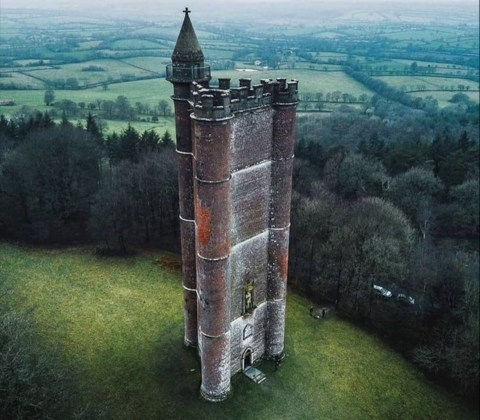
Alfred’s Tower: The Story Behind a Mysterious Somerset Monument
Listen to the audio recording of this article here:
This blog post is essential reading for anyone interested in the history of the tower on Kingsettle Hill because, surprisingly, very little information is available on the internet.
During the summer, we stayed at the tranquil Kingsettle Campsite in South Brewham, near the charming Somerset town of Bruton.
Driving up Kingsettle Hill, we noticed an extraordinary building rising above the landscape. It was far taller than anything I had expected to encounter in the Somerset countryside and, on investigating, I discovered an enormous triangular brick tower.
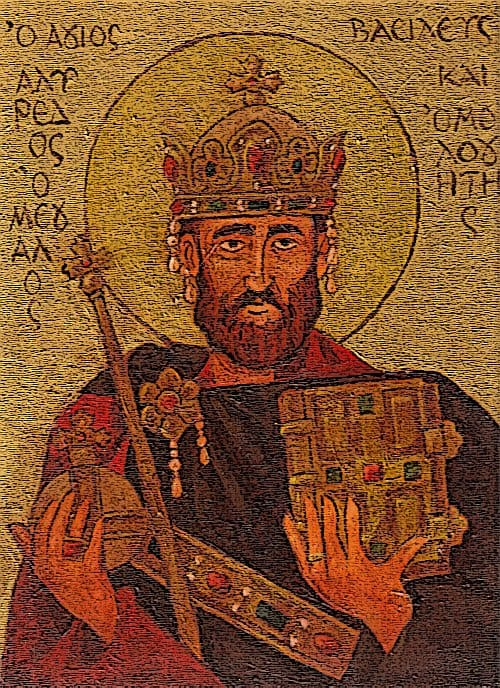
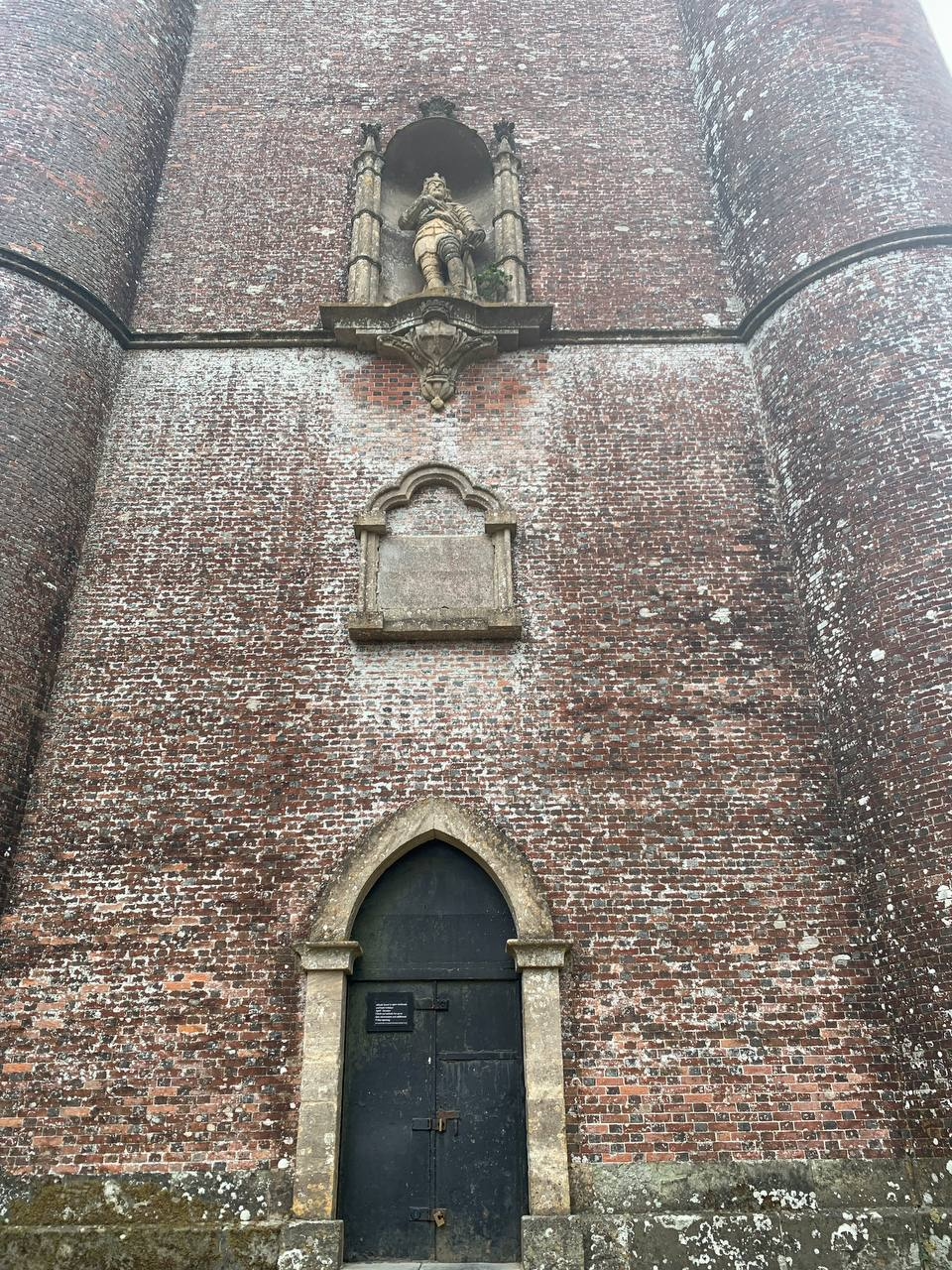
There is a heavily weathered stone inscription above the entrance, but very little information nearby explaining what the tower was, why it had been built or why such an enormous monument stood on this particular hill.
With some difficulty I managed to decipher enough of the inscription to realise that the tower was dedicated to King Alfred the Great, whom I knew to have been an important early medieval monarch. That discovery led me into a much larger historical investigation.
The tower is triangular in plan, with a round turret at each corner and a spiral staircase climbing through one of them to the roof. Battlements crown the main walls, while a stone statue of Alfred stands in a Gothic niche above the entrance and inscription. At approximately 160 feet high, the structure dominates Kingsettle Hill and can be seen from a considerable distance.[1]
Alfred’s Tower is conventionally described as a landscape “folly”, although in this case the term can be misleading if it suggests a building without serious meaning. My research has concluded that the tower was originally conceived as a deliberate historical monument to Alfred.
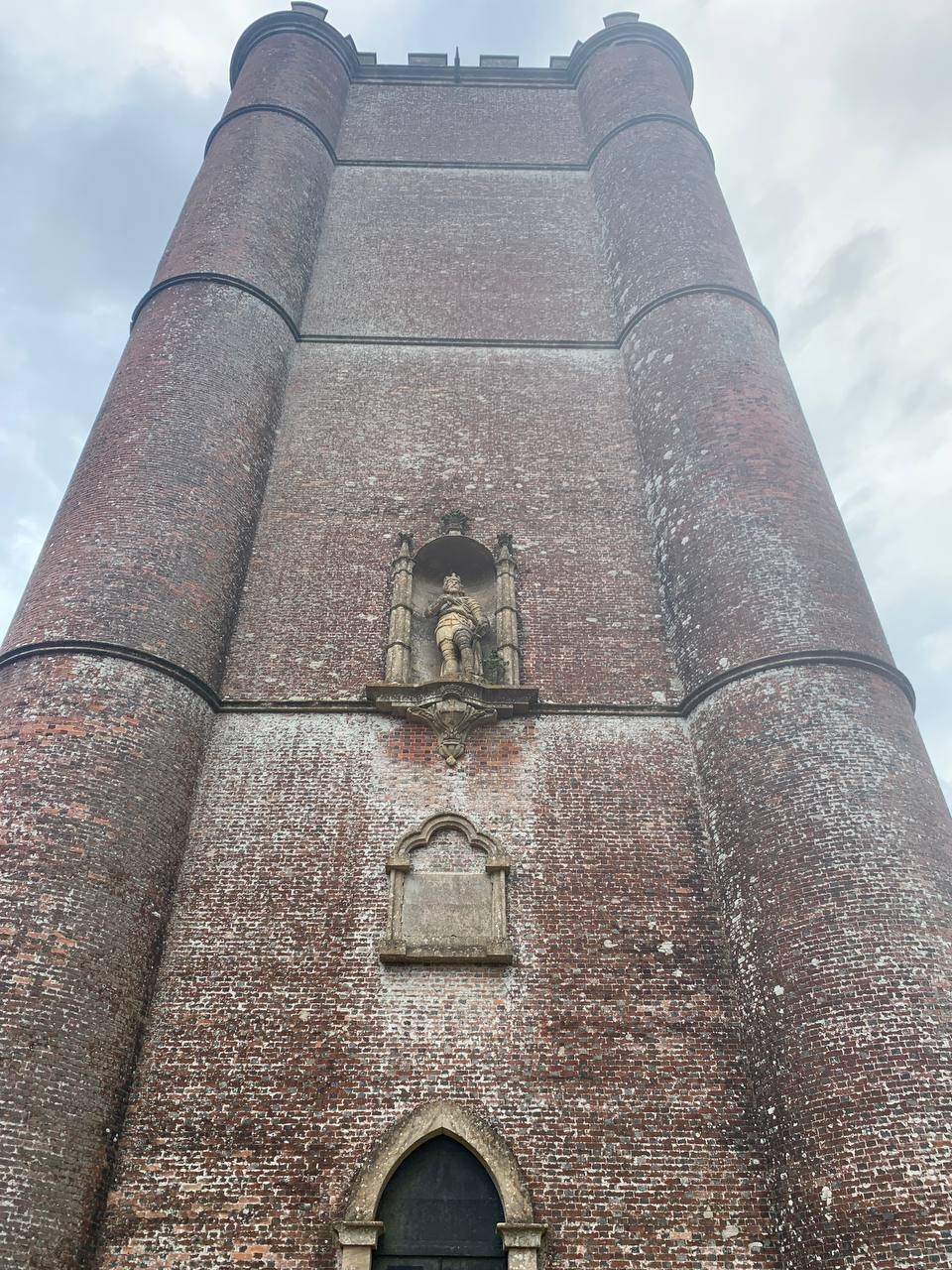
King Alfred the Great
Alfred of Wessex was an Anglo-Saxon king who reigned from 871 until 899. He occupies a unique place among England’s native-born rulers in being remembered by the enduring epithet “the Great”. Medieval historian Matthew Firth describes Alfred as “the only native-born English ruler to have gained the byname ‘the Great’.”[2]
Interestingly, Alfred was not known by this title during his lifetime. Firth’s recent research has demonstrated, however, that the tradition is considerably older than was once believed. References to Alfred as “the Great” can be traced into the medieval period and securely to at least the thirteenth century.[2]
Why, then, was an enormous monument to this ninth-century king erected on a Somerset hill almost nine hundred years after his death?
Henry Hoare II and Stourhead
The answer begins with Henry Hoare II (1705–1785), the wealthy banker and landowner responsible for developing the celebrated landscape at nearby Stourhead. Hoare inherited Stourhead from his father in 1725 and transformed its landscape through an ambitious programme of planting, architecture and garden design.[3]
Alfred’s Tower eventually became one of the most dramatic features associated with this landscape, although it stands some distance from Stourhead House itself, on Kingsettle Hill in Somerset. The location was not accidental.
Why Kingsettle Hill?
Henry Hoare believed that Kingsettle Hill was associated with one of the most dramatic episodes in Alfred’s life.
By 878 Alfred’s position was exceptionally precarious. Viking armies had already conquered or profoundly disrupted several of the major Anglo-Saxon kingdoms, and Guthrum’s sudden occupation of Chippenham forced Alfred from his royal centre into the marshlands of Somerset. The events commemorated by Alfred’s Tower therefore belong not simply to another battle in Alfred’s reign, but to the extraordinary recovery by which he rebuilt his forces, defeated Guthrum at Edington and preserved Wessex as an independent kingdom.[4]
In 878 Alfred was fighting for the survival of his kingdom against the Viking army commanded by Guthrum. Driven into the Somerset marshes, Alfred established a stronghold at Athelney, a raised area within the wetlands of the Somerset Levels near the modern village of East Lyng. From this defensible refuge west of Kingsettle Hill, Alfred began the recovery that would culminate in his victory at Edington.[4][5]
He subsequently emerged from Athelney and summoned his forces. The Anglo-Saxon Chronicle records that men from Somerset, Wiltshire and Hampshire gathered around him at a place called Egbert’s Stone before the army advanced towards Edington.[4] Asser, writing during Alfred’s lifetime, gives a closely corresponding account and places Egbert’s Stone in the eastern part of Selwood.[5]
The gathering at Egbert’s Stone was therefore not simply a geographical stopping point on Alfred’s route. It was the place at which the surviving West Saxon forces rallied to their king after one of the most dangerous periods of his reign. Men came to Alfred from Somerset, Wiltshire and part of Hampshire before the restored army moved onwards towards Edington. The identification of Egbert’s Stone was consequently central to Henry Hoare’s interpretation of Kingsettle Hill: if Hoare’s local tradition was correct, the tower stood at the place associated with the moment when Alfred re-emerged from refuge and once again gathered an army around him.[4][5]
There Alfred defeated Guthrum in one of the decisive battles of his reign.
The exact location of Egbert’s Stone has never been established with certainty. Kingsettle Hill is one of the places subsequently associated with Alfred’s muster, and Henry Hoare clearly believed in this identification. That belief explains the location of the tower, even if it cannot prove that Alfred actually stood on the hill.
Voltaire and the Inspiration for Alfred’s Tower
Remarkably, Henry Hoare’s own correspondence allows us to identify the moment at which the idea for Alfred’s Tower emerged. On 23 October 1762 Hoare wrote to his daughter Susanna, Lady Bruce. He had been reading Voltaire’s history and was particularly impressed by the French philosopher’s assessment of Alfred. Voltaire wrote: “I do not know whether there has ever been upon the earth a man more worthy of the respect of posterity than Alfred the Great, who rendered these services to his country.”[6]
The passage can be traced to Voltaire’s Abrégé de l’Histoire universelle depuis Charlemagne jusques à Charlequint, published at The Hague in 1753. It was subsequently incorporated into his Essai sur les mœurs et l’esprit des nations, in the chapter devoted to ninth-century England and Alfred the Great.[6]
Hoare’s response to what he had read was remarkably direct. “Out of gratitude to Him”, he proposed erecting a tower on Kingsettle Hill, at the place where he believed Alfred had raised his standard after emerging from Athelney.[7]
Hoare’s 1762 letter is the earliest surviving evidence for the conception of Alfred’s Tower and identifies Alfred himself as the reason for the monument. The documentary evidence therefore allows us to say something unusually precise about the monument: Alfred’s Tower originated directly from Henry Hoare’s admiration for Alfred the Great, intensified by reading Voltaire’s extraordinary praise of the Anglo-Saxon king.
One question remains unresolved. Voltaire supplied Hoare with the immediate inspiration for the monument, but he did not identify Kingsettle Hill as the place where Alfred had raised his standard. Hoare must therefore have obtained that local identification from another source or tradition. I have not yet been able to establish where it came from. Whether it derived from an earlier antiquarian theory, local tradition or another historical work remains an open question.
Hoare’s First Proposed Inscription
The idea developed rapidly. On 18 November 1762, less than a month after his letter to Lady Bruce, Hoare wrote to his son-in-law Lord Bruce proposing an inscription for the tower.[8]. It began: “In memory of Alfred the Great, The Founder of the English Monarchy” and described Alfred as: “The Giver of most excellent Laws, Jurys, the Bulwark of English Liberty”.[8]. Hoare also praised Alfred’s naval achievements, writing that through his courage and attention to increasing England’s naval force he had protected the country from foreign invasion and extended its trade.[8]
The proposed inscription then made an explicit connection between Alfred’s Britain and Hoare’s own. Hoare wrote that Britons should revere Alfred because, following his example and under Divine Providence, they had defeated their enemies that year by land and sea in Europe, Asia, Africa and America. This was a reference to Britain’s extraordinary military successes during the Seven Years’ War.[8]. Alfred’s Tower was therefore developing into something more complicated than a simple memorial to a dead king. Alfred remained its central inspiration, but Hoare was using him to connect the achievements of Anglo-Saxon England with the Britain of his own age.
Hoare was not converting the tower into a memorial to the Seven Years’ War. Alfred remained its subject. Rather, Hoare was using Alfred’s achievements as a historical parallel through which to interpret Britain’s successes in his own age. The distinction matters because the tower had already been conceived as a monument to Alfred before the war had ended.
Was It Built to Celebrate George III?
Modern descriptions frequently state that Alfred’s Tower commemorated both the end of the Seven Years’ War and the accession of George III in 1760. The surviving correspondence requires a more careful distinction.[1][9] The Seven Years’ War connection can be demonstrated directly from Hoare’s proposed inscription of November 1762.[8]
The initial idea for the tower, however, had already appeared in his letter of 23 October, before the preliminary peace agreement of 3 November 1762. His stated inspiration at that point was Alfred and Voltaire.[7] I have not found an equivalent statement in the correspondence examined in which Hoare says that he conceived Alfred’s Tower specifically to commemorate George III’s accession.
On the evidence presently identified, George III’s accession is therefore a later interpretation, not a documented reason given by Hoare for conceiving the tower. The fact that the claim is repeated in modern heritage accounts does not substitute for contemporary evidence from Hoare himself. The evidence therefore suggests a progression in Hoare’s thinking: admiration for Alfred inspired the tower; Alfred’s supposed association with Kingsettle Hill determined its location; and contemporary British military success was then incorporated into its political meaning.
The Tower Takes Shape
Henry Flitcroft, the architect closely associated with a number of buildings at Stourhead, is credited with the architectural design.[1][9] Construction did not immediately follow Hoare’s first proposal. By 28 April 1770 the tower was still unfinished. Hoare wrote to Lady Bruce: “I hope it will be finished in as happy Times to this Isle as Alfred finished his Life of Glory in then shall I depart in peace.”[10] This is particularly valuable evidence because it places Hoare directly within the story while construction was taking place.
Contemporary evidence allows us to go further than simply saying that the tower existed by 1772. The Annual Register for that year reported that the “finishing stone was laid” on the tower erected by Henry Hoare “in memory of King Alfred”. It described the brick tower, Alfred’s statue and the inscription above its entrance.[11] The report provides valuable near-contemporary confirmation both of the tower’s completion and of the purpose for which contemporaries understood Hoare to have erected it.
The resulting structure was extraordinary: a vast triangular brick tower approximately 160 feet, or 49 metres, high, with Chilmark stone architectural dressings and a statue of Alfred above its entrance.[1]. A contemporary 1772 account described the tower as 155 feet high; modern sources generally give approximately 160 feet (49 metres).[11][12]
The Inscription
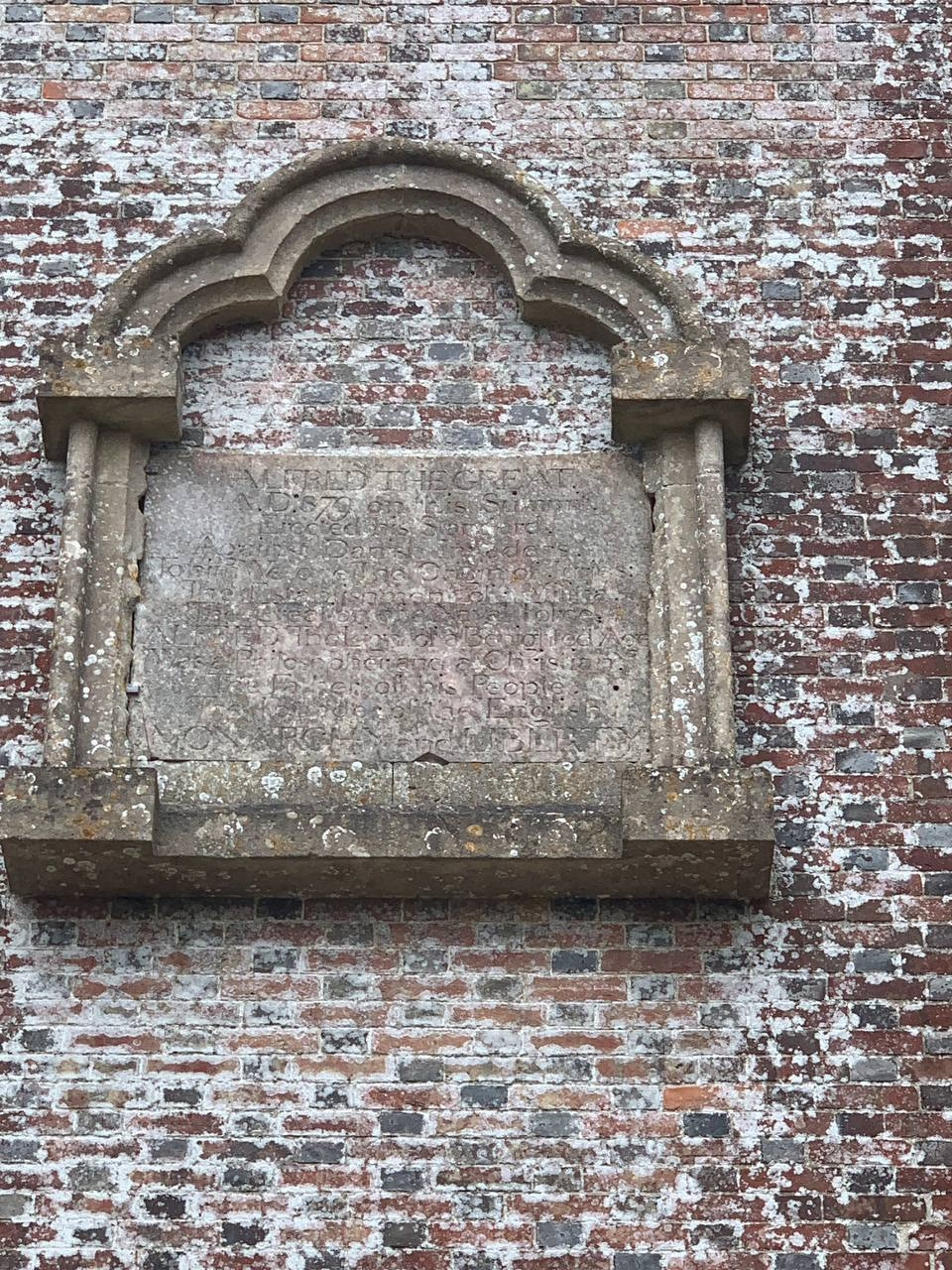
The original stone inscription is heavily weathered and difficult to read. It therefore seems remiss of the National Trust not to have provided an information board for visitors with a readable inscription. The inscription eventually placed upon the tower reads:
“ALFRED THE GREAT
AD 879 ON THIS SUMMIT
ERECTED HIS STANDARD
AGAINST DANISH INVADERS
TO HIM WE OWE THE ORIGIN OF JURIES
THE ESTABLISHMENT OF A MILITIA
THE CREATION OF A NAVAL FORCE
ALFRED THE LIGHT OF A BENIGHTED AGE
WAS A PHILOSOPHER AND A CHRISTIAN
THE FATHER OF HIS PEOPLE
THE FOUNDER OF THE ENGLISH
MONARCHY AND LIBERTY”[12]
The final inscription differs significantly from the much longer version Hoare had contemplated in November 1762. Most noticeably, the explicit reference to contemporary British military victories disappeared. The monument as finally presented to the visitor speaks entirely of Alfred.
The final editorial decision made the monument more exclusively Alfredian, not less. Whatever contemporary political comparisons had entered Hoare’s thinking during the development of the proposed inscription, they were omitted from the words ultimately placed upon the completed tower.
The inscription reflects the eighteenth-century image of Alfred as not merely a warrior king but a foundational figure in English government and liberty. It attributes to him the origin of juries, a militia and naval power, and presents him simultaneously as warrior, philosopher, Christian ruler and father of his people. Whether every institutional claim can be sustained historically is a separate question; what matters here is what these words reveal about the Alfred whom Henry Hoare believed he was commemorating.
Why Does It Say 879?
The date on the tower creates another historical puzzle. The inscription says that Alfred erected his standard on the summit in AD 879. The chronology now accepted for Alfred’s emergence from Athelney, his muster at Egbert’s Stone and his victory at Edington places these events in 878.[4][5] The 879 date therefore belongs to the eighteenth-century understanding of Alfred’s chronology rather than the dating generally accepted today.
The surviving eighteenth-century evidence reveals an additional complication. The contemporary account of the completion of Alfred’s Tower published in 1772 stated that Alfred had erected his standard on the site in 871.[11] That date differs both from the 879 subsequently recorded on the monument and from the 878 chronology accepted today. It suggests that the chronology associated with Alfred’s supposed muster on Kingsettle Hill was itself not entirely stable in the eighteenth century. Why the finished inscription came to specify 879 remains a question worthy of further investigation.
It is a useful reminder that Alfred’s Tower is not itself a ninth-century historical record. It is an eighteenth-century interpretation of ninth-century history. That distinction runs through almost every aspect of the monument.
Who Actually Built Alfred’s Tower?
One of the most surprising discoveries from my investigation concerns the people who physically constructed it. Henry Hoare II is remembered as the patron. Henry Flitcroft is remembered as the architect. But the builders have largely disappeared.
A structure of this scale required an organised workforce and an extensive supply network. Brickmakers or merchants supplied an enormous quantity of bricks. Stone was quarried and dressed. Bricklayers and masons erected the walls. Carpenters were needed for floors and scaffolding. Materials had to be transported to the summit of Kingsettle Hill, and somebody must have supervised the work. Yet the identities of these people are absent from the readily accessible history of Alfred’s Tower.
This is particularly intriguing because the surviving Hoare and Stourhead archive is extensive, and Henry Hoare’s correspondence from 1760–1781 has been published by the Wiltshire Record Society.[13] The Hoare family of Stourhead papers survive principally within collection 383 at the Wiltshire & Swindon History Centre.[14]
It would be wrong to conclude that the original accounts have necessarily been destroyed. Bills, vouchers, ledgers or correspondence identifying the craftsmen may still survive within the archival material. For the moment, however, we know the wealthy man who commissioned Alfred’s Tower and the architect who designed it, while the people who physically constructed one of Somerset’s most extraordinary buildings have largely vanished from its story.
A Monument Recorded as a War Memorial
There is another curious aspect to Alfred’s Tower. The Imperial War Museums includes it in the War Memorials Register as WMR 68253 and classifies the commemorated conflict as the Seven Years’ War.[12]
Hoare’s correspondence certainly shows that he compared Alfred’s military achievements with Britain’s contemporary victories. But this should not be confused with the reason for which the monument was conceived. Hoare had already proposed the tower “out of gratitude” to Alfred before the Seven Years’ War had ended, and the final inscription is entirely concerned with Alfred.[7][8]
The IWM classification therefore appears to conflate the contemporary political context in which Hoare invoked Alfred with the primary commemorative subject of the tower. Alfred’s Tower was conceived as a monument to Alfred.
The Modern Record Is Surprisingly Confused
Having traced this history, I returned to the modern descriptions of Alfred’s Tower and found a surprising number of problems.
The National Trust currently describes it in one place as a 160ft “(59m)” tower “built in 1722”. Both figures are wrong: 160 feet is approximately 49 metres, while the tower belongs to the 1760s–1772 building programme.[15] The same National Trust page calls Henry Hoare II “Sir Henry Hoare II”, although he was not a baronet, and states as fact that Alfred raised his standard on this particular spot in 878, when the precise location of Egbert’s Stone remains uncertain.[15]
Historic England presents further problems. Its individual Grade I listing dates the tower to 1766, while its separate registration of the Stourhead landscape says it was completed in the “late 1770s”.[1][9] Contemporary evidence shows that the completed monument was already being described in print in 1772.[11]
Historic England also transcribes one of the most memorable lines of the inscription incorrectly. It records: “Alfred the Lion of a (benighted) Age”.[1]
The inscription actually reads: “ALFRED THE LIGHT OF A BENIGHTED AGE”.[12]
The correct wording is independently preserved by the Imperial War Museums and historian Simon Keynes.[12][16]
Conclusion
When I first saw Alfred’s Tower from the road at Kingsettle Hill, I knew almost nothing about it. Some basic searching on my phone found a Google page that included none of the history of the monument, and didn’t mention Alfred at all. Similarly, the National Trust pages lacked important detail and contained inaccuracies. The lack of information at the monument itself made the building seem even more mysterious. The documentary trail reveals a far richer story.
We can trace Henry Hoare II reading Voltaire in 1762 and being struck by his extraordinary praise of Alfred. We can see Hoare deciding, “out of gratitude”, to erect a tower at a place he believed was associated with Alfred’s recovery from Athelney. Within weeks he was drafting an elaborate inscription linking Alfred’s achievements with Britain’s own military victories. Eight years later he was still writing anxiously about the unfinished building, hoping that he would live to see it completed.
The contemporary evidence now allows the story to be followed still further. In 1772 the “finishing stone” was reported as having been laid on a tower expressly described at the time as erected by Henry Hoare “in memory of King Alfred”. The completed public inscription removed the explicit references to Britain’s contemporary victories which had appeared in Hoare’s earlier draft and concentrated instead upon Alfred: his resistance to invasion, juries, militia, naval force, philosophy, Christianity, his people, monarchy and liberty.[11][12]
The surviving evidence therefore gives us an unusually clear answer to the question which began this investigation. Henry Hoare did not originally conceive the tower as a generic landscape ornament or as a memorial to the Seven Years’ War; he conceived it for Alfred. The contemporary war subsequently provided Hoare with a political parallel through which he interpreted Alfred’s achievements, but Alfred was the inspiration for the tower before the war had ended, and Alfred remained the subject of the monument when it was finally completed.
Nor has the investigation produced contemporary evidence that George III’s accession was a reason for its conception. On the evidence presently identified, that interpretation belongs to the later history of the monument rather than to the explanation Henry Hoare himself gave when he first proposed it.
The tower that finally emerged was therefore more than a decorative folly. It was Henry Hoare’s interpretation of Alfred the Great: warrior, Christian, philosopher, defender of his people and symbolic ancestor of the England Hoare believed himself to inhabit.
Not every historical claim made by the monument can be accepted literally. We cannot establish that Kingsettle Hill was the site of Egbert’s Stone. The inscription dates Alfred’s muster to 879 rather than 878. Some of the institutions attributed to Alfred reflect later traditions about his reign. But these discrepancies are themselves part of the history of Alfred’s Tower. The monument tells us not only how the eighteenth century remembered Alfred, but how powerful his reputation had become almost nine hundred years after his death.
Perhaps the greatest sadness in this story is that a tower erected to preserve the memory of Alfred has itself acquired a confused modern history. Dates have been misreported, its inscription has been mistranscribed, interpretations have hardened into facts, and the identities of the people who physically built it have disappeared from the readily accessible story.
What began for me as the accidental discovery of a mysterious tower on a Somerset hill therefore became an investigation into several different layers of history. There is the ninth-century story of Alfred himself and the extraordinary recovery from Athelney which culminated at Edington. There is the eighteenth-century story of Henry Hoare, reading Voltaire and deciding that Alfred remained worthy of the gratitude of posterity. There is the unresolved question of the older source or tradition which persuaded Hoare that Kingsettle Hill was connected with Alfred’s muster. And there is the modern history of the monument, in which later interpretations have sometimes been repeated as though they were established contemporary facts.
Standing beneath the tower today, therefore, we are looking at two histories at once: the extraordinary story of Alfred’s recovery in 878, and the equally fascinating story of how an eighteenth-century Englishman decided that Alfred’s memory was important enough to preserve in brick and stone on a Somerset hilltop.

Footnotes
[1] Historic England, ‘Alfred’s Tower’, National Heritage List for England, List Entry 1175610. The listing describes the tower as triangular in plan, built in Flemish-bond brickwork with Chilmark stone dressings and circular corner turrets, and attributes it to Henry Flitcroft. It also gives the disputed date 1766 and mistranscribes “LIGHT” as “Lion”. https://historicengland.org.uk/listing/the-list/list-entry/1175610
[2] Matthew Firth, ‘What’s in a Name? Tracing the Origins of Alfred’s “the Great”’, The English Historical Review, Vol. 139, Issue 596 (February 2024), pp. 1–32, published online 21 May 2024. DOI: 10.1093/ehr/ceae078.
[3] Historic England, ‘Stourhead’, National Heritage List for England, Registered Park and Garden, List Entry 1000471. https://historicengland.org.uk/listing/the-list/list-entry/1000471
[4] The Anglo-Saxon Chronicle, entry for AD 878. The Chronicle records Alfred’s refuge at Athelney and his subsequent journey to Egbert’s Stone east of Selwood, where the men of Somerset, Wiltshire and that part of Hampshire which remained unconquered came to meet him, before the army moved to Æglea and Edington.
[5] Asser, Life of King Alfred, account of the campaign of 878. Asser similarly records Alfred leaving Athelney and proceeding to Egbert’s Stone in the eastern part of Selwood before advancing against the Viking army.
[6] Voltaire, Abrégé de l’Histoire universelle depuis Charlemagne jusques à Charlequint, Tome Premier (The Hague: Jean Neaulme, 1753); subsequently incorporated into Essai sur les mœurs et l’esprit des nations, Chapter 26, ‘De l’Angleterre vers le neuvième siècle. Alfred le Grand’.
[7] Henry Hoare II to Susanna, Lady Bruce, 23 October 1762, quoted and discussed in Kenneth Woodbridge, Landscape and Antiquity: Aspects of English Culture at Stourhead 1718 to 1838 (Oxford: Clarendon Press, 1970), p. 53. Hoare states that, after reading Voltaire, he proposed “out of gratitude to Him” to erect a tower on Kingsettle Hill where he believed Alfred had set up his standard.
[8] Henry Hoare II to Lord Bruce, 18 November 1762, cited and discussed in Woodbridge, Landscape and Antiquity, pp. 53–55. Hoare’s proposed inscription begins “In memory of Alfred the Great, The Founder of the English Monarchy”, describes Alfred as “The Giver of most excellent Laws, Jurys, the Bulwark of English Liberty”, and subsequently compares Alfred’s achievements with Britain’s victories during the Seven Years’ War.
[9] Historic England, ‘Stourhead’, National Heritage List for England, List Entry 1000471. The modern entry states that the tower commemorates both the accession of George III and the end of the Seven Years’ War. No equivalent contemporary statement by Henry Hoare identifying George III’s accession as the reason for the tower has so far been identified. https://historicengland.org.uk/listing/the-list/list-entry/1000471
[10] Henry Hoare II to Lady Bruce, 28 April 1770, cited in Woodbridge, Landscape and Antiquity, p. 61.
[11] The Annual Register, or a View of the History, Politicks, and Literature for the Year 1772, Vol. XV (London, 1773), contemporary notice reporting that the “finishing stone was laid” on the tower erected by Henry Hoare “in memory of King Alfred”. The report describes the tower as a brick building 155 feet high, with Alfred’s statue above the doorway and an inscription beneath it. A contemporary reproduction of substantially the same report appeared in The Virginia Gazette, 31 December 1772. The latter gives the then-reported Alfredian date as 871.
[12] Imperial War Museums, ‘King Alfred’s Tower’, War Memorials Register, WMR 68253. The register gives the height as approximately 49 metres, transcribes “ALFRED THE LIGHT OF A BENIGHTED AGE”, and classifies the commemorated war as the Seven Years’ War. https://memorials.iwm.org.uk/memorial/68253
[13] Dudley Dodd (ed.), The Letters of Henry Hoare, 1760–1781, Wiltshire Record Society, Vol. 71 (Chippenham: Wiltshire Record Society, 2018).
[14] Wiltshire & Swindon History Centre, Hoare family of Stourhead papers, principally collection 383. The surviving archive includes extensive family, estate and financial material relating to Stourhead. https://calmview.wiltshire.gov.uk/
[15] National Trust, ‘Alfred’s Tower’. The current page describes the tower as “160ft (59m)” high, says it was “built in 1722”, refers to “Sir Henry Hoare II”, and states that Alfred raised his standard there in 878. https://www.nationaltrust.org.uk/visit/wiltshire/alfreds-tower/
[16] Simon Keynes, ‘The Cult of King Alfred the Great’, Anglo-Saxon England, Vol. 28 (1999), pp. 225–356. DOI: 10.1017/S0263675100002337.
 0
0