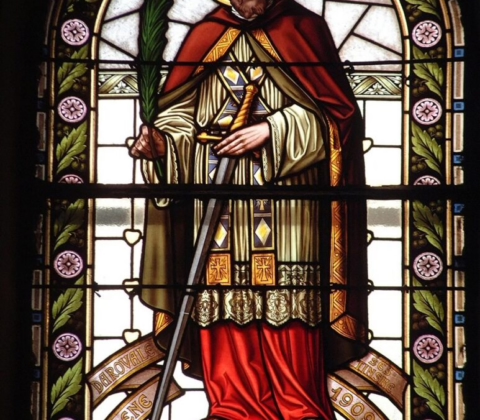
The Hidden Origins of Valentine’s Day
Valentine’s Day: The Demonic Blood Festival
Who was St Valentine—and why do we celebrate with hearts, roses, and a baby with a bow and arrow?
It isn’t what you think.
Valentine’s Day is sold as romance, but beneath the red wrapping sits a ritual calendar that steers attention, emotion, money, and life-force into a scripted performance. In my view, the ancient roots of Cupid and the heart symbol trace back to a supreme being revered in demonology as lord of demons—and what modern culture calls “love” is often a softened mask over spiritual inversion.
Corporations
As with all seasonal celebrations in the modern world, Valentine’s Day is an extraction event. Flowers, jewellery, engagement rings, and weddings separate people from their hard-earned money. Restaurants cram tables and reduce menus to maximise profit. People still go because they don’t recognise the harvest: emotional pressure converted into spending.
Society runs on competition and lack, so people are easily pulled into love-as-performance. But for our tribal ancestors, love wasn’t scheduled—it lived in everyday devotion: stolen kisses, care, presence, community, time.
This manufactured “day of love” was amplified in the Industrial Revolution through mass-produced cards. Hallmark turned it into an annual money-machine—what I see as a commercial blood-sacrifice festival dressed up as romance.
Christianity
The seasonal calendar was hijacked by Christian re-framing. And I’ve already made my position clear: Christianity historically served the empire—separating people from tribal heritage and conditioning obedience, still functioning as a mechanism of control.
Valentine’s Day is commonly linked to the Roman festival of Lupercalia, associated with Lupercus (or Pan) and the protection of flocks. In the fifth century, it was repackaged into a Christian calendar story, tied to Pope Gelasius and the legend of a priest marrying soldiers despite Emperor Claudius II banning marriage to make soldiers less attached and “better fighters.”
To me, this pattern is consistent: older rites absorbed, renamed, and reissued inside a new religious wrapper to manage the “pagan” masses. Nothing new under the sun—only repackaging.
Roman Origins
Cupid’s name is rooted in desire: cupio—to crave.
“Cupio, cupere, cupivi, cupitum” — “To strongly desire, to crave.”
Cupid was the son of Venus, goddess of love, beauty, and desire. Lupercalia (Feb 13–15) was framed as a fertility festival tied to matchmaking. It involved animal sacrifice and striking women with hides, using blood-and-skin symbolism as a fertility rite.
These rites are understood here not as gratitude, but as fear: appease the power, or lose the harvest. Festivals born from fear tend to escalate.
Greek Thread
Pausanias records a theme: consume the entrails of the sacrificed and become a wolf—werewolf symbolism as the price of ritual corruption.
He tells of Lycaon sacrificing an infant to Zeus Lycaeus (Zeus of the Wolves) and being transformed into a wolf. He also mentions Damarchus, said to transform during sacrifice and return to human form years later.
In Greek myth, Venus becomes Aphrodite and Cupid becomes Eros—winged, playful, armed with arrows that override consent and ignite compulsion. The archetype is not devotion, but spellwork through desire.
Mesopotamia
In this line of thought, Cupid/Eros reaches deeper into Mesopotamian myth: Tammuz/Dumuzi, shepherd god of fertility and the seasonal cycle; Ishtar/Inanna, goddess of love, fertility, war, and Venus—creation and destruction braided.
Tammuz is portrayed as dual-natured and arrow-armed:
-
a gold arrow that drives intense passion not for the target’s good, binding misery,
-
a blue arrow that shatters happiness and causes grief.
This strand also includes mother/son marriage themes as subversion of feminine inheritance and power—echoing broader ancient narratives of inversion.
At the same time, Tammuz and Ishtar function as one of the earliest seasonal love myths: death, descent, return—vegetation dying and renewing—fuel for fertility rites and the making of babies.
Serpent Symbolism
In Tammuz and Ishtar (1914), S. Langdon links Tammuz with serpent worship and the “great serpent dragon,” tying serpent symbolism to underworld currents, fertility, and cyclical death/rebirth.
This current is then associated with Nimrod and Semiramis: imperial power, rebellion narratives, and sexual inversion framed as cultural permission—“love is blind” as excuse for deviancy.
Serpent-dragon imagery persists across traditions: two entwined serpents, underworld gates, fertility symbols—later echoed in caduceus-like motifs.
Demons, Lordship, and Bel
In this framework, Tammuz is “lord of little demons and great demons.” Ba’al is read as “Lord/Master,” and “Bel” becomes a title of Babylonian lordship—spiritual authority claimed through dominion.
This expands into an origin story of control: elites, engineered humanity, and a civilisation structured around mastery and slavery—spiritual and material.
Revelation
The “great serpent dragon” is connected here to Revelation 12: the dragon waiting to devour the child—predation and inversion presented as cosmic archetype.
From this angle, a modern parallel is drawn through allegations and reports of child-eating, paedophilia, and satanic ritual abuse linked with political figures and celebrities—and a wider narrative of control through sexual violation and ritual harm.
Revelation 12:9 then names the dragon as deceiver of the inhabited world—cast down with its messengers.
Divine Feminine
Within this worldview, Satan is the dragon archetype: patriarchal energy that despises the feminine current of creation and love of children. “Satanists” are described as those who rape and pillage Mother Earth, showing no gratitude for the Goddess of Abundance.
The feminine is portrayed as mocked, inverted, and replaced with artificial archetypes—manufactured media personas and confusion by design—because the unity of divine feminine and divine masculine produces sovereignty.
A sovereign human is hard to control.
Why It Matters
Valentine’s Day is not “just a bit of fun” when the ritual structure runs on pressure, spending, waste, and performance. If people stopped buying the script, corporate profiteers would feel it immediately.
In this framing, the problem goes beyond waste: a deliberate agenda to funnel wealth upward, reinforce economic disparity, and keep people consenting to deception under the name of “love.”
The Hidden Costs
1) Banking & jewellery cartel 💰
Overspending, debt cycles, inflated scarcity, mining harm, paper waste, and profit concentrated at the top.
2) Chocolate 🍫
Addictive, processed sugar products and exploitative labour shadows in supply chains.
3) Flowers 🌹
Chemical treatment, long-distance shipping, worker exposure, environmental footprint—purchased for days, discarded immediately.
The Psychological Toll
Valentine’s Day can intensify loneliness, shame, comparison, and financial stress. It teaches the lie that love must be proven with purchases instead of presence.
A More Meaningful Alternative
For singles, the day can become self-devotion: rest, beauty, friendship, creativity, nourishment.
For couples and families, it can become presence and appreciation: candles, home-cooked food, no tech, gratitude, intentions, real time together.
Love would still exist if the ritual of spending collapsed. But corporations would lose billions—which is exactly why the tradition is so aggressively maintained.
Choose love, truth, and intention over manufactured obligation. 💖
 0
0 0
0
 20
20